The rapid evolution of artificial intelligence has shifted the industry focus from simple large language model (LLM) prompts to the creation of autonomous agentic systems. As these systems move from experimental prototypes to production-grade applications, developers face a critical architectural fork in the road: how to manage the agent’s memory. The decision to adopt a stateless or stateful design is not merely a coding preference but a fundamental choice that dictates the entire deployment infrastructure, scalability potential, and operational cost of the AI system.
In the current landscape of AI deployment, the infrastructure required to support these agents has become increasingly complex. Following established architectural roadmaps for AI production, engineers must determine where the "state"—the cumulative context of a conversation and the history of interactions—resides. This decision impacts how load balancers are configured, how databases are scaled, and how latency is managed across global networks.
The Foundation of Modern Agentic Systems
To understand the tension between stateful and stateless designs, one must first look at the tools driving modern inference. High-speed API providers, such as Groq, have revolutionized the field by offering near-instantaneous inference through specialized hardware like the Language Processing Unit (LPU). For instance, the Llama 3.1 8B Instant model, currently a staple for developers due to its cost-efficiency and high throughput, allows for up to 14,400 requests per day on certain free tiers. However, the speed of the model does not solve the architectural question of memory; it only makes the consequences of that choice manifest more quickly.
State, in the context of an AI agent, refers to the short-term memory that allows a model to understand that "it" refers to the "API infrastructure" mentioned three sentences ago. Without state, every interaction is a blank slate.
Stateless Agents: The "Fire and Forget" Philosophy
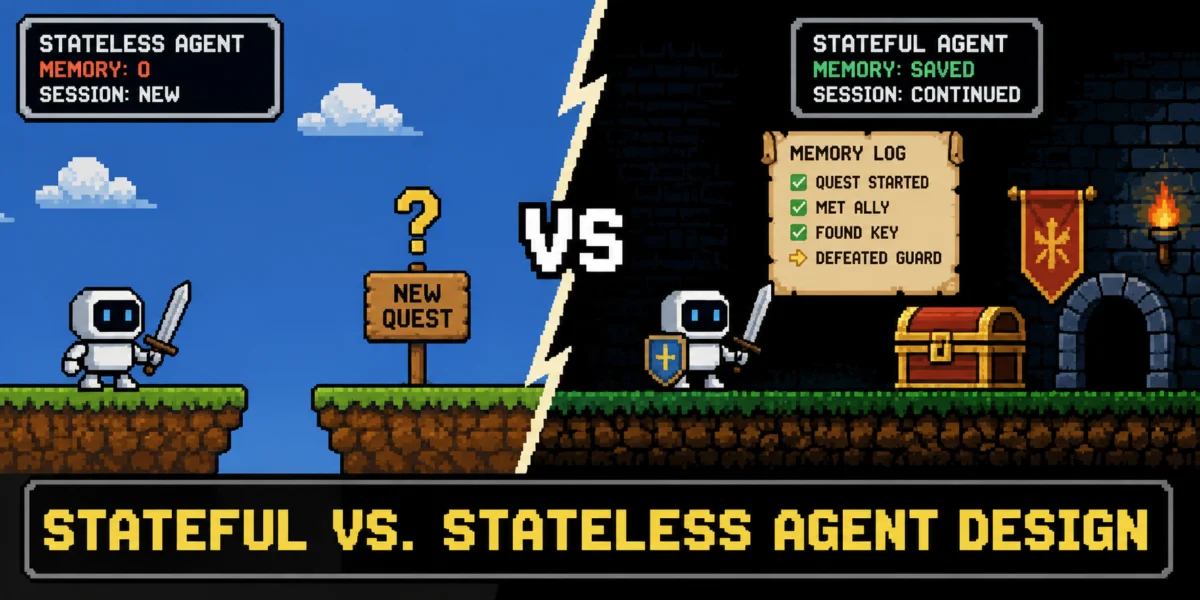
Stateless agents operate on a principle of total isolation. In this paradigm, the agent does not remember anything once a specific request-response cycle is completed. Each time a user interacts with the agent, the system treats it as a brand-new encounter.
The Mechanics of Statelessness
In a stateless implementation, such as one using Python and the Groq API, the stateless_agent function processes a prompt and immediately clears its local cache. If a conversation requires context, that context must be provided externally. This usually means the frontend application—whether it is a web browser or a mobile app—must maintain the history and send the entire conversation log back to the server with every new message.
Advantages of the Stateless Model
The primary benefit of stateless architecture is horizontal scalability. Because no user-specific data is stored on the application server, a load balancer can route an incoming request to any available instance in a cluster. This makes stateless agents ideal for "serverless" deployments (like AWS Lambda or Google Cloud Functions) where instances are spun up and down based on demand. There is no risk of a user being routed to a server that doesn’t "know" who they are, because no server knows who they are.
The "Token Tax" and Performance Bottlenecks
However, this simplicity comes with a significant trade-off: the snowballing effect of context. Because the frontend must re-send the entire history every time, the payload size grows linearly with the length of the conversation. In a multi-turn dialogue, a user might send 50 tokens of new text, but the system must process 2,000 tokens of previous history to maintain coherence. This leads to increased latency and higher costs, as most LLM providers charge by the total number of tokens processed (input plus output).
Stateful Agents: Context-Driven Continuity
Stateful agents take a different approach by assuming the "memory burden" themselves. In this model, the agent is responsible for remembering the user, their preferences, and the preceding turns of the conversation.
The Mechanics of Statefulness
A stateful agent typically relies on a persistent storage layer, such as a SQL database (SQLite, PostgreSQL) or a high-speed caching system like Redis. When a request arrives, it includes a unique session identifier. The agent uses this ID to fetch the relevant history from the database, appends the new user prompt, sends the combined package to the LLM, and then saves the updated history back to the storage layer.
The Client-Side Experience
From the perspective of the client or frontend developer, stateful agents are significantly easier to work with. The frontend only needs to track a session ID and the latest user input. This reduces the complexity of state management on the client side and minimizes the amount of data transmitted over the network.
The Scaling Challenge: Localized Amnesia
The challenge of stateful design lies in its infrastructure requirements. If an agent stores memory in a local database or in-memory cache, the system faces "localized amnesia" when scaled horizontally. If Turn 1 of a conversation is handled by Server A, but the Load Balancer sends Turn 2 to Server B, Server B will have no record of the previous interaction.
To solve this, architects must implement centralized state management. This often involves using a distributed cache like Redis or a global database. While effective, this adds moving parts to the system, increasing the surface area for potential failures and introducing "state latency"—the time it takes to fetch the history from a database before the LLM can even begin its work.
Comparative Analysis: Strategic Implications
The choice between these two designs often depends on the specific use case and the expected scale of the application.
| Feature | Stateless Agent | Stateful Agent |
|---|---|---|
| Memory Location | Client-side (Frontend) | Server-side (Database/Cache) |
| Scalability | High (Easy horizontal scaling) | Complex (Requires centralized state) |
| Token Efficiency | Low (History re-sent every turn) | Moderate (Server manages pruning) |
| Client Complexity | High | Low |
| Best For | Simple bots, high-volume APIs | Enterprise workflows, long-running tasks |
Economic Considerations
For startups and individual developers, stateless agents offer a lower barrier to entry and lower infrastructure costs. However, as a product scales, the "token tax" of resending history can become more expensive than the cost of maintaining a Redis cluster. Conversely, for enterprise applications where data privacy and complex, multi-day workflows are required, a stateful architecture is often the only viable path.
Chronology of an Interaction: A Technical Comparison
To illustrate the practical difference, consider a two-turn interaction where a user identifies themselves as "Alice" and later asks for their name.
In a Stateless Flow:
- Turn 1: Alice sends "My name is Alice" to the server. The server responds "Hello Alice" and forgets everything.
- Turn 2: Alice asks "What is my name?" If the frontend only sends this question, the agent responds, "I don’t know your name."
- Correction: The frontend must send:
[User: "My name is Alice", Assistant: "Hello Alice", User: "What is my name?"]. Only then can the agent answer correctly.
In a Stateful Flow:
- Turn 1: Alice sends "My name is Alice" +
Session_ID: 123. The agent saves this to a database and responds. - Turn 2: Alice sends "What is my name?" +
Session_ID: 123. - Internal Action: The agent sees ID 123, fetches the history from the database, realizes the user is Alice, and answers immediately.
Broader Impact and Future Outlook
As the industry moves toward "Long-Context" LLMs—models capable of handling millions of tokens in a single window—the pressure on state management is shifting. However, the fundamental architectural trade-off remains. Even with massive context windows, the cost and latency associated with processing that context favor intelligent state management.
We are beginning to see the rise of hybrid architectures. In these systems, "hot" memory (the last few turns of a conversation) is handled statelessly by the frontend for speed, while "cold" memory (long-term user preferences and historical data) is handled statefully by the backend using Retrieval-Augmented Generation (RAG).
The evolution of agentic systems suggests that the most successful deployments will be those that can abstract this complexity away from the user while maintaining a lean, scalable backend. Whether an engineer chooses the "fire and forget" simplicity of statelessness or the "context-driven continuity" of statefulness, the decision will remain a cornerstone of AI system design for the foreseeable future. Matching the infrastructure to the specific workflow is not just a technical requirement—it is a prerequisite for building AI that feels truly intelligent and responsive.