The landscape of artificial intelligence has undergone a fundamental transformation by mid-2026, moving away from the monolithic, all-purpose models that defined the early 2020s toward a sophisticated ecosystem of specialized, agentic architectures. This shift represents the maturation of AI from a "chat-centric" tool to an "agent-centric" workforce. In this new paradigm, the focus of AI engineering has moved from hand-crafting brittle prompt chains to designing the underlying infrastructure and communication protocols that allow decentralized "swarms" of agents to operate autonomously. The emergence of native reasoning capabilities within foundation models, coupled with the standardization of the Model Context Protocol (MCP), has rendered previous orchestration frameworks nearly obsolete, ushering in an era where the complexity of AI systems is managed through modularity rather than brute-force code.
The Decline of Brute-Force Orchestration and the Rise of Native Reasoning
Just twelve months ago, the industry was dominated by complex external frameworks designed to force large language models (LLMs) to think logically. Engineers relied heavily on patterns like ReAct (Reasoning and Acting), Plan-and-Execute, and Reflexion. These methods required significant computational overhead, as they involved external "loops" where a model would output a thought, an external script would parse that thought, and a new prompt would be sent back to the model for the next step.
By mid-2026, foundation models have integrated "System 2" thinking directly into their architectures. Modern models now utilize test-time compute to generate hidden reasoning tokens, allowing them to explore multiple solution branches and self-correct internally before providing a final response. Data from recent industry benchmarks suggest that these native reasoning models have reduced the failure rate of complex planning tasks by nearly 45% compared to the orchestrated loops of 2024.
As a result, the "orchestration layer" that previously defined AI development has been hollowed out. Engineers no longer need to build scaffolding to simulate reflection; the models handle the cognitive load natively. This has shifted the developer’s responsibility toward routing, state management, and the creation of "sandboxes" where agents can safely execute their tasks. The focus is no longer on making the model "smart" enough to plan—it is on providing the model with the environment it needs to execute those plans.
A Chronology of Agentic Evolution: 2023 to 2026
The transition to current agentic architectures followed a distinct chronological path:
- 2023: The Era of RAG and Basic Prompting. Early applications focused on Retrieval-Augmented Generation (RAG) to provide context to models. Agents were largely experimental and highly prone to "hallucinating" tool calls.
- 2024: The Proliferation of Frameworks. Tools like LangChain, AutoGPT, and CrewAI gained massive adoption. However, developers began encountering the "monolithic bottleneck," where a single agent equipped with too many tools became confused and inefficient.
- 2025: The Standardization of Agency. The introduction of the Model Context Protocol (MCP) provided a universal language for agents to interact with external data. This year also saw the first "native reasoning" models that reduced the need for external loop-management code.
- 2026: The Swarm Paradigm. Production environments have largely moved to "agentic swarms." These are collections of small, highly specialized agents that handle specific sub-tasks, such as SQL generation, data analysis, or customer sentiment tracking, communicating through standardized handoff protocols.
The Architecture of Agentic Swarms: Multi-Agent Microservices
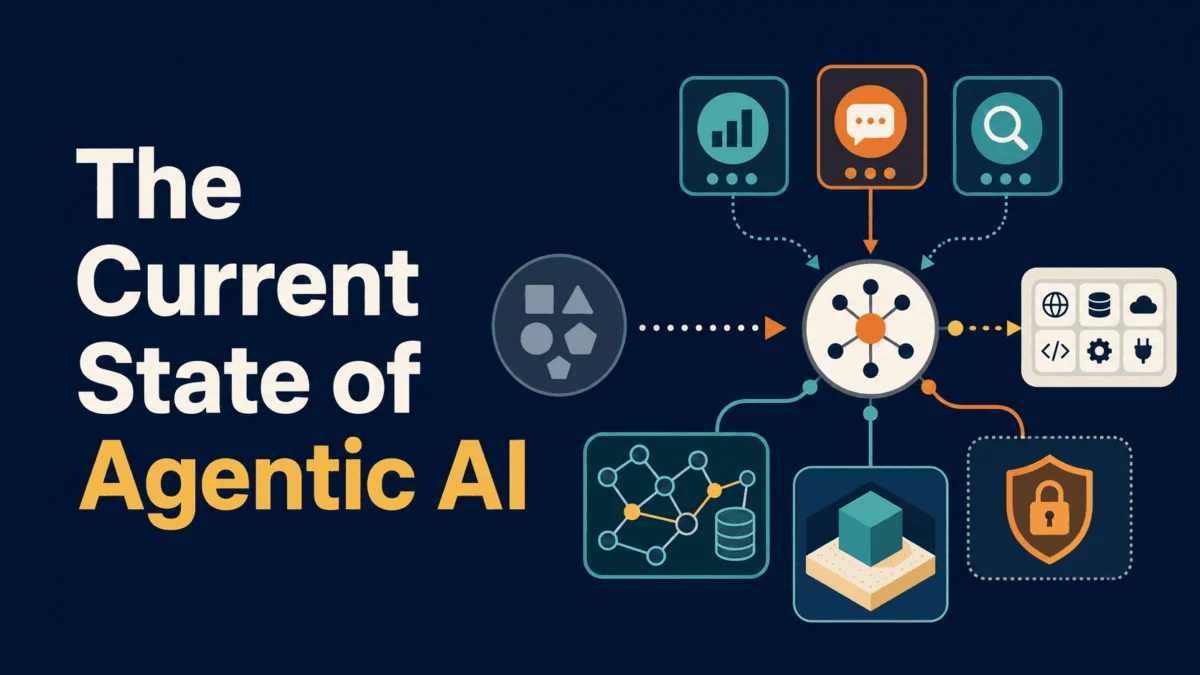
The most significant architectural shift in 2026 is the adoption of "swarms." Industry leaders have realized that attaching dozens of tools to a single massive model creates a cognitive bottleneck. Instead, the modern standard is to utilize a collection of smaller, specialized agents—essentially an AI version of microservices.
In a typical enterprise swarm, a "Triage Agent" acts as the entry point. Its sole responsibility is to analyze the user’s intent and route the request to the appropriate specialist. For instance, a request regarding financial correlations might involve a "SQL Agent" to fetch raw data, a "Data Analyst Agent" to process that data in a Python sandbox, and a "Synthesis Agent" to format the final report.
This architecture offers several advantages:
- Context Leanliness: Each specialist agent only receives the context relevant to its specific task, preventing "context window fatigue" and reducing token costs.
- Model Flexibility: Developers can use cheaper, faster models for simple routing or data fetching while reserving expensive, high-reasoning models for complex synthesis.
- Testability: Because each agent has a narrow scope, it is significantly easier to unit-test and debug specific parts of the workflow.
Industry analysts estimate that swarm-based architectures have improved the reliability of enterprise AI workflows by 60%, as the failure of one specialized agent no longer necessitates the failure of the entire system.
Standardization via the Model Context Protocol (MCP)
Until recently, the most labor-intensive part of AI engineering was the integration of models with real-world APIs. Each tool required custom JSON schemas, specific error-handling logic, and manual credential management. The Model Context Protocol (MCP) has revolutionized this by acting as a universal adapter.
In the current 2026 ecosystem, MCP servers act as isolated environments that expose tools and resources to agents automatically. Instead of an engineer writing code to connect an agent to GitHub or Slack, the agent simply connects to a standardized MCP server that broadcasts its capabilities. This separation of concerns ensures that the agent does not need to know the underlying mechanics of the API; it only needs to know the standard protocol for requesting an action.
The shift from hardcoded API integrations to MCP-based connections has reduced the development time for new AI features by an average of 70%, according to a 2026 survey of Fortune 500 software engineering teams.
Continuous Learning through Memory Graphs
A persistent challenge in early agentic systems was their "forgetfulness." Every session started from scratch, and the system did not improve based on past mistakes unless the underlying model was fine-tuned—a costly and slow process.
The 2026 architecture solves this through the use of "Memory Graphs." While individual agents remain stateless for efficiency, the system as a whole maintains a persistent memory layer, often powered by graph databases like Neo4j. A specialized "Memory Agent" runs asynchronously in the background of every swarm. Its job is to observe the trajectory of tasks, extract key facts or successful strategies, and update the memory graph.
When a new task is initiated, the system queries the memory graph to provide the agents with "learned context." This allows the swarm to remember user preferences, past errors, and successful workflows without the need for model retraining. This "context engineering" approach has emerged as a more viable alternative to fine-tuning for most enterprise applications.
Security Implications: The Swarm Attack Surface
The transition to multi-agent swarms has not been without risks. Security experts have identified a new class of vulnerabilities known as "lateral movement" within AI swarms. Because agents are designed to hand off control and context to one another, a malicious instruction hidden in an external data source (like an email or a web page) can hijack one agent and use it to attack another.
For example, if an "Email Reader Agent" encounters a prompt injection, it might be commanded to send a malicious payload to a "Database Agent." Because the Database Agent trusts the handoff from the Email Agent, the injection can bypass traditional security perimeters.
To combat this, the industry is moving toward three primary defense mechanisms:
- Human-in-the-Loop (HITL) Handoffs: Requiring manual approval for sensitive transitions between agents.
- Sandboxed Execution: Running every tool-call in a strictly isolated environment that cannot access the broader network.
- Honey-Agents: Deploying "decoy" agents within a swarm to detect and trap malicious lateral movement.
Broader Impact and Future Implications
The move toward agentic swarms is fundamentally changing the role of the AI practitioner. The era of "prompt engineering" is being replaced by "system architecture." Success in 2026 is defined by how well an engineer can design the topology of a swarm, establish robust memory pipelines, and secure the communication channels between agents.
Furthermore, this shift is accelerating the automation of complex white-collar tasks. In the legal and financial sectors, swarms are now capable of conducting multi-week research projects, cross-referencing thousands of documents, and producing internal audits with minimal human intervention.
As we look toward the latter half of the decade, the trend suggests a further decentralization of AI. We are moving toward a future where "agentic swarms" are not just software patterns, but the standard operating procedure for how organizations process information and make decisions. The focus for developers now is not to build a smarter agent, but to build a more resilient and specialized collective.