The rapid evolution and widespread enterprise adoption of Retrieval-Augmented Generation (RAG) architectures have fundamentally transformed how organizations harness artificial intelligence over proprietary data repositories. As generative language models and vector embedding networks become standard pillars of modern enterprise software, engineers face a persistent technical bottleneck: the fundamental structural mismatch between the massive volume of corporate documentation and the strict, finite context windows of underlying neural networks. While modern foundational models routinely advertise context lengths scaling from 32,000 to over a million tokens, naive ingestion of large, unstructured text corpora invariably degrades retrieval accuracy, inflates operational latency, and degrades the signal-to-noise ratio during generation.
To bridge this chasm, data architects rely on document chunking—the systematic process of partitioning extensive textual payloads into smaller, discrete segments suitable for vectorization and semantic indexing. However, treating chunk size and overlap parameters as mere configuration defaults often leads to cascading retrieval failures. Ineffective boundaries can prematurely sever vital context, causing a vector database to entirely miss the passage containing a precise answer or, conversely, to retrieve a technically proximate chunk stripped of the necessary surrounding semantics. Consequently, selecting an optimal chunking strategy requires a rigorous, analytical approach tailored to both the underlying architecture of the source documents and the precise functional requirements of the retrieval task.
The Architectural Anatomy of Information Loss in RAG Pipelines
At its core, a RAG pipeline functions by converting raw textual data into dense numerical vectors via specialized embedding models, storing these vectors within a specialized database, and performing vector similarity searches in response to user queries. The retrieved text passages are then injected into a Large Language Model’s (LLM) prompt context to ground its generative responses. The integrity of this entire pipeline depends heavily on the initial preprocessing phase.
When a document is split arbitrarily, the boundaries dictated by fixed character counts or naive word thresholds frequently violate the natural semantic units of human language. A fixed-size strategy with a 500-token limit, for instance, may easily sever a complex conditional statement in a legal contract, separating a core obligation from its defining exceptions. Although sliding window overlaps attempt to mitigate this by duplicating text across adjacent boundaries, they introduce computational redundancy and fail to resolve structural discontinuities.
Advanced engineering teams now recognize that no single chunking heuristic functions universally across all document classes. Technical specifications, legal agreements, financial spreadsheets, conversational transcripts, and academic papers each demand bespoke parsing methodologies. Matching the strategy to the document structure optimizes retrieval fidelity while eliminating unnecessary computational overhead.
A Comparative Taxonomy of Chunking Strategies and Their Underlying Assumptions
Every chunking methodology is anchored in specific foundational assumptions regarding document topology and semantic distribution. Understanding these assumptions allows developers to align preprocessing pipelines with specific enterprise data profiles.
- Fixed-Size Chunking: This traditional approach assumes that boundary placement is largely inconsequential because sliding overlaps can patch over information cut mid-thought. While computationally efficient and straightforward to implement, it completely disregards document structure and semantic boundaries.
- Recursive Chunking: This method assumes that standard typographic divisions—such as paragraph breaks, line feeds, and sentence delimiters—serve as reliable proxies for semantic meaning when explicit structural markers are absent. It iteratively splits text using a hierarchical list of separators until target chunk sizes are achieved.
- Document-Based (Structural) Chunking: Operating on the assumption that a document’s native formatting (Markdown headers, HTML tags, PDF tables, or programming language syntax blocks) directly mirrors its logical semantic structure, this strategy parses content strictly along native structural boundaries.
- Semantic Chunking: This strategy assumes that topic shifts can be dynamically detected by measuring the semantic distance between consecutive sentences using embedding models. When the distance crosses a calibrated threshold, a boundary is established.
- Late Chunking: Grounded in the assumption that a chunk’s true meaning is inextricably linked to the broader document context, this advanced technique processes the entire long-form document through an embedding model first, subsequently deriving chunk-level representations from the enriched global tensor.
- Adaptive Chunking: This methodology addresses documents featuring sharply uneven information density, operating on the premise that uniform chunk sizes inherently fail in variable-density environments.
- Hierarchical Chunking: Designed for complex corpora, this approach assumes that retrieval tasks demand multi-scale granularity, requiring concurrent indexing of broad contextual summaries and hyper-specific sub-passages.
- LLM-Based and Agentic Chunking: These cutting-edge paradigms assume that standard algorithmic rules and basic embedding distances remain insufficient for complex, highly heterogeneous data collections. They leverage autonomous model calls or intelligent agents to evaluate, reason through, and establish logical breakpoints that structural parsers miss.
Navigating the Decision Tree: A Step-by-Step Selection Framework
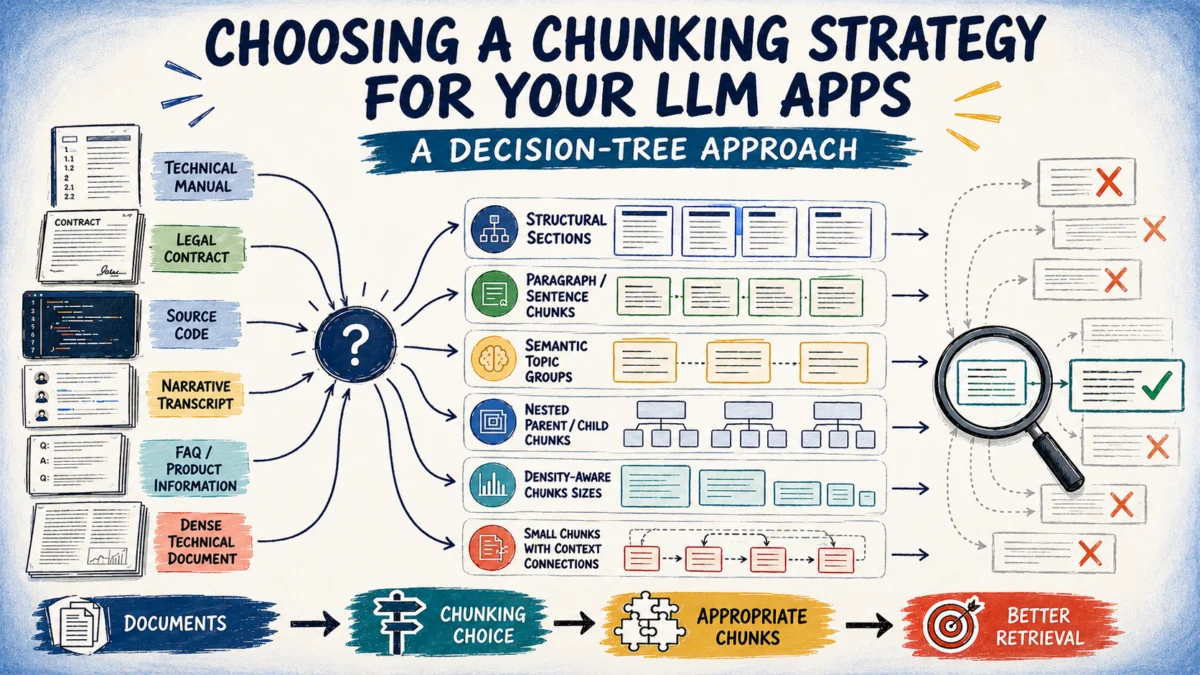
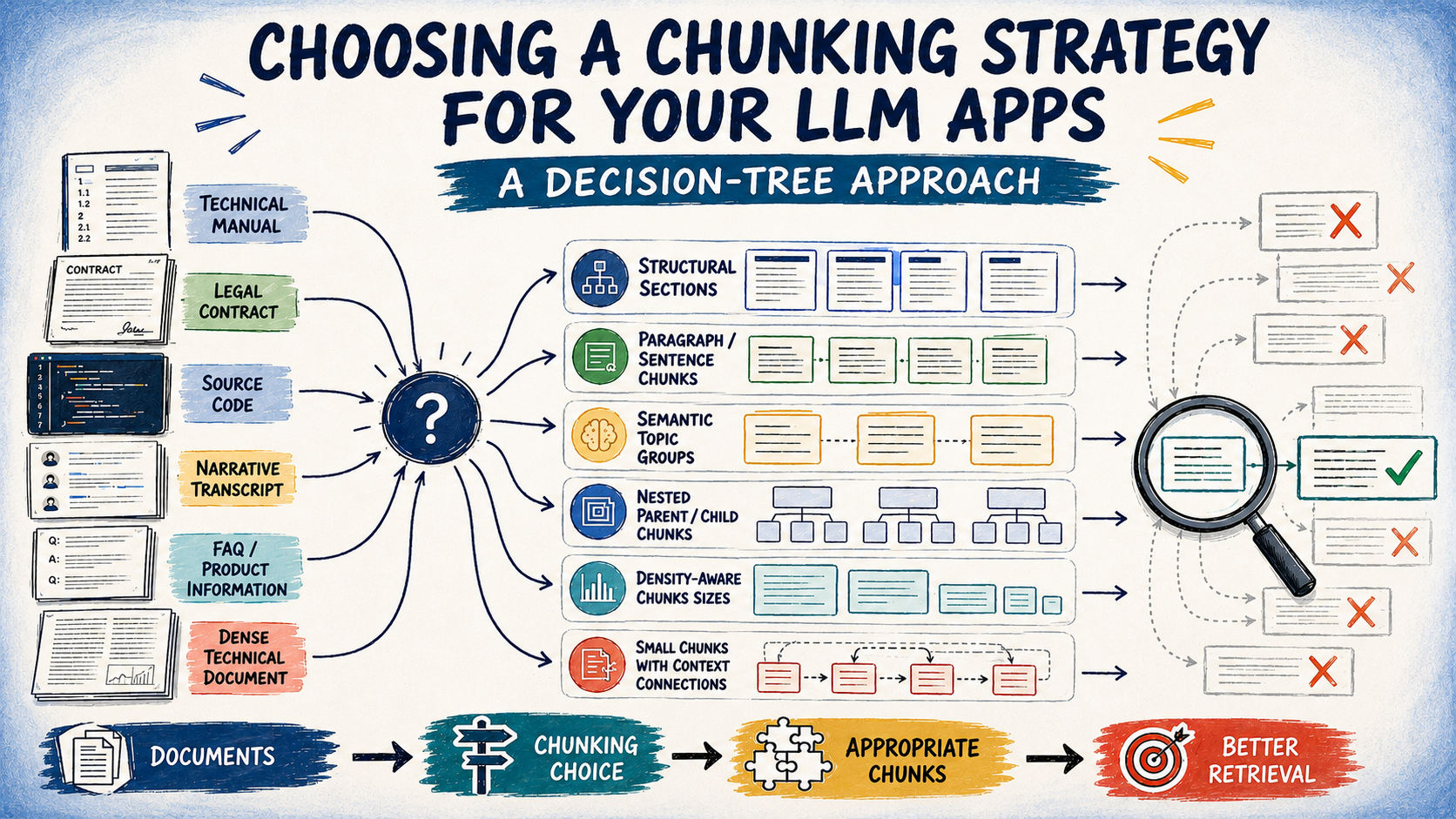
To systematically eliminate guesswork in production environments, systems architects employ a structured decision tree consisting of sequential evaluative queries designed to isolate the optimal chunking strategy.
Question 1: Does the Document Require Chunking at All?
The evaluation begins by assessing whether the raw content already fits comfortably within the target model’s operational context window while addressing a singular, unified topic. Short-form assets such as frequently asked questions (FAQs), concise product descriptions, or isolated configuration snippets rarely require segmentation. Embedding these items as monolithic entities avoids unnecessary preprocessing overhead. If the source material exceeds optimal context thresholds or encompasses multiple divergent subjects, the pipeline proceeds to the second evaluation tier.
Question 2: Does the Document Exhibit a Reliable Internal Structure?
Engineers must then examine whether the document contains explicit, machine-readable organizational markers. Structured formats—including Markdown files, HTML documents, code repositories marked by function and class definitions, and well-formed PDF tables—provide native boundaries. If these structural elements accurately map to logical content units, document-based chunking is deployed. Conversely, if formatting is inconsistent, missing, or fails to reflect topical shifts, the workflow advances.
Question 3: Are Cross-Document or Long-Range Context Dependencies Present?
Certain enterprise documents maintain semantic dependencies that span vast textual distances. A primary example is a comprehensive corporate legal agreement where a key term defined in the preliminary definitions section dictates the legal interpretation of clauses dozens of pages later. If preserving these global relationships is critical to retrieval accuracy, late chunking is implemented to ensure localized vectors retain global contextual signatures. If individual passages can be understood independently, evaluation continues.
Question 4: Does Information Density Vary Significantly Across the Corpus?
When documents alternate between dense technical proofs and expansive narrative introductions, uniform chunking strategies falter. If information density fluctuates wildly or if the retrieval engine must field both broad summarization queries and hyper-specific factual lookups, adaptive or hierarchical chunking strategies are enacted.
Question 5: What is the Economic and Operational Priority Between Retrieval Quality, Cost, and Latency?
This juncture addresses core enterprise trade-offs. If absolute retrieval fidelity is paramount and infrastructure budgets permit intensive per-document computational expenses, LLM-based chunking is selected to identify atomic propositions and logical breakpoints. If high precision is required on a moderate budget, semantic chunking provides an effective middle ground by tracking embedding distance shifts. When system throughput and low latency supersede semantic perfection, the pipeline defaults to high-speed algorithmic methods.
Question 6: Is the Ingestion Corpus Homogeneous or Heterogeneous?
For multi-format data repositories containing mixed media types—such as financial spreadsheets, unstructured transcripts, and software source code simultaneously—agentic chunking provides dynamic flexibility. An intelligent orchestration agent inspects each incoming document and routes it to the most appropriate parsing submodule. For uniform collections, standard recursive chunking serves as a reliable enterprise default.
Quantifying the Trade-Offs: Performance, Cost, and Complexity
Balancing performance metrics against operational expenditure remains a central challenge for machine learning operations (MLOps) teams deploying RAG architectures at scale.
| Strategy Class | Implementation Complexity | Computational Overhead | Primary Failure Mode |
|---|---|---|---|
| No Chunking | Negligible | Minimal (Single pass) | Context overflow, retrieval noise on large texts |
| Fixed-Size Chunking | Low | Low | Semantic fragmentation, mid-sentence cuts |
| Recursive Chunking | Low to Moderate | Low | Inadequate handling of domain-specific syntax |
| Document-Based | Moderate | Moderate | Vulnerable to malformed headers and missing tags |
| Semantic Chunking | Moderate to High | Moderate to High | Sensitivity to threshold miscalibration |
| Late Chunking | High | High | Requires specialized long-context embedding models |
| Hierarchical Chunking | High | High | Increased storage requirements, index synchronization overhead |
| LLM / Agentic Chunking | Very High | Prohibitive | High latency, substantial API or compute costs |
Diagnosing and Remedying Common Preprocessing Pitfalls
Even meticulously engineered pipelines frequently encounter runtime anomalies once exposed to messy, real-world enterprise documentation. Recognizing these failure modes enables engineering teams to implement targeted remediations.
A frequent symptom in production environments involves chunks consistently terminating mid-sentence or cutting across tabular data boundaries. This typically indicates that a structure-blind fixed-size method was applied to structured documents. The immediate remedy requires transitioning to a recursive chunking algorithm or enforcing structural boundary constraints, rather than simply expanding the sliding window overlap size.
Another prevalent issue is semantic chunking producing erratic, wildly inconsistent chunk counts across structurally similar documents. This behavior usually stems from an improperly calibrated similarity threshold. Tightening the mathematical sensitivity threshold or introducing fallback LLM-based boundary detection for anomalous files generally stabilizes output distributions.
Furthermore, when hierarchical or adaptive chunking implementations introduce noticeable latency without measurable gains in generation accuracy, it often indicates that the underlying corpus is fundamentally uniform and small-scale. In such scenarios, streamlining the architecture by reverting to a standard recursive chunking strategy eliminates unnecessary complexity and restores optimal system responsiveness.
Strategic Implications and Future Outlook
The strategic selection of a chunking methodology represents far more than a routine data-engineering chore; it forms the foundational bedrock of reliable enterprise artificial intelligence deployment. As generative architectures transition from experimental prototypes to mission-critical operational systems, the demand for precision, transparency, and computational efficiency will only intensify.
Organizations that invest the necessary engineering rigor into diagnosing their data topologies and tailoring their preprocessing pipelines will achieve significantly higher retrieval precision, minimized hallucination rates, and optimal utilization of computational resources. By treating document chunking as a dynamic, context-aware science rather than a static preprocessing afterthought, enterprises can unlock the full, uncompromised potential of their proprietary knowledge bases.