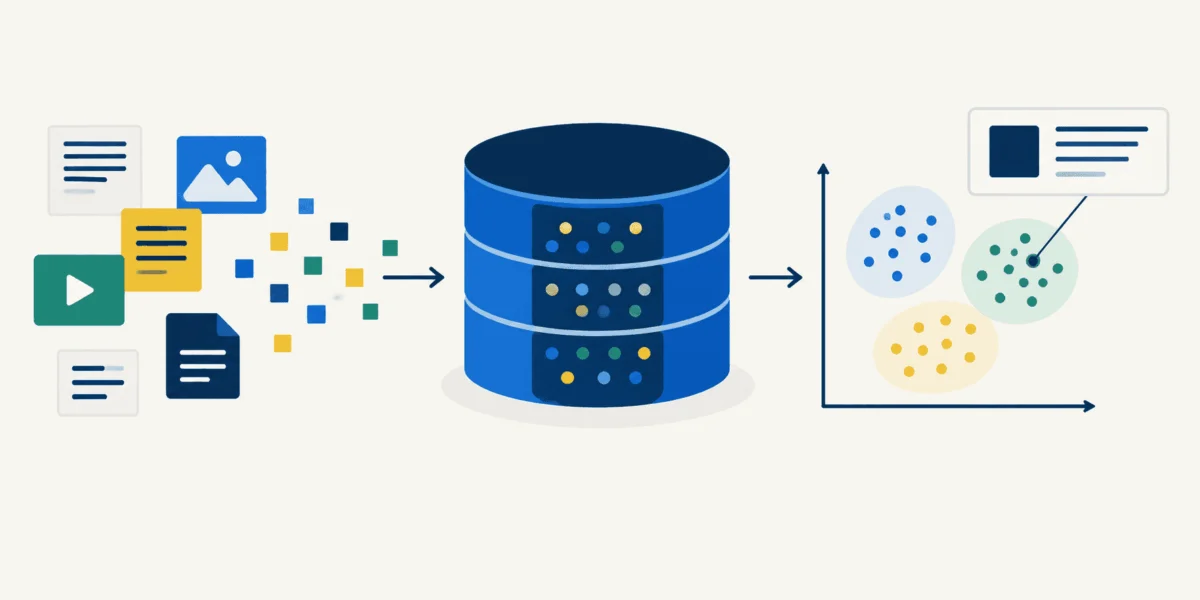
The modern paradigm of artificial intelligence and information retrieval has shifted decisively from keyword matching to semantic understanding. At the heart of this transition lies the vector database, a specialized storage and query engine designed to retrieve documents, images, and other data types based on conceptual meaning rather than exact lexical matches. While commercial solutions and managed cloud services often abstract the underlying mechanics behind proprietary APIs and complex architectures, the fundamental principles governing vector databases are remarkably accessible. By leveraging Python and NumPy, developers can construct a fully functional, zero-dependency vector database in ten incremental steps, demystifying the technology powering contemporary search engines and retrieval-augmented generation (RAG) systems.
Understanding Vector Database Fundamentals
Traditional relational databases and search indices rely on exact or fuzzy keyword matches, querying data by looking up specific tokens, stems, or inverted indices. In contrast, vector databases operate by converting raw text or other data modalities into dense numerical representations known as embeddings. These embeddings are produced by machine learning models—such as transformer-based neural networks—which map semantic concepts into high-dimensional geometric spaces.
When a user submits a natural language query, the vector database encodes that query into a corresponding numerical vector. It then calculates the geometric distance or directional similarity between the query vector and the pre-computed document vectors stored in its index. Documents whose vectors point in a similar direction are deemed semantically relevant, regardless of whether they share a single keyword with the query. This capability enables systems to successfully handle complex, abstract, or colloquial search queries that would otherwise fail under traditional keyword-based paradigms.
Step 1: Environment Setup and Dependencies
The implementation of a custom vector database requires minimal tooling, relying primarily on NumPy for high-performance matrix operations and Sentence Transformers for generating semantic embeddings. To follow the architectural framework provided by open-source educational repositories, developers begin by establishing a clean working directory containing three core files: a database logic script, a corpus module containing simulated sample documents with topic tags, and a test suite to verify functional integrity.
Installing the necessary dependencies requires a straightforward package manager execution:
pip install numpy sentence-transformersOnce installed, the initialization script sets up core display helpers and imports. The environment is designed to execute locally without requiring specialized hardware accelerators like graphics processing units (GPUs) or external API keys. Following an initial download of a lightweight pre-trained model (such as all-MiniLM-L6-v2), all subsequent vector operations execute via pure NumPy routines, ensuring deterministic execution and transparent memory management.
Step 2: Building and Structuring the Index
The second phase involves instantiating the database class and populating the index. Creating the VectorDB object loads the embedding model into memory, after which the add() method encodes each text document into a fixed-length vector.
A critical characteristic of vector databases is index size predictability. Regardless of whether an ingested document consists of a six-word sentence or an extensive multi-page essay, the resulting vector universally translates to 384 floating-point dimensions (using the MiniLM architecture). At 4 bytes per float32 value, each document occupies precisely 1,536 bytes of flat vector space. For a corpus of 25 documents, the total index size remains a modest 37.5 kilobytes. This fixed-size dimensionality is what makes vector indices exceptionally predictable in memory consumption and highly efficient to scan computationally.
Steps 3, 4, and 5: Semantic Search and Scoring Mechanics
Demonstrating the power of semantic search highlights the core utility of vector architectures. When querying a database with a sentence like "what keeps a cell supplied with energy?", traditional keyword indices rely heavily on exact term overlap. However, a vector database successfully retrieves documents discussing cellular respiration and mitochondrial adenosine triphosphate (ATP) production even when minimal lexical overlap exists.
More profoundly, vector search enables queries that share zero words with the retrieved documents. For instance, searching for "why does my loaf taste sour" successfully surfaces documents detailing acetic and lactic acid fermentation in sourdough bread, despite the words "loaf" and "sour" being entirely absent from the target text. Similarly, querying "superheroes" retrieves passages detailing comic book characters like Iron Man and the Hulk based purely on conceptual proximity.
Search results are quantified via similarity scores derived from vector math. Because embeddings are normalized to a length of one, a simple matrix dot product yields the cosine similarity. However, a crucial operational nuance is that a vector search will always return the requested number of results ($k$), even if the corpus lacks genuinely relevant content. The numerical score acts as the sole indicator of relevance; production systems must implement strict score thresholds to filter out low-quality matches.
Steps 6 and 7: Metadata Filtering and Guard Rails
While semantic similarity handles conceptual matching, real-world search applications frequently require strict categorical constraints. Vector databases achieve this by associating metadata dictionaries (such as "topic": "bio") with each ingested vector. Metadata filters execute prior to similarity ranking, ensuring that non-matching documents are excluded entirely rather than padded into the final results to fulfill the requested $k$ count. This prevents semantic "traps"—such as retrieving a comic book passage about fictional muscle fibers when searching for rigorous biological explanations.
To maintain index integrity, robust database implementations enforce strict guard rails during data ingestion. The add() method incorporates type checking and length validation to ensure that text documents, metadata dictionaries, and computed vectors remain strictly aligned on a one-to-one basis. Failing to catch common input errors—such as passing a raw string instead of a list—can silently corrupt index structures.
Steps 8, 9, and 10: Persistence, Scaling, and Industry Implications
Persisting a vector database requires separating storage formats based on data characteristics. Dense floating-point vectors are serialized into .npy NumPy binary files for rapid, unparsed loading, while human-readable document texts and metadata dictionaries are stored in structured JSON files. Furthermore, database loading routines enforce strict validation checks to prevent users from querying an index with an incompatible embedding model, protecting against semantic corruption.
As datasets scale from dozens of documents to hundreds of thousands, computational performance becomes paramount. Benchmarking flat vector scans against synthetic corpora demonstrates that unindexed brute-force matrix multiplication remains remarkably fast for moderate scales. Searching across 100,000 vectors of 384 dimensions takes only a few milliseconds on standard hardware.
However, exact nearest-neighbor search via linear scanning eventually hits performance bottlenecks at enterprise scale (millions to billions of vectors). This operational reality underpins the commercial vector database market. Enterprise platforms do not reinvent the fundamental mathematics demonstrated in basic Python implementations; rather, they introduce advanced approximate nearest neighbor (ANN) index structures—such as Hierarchical Navigable Small World (HNSW) graphs and Inverted File (IVF) quantization—to accelerate retrieval times across massive corporate repositories. Ultimately, mastering a vector database built from scratch proves that the core mechanics of semantic search rest on elegant, foundational linear algebra.