The rapid proliferation of autonomous artificial intelligence agents and large language models (LLMs) has introduced a hidden, yet rapidly escalating operational expenditure for modern enterprises: token bloat. As artificial intelligence systems are deployed to handle complex, multi-step workflows—ranging from automated market research and customer support to dynamic software engineering—they increasingly rely on external search engines and file retrieval tools to gather real-time data. However, the traditional methods of delivering this information have remained tethered to legacy data formats designed for traditional software applications rather than neural networks. Consequently, organizations find themselves bearing substantial financial costs for data that models never actually utilize, paying dearly for nested JSON objects, redundant tracking parameters, and extraneous metadata.
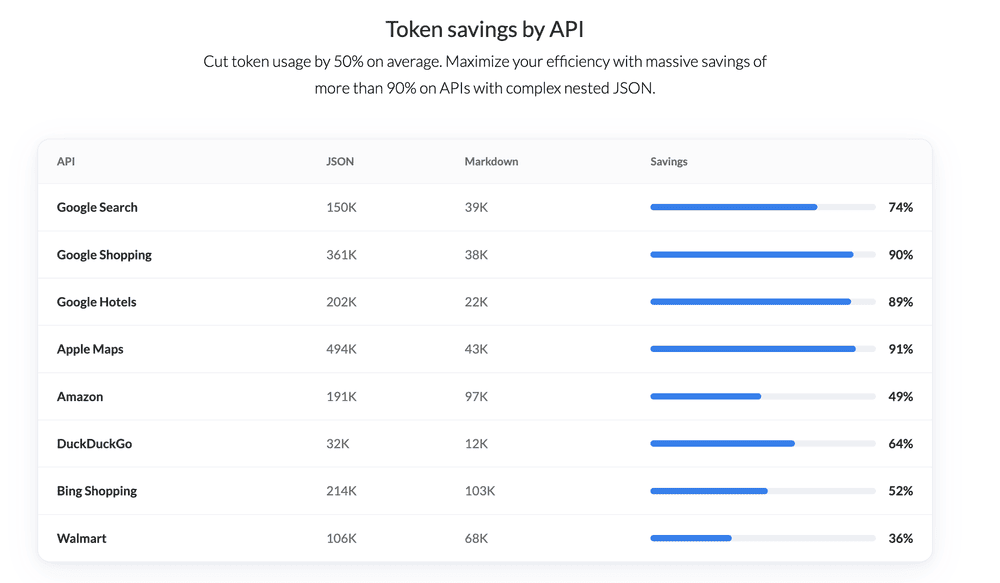
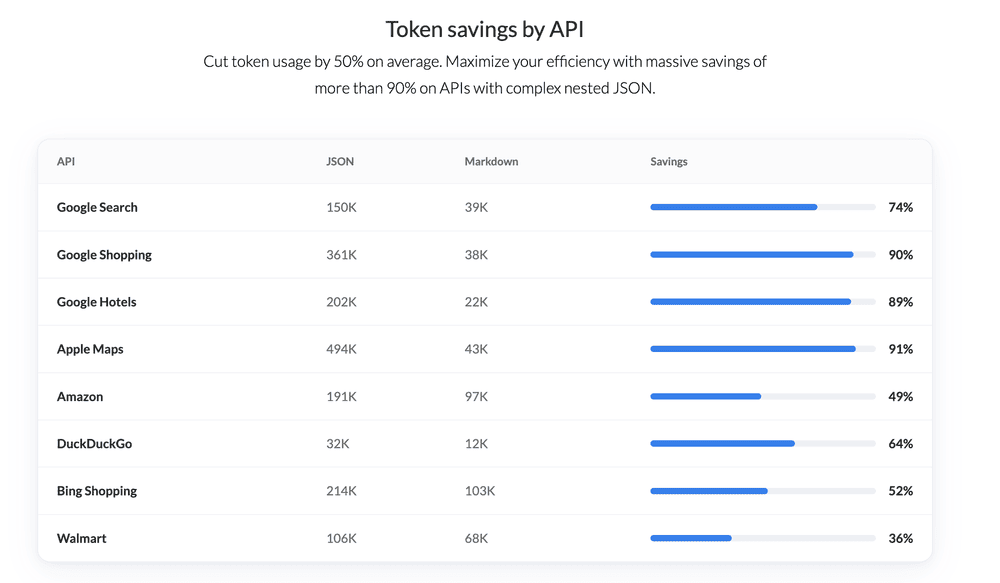
To address this structural inefficiency in the AI pipeline, SerpApi has rolled out a native Markdown output feature across its entire suite of over 100 search application programming interfaces. By reshaping how search engine results are serialized before they enter a model’s context window, this new feature has demonstrated empirical token reductions of up to 74 percent in standard queries. This development marks a significant pivot in how developers approach data ingestion, offering a pragmatic solution to the ballooning costs and contextual constraints that threaten to throttle the scalability of agentic AI systems.
The Anatomy of Token Bloat in Agentic Workflows
To understand the magnitude of the problem, one must examine the mechanics of how autonomous agents interact with the web. When a user issues a prompt that requires external information—such as a seemingly straightforward request to look up local coffee shops—an AI agent does not simply receive a clean, concise list of establishments. Instead, the underlying search infrastructure executes a query and returns a massive payload.
In a conventional JavaScript Object Notation (JSON) format, this payload is laden with structural syntax: curly braces, quotation marks, array brackets, internal routing keys, tracking links, localized metadata, and deeply nested objects designed for front-end rendering engines and relational databases. For a human developer or a traditional web application, this verbosity is necessary. For an LLM, however, it represents cognitive noise.
The model must parse every single token, consuming valuable processing cycles and filling the context window with character strings that carry zero semantic value for reasoning or summarization. Furthermore, this inefficiency compounds exponentially in agentic architectures. Autonomous agents frequently operate in recursive loops, re-running queries, validating hypotheses, and cross-referencing multiple sources over dozens of iteration steps. A few thousand wasted tokens per search call quickly escalate into millions of wasted tokens across enterprise-grade deployments, directly inflating API bills from providers like OpenAI, Anthropic, and Google, while simultaneously crowding out space that could have been used for critical instructions or historical conversation context.
Comparative Analysis: JSON Versus Markdown in Production
The core innovation of SerpApi’s new offering lies in its intelligent distillation of search results. By leveraging Markdown—a lightweight markup language natively understood by modern LLMs—the service strips away the programmatic overhead inherent in JSON without sacrificing the underlying informational signal.
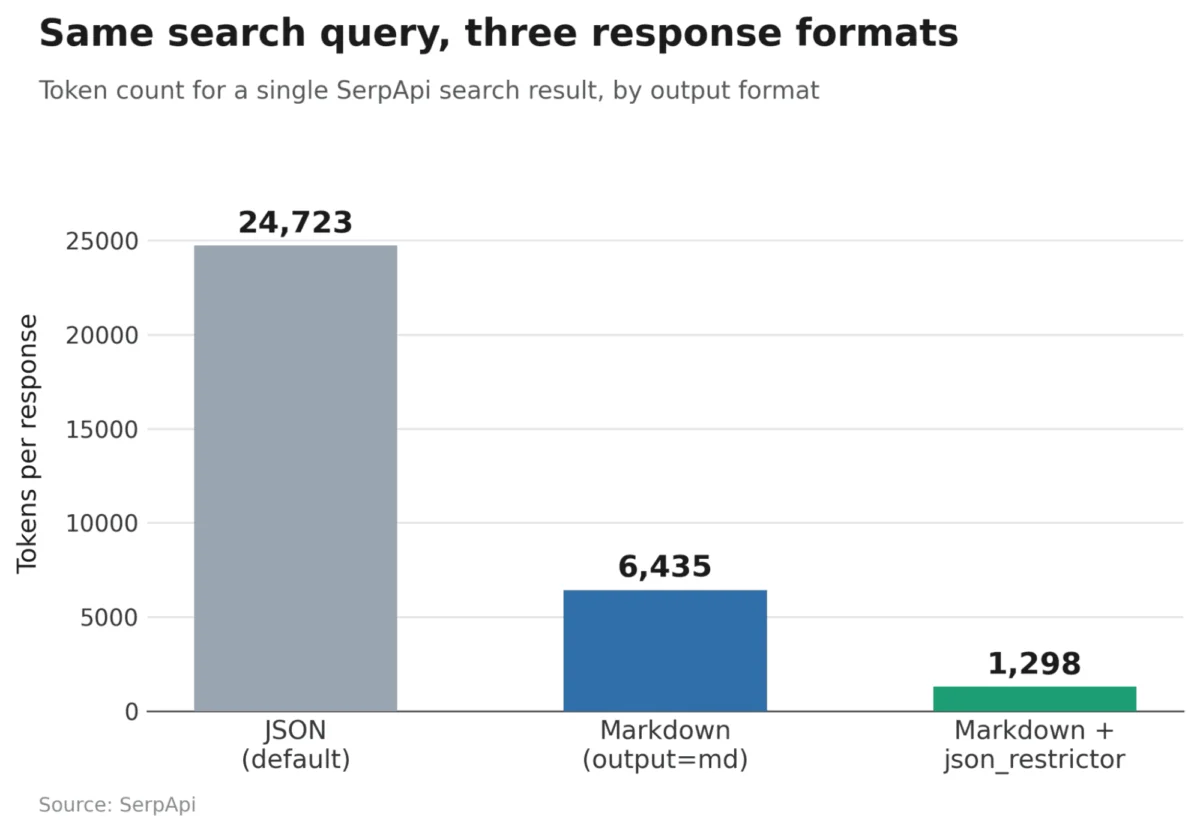
Empirical benchmarks provided by the company illustrate the stark difference in token consumption. In a controlled test evaluating a standard search query for the term "coffee," the traditional JSON response consumed a staggering 24,723 tokens. When the identical query was executed using the new Markdown output format, the token count plummeted to 6,435. This represents an immediate 74 percent reduction in data volume. Furthermore, when combined with server-side field restrictions, the token footprint can be compressed even further down to just 1,298 tokens for a streamlined, highly focused view.
This dramatic reduction unlocks three immediate benefits for developers and enterprise architects:
- Cost Optimization: Organizations pay significantly less per API call to foundation model providers, as the total volume of input tokens processed by the LLM is drastically curtailed.
- Expanded Context Windows: By freeing up thousands of tokens previously squandered on JSON syntax and tracking metadata, applications can retain more historical conversation context, longer document payloads, or more complex reasoning chains within the model’s active window.
- Enhanced Latency and Responsiveness: Smaller payloads translate to faster network transfer times and reduced time-to-first-token metrics for end users interacting with real-time AI applications.
Technical Mechanics: What Gets Stripped and What Remains
The philosophical shift behind Markdown output is rooted in a simple maxim: code exists for parsers and user interfaces to read, whereas semantic text exists for models to reason over. SerpApi’s implementation systematically identifies and eliminates the elements of a search result that inflate token counts while remaining completely opaque or irrelevant to neural networks.
Based on technical documentation, the transformation process automatically purges internal tracking parameters, redundant array keys, graphical asset links intended solely for web browsers, and deeply nested stylesheet identifiers. What survives the distillation process are the core informational pillars: YAML frontmatter for structural metadata, clean Markdown tables for comparative data, and native inline hyperlinks that allow agents to cite sources accurately without dragging along verbose redirection URLs.
Crucially, this optimization is achieved without requiring developers to rewrite their core integration architecture. The Markdown output is made available seamlessly across all of SerpApi’s extensive API catalog at no additional cost. Developers can invoke the feature using a simple query parameter, a route extension, or a custom HTTP header, making adoption frictionless across diverse technical stacks.
The Strategic Trade-Off: When JSON Remains Indispensable
Despite the clear advantages of Markdown for natural language processing tasks, industry experts emphasize that Markdown is not a universal replacement for JSON in every engineering scenario. The choice of data format must be dictated by the specific downstream consumer of the data.
Markdown is explicitly optimized for LLMs, conversational agents, and summarization engines. However, it falls short when search results must feed into traditional deterministic software pipelines. If an application relies on precise numeric data types—such as exact integer pricing, geographical coordinates, floating-point user ratings, or strictly typed arrays for automated financial transactions and inventory pricing engines—JSON remains the superior and necessary choice.
For example, consider a localized shopping search result via platforms like Naver Shopping. A JSON payload exposes explicit key-value pairs for price, old_price, coupon_price, and rating as discrete floats, alongside structured arrays for reviews and stores. For a quantitative pricing algorithm or an automated e-commerce arbitrage bot, these strongly typed fields are mandatory. Conversely, for an AI shopping assistant whose only task is to converse with a consumer and summarize the top three product recommendations, those rigid programmatic types represent unnecessary overhead. For the agent, Markdown table rows and inline links convey the exact same semantic signal with a fraction of the token cost.
Granular Control via Server-Side Restrictions
Recognizing that different use cases demand varying levels of data granularity, SerpApi has complemented its Markdown rollout with advanced server-side filtering mechanisms. Tools such as the json_restrictor parameter (or the --fields argument in the command-line interface) empower developers to curate payloads before they ever traverse the network.
By specifying exact keys required by the application, developers can prune unwanted data at the source. This dual approach—combining format shifting (JSON to Markdown) with targeted field restriction—gives engineering teams unprecedented control over their data ingestion pipelines. Rather than pulling entire document trees and filtering them within the application layer, teams can optimize bandwidth and token consumption simultaneously at the API boundary.
Broader Industry Implications and the Future of Agentic Efficiency
The introduction of format-aware search APIs highlights a maturing software ecosystem that is increasingly conscious of the unique operational constraints of generative artificial intelligence. As enterprise adoption shifts from experimental proof-of-concept chatbots to deeply integrated, autonomous multi-agent systems, the economics of token management will become a primary determinant of project profitability.
Historically, software optimization focused primarily on CPU cycles, memory allocation, and database query latency. In the era of LLMs, the token has become the fundamental currency of compute. Every superfluous character transmitted to a model incurs a tangible financial penalty. Initiatives like SerpApi’s Markdown integration signal a broader industry trend wherein data providers are redesigning their output interfaces to respect the cognitive architectures of neural networks.
Industry analysts note that as agentic systems become more prevalent in mission-critical enterprise workflows, developers will no longer tolerate the passive acceptance of unoptimized data feeds. The ability to measure, audit, and systematically reduce payload bloat will transition from a nice-to-have optimization technique to a core engineering best practice.
For organizations seeking to evaluate these efficiencies firsthand, the verification process requires minimal friction. By taking an existing production query, appending the output=md parameter, and conducting a side-by-side token audit, engineering teams can immediately quantify their specific cost savings and latency improvements. As artificial intelligence continues to reshape the digital landscape, the careful curation of what we feed our models will remain a critical frontier in building scalable, cost-effective, and high-performance intelligent systems.