The rapid evolution of artificial intelligence has shifted corporate deployment strategies from exploratory trials to robust operational implementations, forcing development teams worldwide to confront a fundamental architectural decision. Engineers must determine whether a singular, generalized autonomous agent should manage end-to-end workflows or if workloads should be disaggregated and distributed across a collaborative network of specialized, role-specific agents. This foundational choice directly dictates system latency, computational overhead, economic expenditure, and overall system scalability.
As multi-agent ecosystems capture the imagination of software architects and industry analysts alike, organizations frequently rush to implement intricate, multi-layered infrastructures before thoroughly testing the limits of streamlined, single-agent models. To establish operational efficiency, enterprise engineering divisions require a rigorous, evidence-based framework that delineates the capabilities of both architectures, identifying the precise thresholds where heightened structural complexity delivers a justifiable return on investment.
Defining the Boundaries of Agentic Autonomy
To properly evaluate these architectural paradigms, distinguishing conventional large language model interactions from genuinely agentic frameworks is essential. Traditional model deployments operate on a simple stimulus-response dynamic: a user submits a prompt, and the underlying model generates a corresponding output in a single inference pass. Conversely, agentic systems introduce functional autonomy by empowering the software to make decisions, dynamically select from a pre-defined library of utilities, and execute sequential actions to accomplish a designated objective.
These operations routinely incorporate web scraping, database querying, code synthesis, and API integrations. Fundamentally, an agent functions through a continuous perceptual feedback loop: it executes an action, observes the environmental response, and computes subsequent steps based on that feedback. Both single-agent and multi-agent methodologies utilize this foundational loop, differing primarily in the volume of autonomous entities deployed and the orchestration mechanisms governing their collaboration.
The Pragmatic Utility of Single-Agent Systems
A single-agent architecture concentrates organizational workflows around a central entity possessing a comprehensive toolset, tasked with shepherding a task from inception to completion. Contrary to prevailing engineering assumptions, a solitary agent can manage a remarkably diverse spectrum of enterprise problems. When equipped with modular utilities—such as web search interfaces, document retrieval systems, and text generation blocks—a single agent effectively governs customer support ticket triage, exploratory research summarization, preliminary report drafting, and structured data extraction. For many mid-sized enterprises, this capacity satisfies the vast majority of operational automation requirements.
The advantages inherent in this model are substantial. Operational latency remains minimal because communication overhead is virtually non-existent. Computational expenditures are strictly controlled through reduced model call frequencies, directly decreasing token consumption and operational costs. Furthermore, system troubleshooting is exceptionally straightforward. Because a solitary decision-maker governs the trace, engineers analyze a singular conversation history to diagnose and isolate failures.
Industry analysts frequently compare the single-agent model to a skilled generalist employee. Provided with adequate resources and a well-defined mandate, an individual professional can accomplish a vast array of tasks before an organization necessitates departmental division. However, as operational complexity scales, generalized entities invariably encounter systemic performance boundaries, revealing the limitations that inspire alternative architectures.
The Operational Overhead and Complexity Tax of Multi-Agent Deployments
Multi-agent ecosystems distribute functional responsibilities among a consortium of specialized agents, each configured with dedicated roles, distinct tool access permissions, and customized system prompts. Typically, a supervising orchestrator agent manages the macro-workflow, delegating micro-tasks to subordinate agents and synthesizing their cumulative outputs. While powerful, this structure introduces a measurable complexity tax, amplifying overhead across multiple operational vectors.
Latency compounds exponentially within multi-agent environments. When a downstream operational node must wait for the output of an upstream agent before initiating its own calculations, workflow delays accumulate rapidly. Consequently, a composite task executed by a single agent within seconds can require significantly extended processing timelines when routed through sequential handoff protocols.
Economic expenditures scale in direct proportion to agent proliferation. Every autonomous entity within the network executes independent model calls, driving up aggregate token consumption. In parallel processing workflows, this consumption curve steepens drastically.
Failure modes multiply in tandem with architectural expansion. In a single-agent system, an anomalous output is readily identified and mitigated. Within a multi-agent framework, however, an initial miscalculation by one agent can propagate downstream, corrupting subsequent processes before human or automated monitors detect the anomaly. Furthermore, poorly defined operational parameters frequently trap interacting agents in unproductive, circular feedback loops.
Orchestration complexity presents an additional hurdle. Maintaining persistent state awareness, shared contextual memory, and synchronized data boundaries across disparate agents requires advanced systems engineering. Determining precise task completion criteria and tracking inter-agent communication channels remain formidable technical challenges.
Chronological Evolution of Generative AI Workflows
The architectural transition from monolithic language models to multi-agent frameworks reflects a broader historical progression in software engineering and artificial intelligence research.
During the initial commercialization phase of large language models, enterprise deployment was characterized by simple prompt-engineering paradigms. Organizations relied on monolithic interactions where a single prompt attempted to capture all contextual nuances. As enterprise requirements expanded, developers integrated Retrieval-Augmented Generation to ground model outputs in proprietary datasets, creating the first rudimentary iterations of tool-using software.
By subsequent development cycles, the industry recognized the limitations of static prompt-response loops, giving rise to the concept of the autonomous agent. Early agent frameworks demonstrated that models could iteratively plan, execute, and evaluate tasks using external APIs. However, as developers attempted to automate increasingly intricate corporate workflows—such as comprehensive software development lifecycles or multi-market financial audits—single-agent systems struggled with cognitive overload, tool misselection, and contextual drift. This operational bottleneck catalyzed the current multi-agent era, where researchers and enterprise engineering teams design collaborative, multi-tiered agent networks to tackle complex, multi-domain problems.
Justifying Multi-Agent Complexity: Core Operational Drivers
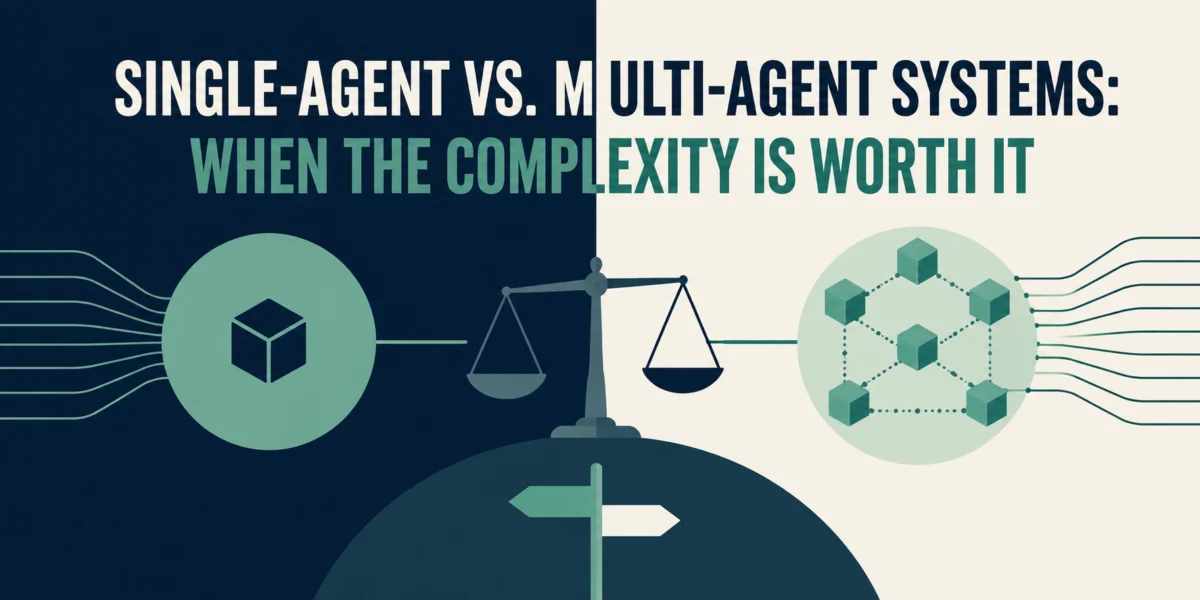
Given the considerable infrastructural overhead associated with multi-agent networks, industry best practices dictate that deployment should be strictly reserved for scenarios where simpler architectures demonstrably fail. Four specific operational conditions justify the adoption of a multi-agent paradigm:
- Adversarial and Critic Workflows
Large language models historically exhibit deficiencies when evaluating the veracity and quality of their own generated output. When instructed to author and subsequently review software code for bugs, models frequently overlook errors they introduced during the initial generation phase, as self-review mechanisms remain inherently biased toward the original output generation path.
Multi-agent networks resolve this limitation through functional segregation. An actor agent focuses exclusively on output generation, while a designated critic agent operates under a conflicting objective: systematically identifying flaws, logical gaps, and unverified assumptions. Because the critic possesses no operational attachment to the actor’s output, it delivers objective evaluation. This pattern proves indispensable in secure software development pipelines, compliance review boards, and high-stakes content generation.
- Tool Set Congestion and Cognitive Overload
Providing a single agent with an excessively large repository of tools systematically degrades operational performance. When the available utility list expands beyond optimal cognitive boundaries, agents exhibit degraded tool selection accuracy, execute tools in illogical sequences, or experience confusion regarding contextual application.
When enterprise workflows demand distinct tool sets for separate operational phases—such as utilizing an isolated suite of database extraction utilities followed by a completely separate suite of visualization and rendering tools—partitioning these functions into specialized agents yields superior functional reliability. Specialization reduces the immediate decision surface area managed by any single operational node.
-
Parallelizable Task Structures
Enterprise workflows diverge significantly between linear and non-linear execution models. When an analytical workflow requires the evaluation of multiple independent entities—such as performing simultaneous competitive intelligence assessments on three separate market competitors—sequential processing introduces unnecessary latency. Distributing these parallelizable sub-tasks across concurrent agents collapses overall execution timelines. Parallel execution represents one of the most reliable justifications for multi-agent adoption, offering measurable efficiency gains with manageable orchestration complexity. -
Divergent Personas and Security Guardrails
Complex workflows frequently demand radically contrasting behavioral modes across different operational stages. A customer-facing interaction agent requires a specific brand tone, rigorous consumer safety guardrails, and tightly constrained behavioral boundaries. Conversely, an internal analytics agent processing unmasked enterprise data requires entirely different security constraints and analytical freedom. Forcing these divergent modalities into a single agent compromises performance or necessitates complex, error-prone conditional prompt branching. Deploying dedicated agents with immutable system prompts ensures uncompromised behavioral compliance across distinct operational tiers.
Comparative Analysis of AI System Architectures
| Performance Metric | Single-Agent Architecture | Multi-Agent Architecture |
|---|---|---|
| Operational Latency | Minimal; direct request-response cycles. | Elevated; compounds through inter-agent handoffs. |
| Financial Expenditure | Controlled; constrained model call volume. | Substantial; driven by concurrent inference passes. |
| Debugging Complexity | Straightforward; linear conversation traces. | Advanced; requires multi-turn execution logging. |
| Optimal Use Cases | Linear tasks, focused data retrieval, simple triage. | Parallelized workflows, adversarial critic loops, multi-tool domains. |
| Failure Propagation Risk | Contained; errors remain isolated to single session. | High; downstream propagation of upstream errors. |
Evaluating Architectural Suitability
Industry experts recommend a pragmatic heuristic to guide architectural selection: if a human professional executing the identical enterprise task would be required to execute a significant context switch, transition between disparate specialized software platforms, or fundamentally alter their professional mindset between operational steps, a multi-agent framework is likely warranted. Conversely, if a competent human analyst could successfully conclude the task from a single workstation, utilizing a consolidated workspace without pausing to reframe their methodology, a single-agent system remains the optimal architectural choice.
Strategic Implementation Roadmap
Enterprise implementation strategies should consistently prioritize simplicity over preemptive structural complexity. Development teams are advised to deploy the simplest viable single-agent system, equip it with necessary foundational tools, and monitor its operational failure modes in a live staging environment.
Empirical failure patterns provide precise engineering roadmaps for subsequent iteration. If an agent consistently fails to catch logical errors in its generated output, engineering teams can introduce an isolated critic agent. If the agent exhibits confusion due to tool proliferation, role specialization becomes necessary. If processing pipelines suffer from excessive latency stemming from sequential bottlenecks, asynchronous, parallelized agent branches can be integrated.
Multi-agent systems justify their infrastructural complexity only when architectural evolution emerges organically from observed operational limitations, rather than anticipated theoretical requirements. By starting with a solitary agent and scaling deliberately, organizations build resilient, highly efficient AI systems tailored precisely to their enterprise demands.