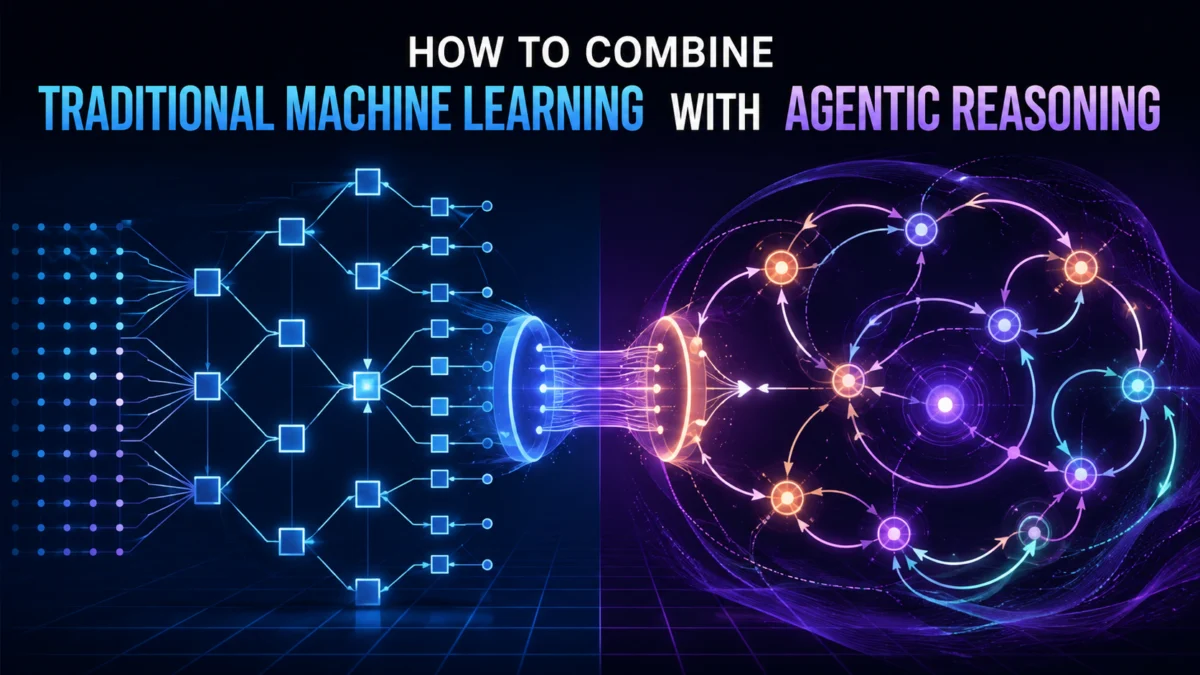
The landscape of artificial intelligence is undergoing a profound structural evolution, moving past the era of isolated, single-function predictive models toward integrated ecosystems capable of complex, multi-step execution. For years, the enterprise deployment of artificial intelligence has been defined by a fundamental dichotomy: the remarkable statistical reliability of traditional machine learning and its rigid, transactional limitations. While a supervised classifier can evaluate a medical scan or flag a financial transaction in milliseconds, it remains completely static—incapable of gathering additional context, altering its trajectory mid-task, or executing independent operations in the physical or digital world.
To overcome these barriers, the artificial intelligence research and engineering community is increasingly turning to hybrid architectures that merge traditional machine learning with agentic reasoning. By pairing statistical pattern-recognition models with large language model-driven reasoning engines, developers are constructing systems that not only predict outcomes but actively orchestrate the workflows those predictions are meant to inform. This synergy marks a critical turning point in how organizations deploy artificial intelligence to solve messy, multi-layered real-world problems.
The Foundations and Limits of Traditional Machine Learning
To understand the necessity of agentic reasoning, one must first examine the precise mechanics and historic successes of traditional supervised machine learning. Over the past three decades, the technology industry has perfected the paradigm of supervised learning, wherein algorithms ingest vast amounts of labeled historical data to learn a direct mapping from inputs to outputs.
This methodology underpins the modern digital economy. Fraud detection algorithms distinguish illicit wire transfers from legitimate consumer behavior with high fidelity; customer churn models identify behavioral indicators that precede subscription cancellations; and supply chain demand forecasting tools correlate historical market variables with future inventory requirements. These systems are paragons of computational efficiency. Once trained, they execute inferences in mere milliseconds, process millions of requests concurrently, and yield outputs that are statistically calibrated, interpretable, and auditable.
Yet, this exact reliability constitutes the core limitation of traditional machine learning. A trained model is a frozen artifact of the historical distribution upon which it was trained. It operates on a strict stimulus-response loop: it receives a predefined input, applies a learned mathematical function, and returns a singular output—be it a classification label, a regression value, or a probability score. It possesses no internal mechanism to recognize when its input data is missing crucial context, no ability to pause inference to query an external database, and no agency to execute downstream tasks based on its findings. When deployed into dynamic operational environments where problems rarely manifest as clean, pre-packaged input-output pairs, traditional machine learning models frequently require an extensive scaffolding of human intervention and brittle, rule-based software to deliver operational value.
The Emergence of Agentic Reasoning
Agentic reasoning directly addresses the operational vacuums left by static machine learning models. Within modern artificial intelligence architectures, an "agent" refers to a system capable of perceiving its environment, formulating a plan of action, executing that plan through various tools, and observing the resultant feedback to iteratively approach a complex goal.
Unlike traditional models that operate entirely within a single inference pass, agentic systems utilize large language models as cognitive orchestration engines. These engines do not merely compute statistical probabilities; they reason through scenarios, break down ambiguous objectives into structured sequences, and dynamically adjust their strategies based on intermediate outcomes. This paradigm introduces four fundamental capabilities previously absent from automated workflows:
- Planning: The capacity to decompose a high-level, abstract objective into a granular sequence of ordered steps, continuously tracking progress and maintaining a state representation across extended temporal horizons.
- Tool Use: The ability to interface programmatically with external resources—including relational databases, enterprise application programming interfaces (APIs), web search engines, and specialized analytical models—retrieving fresh information on demand rather than relying exclusively on static training parameters.
- Adaptation: The implementation of closed-loop feedback mechanisms that allow the system to evaluate the success of an intermediate action, interpret errors or unexpected outputs, and alter its procedural course autonomously.
- Action Execution: The transition from passive observation and prediction to active operational intervention, such as dispatching communications, writing records to databases, triggering external software pipelines, or modifying system configurations.
Industry analysts note that this shift from passive inference to active agency transforms artificial intelligence from an analytical oracle into an operational participant. Rather than simply forecasting a metric, an agentic system can initiate the remedial processes required to address the underlying condition.
Hybrid Systems in Practice: Case Studies Across Industries
The practical implementation of this hybrid approach is best understood not as a competition between machine learning and agentic reasoning, but as a division of labor where each paradigm executes the functions for which it was mathematically and structurally optimized. Traditional machine learning remains unrivaled in fine-grained pattern recognition on structured or perceptual data, whereas agentic reasoning excels at macro-level orchestration, contextual synthesis, and procedural management.
Consider the domain of enterprise insurance claims processing. Historically, insurance companies deployed supervised machine learning models to ingest structured tabular data—such as claim amounts, historical policyholder infractions, and regional risk indices—to generate a singular fraud probability score. While effective at flagging high-risk submissions, the model’s utility ended at the score; human claims adjusters were still required to manually gather medical documentation, cross-reference policy clauses, investigate provider histories, and draft formal justification reports.
In a modern hybrid architecture, the predictive fraud model is preserved for its specialized statistical acumen, but it is encased within an agentic orchestration layer. When a complex claim enters the enterprise queue, the autonomous agent initiates a multi-step investigative workflow:
- It queries internal policy management systems to retrieve complete historical records and coverage limits for the claimant.
- It formats the relevant parameters and passes them to the specialized fraud detection machine learning model, capturing the resulting probability score.
- Finding the score elevated above a predefined risk threshold, the agent independently executes API calls to search for historical claims filed by the same medical provider, scanning for anomalies or duplicate billing patterns.
- It checks external weather and traffic databases if the claim involves an automotive accident, verifying the factual plausibility of the incident narrative.
- Finally, it synthesizes these multi-source findings into a comprehensive, human-readable case summary, attaches an auditable reasoning trace, and routes the file directly to the appropriate senior adjuster queue.
Through this collaborative framework, neither component attempts to execute the other’s responsibilities. The machine learning model is spared from attempting complex symbolic reasoning or database navigation, while the agent is spared from performing raw matrix multiplications to detect subtle statistical anomalies in millions of historical transactions.
Broader Economic and Operational Implications
The integration of agentic reasoning with traditional machine learning models carries profound implications for enterprise software architecture and labor productivity. For decades, organizations have invested billions of dollars in building, training, and validating predictive models for specific business verticals. Scrapping these heavily audited, production-ready assets in favor of unconstrained generative models represents an untenable operational risk due to issues of latency, cost, and hallucination.
Hybrid architectures protect these legacy investments while dramatically multiplying their utility. By utilizing large language model agents as the connective tissue between disparate software tools and specialized predictive models, enterprises can automate complex, end-to-end business workflows that previously demanded extensive human cognitive labor.
According to enterprise technology researchers, this operational shift redefines the return on investment for artificial intelligence deployments. Rather than optimizing isolated steps within a broader process—such as marginally improving the accuracy of a demand forecasting algorithm—organizations can now automate entire operational loops, from predictive signal detection to environmental adaptation and automated execution.
As these hybrid systems mature, industry standards for governance, security, and auditability are also evolving. Enterprise deployment requires strict guardrails to ensure that autonomous agents operating via external APIs and transactional databases do not execute unauthorized actions. Consequently, software engineering frameworks are increasingly incorporating deterministic validation layers, human-in-the-loop checkpoints at critical decision boundaries, and cryptographic logging of agentic reasoning traces to ensure complete regulatory compliance.
Ultimately, the convergence of traditional machine learning and agentic reasoning signals the maturation of artificial intelligence from a collection of impressive parlor tricks and narrow analytical tools into a cohesive operational infrastructure. By uniting the statistical precision of predictive models with the dynamic planning and execution capabilities of autonomous agents, the technology sector is constructing resilient systems capable of meeting the complex, multifaceted demands of the modern enterprise.