The incident report arrived without fanfare in the engineering queue, documenting an unexpected catastrophic failure in the nightly telemetry aggregation pipeline. For over twelve months, the automated log-summarization script had executed flawlessly. It ingested application logs, parsed incoming records into structured lists, isolated error-level flags, and rendered structured text summaries for system diagnostics. However, a recent shift in infrastructure log-rotation protocols dramatically altered payload volumes, culminating in a single seven-day traffic block compressed into a massive 9-gigabyte file. When the cron job fired at midnight, it crashed almost immediately with a fatal MemoryError, halting execution before a single summary record could be processed.
An exhaustive forensic code review confirmed that the parsing logic itself contained no syntactical errors, algorithmic leaks, or unhandled exceptions. The root cause of the failure was architectural: the utilization of eager list comprehensions. By attempting to read and load every parsed record into random-access memory simultaneously, the software design violated physical hardware constraints. This systemic vulnerability underscores a foundational challenge in modern software engineering—bridging the gap between scalable data volumes and constrained system random-access memory (RAM).
The Mechanics of the Memory Wall and the Eager Evaluation Trap
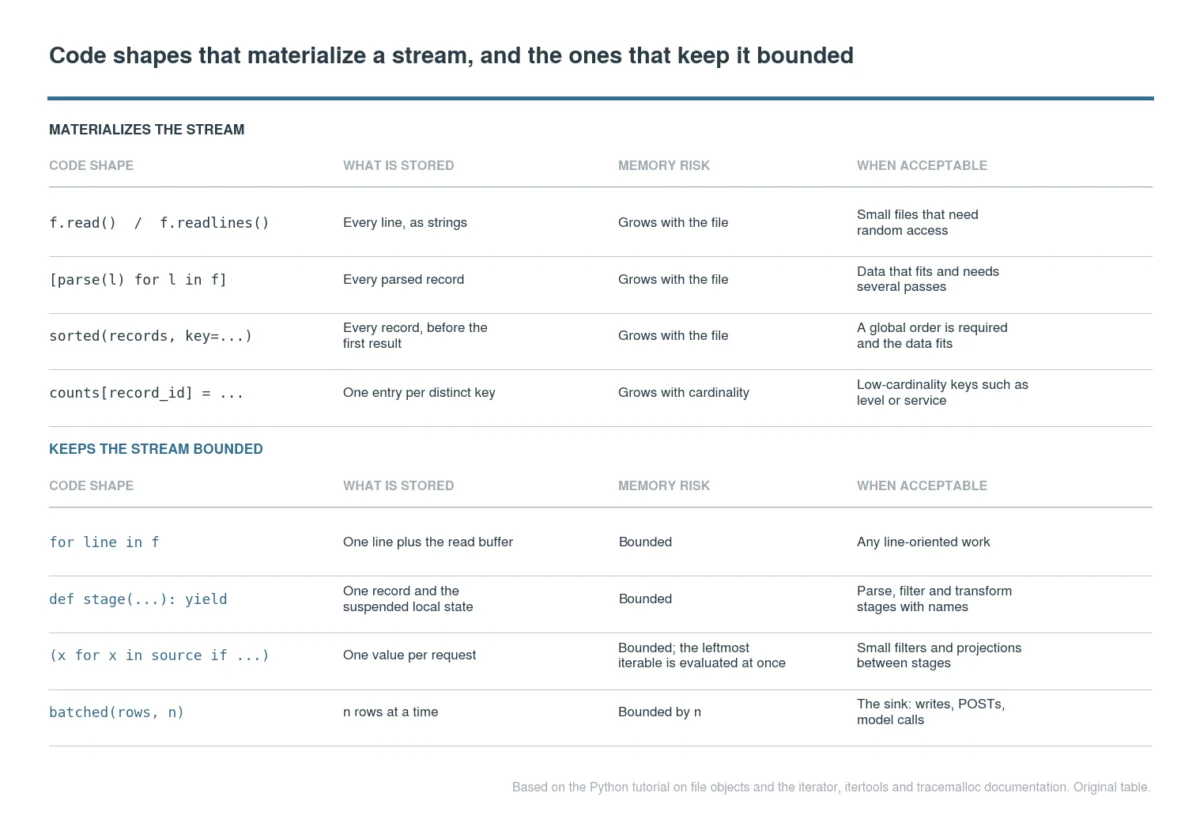
In data-intensive computing environments, developers frequently rely on eager evaluation paradigms, such as standard list comprehensions, due to their readability and concise syntax. In the case of the failed telemetry script, the codebase instantiated three distinct sequential lists:
with open("app.log") as f:
    records = [parse(line) for line in f]      # every record exists at once
errors = [r for r in records if r["level"] == "ERROR"]
slow = [r for r in errors if int(r["latency_ms"]) > 1000]
To an uninitiated reviewer, these operations appear idiomatic and safe. Yet, the first line forces the Python interpreter to read the entire file payload into a singular list object residing in RAM before any filtering operations can initiate. If an infrastructure generates log entries scaling into tens of gigabytes, hardware limits are quickly saturated.
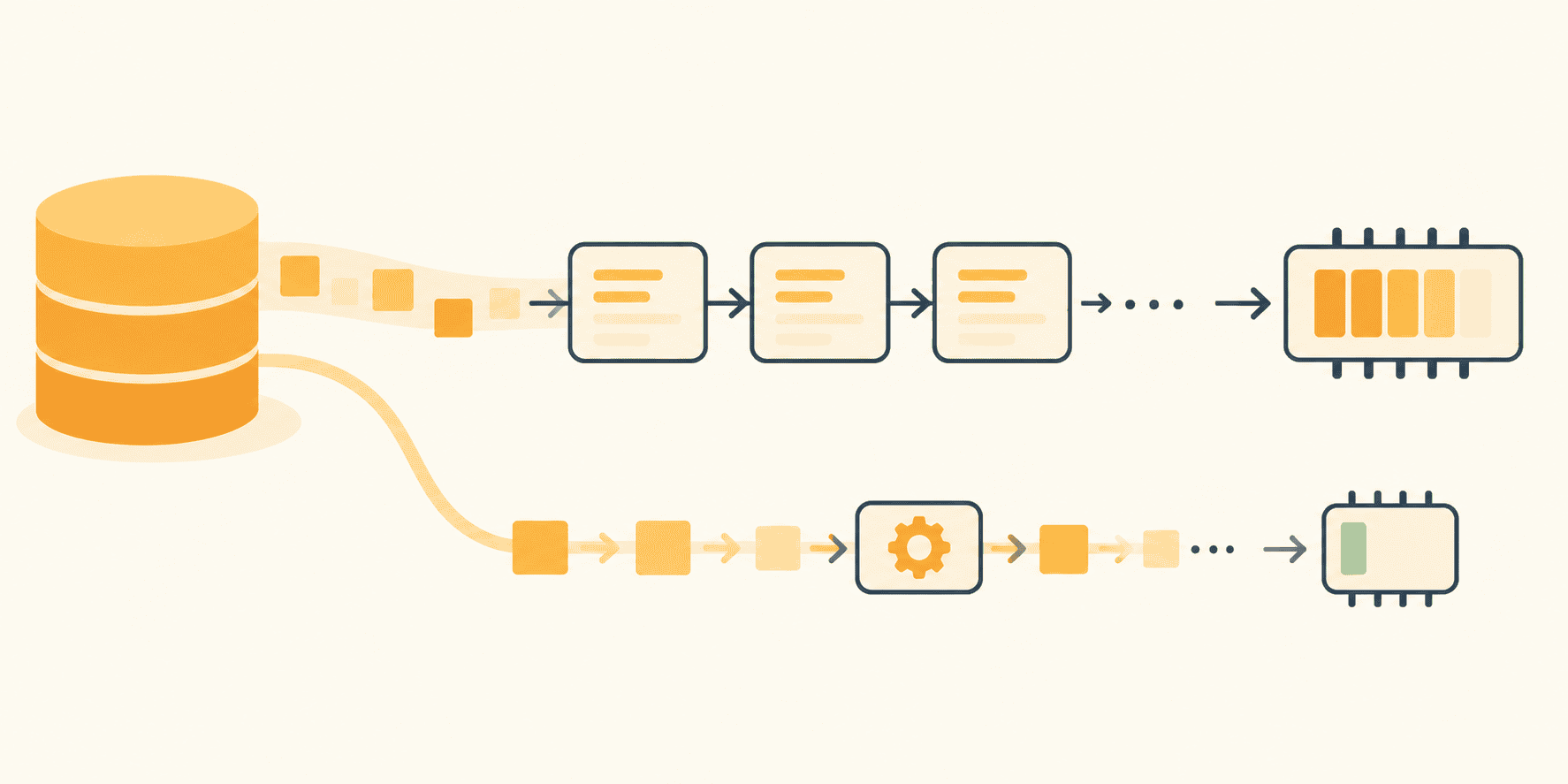
To circumvent this constraint without rewriting applications in lower-level compiled languages like C++ or Rust, developers can leverage Python’s native iterator protocol and generator expressions. These built-in constructs, present within the language for over two decades, enable lazy evaluation pipelines where a single record is fetched, processed through multiple transformation stages, and released from memory before the next record enters the processing stream. Maintaining this "lazy" state across the entire data path—from the foundational file object down to the final batch sink—prevents memory bloat and ensures consistent runtime resource utilization.
Chronology of Data Processing Evolution in Python
The evolution of memory management in high-level scripting languages like Python reflects a broader industry shift toward streaming paradigms. Understanding this chronology clarifies why native iterators remain relevant despite the proliferation of heavy distributed processing frameworks.
- Early Python (Late 1990s – 2000s): Initial file input/output operations relied heavily on methods like
readlines(), which inherently loaded entire file contents into memory lists, leading to frequent out-of-memory errors on large datasets. - Introduction of Generators (Python 2.2, 2001): The incorporation of the
yieldkeyword and generator functions revolutionized how sequences were generated, allowing iterables to produce values on-demand without prior allocation. - Standardization of Itertools (Python 2.3, 2003): The introduction of the
itertoolsmodule provided memory-efficient building blocks for iterator manipulation, mirroring functional programming concepts in C-optimized routines. - Modern Streaming and Batched Operations (Python 3.12+, 2023): The addition of native utilities like
itertools.batched()formalized boundary-layer batching, providing standardized idioms for transitioning from lazy streams to persistent storage or API sinks.
The Iterator Contract: Iterable vs. Iterator
Python’s ubiquitous for loop conceals a fundamental structural contract that underpins all streaming operations. Understanding the distinction between an iterable and an iterator is vital for designing robust data pipelines.
An iterable is any Python object capable of returning its members one at a time—such as lists, dictionaries, strings, and open file handles. An iterator, conversely, is an object representing a state of data streaming progress, maintaining a cursor over the underlying data source. When a loop executes for line in f, Python implicitly invokes iter(f) to secure an iterator, and subsequently calls next() on that iterator iteratively until a StopIteration exception is raised. Far from being an error state, StopIteration serves as the standard, expected termination signal for the iterator protocol, which consists of precisely two core methods: __iter__() and __next__().
numbers = iter([10, 20, 30])
next(numbers)   # 10
next(numbers)   # 20
next(numbers)   # 30
next(numbers)   # raises StopIteration
Crucially, an iterator acts as a forward-only cursor rather than a cloned data container. While this mechanism allows processing a 9-gigabyte file using a negligible read buffer, it introduces operational hazards. Exhausted iterators cannot be rewound; once StopIteration is triggered, subsequent calls will continuously raise the exception. Developers frequently encounter bugs where generators appear mysteriously empty during secondary loops—often because an initial inspection, such as checking len() or casting to a list(), consumed the underlying stream.
Constructing Stateful Generator Functions
While standard file objects naturally function as iterators when read line-by-line, complex data processing workflows require custom transformation logic. Developer efficiency improves significantly when parsing, filtering, and projecting operations are decoupled into modular generator functions powered by the yield keyword.
import re

LINE = re.compile(r"^(?P<ts>S+) (?P<level>[A-Z]+) (?P<service>[w-]+)(?P<rest>.*)$")

def read_lines(paths):
    for path in paths:
        with open(path, encoding="utf-8") as f:
            yield from f

def parse_records(lines):
    for line in lines:
        match = LINE.match(line)
        if match is None:
            continue
        record = match.groupdict()
        record["fields"] = dict(
            item.split("=", 1) for item in record.pop("rest").split() if "=" in item
        )
        yield record

def only_level(records, level):
    for record in records:
        if record["level"] == level:
            yield record
In this decoupled architecture, read_lines utilizes yield from to seamlessly chain multiple rotated log files into a unified logical stream while ensuring individual file descriptors close immediately after processing. The parse_records and only_level functions maintain execution state suspension. When a generator function hits a yield statement, local variables, instruction pointers, and evaluation stacks are preserved in memory suspension, allowing execution to resume precisely where it paused upon the caller’s next request.

Industry Implications and Performance Analysis
Adopting lazy evaluation and streaming paradigms carries profound operational implications for enterprise data infrastructure. Profiling memory allocation using standard library tools such as tracemalloc reveals the stark contrast between eager and lazy architectures.
When benchmarking an eager log-parsing script against a 200,000-line synthetic dataset totaling approximately 17 megabytes, peak memory consumption reaches nearly 198 megabytes due to duplicated string allocations and nested list overhead. Conversely, a fully optimized streaming generator pipeline processing the identical dataset peaks at a mere 0.4 megabytes of RAM. Crucially, while the eager execution profile scales linearly—or exponentially—with file volume, the lazy pipeline’s memory footprint remains bound strictly to the configured batch size, insulating production environments from out-of-memory daemon terminations.
Industry experts emphasize that streaming architectures are not a universal panacea. Operations requiring global state acquisition—such as global sorting, exact deduplication across non-contiguous datasets, or statistical percentile calculations over unindexed sequences—fundamentally necessitate complete dataset materialization or specialized external sorting algorithms. Recognizing these limitations prevents architectural missteps, ensuring that developers apply generators where streaming efficiency yields optimal returns.
Boundary Management and Production Best Practices
Implementing an efficient data pipeline requires establishing deliberate boundaries where streams materialize into concrete storage mechanisms, databases, or API payloads. The introduction of itertools.batched() in Python 3.12 has standardized bounded chunk processing within the standard library:
from itertools import batched

def write_batches(rows, path, size=1000):
    with open(path, "w", encoding="utf-8") as out:
        for batch in batched(rows, size):
            out.writelines(f"tstservicetridn" for ts, service, rid in batch)
            out.flush()
By explicitly defining batch boundaries, engineering teams ensure that downstream consumers receive manageable data structures without reintroducing systemic memory risks upstream. Maintaining a rigorous focus on lazy evaluation from source file ingestion down to bounded sink execution guarantees that modern applications can process arbitrarily large datasets with deterministic resource consumption, preserving system stability across enterprise architectures.