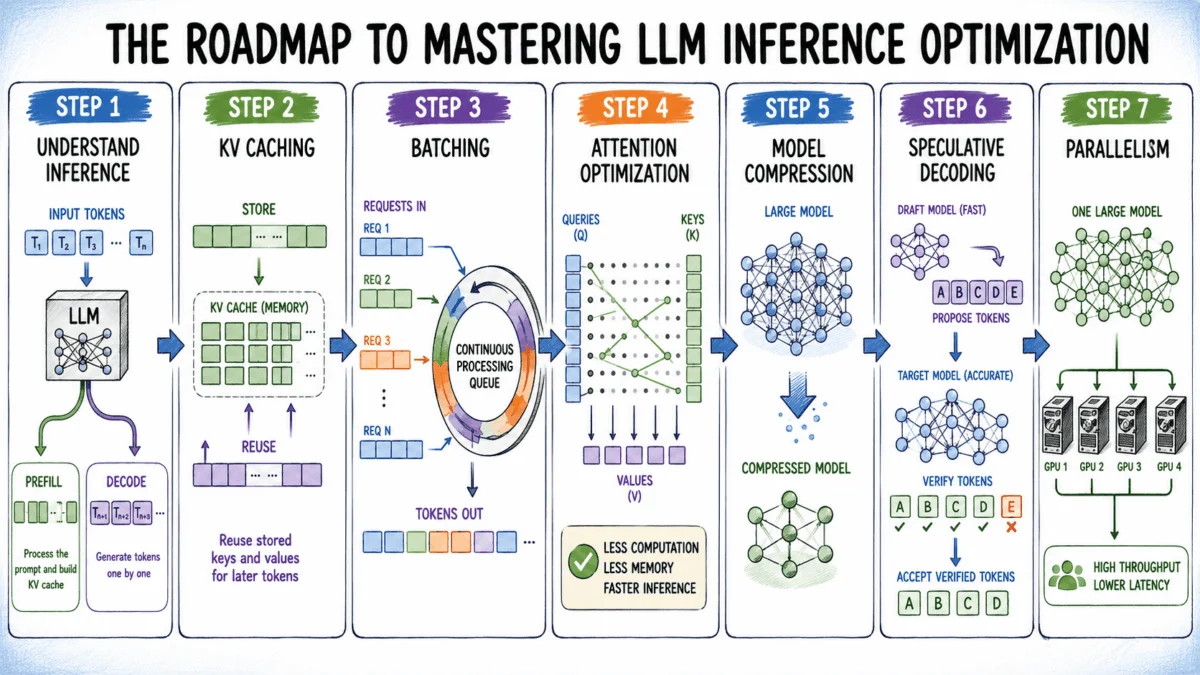
As the enterprise adoption of generative artificial intelligence reaches an inflection point, engineering teams face a mounting operational paradox. While deploying a large language model (LLM) to produce structurally sound text is now a solved problem, achieving the requisite speed, cost-efficiency, and reliability in a high-concurrency production environment remains a formidable engineering hurdle. In recent benchmark evaluations conducted across high-traffic production deployments, up to 40 percent of systems experience latency degradation during peak traffic hours, primarily driven by unoptimized memory and compute bottlenecks.
The financial toll of these inefficiencies compounds rapidly. As organizations scale context windows from traditional 4K tokens to 128K and beyond, cloud infrastructure expenditures threaten to outpace business value. Inference optimization—the systematic engineering discipline of maximizing throughput and minimizing latency without altering a model’s foundational training weights—has consequently emerged as a critical domain within systems architecture. By deploying targeted interventions at the scheduling, memory management, and algorithmic levels, modern infrastructure teams are discovering that they can dramatically increase request handling capacity while drastically cutting hardware overhead.
The Dual-Phase Mechanics of Decoder-Only Inference
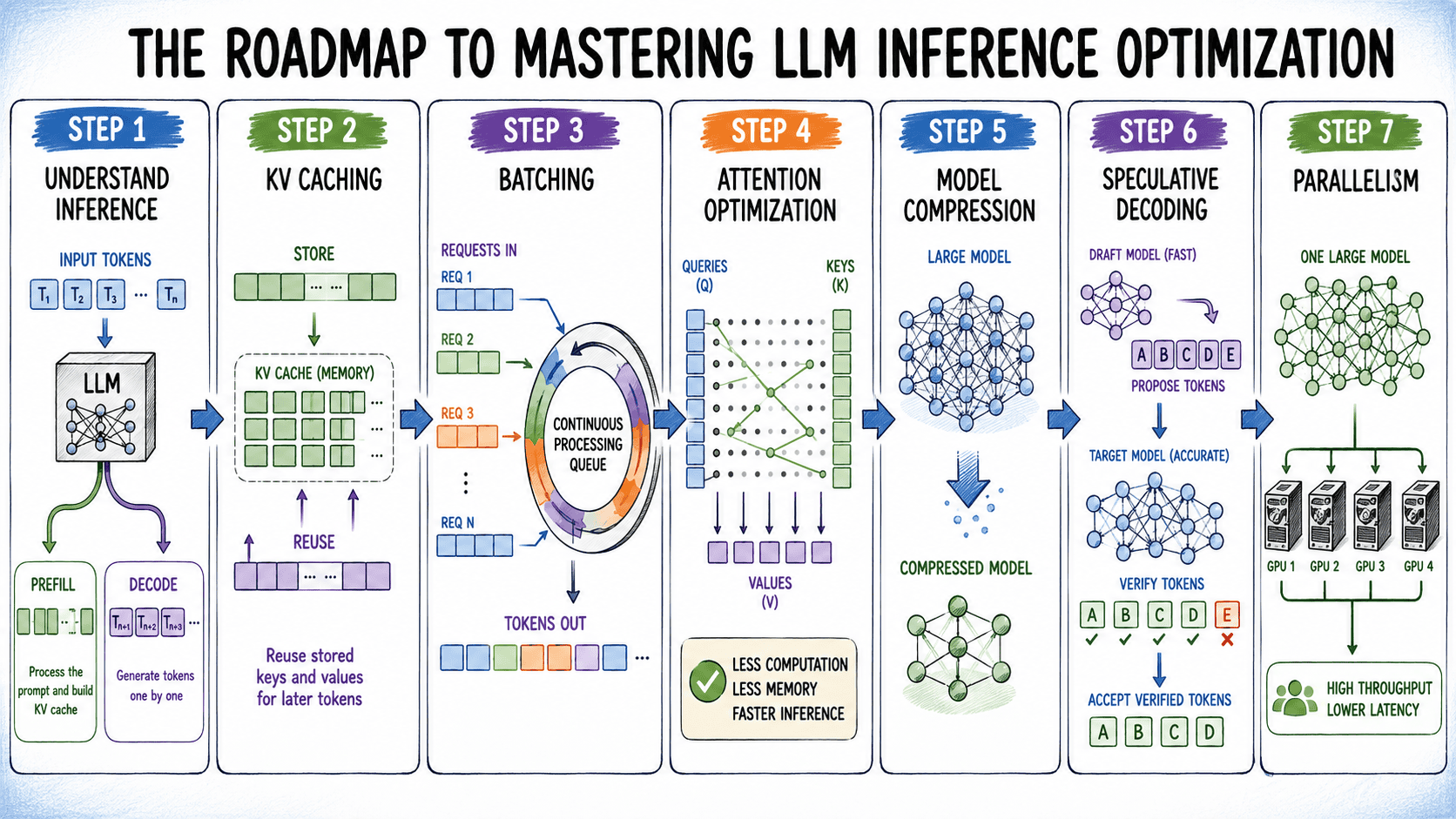
To understand how optimization strategies function, one must first examine the life cycle of a single request passing through a decoder-only transformer model. The inference process is strictly bifurcated into two distinct operational phases: the prefill phase and the decode phase. Each phase exhibits radically different performance profiles and resource bottlenecks.
The prefill phase initiates the moment a request hits the serving engine. During this stage, the model ingests the entire prompt simultaneously, performing massive matrix multiplications to compute the intermediate key (K) and value (V) tensors necessary for subsequent generation steps. Because the full input sequence is known upfront, this computation is heavily parallelized, effectively saturating the floating-point arithmetic units of modern Graphics Processing Units (GPUs). Consequently, the prefill phase is fundamentally compute-bound.
Conversely, the decode phase operates under an entirely different set of physical constraints. Once the initial token is generated, the model transitions to an autoregressive regime, producing subsequent tokens strictly one at a time. Each new token depends mathematically on all preceding tokens, rendering intra-sequence parallelization impossible. The primary bottleneck shifts abruptly away from raw compute capability toward memory bandwidth. During the decode phase, the GPU spends the vast majority of its time moving model weights and cached attention states back and forth from High Bandwidth Memory (HBM) to the processor cores.
Industry benchmarks reveal that hardware memory bandwidth, rather than raw computational floating-point operations per second (FLOPS), serves as the ultimate binding constraint during generation. Consequently, optimizations that minimize data movement or maximize work-per-memory-access yield immediate performance dividends. This dichotomy also explains why rudimentary performance metrics often mislead engineering leaders. Time-to-First-Token (TTFT) acts as a direct reflection of prefill efficiency, whereas tokens-per-second (TPS) throughput metrics measure decode performance. Tailoring infrastructure requires diagnosing which of these specific metrics dictates the end-user experience.
Mitigating Memory Exhaustion Through Advanced KV Caching
The most critical optimization developed for the decode phase is the Key-Value (KV) cache. Without this mechanism, a model would be forced to recompute the K and V tensors for every historical token at each sequential generation step—an O(N^2) computational nightmare. By storing these intermediate tensors in GPU memory and referencing them iteratively, systems trade memory capacity for computational cycles.
However, this trade-off introduces a severe memory footprint challenge. The memory required to maintain a KV cache scales simultaneously with both batch size and sequence length. For a standard 7-billion parameter model operating at 16-bit precision, the KV cache alone can consume several gigabytes of memory for a single moderate-length request. At enterprise scale, with hundreds of concurrent users executing long-context interactions, memory capacity becomes the hard ceiling on system concurrency.
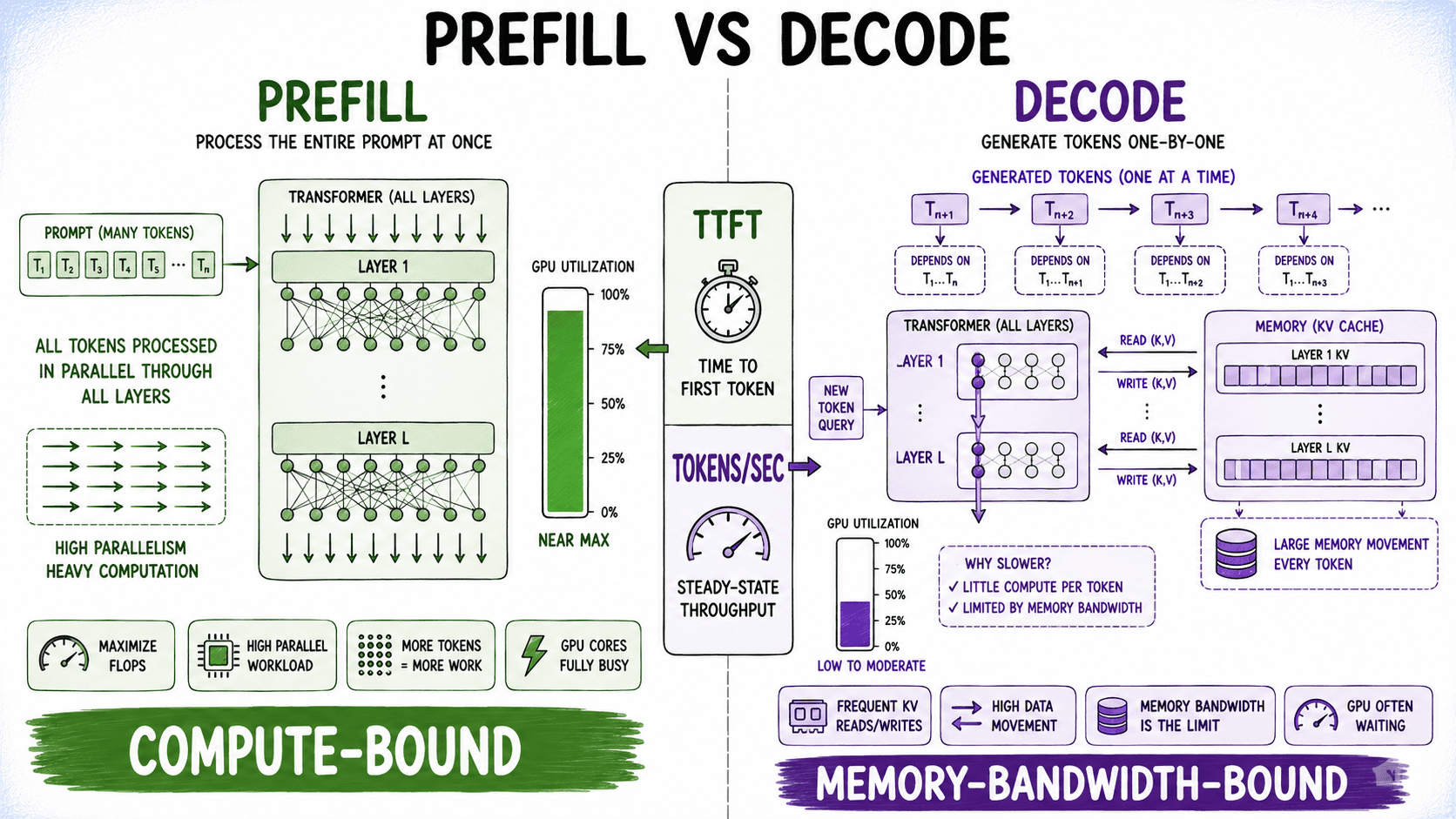
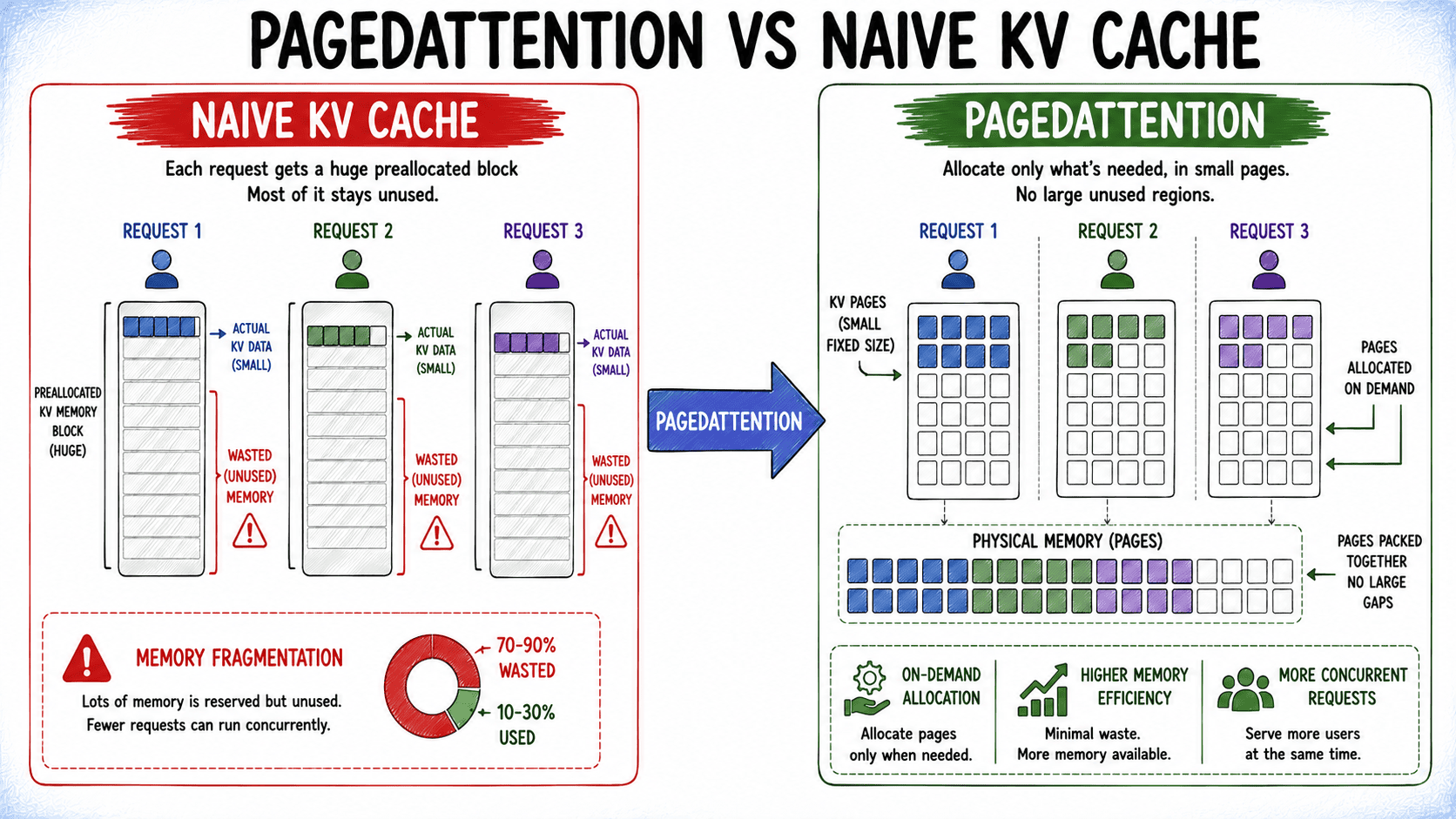
Legacy serving engines exacerbate this issue through naive memory allocation strategies. Because the final length of an arbitrary user generation cannot be predicted in advance, systems historically allocated contiguous blocks of GPU memory based on the theoretical maximum sequence length. This practice triggered catastrophic internal fragmentation, leaving vast swaths of memory inaccessible and severely restricting maximum batch sizes.
To solve this systemic vulnerability, systems engineers introduced PagedAttention, a memory management architecture borrowed directly from operating system virtual memory paging. PagedAttention eliminates contiguous allocation requirements by dividing the KV cache into fixed-size physical memory blocks. These blocks can be allocated non-contiguously and dynamically on-demand as generation proceeds, reserving precisely zero speculative memory overhead. Production runtimes implementing PagedAttention have demonstrated up to a 3-fold increase in maximum serving capacity on identical hardware configurations.
Building upon dynamic memory allocation, modern serving stacks increasingly rely on prefix caching. In enterprise environments utilizing Retrieval-Augmented Generation (RAG) pipelines or complex system prompts, thousands of incoming requests frequently share identical foundational text blocks, such as corporate policy documents or multi-shot examples. Prefix caching computes the KV cache for these shared segments a single time and securely reuses them across disparate user requests, eliminating redundant computational overhead entirely.
Evolving Beyond Static Scheduling to Continuous Batching
Hardware utilization remains a persistent challenge in single-request inference models. Because the entire set of model weights must be loaded into memory for every forward pass regardless of prompt size, processing a single request leaves the vast majority of GPU compute units idle. Amortizing that fixed weight-loading cost across a larger batch of simultaneous requests is vital for economic viability.
Historical implementations relied on static batching, wherein a serving engine waits for a fixed number of requests to accumulate before initiating a processing round. In production environments characterized by highly variable output lengths, static batching performs disastrously. Because a batch cannot advance to completion until its longest-running sequence finishes generating, faster requests sit completely idle, waiting for outliers. This high variance in output generation time turns static batching into an acute throughput bottleneck.
To mitigate this, dynamic batching introduced time-out windows, allowing batches to dispatch either when a maximum size threshold is reached or a strict time limit expires. While this improved responsiveness, it failed to solve the fundamental problem of sequence length disparity.
The current industry standard for production serving is continuous batching—alternatively referred to as in-flight batching. Pioneered by modern inference frameworks, continuous batching completely decouples request completion from batch boundaries. The moment an individual sequence finishes generating its final token, it is instantaneously evicted from the active batch, and a new incoming request takes its vacant slot without interrupting the broader processing loop. The batch is continuously replenished on a per-iteration basis, ensuring optimal GPU compute saturation even when handling workloads with wildly unpredictable output distributions.
Architectural Refinements in Attention Mechanisms
At the core of every transformer-based language model lies the attention mechanism, an operation that historically dominated computational latency. Over recent years, systems researchers have introduced profound architectural variants designed to streamline this process without requiring extensive model retraining.
Standard Multi-Head Attention (MHA) maintains independent key and value projection matrices for every individual attention head. While effective for modeling complex relationships, this approach multiplies memory bandwidth requirements during the decode phase. Multi-Query Attention (MQA) addresses this by forcing all query heads to share a single, unified set of key and value heads. While this induces a negligible reduction in downstream task accuracy, it dramatically shrinks the volume of data that must traverse memory during generation.
Grouped-Query Attention (GQA) represents a balanced architectural compromise between MHA and MQA. By clustering key and value heads into distinct groups shared by subsets of query heads, GQA captures the vast majority of MQA’s memory bandwidth savings while preserving the nuanced modeling capacity of traditional multi-head architectures. Modern open-weights foundation models increasingly adopt GQA natively to optimize downstream inference speeds.
Complementing architectural alterations, algorithmic breakthroughs such as FlashAttention optimize the physical execution of attention operations on silicon hardware. Traditional attention implementations repeatedly write and read intermediate attention matrices to and from global GPU High Bandwidth Memory, creating severe memory-bound bottlenecks. FlashAttention reformulates the execution order through smart tiling and kernel fusion, keeping intermediate values within the ultra-fast on-chip Static RAM (SRAM) of the GPU. Because it requires no model retraining and acts as a drop-in software replacement, FlashAttention has become a ubiquitous standard in modern inference engineering.
Model Compression: Shrinking Footprints Without Sacrificing Intelligence
While runtime scheduling and attention optimizations govern how a model is served, model compression fundamentally alters what is being served. By reducing the physical size of the model weights, compression techniques enable deployment on cost-effective hardware tiers while accelerating throughput.
Quantization stands as the most widely adopted compression modality. Standard training methodologies typically preserve weights in 16-bit floating-point precision (FP16), consuming roughly two bytes of memory per parameter. Advanced quantization algorithms—such as GPTQ, AWQ, and dynamic mixed-precision techniques—compress these weights down to 8-bit or 4-bit integer representations. For a 70-billion parameter model, transitioning from FP16 to INT4 reduces memory overhead from approximately 140 gigabytes to just 35 gigabytes, effectively enabling models that once required multi-GPU enterprise server nodes to run efficiently on single-accelerator hardware.
Simultaneously, structured sparsity exploits the mathematical reality that many weight values within trained neural networks cluster near zero and contribute minimally to final output distributions. Pruning these parameters into exact structural patterns—such as NVIDIA’s hardware-accelerated 2:4 sparsity format—delivers up to a 2-fold acceleration on compatible tensor cores without incurring software overhead.
For extreme latency-critical applications, knowledge distillation offers a different path. Rather than compressing an existing model directly, engineers train a smaller, agile "student" model to replicate the precise output probability distributions of a massive "teacher" model. By absorbing the nuanced behavioral patterns of the larger model rather than relying solely on rigid ground-truth labels, the distilled student achieves superior task performance relative to its size class.
Overcoming Autoregressive Bottlenecks Through Speculative Decoding
Despite comprehensive optimization, the fundamental autoregressive nature of token generation—whereby every single token must wait for its predecessor—remains an immutable physical bottleneck for single-request latency. Speculative decoding bypasses this constraint mathematically without altering the final generated output.
The mechanism operates via a symbiotic pairing of two models: a small, ultra-fast draft model and a large, computationally heavy verification model. The draft model rapidly generates a short candidate sequence of several tokens autoregressively. The primary verification model then evaluates the entire candidate sequence in parallel in a single forward pass, treating the draft tokens as a batch of independent scoring problems.
Tokens where the verification model’s probability distribution aligns with the draft are accepted instantly. The first token that fails validation triggers the truncation of subsequent speculative tokens, and generation resumes seamlessly from the point of disagreement. Because the verification model can validate multiple candidate tokens in a fraction of the time required to generate them sequentially, speculative decoding yields significant speedups in latency-sensitive, single-user interactive workloads where batching efficiencies do not apply.
Scaling via Parallelism and Disaggregated Architectures
When model parameters exceed the memory capacity of a single physical accelerator, or when enterprise throughput SLAs demand compute power beyond single-device limits, infrastructure architects turn to multi-GPU parallelism.
Tensor parallelism partitions individual weight matrices across multiple devices operating within a high-speed NVLink domain, splitting layers so that each GPU computes a distinct fraction of the matrix multiplication before synchronizing results. Pipeline parallelism, conversely, divides the model vertically, assigning sequential blocks of layers to discrete GPUs. While pipeline parallelism simplifies communication overhead, it introduces pipeline bubbles—periods where downstream GPUs sit idle waiting for upstream computations to finish. Modern systems mitigate these bubbles through sophisticated microbatching strategies.
At the cutting edge of infrastructure design lies prefill-decode disaggregation. Recognizing that the prefill phase is compute-bound while the decode phase is memory-bandwidth-bound, disaggregated architectures route incoming requests to entirely separate pools of hardware optimized specifically for each task. Prefill requests land on high-compute clusters designed for heavy matrix multiplication, while active decode sequences are offloaded to memory-optimized hardware pools. This separation prevents massive, long-context prefill computations from stalling active token generation streams, representing the state-of-the-art in scalable enterprise LLM deployment.
Strategic Implementation Framework
Deploying an optimized LLM inference pipeline requires rigorous alignment between operational constraints and technological interventions. Engineering leadership must continuously profile actual production workloads against latency targets, throughput requirements, and hardware budgets.
| Optimization Domain | Primary Mechanism | Core Operational Benefit |
|---|---|---|
| Two-Phase Separation | Disentangling Prefill and Decode | Identifies precise hardware bottlenecks and aligns metrics (TTFT vs. TPS). |
| KV Caching & PagedAttention | Non-contiguous virtual memory blocks | Eliminates internal fragmentation, expanding concurrent user capacity. |
| Continuous Batching | Dynamic per-iteration queue replenishment | Maximizes GPU compute saturation despite variable output lengths. |
| Attention Optimizations | FlashAttention, GQA, and MQA | Reduces memory bandwidth consumption during the decode phase. |
| Model Compression | Quantization (GPTQ/AWQ) and Sparsity | Shrinks memory footprint, enabling deployment on smaller hardware tiers. |
| Speculative Decoding | Dual-model draft and parallel verification | Accelerates single-request generation latency without accuracy loss. |
| Hardware Parallelism | Tensor/Pipeline splitting and disaggregation | Scales serving capacity across multi-GPU clusters for massive models. |
By implementing these optimization layers systematically—starting with efficient runtime scheduling and memory management before moving into architectural attention refinements and hardware parallelism—organizations can successfully bridge the gap between theoretical model capability and production-grade economic viability.