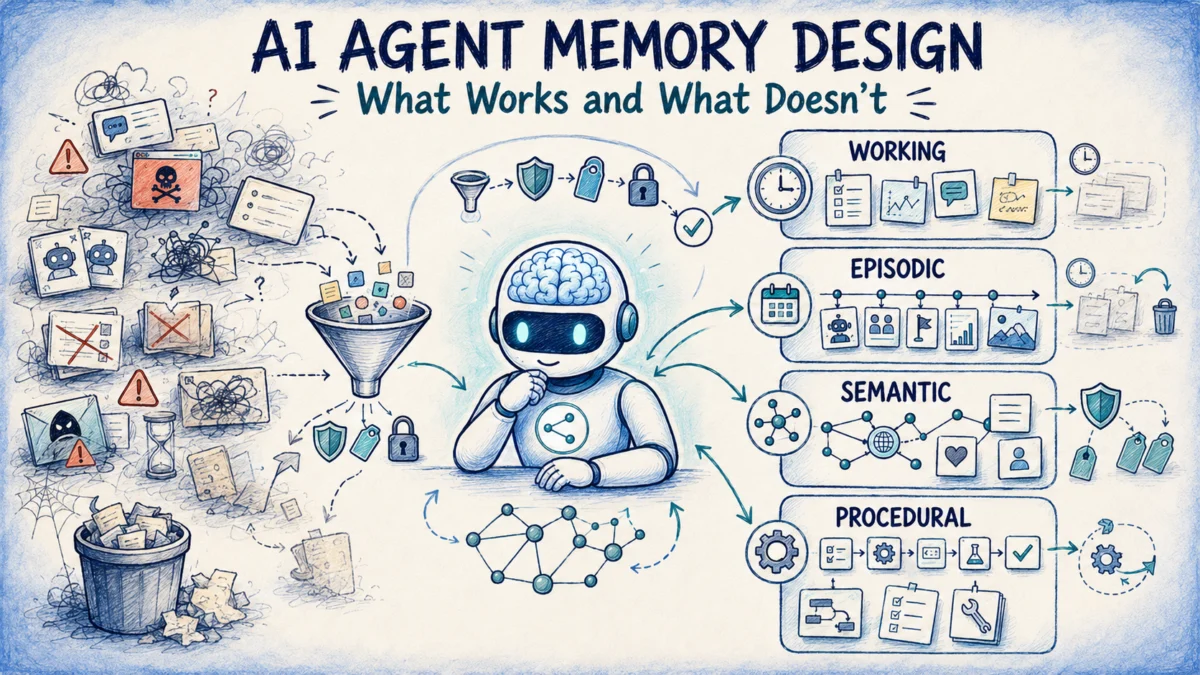
The deployment of autonomous artificial intelligence agents has shifted rapidly from experimental, single-session sandbox environments to complex, multi-session production workflows. While early implementations relied strictly on an immediate context window—clearing all operational state upon task completion—modern software architecture demands that agents retain operational continuity, recall user preferences, and avoid redundant computations across independent interactions. However, persisting data outside the native context window introduces significant engineering challenges. Without a robust architectural framework, poorly designed memory systems routinely cause silent regressions, memory poisoning, and compounding computational loops that are notoriously difficult to trace and remediate.
To understand the scope of the problem, software architects must first distinguish true agent memory from static configurations. System prompts, conversation logs, and static retrieval-augmented generation (RAG) knowledge bases constitute static context or configuration files rather than runtime memory. True agent memory is defined as dynamic information written by an agent to external storage during execution and retrieved across subsequent steps or multi-session lifecycles.
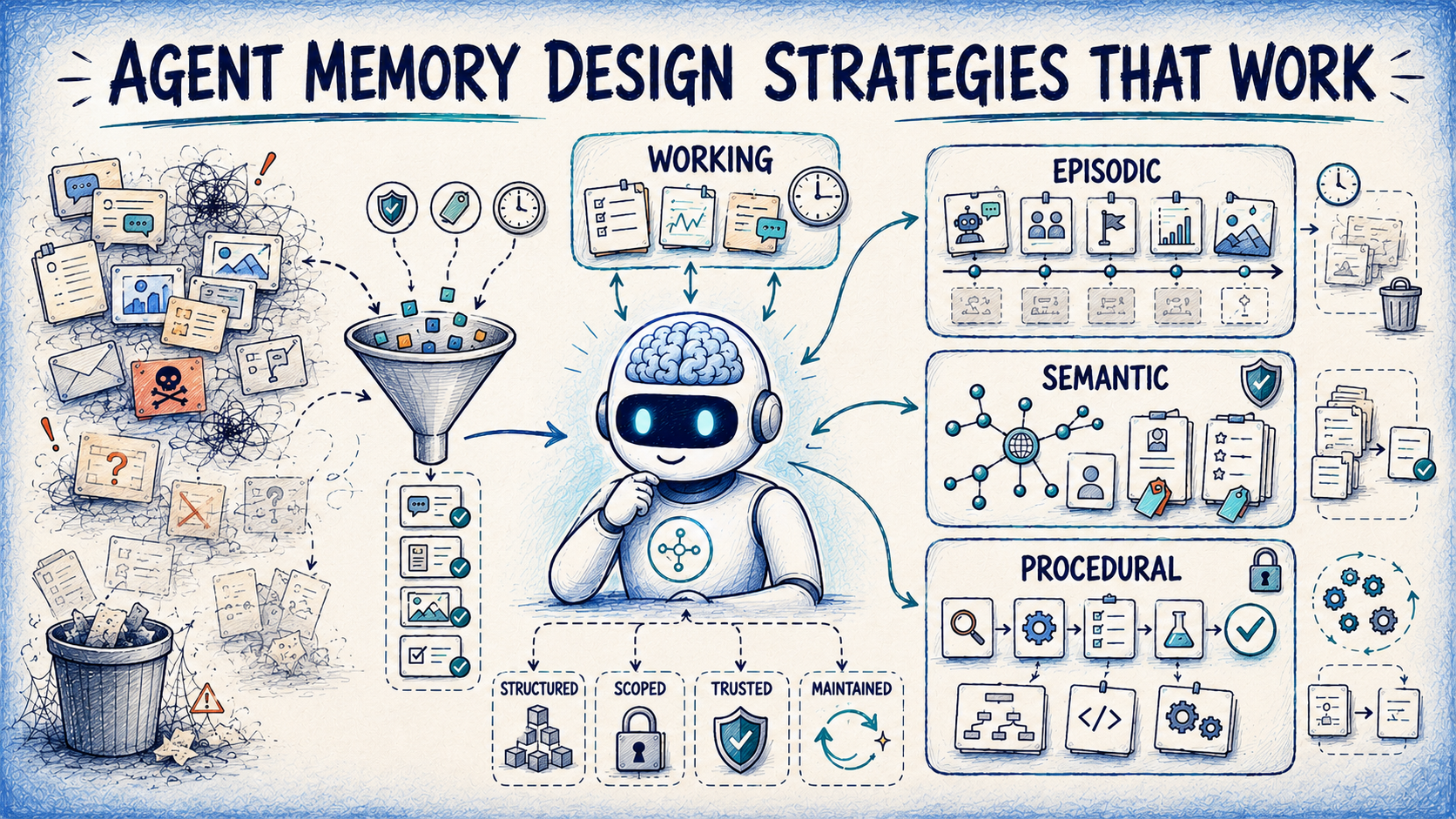
Taxonomically, enterprise-grade agent memory typically fragments into four distinct cognitive layers: episodic, semantic, procedural, and working memory. Episodic memory records historical interactions, past task runs, and historical decisions, typically housed in vector stores or document databases. Semantic memory manages evolving facts, user preferences, and domain knowledge, often utilizing a hybrid of vector storage and key-value databases. Procedural memory preserves successful action patterns and learned execution workflows. Finally, working memory tracks active task states, intermediate calculation scratchpads, and short-term variables.
Engineering teams that collapse these disparate layers into a single, monolithic vector database inevitably encounter severe architectural bottlenecks. Each layer exhibits fundamentally different retrieval behaviors and failure modes, necessitating decoupled storage strategies tailored to specific operational requirements.
Effective Memory Strategies for Production Environments
Building a resilient memory architecture requires intentional design choices regarding how data is scored, scoped, and written. A primary best practice involves implementing hierarchical memory structures governed by strict importance and confidence scoring. Storing every generated token increases vector storage costs and degrades retrieval precision with noise, while storing insufficient data forces agents to execute tasks from scratch.
To resolve this trade-off, agents can evaluate the durability and confidence of information prior to persistence. High-value insights are committed to long-term storage paired with precise timestamps and confidence metrics, whereas volatile, low-value data remains isolated in short-term working memory. For instance, developers frequently utilize programmatic schemas—such as Pydantic models—to enforce strict validation before any entry crosses the write threshold.
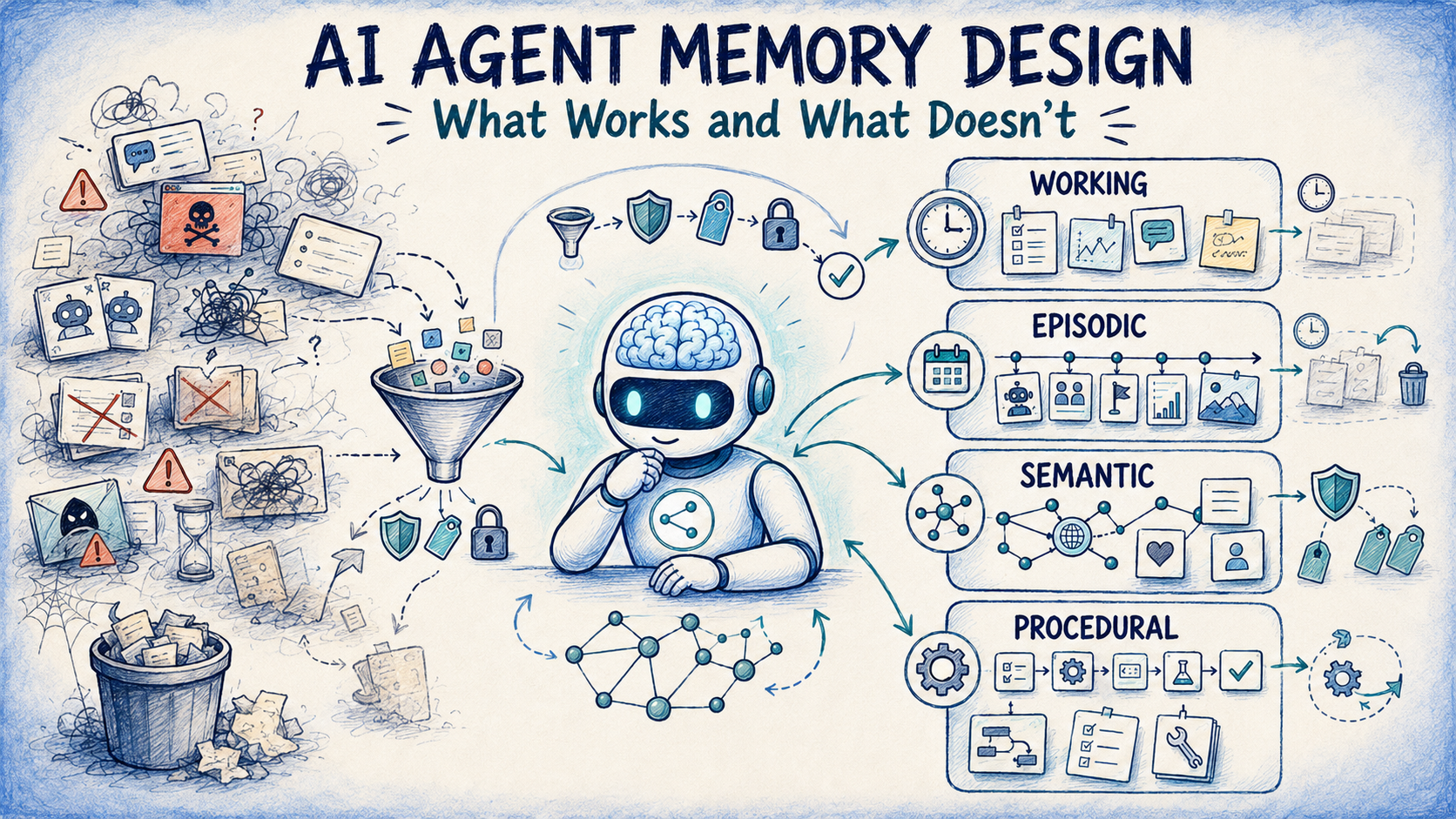
Furthermore, multi-agent systems require rigorous memory scoping. A common architectural failure involves provisioning a single, shared memory pool across heterogeneous agent roles. Under a flat architecture, a research agent might write intermediate exploratory notes that a downstream code-execution agent misinterprets as authoritative directives. Enforcing strict role-based namespaces ensures that sub-agents write exclusively to designated areas while restricting broader read access through a centralized orchestrator.
Another critical intervention involves shifting from end-of-task persistence to step-by-step working memory updates. Historically, agent frameworks committed state only upon successful workflow termination. If an agent failed midway through a complex procedure, all intermediate learning was lost. Modern architectures write step results to low-latency working memory immediately, applying short-term time-to-live (TTL) expiration policies. Only upon verifiable step success are these entries promoted to persistent episodic storage, keeping the long-term database free of fragmented or misleading task remnants.
Finally, advanced systems prioritize contextual retrieval at every discrete decision point rather than relying solely on initialization-phase memory loads. By querying working memory dynamically before initiating tool calls, agents maintain hyper-targeted context windows that drastically minimize irrelevant token injection.
Common Architectural Anti-Patterns and Failure Modes
Despite the availability of proven design patterns, development teams frequently commit critical architectural missteps. One prevalent anti-pattern is treating vector databases as universal solutions. While vector similarity search excels at semantic matching, it inherently lacks relational mapping, explicit structural constraints, and automated mechanisms for data invalidation. Relying entirely on vector distance metrics without deterministic key-value lookups inevitably leads to erratic retrieval performance.
Another hazardous approach is the reliance on free-form summarization for memory compression. When long conversation histories exceed prompt limitations, developers often instruct a language model to summarize the history and store the summary. This practice introduces two major failure modes: the loss of critical technical constraints and the compounding of hallucinations. Because summarization compresses data by omission, vital edge cases, specific version numbers, or strict operational constraints are routinely discarded. Worse, if a language model hallucinates a fact during an early session, the subsequent summarization process embeds that fabrication into long-term storage as high-confidence ground truth. Future sessions treat the hallucinated detail as verified fact, causing persistent, compounding errors across the agent’s lifecycle.
To mitigate this, production systems should replace unstructured textual summaries with strict, schema-driven fact extraction. By instructing models to extract discrete, typed variables validated against predefined schemas, systems preserve verifiable data points while dropping subjective conversational prose.
Memory maintenance represents yet another neglected vector of technical debt. Unmonitored memory stores expand indefinitely, driving up computational costs and amplifying retrieval latency. Production systems require automated maintenance routines, including time-to-live expiration for temporary scratchpads, confidence decay algorithms for volatile facts, routine deduplication sweeps, and periodic contradiction resolution protocols.
Addressing the Threat of Memory Poisoning
Perhaps the most alarming vulnerability in modern agent architecture is memory poisoning, a security exploit where an autonomous agent processes external, untrusted content—such as a malicious webpage or compromised user input—containing hidden prompt injections. If the agent writes the resulting output to its long-term memory, the injected directive persists across sessions.
Recent cybersecurity research highlights the severity of this issue through exploits such as the MemoryGraft attack, which demonstrates how a minimal number of poisoned memory entries can systematically subvert future semantic queries. Because standard vector retrieval relies solely on embedding distance without provenance verification, malicious instructions embedded in stored memories continually resurface during high-stakes executions.
To neutralize memory poisoning, architects must implement rigorous provenance tracking and trust-level filtering. Every memory entry should record exhaustive metadata, including the originating agent ID, specific tool name, input hash, session identifier, and an assigned trust level (e.g., internal system inputs marked high-trust, user inputs marked medium-trust, and external web data marked low-trust). Prior to committing untrusted or low-trust content to persistent storage, automated sanitization routines must evaluate the text for embedded imperative commands or behavioral alterations, rejecting compromised entries outright.
Implications and Future Outlook
The evolution of agentic workflows highlights a fundamental reality: memory is no longer a peripheral feature but the core operating system of autonomous artificial intelligence. As enterprises scale multi-agent deployments across finance, healthcare, and software engineering, the stability of these systems will depend entirely on disciplined engineering paradigms.
Moving forward, the industry is coalescing around standardized architectural blueprints. Multi-layered storage strategies—partitioning working, episodic, semantic, and procedural domains—are rapidly replacing naive, single-store implementations. Concurrently, the implementation of automated memory maintenance, strict schema extraction, and aggressive trust-boundary sanitization will separate resilient production-grade agents from fragile experimental prototypes.
Ultimately, designing reliable memory systems requires treating agentic persistence with the same rigor applied to traditional distributed databases. By enforcing clear write policies, maintaining strict provenance trails, and scoping memory access by operational role, developers can construct AI agents capable of long-term autonomy, contextual adaptability, and operational safety.