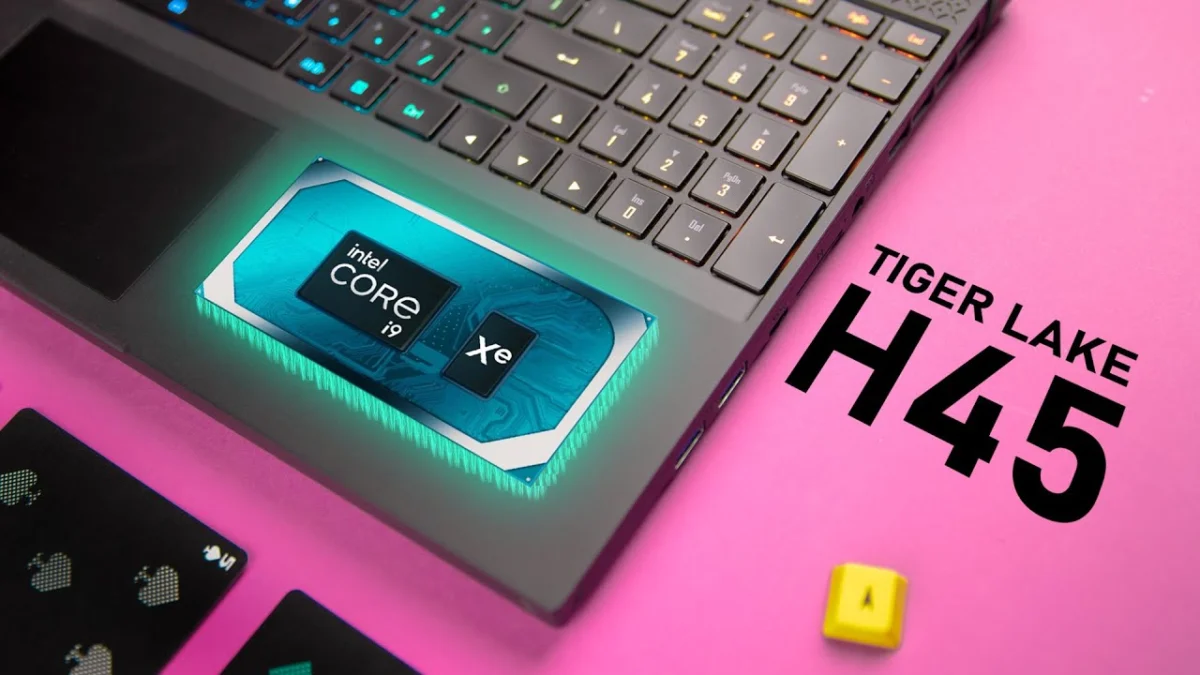
The landscape of high-performance mobile computing is set for a significant shake-up with the official launch of Intel’s 11th Gen Core H-series processors, codenamed "Tiger Lake H45." This release marks a pivotal moment in the ongoing rivalry between semiconductor giants Intel and AMD, promising renewed competition and potentially enhanced options for consumers in the gaming and enthusiast laptop segments. For years, the industry has underscored the importance of competition to prevent monopolies, foster innovation, and drive down prices. While AMD’s Ryzen Mobile series has enjoyed a period of significant market momentum, Intel’s latest offensive aims to reclaim its position, introducing a host of architectural and platform advancements designed to deliver superior performance and features.
A Shifting Battlefield: Intel’s Quest for Mobile Supremacy
For a considerable period, Intel has grappled with the formidable challenge posed by AMD’s Ryzen CPUs across both desktop and mobile platforms. On the desktop front, Intel’s recent "Rocket Lake" architecture, an attempt to integrate new core designs with an older 14nm manufacturing process, largely garnered a lukewarm reception, failing to decisively counter AMD’s Zen 3-based offerings. However, the situation in the gaming laptop market has been even more pronounced.
Intel’s 10th Gen Comet Lake-H processors found themselves consistently outmatched by AMD’s Ryzen Mobile 4000 and, subsequently, the highly acclaimed Ryzen Mobile 5000 series. AMD’s processors offered a compelling combination of multi-core performance and power efficiency that often translated into superior experiences for users. The primary factor preventing AMD from achieving outright market dominance was its inability to meet surging demand, leading to persistent supply shortages that made Ryzen-powered laptops difficult to acquire. This bottleneck inadvertently created an opening for Intel, presenting a critical window to introduce a competitive architecture before AMD’s supply chain could fully catch up.
The Evolution of Tiger Lake: From Ultrabooks to High-Performance H45
The foundation for Intel’s resurgence in the high-performance mobile segment lies in its Tiger Lake architecture. Initially introduced for ultra-thin and light notebooks, the Tiger Lake U-series processors demonstrated significant improvements in single-threaded performance, integrated graphics capabilities (Xe-LP), and power efficiency, thanks to the new 10nm SuperFin manufacturing process. This process represents a crucial departure from Intel’s long-standing reliance on its 14nm node, incorporating advanced FinFET transistor enhancements to deliver higher clock speeds at lower power.
Following the U-series, Intel expanded the Tiger Lake family with the H35 series, a more potent quad-core variant designed for thin-and-light gaming laptops, exemplified by devices like the ASUS TUF Dash F15. These processors offered a taste of the performance potential of the new architecture. However, the true game-changer for the enthusiast and high-performance gaming laptop market is the Tiger Lake H45. This iteration scales the Willow Cove architecture to a maximum of 8 cores and 16 threads, paired with significantly higher clock speeds and a robust platform, indicating a comprehensive top-to-bottom redesign that goes beyond mere iterative refreshes. Intel’s long-term strategy for Tiger Lake was clear: to leverage a modern, efficient architecture across various power envelopes, culminating in a powerful H-series for demanding applications.
Unveiling the 11th Gen H-Series Lineup: Specifications and Features

The new 11th Gen Core H-series processors are offered in both 6-core/12-thread and 8-core/16-thread configurations, all designed as 45W thermal design power (TDP) parts. The flagship i9-11980HK stands out, being configurable up to 65W and fully unlocked for overclocking via Intel’s Extreme Tuning Utility (XTU) or Speed Optimizer feature. This 8-core, 16-thread behemoth boasts an impressive boost clock of up to 5.0GHz on two cores and can sustain 4.5GHz across all eight cores. On paper, these specifications bring it remarkably close to the performance profile of desktop CPUs like the Rocket Lake i7-11700K, which operates at a significantly higher 125W+ TDP, highlighting the efficiency gains of the new architecture.
Beneath the i9-11980HK, the lineup includes the i9-11900H and the i7-11800H. Both are 8-core/16-thread processors, with the i7-11800H positioned as a potential sweet spot for mainstream gaming laptops, offering performance within 7-9% of the flagship HK model. A shared feature across all three 8-core Tiger Lake CPUs is the substantial 24MB of L3 cache, exceeding even that found in many desktop Rocket Lake CPUs, a factor expected to boost performance in cache-sensitive applications and games. Intel also highlights a "Frequency at cTDP" column, indicating the base frequency at a configurable 35W TDP for non-HK models, emphasizing their adaptability for thinner designs. Furthermore, native memory support has been upgraded to DDR4-3200 across the entire lineup, a notable improvement over the previous DDR4-2933 standard.
For the mid-range, Intel introduces two Core i5 models, both featuring 6 cores and 12 threads. While these maintain competitive clock speeds, Intel has reduced their L3 cache to 12MB, a clear differentiation from the higher-end 8-core SKUs. The primary distinction between the two i5 models, the 11400H and 11260H, is a minor 50MHz difference in maximum integrated GPU frequency, a detail less relevant given their intended pairing with discrete graphics.
Integrated Graphics: A Strategic Compromise
Despite carrying the "UHD Graphics" moniker, the integrated graphics within these 11th Gen H-series processors are based on the Xe-LP architecture, similar to their U-series counterparts. However, they are scaled down to 32 Execution Units (EUs), a reduction from the 48, 80, or 96 EUs found in the quad-core Tiger Lake chips. While a more powerful 96 EU integrated GPU paired with 6 or 8 cores would have been appealing for affordable thin-and-light laptops without discrete GPUs, Intel’s decision reflects a strategic understanding of the market. An 8-core die with a full 96 EU IGP would necessitate a significantly larger and more expensive die size. Crucially, Intel’s engagements with OEM partners indicated that these high-performance H-series processors would almost exclusively be paired with discrete graphics cards, making a powerful integrated solution less critical for their target segment.
A Holistic Platform Approach: PCIe Gen4, Thunderbolt 4, and WiFi 6E
Beyond the CPU itself, the 11th Gen H-series platform introduces a completely new and compelling set of features. Intel has transitioned to a full top-to-bottom PCIe Gen4 architecture, allocating 8 lanes directly to the discrete GPU. This is a significant advancement, especially when contrasted with AMD’s Ryzen Mobile 5000 series, which remains limited to PCIe Gen3 lanes for power efficiency reasons, even for storage solutions. The inclusion of Resizable BAR support at launch further solidifies Tiger Lake H45’s gaming credentials, enabling the CPU to access the entire GPU frame buffer, potentially boosting performance in supported titles.
The processors feature 20 PCIe Gen4 lanes originating from the CPU. With 8 lanes dedicated to the graphics card, the remaining 12 can be utilized for high-speed storage configurations, including RAID arrays. This capability opens avenues for advanced storage solutions, such as PCIe Gen4 RAID arrays in gaming laptops, which could significantly benefit upcoming technologies like Microsoft DirectStorage. DirectStorage is a Windows API designed to reduce CPU overhead during the massive I/O operations characteristic of modern games interacting with fast NVMe SSDs.
Complementing the CPU-native PCIe lanes, an additional 24 PCIe Gen3 lanes emanate from the Platform Controller Hub (PCH), bringing the total platform PCIe lanes to a staggering 44. This expansive connectivity enables a wide array of storage and peripheral options, though its full utilization ultimately rests with laptop manufacturers. Intel asserts that even with a single PCIe SSD, the Gen4 platform can deliver up to 80% higher bandwidth and 75% faster access times in real-world workloads compared to their previous Comet Lake mobile platform, which only supported PCIe Gen3.

Another hallmark of the new platform is native support for Thunderbolt 4, a technology that first debuted with the U-series Tiger Lake processors. Thunderbolt 4 offers a robust 40Gbps bandwidth, enabling support for multiple high-resolution external displays and versatile connectivity. Intel also promotes the feature of charging capability through Thunderbolt 4 ports, though concerns remain about potential trade-offs in port availability if it becomes the sole high-speed connection.
Finally, Tiger Lake H-series laptops will natively support Killer WiFi 6E, extending wireless connectivity into the 6GHz band. This new spectrum offers four times the available space for routers and devices, translating into significantly more bandwidth and reduced interference, addressing congestion issues common in the 5GHz band, at least until widespread adoption of 6E devices.
Intel’s Performance Claims: A Direct Challenge to AMD
Intel’s internal benchmarks paint a compelling picture of the 11th Gen H-series’ performance capabilities. The company claims substantial gaming performance gains over both its previous generation and AMD’s leading Ryzen 5000 Mobile chips. The i9-11980HK is shown to significantly outperform the previous i9-10980HK. More notably, Intel positions its new flagship i9 as superior to the Ryzen 9 5900HX in various gaming titles, even when paired with an RTX 3080 Mobile GPU running at a 10W lower TGP. While AMD offers an even higher-end Ryzen 9 5980HX, its marginal 200MHz Max Boost Clock advantage is unlikely to drastically alter these comparative results.
Intel also highlighted the competitive positioning of its mainstream Core i5-11400H, which reportedly trades blows with the higher-end Ryzen 9 5900HS, despite having two fewer cores and being paired with an RTX 3060 GPU running at 15W less. This suggests the 11400H could emerge as a stronger gaming CPU than the mainstream Ryzen 5 5600H.
In content creation and productivity workloads, Intel refrained from providing specific benchmark numbers but claimed significant average increases over its 10th Gen chips, percentages that align with improvements observed in Tiger Lake ultrabooks. While direct comparisons against AMD in these specific areas are yet to be independently verified, even partial realization of Intel’s claims would represent a substantial gain and a boon for market competition.
Market Implications and The Road Ahead
The success of Intel’s 11th Gen H-series will ultimately hinge on several critical factors beyond raw specifications and internal benchmarks.
- Pricing: AMD’s Ryzen Mobile processors have established an ultra-competitive price-to-performance ratio. If Intel-based systems continue to demand a premium, they risk alienating a significant portion of the market, particularly as Ryzen-powered laptops are increasingly paired with high-end GPUs.
- Laptop Design and Thermals: Even with cutting-edge processors, a laptop’s overall design, especially its thermal management system, can make or break the user experience. Intel must work closely with its OEM partners to ensure that laptops integrating these powerful chips are designed to dissipate heat effectively, allowing the processors to maintain their high clock speeds without thermal throttling. Past instances of poorly implemented designs, such as the MSI Bravo 15 or Dell G5 15 SE, underscore this point.
- Real-World Performance Consistency: The significant variation in CPU and GPU wattages configurable by laptop manufacturers means that judging an entire CPU lineup solely on its peak specs can be misleading. Consistent, real-world performance across a range of laptop designs will be crucial for consumer confidence.
- Availability: Given AMD’s ongoing supply constraints, Intel has a unique opportunity. If they can ensure a robust supply of 11th Gen H-series chips to coincide with the typical summer surge in gaming laptop sales, they could capture significant market share before AMD’s supply chain fully stabilizes.
The introduction of the 11th Gen H-series processors signals Intel’s renewed commitment to innovation and competition in the high-performance mobile segment. The technological advancements—from the 10nm SuperFin process and Willow Cove architecture to comprehensive PCIe Gen4 support, Thunderbolt 4, and WiFi 6E—demonstrate a strategic overhaul aimed at delivering a compelling platform. While independent verification of Intel’s performance claims and real-world implementation by OEMs are pending, the immediate implication is a fiercely competitive market that will ultimately benefit consumers through more diverse choices, advanced features, and potentially more aggressive pricing. The coming months are poised to be exceptionally dynamic for anyone seeking a new gaming or enthusiast laptop, as the titans of the semiconductor industry vie for supremacy.