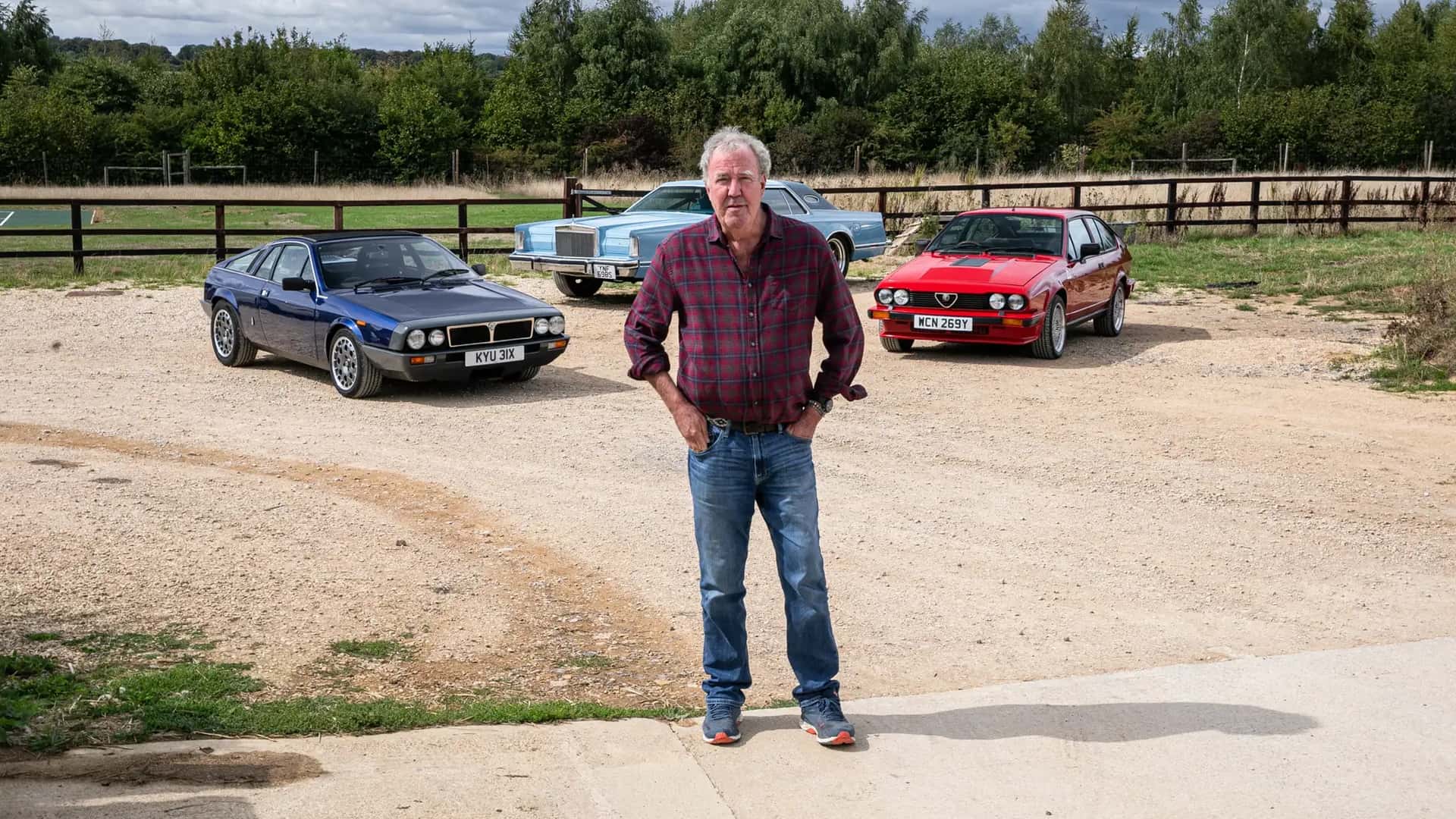
The automotive world is bracing for a historic event as television personality and motoring journalist Jeremy Clarkson prepares to part ways with a trio of vehicles that defined some of the most memorable moments in the history of The Grand Tour. Iconic Auctioneers has confirmed that three automobiles, each playing a starring role in the long-running Amazon Prime series, will cross the auction block without reserve during The Iconic Sale at the NEC Classic Motor Show in Birmingham, England, scheduled for November 14 and 15. This high-profile sale marks a significant transition for both the host and the legacy of the show, offering collectors a rare opportunity to acquire pieces of modern television history.
The vehicles on offer are a 1982 Lancia Montecarlo Spider, a 1983 Alfa Romeo GTV6, and a 1978 Lincoln Continental Mark V. Each car carries a unique narrative, ranging from the emotional conclusion of the trio’s final journey to the mechanical eccentricities of their various road trip specials.
The Significance of the Lancia Montecarlo Spider
The centerpiece of the collection is undoubtedly the 1982 Lancia Montecarlo Spider. This vehicle holds immense sentimental value, as it was the machine Jeremy Clarkson drove during The Grand Tour Presents: One for the Road, the emotional final special filmed in Zimbabwe and Botswana. The episode marked the definitive end of the on-screen partnership between Clarkson, Richard Hammond, and James May, spanning over two decades of collaborative television.
To prepare the vintage Italian sports car for the grueling African terrain, the production team undertook extensive modifications. The vehicle was fitted with Ferrari 308 rear lights, a quad-exhaust system, and robust wheels sourced from a Lancia Delta Integrale. Perhaps most importantly, the interior was overhauled to address the reliability concerns inherent in 40-year-old Italian electronics. Clarkson replaced the original leather seats with durable cloth alternatives and installed a simplified Alcantara-covered steering wheel, removing unnecessary buttons to ensure functionality in the extreme heat of the Zambezi region.
Unlike many vehicles utilized by film production companies—which are often leased or scrapped following filming—Clarkson purchased this Lancia for his personal collection. Following the conclusion of the series, the car underwent a full refurbishment to ensure it remained in peak operating condition, effectively bridging the gap between a television prop and a collector-grade classic.
A Return to the Alfa Romeo GTV6
The second vehicle, a 1983 Alfa Romeo GTV6, is perhaps the most personal for Clarkson. It featured prominently in the 2019 episode titled Well Aged Scotch, where the trio traversed the North Coast 500 in Scotland. Clarkson’s affinity for this particular model is well-documented; in fact, he had owned an example of the GTV6 previously and admitted to regretting its sale.
When the opportunity arose to acquire another, he did so, subsequently integrating it into the production for the Scottish special. Powered by a 2.5-liter V6 engine, the GTV6 is celebrated by enthusiasts for its distinctive exhaust note and mechanical character. With only 28,315 miles on the odometer, the vehicle has been maintained to a high standard, with the auction house noting that it has received regular attention from in-house mechanics throughout its time in Clarkson’s care. The decision to auction it represents a second farewell to a car he has held in high regard for years.
The American Excess of the Lincoln Continental
Completing the trio is the 1978 Lincoln Continental Mark V, which appeared in the Lochdown special. In this episode, the hosts were tasked with driving massive American luxury sedans through the winding, narrow roads of the Scottish Highlands—a setup that provided both comedic contrast and a test of automotive endurance.
The Lincoln is a behemoth of 1970s American manufacturing, powered by a 6.6-liter V8 engine. For the purposes of the show, it was equipped with a nitrous-injection system to provide a boost of power, though it was noted during production that the engine lacked the necessary internal modifications to fully utilize the system. Despite this, the nitrous setup remains installed as a quirky artifact of the show’s production. The interior remains largely as it was during filming, retaining the original Cartier clock that Clarkson famously praised, along with a set of bagpipes found in the trunk—a final, humorous reminder of the production’s commitment to the theme of the episode.
Auction Dynamics and Market Context
The decision to sell these vehicles without a reserve price is an unusual move for high-profile celebrity memorabilia. By removing the reserve, the sellers are ensuring that the cars will inevitably change hands, regardless of the final hammer price. This approach often encourages aggressive bidding from fans and collectors alike, as it creates a "guaranteed sale" environment that generates significant momentum in the auction room.
For Iconic Auctioneers, the event serves as a major draw for the NEC Classic Motor Show. The show, which is one of the largest of its kind in the United Kingdom, typically attracts tens of thousands of visitors. The inclusion of these three vehicles adds a layer of pop-culture relevance that distinguishes this auction from standard classic car sales. Industry analysts expect the Lancia to garner the highest interest, given its role as the "final" car of the trio’s original era, effectively serving as an artifact of the end of an era in television history.
Contextualizing the Departure
The sale of these vehicles comes at a time of broader transition for the Clarkson brand. While the trio’s time on The Grand Tour has concluded, Clarkson continues to maintain a significant presence in the media through his work on the hit series Clarkson’s Farm. Reports from the production of the next season suggest that the rationale for selling these specific cars will be explored, providing viewers with a behind-the-scenes look at the necessity of shedding assets as he focuses on his agricultural endeavors.
From an economic perspective, these cars represent an intersection of automotive history and modern celebrity provenance. In the world of high-end car collecting, "celebrity ownership" usually commands a premium, provided the history of the car is well-documented. Because all three vehicles have been featured in globally broadcast episodes, their histories are indisputable, likely insulating them from the volatility often seen in the collector market.
Implications for the Future of Automotive Media
The conclusion of The Grand Tour and the subsequent auctioning of these vehicles symbolize a broader shift in how automotive content is consumed and produced. The departure of the Clarkson-Hammond-May era leaves a vacuum in the media landscape, and these auction items act as a tangible link to that period.
As the automotive industry pivots toward electrification and automated driving, the vehicles chosen by the trio for their specials—often analog, unreliable, and visually striking—have gained a cult following. They represent a "golden age" of internal combustion, characterized by mechanical complexity and the sheer joy of driving, which resonates deeply with a specific demographic of enthusiasts.
The upcoming sale in Birmingham will not only provide a financial boost to the seller but will also act as a closing ceremony for fans of the show. By allowing the public to bid on these machines, Clarkson is essentially handing over the stewardship of his television legacy to the audience that supported him for over two decades. Whether the new owners intend to keep them as museum pieces or drive them as intended, the cars will remain permanent fixtures in the history of global motoring entertainment. As the auction date approaches, the anticipation continues to build, with observers noting that the final prices will serve as a bellwether for the enduring value of celebrity-backed classic cars in a changing world.