The evolution of automotive manufacturing has long been tethered to a handful of capital-intensive, highly resource-dependent processes, with the traditional paint shop standing out as one of the most complex and expensive stages of vehicle production. For decades, constructing a conventional automotive paint line has required hundreds of millions of dollars in capital expenditure, sprawling real estate footprints, and over a million man-hours of labor. However, Tesla has fundamentally rewritten this engineering playbook with the production of its fully autonomous Cybercab at Gigafactory Texas. By entirely eliminating the conventional paint shop through advanced material science and in-mold color injection, the electric vehicle pioneer has demonstrated a radical application of first-principles manufacturing.
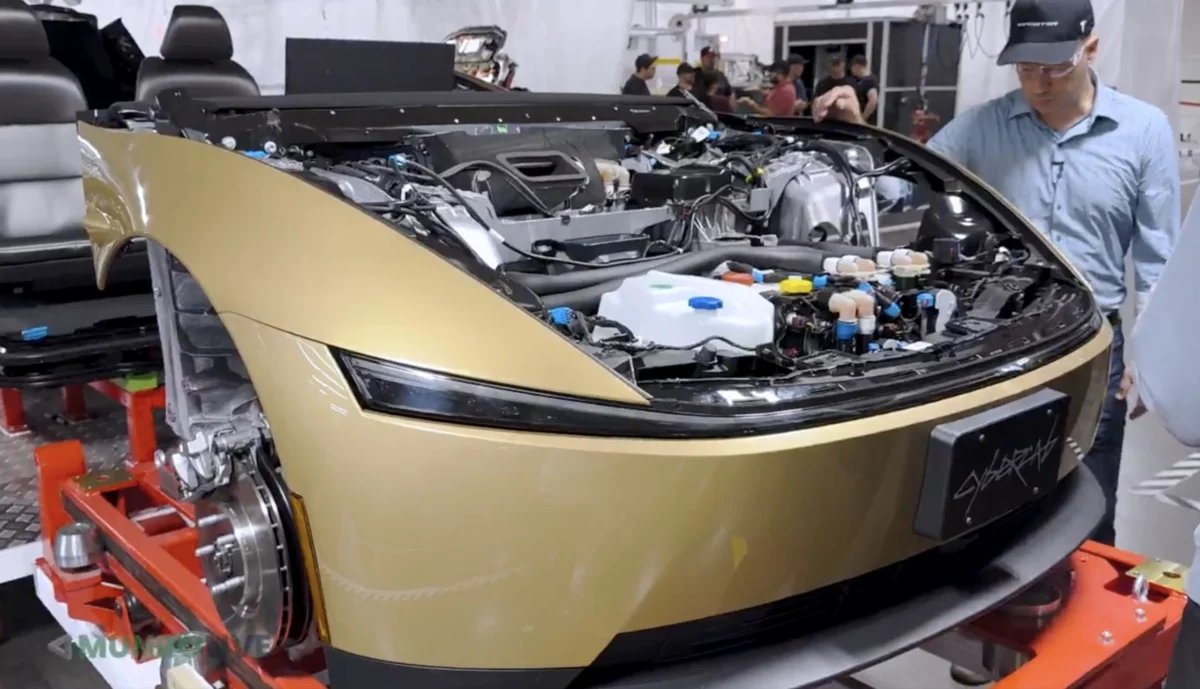
This unorthodox approach was recently brought to light during a factory walkthrough featuring Tesla Vice President of Vehicle Engineering Lars Moravy and manufacturing expert Munro Live. The resulting deep dive into the Giga Texas Cybercab lines has provided unprecedented insight into how modern automotive engineering can systematically delete entire layers of factory infrastructure when traditional requirements are critically interrogated.
The Genesis of First-Principles Manufacturing at Tesla
To understand the magnitude of Tesla’s design choice for the Cybercab, one must examine the traditional role of a paint shop in modern automotive plants. Typically, a vehicle body travels through extensive pretreatment baths, electrodeposition coating (e-coat) tanks for corrosion protection, primer applications, base coats, and clear coats, followed by massive thermal curing ovens. These facilities consume immense amounts of energy, demand rigorous environmental controls to manage volatile organic compound (VOC) emissions, and account for roughly half of a standard assembly plant’s physical footprint.
When evaluating the requirements for a dedicated, two-seat autonomous robotaxi designed to operate continuously in fleet service, Tesla’s engineering team applied its foundational design rule: question every inherited requirement. As Lars Moravy articulated during the Munro Live factory tour, the fundamental question driving the project was straightforward: "Why do you need paint?"
By interrogating the necessity of a traditional multi-layer spray-painting process, Tesla discovered that the structural realities of the Cybercab’s architecture rendered conventional paint shops entirely obsolete. The solution relied on a two-pronged strategy: advanced material selection for the vehicle’s structural castings and reaction injection molding (RIM) for exterior body panels.
Material Science and Structural Anti-Corrosion Strategies

Unlike high-volume consumer vehicles such as the Model 3 and Model Y—whose complete steel and aluminum bodies undergo full immersion e-coating and multi-stage painting—the Cybercab takes a highly selective approach to corrosion protection.
The structural backbone of the Cybercab heavily features large front and rear aluminum castings. The specific aluminum alloys selected by Tesla possess inherent metallurgical properties that prevent them from oxidizing and losing structural integrity over time, eliminating the baseline requirement for total-body anti-corrosion coating.
The only components requiring active environmental defense are the side modules, which are constructed around hot-stamped boron-steel door rings. These specific steel elements undergo a conventional anti-corrosion dip coat. Meanwhile, the massive front and rear structural modules skip the immersion coating process altogether. This selective application drastically reduces chemical consumption, energy waste, and the physical footprint of the manufacturing line.
Exterior Coloring via Reaction Injection Molding

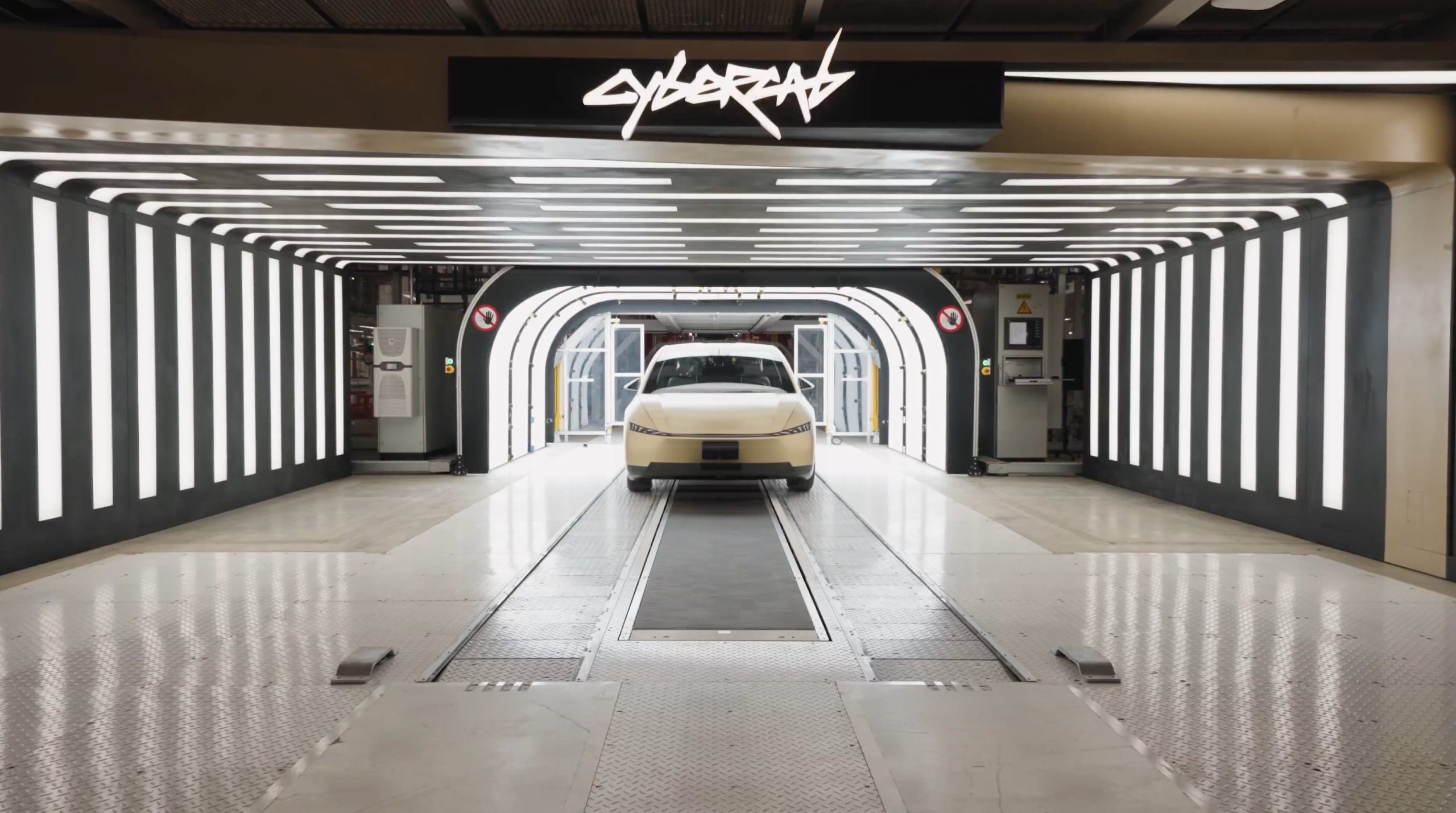
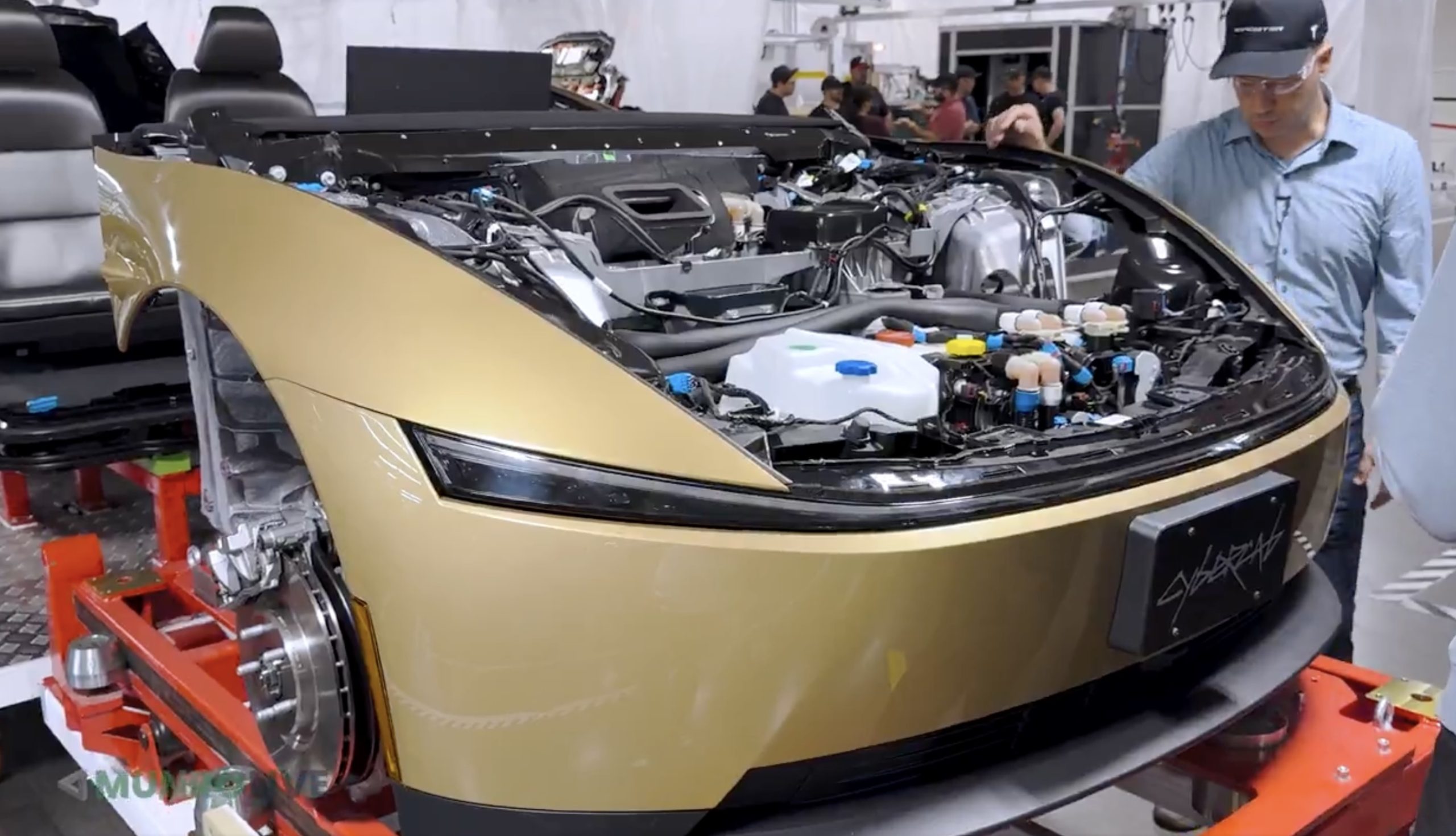
The most radical departure from traditional manufacturing is how the Cybercab achieves its exterior aesthetic. Instead of routing stamped metal or plastic panels through a spray booth, Tesla utilizes the vehicle’s plastics production shop as its functional paint shop.
Exterior body panels are manufactured using reaction injection molding (RIM). During this process, color is homogeneously mixed into a polyurethane resin at the mix head precisely moments before it is injected into the mold. Consequently, the panel emerges from the machine already saturated with its final hue, featuring a pristine Class-A surface finish straight out of the tool.
Robotic trimmers handle the overflow to meticulously control potential sink marks and flow lines. This method completely bypasses common paint shop defects such as orange peel texture, overspray, and inconsistent film builds. Furthermore, because the pigmentation is chemically integrated throughout the entire thickness of the material rather than applied as a fragile surface layer, shallow surface scratches do not expose a contrasting primer or bare metal undercoat. For minor blemishes, Tesla has developed compatible touch-up formulations that behave similarly to traditional automotive paint.
Factory Footprint Reduction and the Unboxed Process
The elimination of the paint shop is not an isolated design choice; it serves as a cornerstone of Tesla’s broader "unboxed" manufacturing methodology. By building and testing front, rear, side, and center modules in parallel before bringing them together for rapid final assembly, Giga Texas has achieved extraordinary spatial efficiency.
According to engineering disclosures, the Cybercab production strategy cuts factory floor space consumption per vehicle by roughly 50 percent compared to conventional lines. Final assembly operations have been streamlined to just 25 fully automated stations—a fraction of the complexity found on a standard Model Y line. The overall manufacturing process operates at approximately 78 percent automation, with framing lines achieving 100 percent automation and a targeted cycle time of one vehicle every 10 seconds.
This spatial and mechanical reduction yields profound environmental and financial benefits. By omitting spray-painting operations for these exterior panels, Tesla entirely eliminates the generation of associated VOC emissions on those lines, drastically reduces facility power consumption, and compresses the coloring cycle from hours of multi-stage curing down to mere minutes.
Production Outpacing Deployment: The New Bottleneck

As volume manufacturing lines at Giga Texas have ramped up following their initial rollout, Tesla has encountered an ironic industrial challenge: the manufacturing capability is currently outstripping the immediate deployment infrastructure.
During recent earnings disclosures and engineering reviews, leadership noted that the Cybercab line is capable of running at speeds that easily outpace the current velocity of physical fleet rollouts and regulatory approvals. With hundreds of units already registered in Texas and high-profile public demonstrations—such as fleet deployments during Formula 1 weekend events in Austin—Tesla has concentrated its early production inventory entirely into its proprietary autonomous ride-hailing network. Expansion into neighboring markets, such as planned commercial service launches in Dallas, will dictate how quickly the manufacturing velocity translates into widespread public availability.
Implications for the Broader Automotive Industry
Tesla’s implementation of in-mold coloring and the elimination of the traditional automotive paint shop signals a potential watershed moment for the global manufacturing sector. For over a century, the paint shop has been accepted as an immovable financial and spatial anchor of vehicle assembly plants, dictating capital expenditure budgets and environmental compliance strategies alike.
By demonstrating that a commercial vehicle can be structurally optimized to bypass traditional coating while achieving superior durability and aesthetic finish through advanced plastics engineering, Tesla has established a new benchmark for capital efficiency. As legacy automakers and emerging EV competitors grapple with tightening profit margins, high facility costs, and the complex infrastructure required for autonomous fleet production, the industry will likely look closely at Giga Texas as proof that some of manufacturing’s most sacred traditions can be successfully erased through first-principles design.