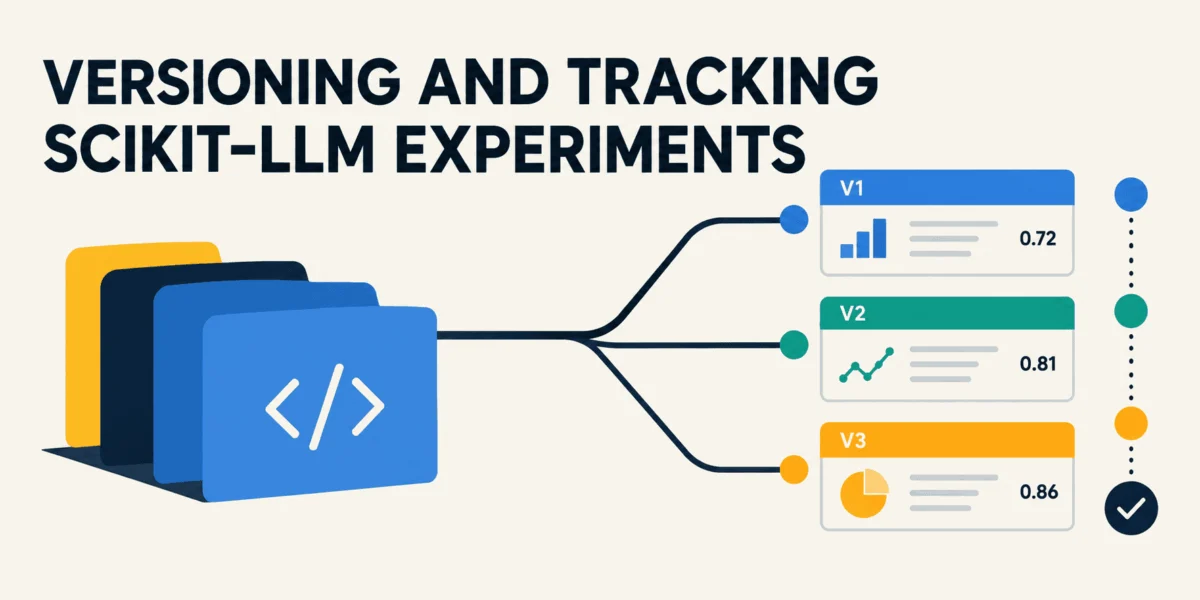
The integration of Large Language Models (LLMs) into traditional machine learning pipelines has shifted from an experimental novelty to an enterprise-grade standard. As data scientists and machine learning engineers increasingly combine the structured efficiency of Scikit-Learn with the generative and zero-shot capabilities of foundational models, the complexity of managing these workflows has grown exponentially. In real-world production environments, foundational backends are updated frequently, prompts are iterated upon, and hyperparameters shift. Without a robust tracking and versioning infrastructure, reproducibility collapses, creating blind spots in model governance. To address these challenges, practitioners are turning to a powerful architectural synergy: combining Scikit-LLM—a library designed to bridge Scikit-Learn with LLMs—and MLflow, the industry-standard open-source platform for managing the end-to-end machine learning lifecycle.
The evolution of modern machine learning operations (MLOps) demands that pipelines incorporating generative AI components be treated with the same rigorous governance applied to traditional regression or classification models. When an application relies on underlying LLM updates—such as transitioning from a lightweight quantized model to a larger architecture—even subtle changes in tokenization, inference latency, or output formatting can destabilize downstream tasks. Consequently, implementing a systematic methodology to build, track, compare, and register these hybrid pipelines is no longer optional. This technical analysis explores the systematic deployment of Scikit-LLM and MLflow, detailing how organizations can maintain strict reproducibility, audit experimental runs, and selectively promote top-performing pipeline iterations into a centralized model registry.
Architectural Foundations and Initial Setup
Setting up a robust environment for LLM-integrated pipelines requires careful orchestration of dependencies and configurations. Because libraries like Scikit-LLM interface directly with external or locally hosted foundational weights, establishing a standardized runtime environment is the critical first step. When executing workflows in cloud-based interactive notebooks, such as Google Colab, or on dedicated on-premises infrastructure, engineers must ensure precise package compatibility.
The installation procedure requires specific extra parameters to handle localized model execution engines, such as GPT4All. Specifically, installing the core packages via pip establishes the necessary hooks between the scikit-learn pipeline ecosystem and the execution runtimes:
pip install "scikit-llm[gpt4all]" mlflowFollowing package installation, the runtime configuration must be initialized. For local executions utilizing open-source weights, Scikit-LLM requires baseline configuration parameters. Even when proprietary API keys are bypassed in favor of local backends, internal configuration variables must be populated with placeholder credentials to satisfy the library’s authentication schema. Simultaneously, MLflow must be directed toward a persistent storage backend—such as a SQLite database instance—to ensure that all experimental metadata, parameters, and artifact references are permanently recorded rather than lost in volatile memory.
In parallel with backend storage configuration, defining a standardized tracking experiment establishes the logical container for all subsequent model iterations. For classification tasks, particularly zero-shot learning scenarios where models categorize text without explicit prior training on target labels, initial datasets must be structured cleanly. A representative training set featuring diverse categorical outcomes—such as identifying software bugs, customer praise, or general feedback—serves as the foundational benchmark for pipeline evaluation.
Constructing and Logging Baseline versus Upgraded Pipelines
The core of reproducible MLOps lies in isolating changes across experimental runs. To demonstrate the efficacy of model swapping within an MLflow tracking paradigm, developers typically construct a baseline pipeline utilizing a lightweight, highly efficient pre-trained LLM. In this context, a zero-shot classifier encapsulated within a standard Scikit-Learn Pipeline object acts as the primary estimator.
import mlflow
import mlflow.sklearn
from sklearn.pipeline import Pipeline
from skllm.config import SKLLMConfig
from skllm.models.gpt.classification.zero_shot import ZeroShotGPTClassifier

# 1. Configuration for local execution
SKLLMConfig.set_openai_key("local-execution-key")
SKLLMConfig.set_openai_org("local-execution-org")

# 2. MLflow Tracking Setup
mlflow.set_tracking_uri("sqlite:///mlflow.db")
mlflow.set_experiment("Scikit-LLM-Versioning")

# Baseline Dataset
X_train = [
    "The application crashed immediately.",
    "Absolutely wonderful support team!",
    "It works fine but is a bit slow."
]
y_train = ["bug", "praise", "feedback"]

# Baseline Pipeline Definition (Orca Mini)
LLM_V1 = "gpt4all::orca-mini-3k-71m-q4_0.gguf"
pipeline_v1 = Pipeline([
    ('llm_classifier', ZeroShotGPTClassifier(model=LLM_V1))
])

with mlflow.start_run(run_name="Baseline_Orca_Mini") as run_v1:
    mlflow.log_param("llm_backend", "gpt4all")
    mlflow.log_param("llm_model_file", LLM_V1)
    pipeline_v1.fit(X_train, y_train)

    # Logging with cloudpickle serialization for complex pipeline objects
    mlflow.sklearn.log_model(
        pipeline_v1,
        "model",
        serialization_format="cloudpickle"
    )
    print(f"V1 Logged - Run ID: run_v1.info.run_id")
Execution of this baseline block registers a unique run ID within the MLflow tracking database—for instance, 0852aaec23364725b433f09973a3d911. The explicit logging of parameters, such as the exact model file string and backend type, ensures that any future auditor can trace the lineage of the artifacts produced. Furthermore, utilizing the cloudpickle serialization format overrides strict default type-checking mechanisms, accommodating the intricate internal states of pipelines that wrap deep learning and LLM components.
To simulate a realistic engineering lifecycle, requirements often dictate upgrading the underlying model architecture. Suppose an organization decides to transition from the lightweight Orca Mini baseline to a more robust, heavier foundational architecture, such as the quantized Falcon model (gpt4all::ggml-model-gpt4all-falcon-q4_0.bin). This upgrade is executed by instantiating a secondary pipeline within a distinct MLflow run context:
LLM_V2 = "gpt4all::ggml-model-gpt4all-falcon-q4_0.bin"
pipeline_v2 = Pipeline([
    ('llm_classifier', ZeroShotGPTClassifier(model=LLM_V2))
])

with mlflow.start_run(run_name="Upgraded_Falcon") as run_v2:
    mlflow.log_param("llm_backend", "gpt4all")
    mlflow.log_param("llm_model_file", LLM_V2)
    pipeline_v2.fit(X_train, y_train)

    mlflow.sklearn.log_model(
        pipeline_v2,
        "model",
        serialization_format="cloudpickle"
    )
    print(f"V2 Logged - Run ID: run_v2.info.run_id")
This modular approach isolates experimental variables. Each run captures its own set of artifacts, execution metrics, and parameter states, providing a clear audit trail of how architectural changes impact pipeline behavior.
Auditing, Comparing, and Querying Experimental Runs
As machine learning projects scale, developers frequently encounter scenarios where multiple experimental iterations—some successful, others failing due to out-of-memory errors, invalid configurations, or network timeouts—clutter the tracking database. Effective MLOps governance requires systematic querying and auditing capabilities to filter out noise and isolate valid candidate models.
By leveraging MLflow’s search API, engineers can programmatically extract experiment metadata into a structured Pandas DataFrame. This allows teams to review historical executions, compare parameters across baseline and upgraded models, and verify run statuses before proceeding to model registration.
experiment = mlflow.get_experiment_by_name("Scikit-LLM-Versioning")
runs_df = mlflow.search_runs(experiment.experiment_id)

comparison_df = runs_df[['run_id', 'tags.mlflow.runName', 'params.llm_model_file', 'status']]
print("Experiment Tracking Audit:")
display(comparison_df)
In a production tracking repository, this query typically yields a comprehensive log detailing both finished runs and historical failures. For instance, an audit table might display multiple entries corresponding to the Baseline_Orca_Mini and Upgraded_Falcon runs, alongside interrupted attempts marked with a FAILED status. This visibility prevents corrupted or incomplete training runs from being accidentally promoted to production environments.
Promoting Candidates to the MLflow Model Registry
The ultimate objective of experiment tracking is the transition from rough developmental drafts to a validated, production-ready artifact. Once quantitative evaluations or qualitative audits confirm that a specific pipeline version outperforms its predecessors, that model must be promoted from the tracking store to the centralized MLflow Model Registry.
The promotion workflow involves identifying the specific run ID associated with the desired model iteration, constructing a valid model URI, and invoking the registration API. For example, to programmatically secure the top-performing Upgraded_Falcon pipeline and designate it as Version 1 of a production classifier, engineers execute the following procedure:
best_run_id = runs_df[runs_df['tags.mlflow.runName'] == 'Upgraded_Falcon'].iloc[0]['run_id']
model_uri = f"runs:/best_run_id/model"

registered_model = mlflow.register_model(
    model_uri=model_uri,
    name="Production_ZeroShot_Classifier"
)

print(f"Successfully registered model 'registered_model.name'")
print(f"Current Registry Version: registered_model.version")
While hardcoding run selection based on qualitative tags is useful for demonstrations, enterprise pipelines require automated, metric-driven promotion criteria. Rather than relying on static run names, advanced MLOps workflows query the experiment database, ordering historical runs dynamically by performance metrics such as accuracy, F1-score, or inference latency.
best_runs_df = mlflow.search_runs(
    experiment_ids=[experiment.experiment_id],
    order_by=["metrics.accuracy DESC"]
)

metric_winner_id = best_runs_df.iloc[0]['run_id']
print(f"Optimal Model Run Identified: metric_winner_id")
By querying the database for the absolute top performer based on validated metrics, organizations eliminate human bias and ensure that only quantitatively superior models enter the registry pipeline.
Broader Implications and Enterprise Best Practices
The integration of foundational language models into structured machine learning pipelines introduces unique governance challenges that traditional software deployment strategies cannot fully address. Because LLM outputs can be non-deterministic and heavily dependent on specific underlying model weights and prompt structures, maintaining strict version control is paramount for regulatory compliance, safety auditing, and system reliability.
Implementing a decoupled two-step workflow—where raw experimentation occurs in a tracking store and only validated champions are promoted to a centralized model registry—offers several distinct operational advantages:
- Clutter Reduction: Prevents the official model registry from becoming saturated with failed debugging runs, exploratory scripts, or inferior developmental drafts.
- Lineage Transparency: Ensures that every production-deployed artifact is fully traceable to the exact code version, parameter configuration, and training dataset utilized during its creation.
- Seamless Upgradability: Simplifies the process of swapping underlying LLM backends (such as transitioning from open-source local weights to commercial API endpoints) without breaking downstream application code or risking pipeline incompatibility.
- Reproducibility Across Environments: Mitigates the "it works on my machine" phenomenon by packaging complex dependencies and custom pipeline structures into standardized serialization formats like cloudpickle.
As enterprises scale their generative AI initiatives, adopting these rigorous tracking and registration protocols bridges the gap between experimental data science and reliable software engineering. By combining the textual versatility of Scikit-LLM with the enterprise governance features of MLflow, organizations can harness the power of large language models while maintaining the stability, predictability, and accountability required in modern production environments.