The rapid adoption of Retrieval-Augmented Generation (RAG) within corporate environments has exposed a significant performance gap between proof-of-concept prototypes and production-ready systems. While the industry has long attributed the inaccuracy of Large Language Models (LLMs) to "hallucinations"—instances where a model creates facts from nothing—a new technical analysis suggests that these errors are frequently the result of systemic failures in the underlying data pipeline. By examining the structural weaknesses of "naive" RAG architectures, researchers have identified a four-brick framework for what is being termed "context engineering," a methodology designed to ensure that models are provided with the correct relational and semantic context before they are asked to generate a response.
The Evolution of RAG and the "Naive" Baseline
The standard RAG architecture, often referred to as "naive RAG," typically consists of a simplified 100-line pipeline. In this model, a PDF document is parsed into flat text, a user’s question is converted into keywords or vector embeddings, and the system retrieves the top few "chunks" of text based on similarity. This approach often proves sufficient for short, prose-heavy documents such as the seminal "Attention Is All You Need" research paper. However, as organizations attempt to apply this technology to complex enterprise documents—including financial reports, regulatory standards, and technical manuals—the naive approach consistently fails.

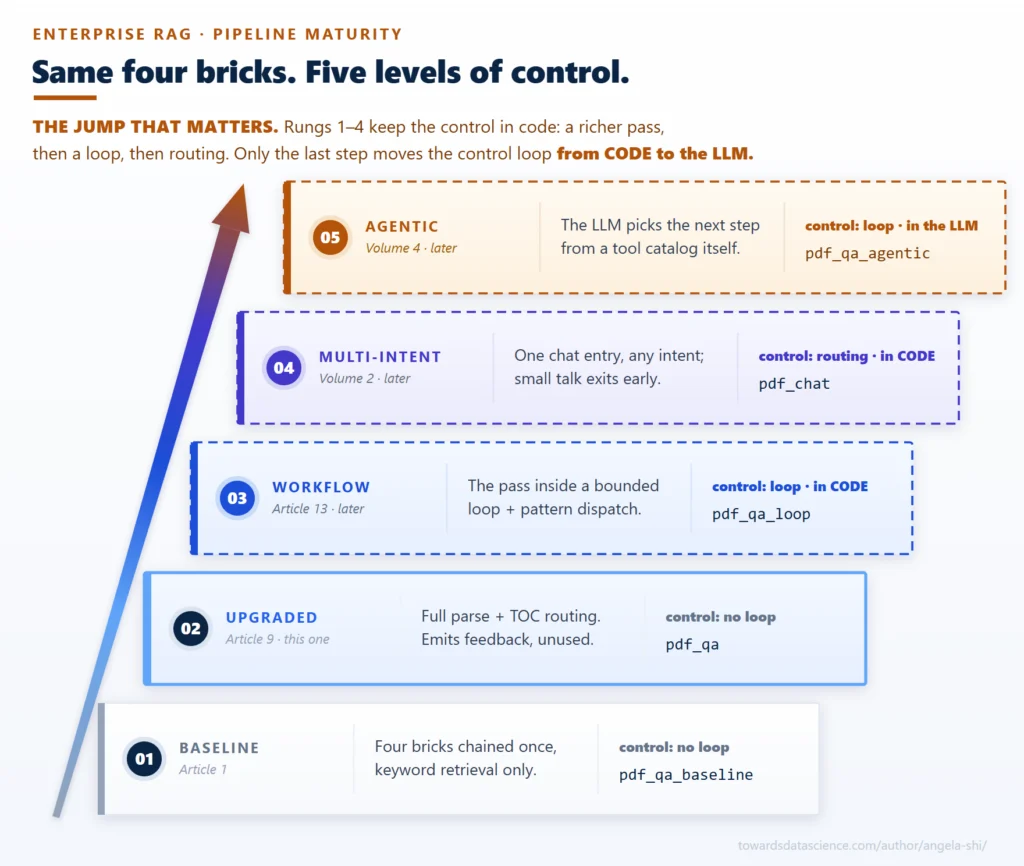
The failure is rarely located in the LLM itself. Instead, the breakdown occurs at one of four critical "bricks" in the pipeline: document parsing, question parsing, information retrieval, or response generation. The transition from naive RAG to an upgraded production pipeline involves tightening the "contract" between these bricks. This involves moving from flat text to relational dataframes, expanding queries into the document’s specific vocabulary, routing retrieval through structural maps like tables of contents, and enforcing typed, validated outputs during the generation phase.
Chronology of Pipeline Development
The development of the "context engineering" framework follows a logical progression of identifying and solving specific failure modes encountered in real-world data processing:
- The Minimalist Era (Article 1-4): Early RAG development focused on basic connectivity—connecting a PDF parser to a vector database and an LLM. Success was measured by the model’s ability to answer questions about simple prose.
- The Relational Realization (Article 5): Developers discovered that flattening PDFs into text strings destroyed the spatial relationships inherent in tables and charts. This led to the development of relational parsing.
- The Retrieval Crisis (Article 7): As document libraries grew, "top-k" retrieval (finding the top few matches) became increasingly unreliable. It became clear that most "hallucinations" were actually cases where the retriever failed to find the correct page.
- The Structural Routing Solution (Article 9): The introduction of table-of-contents (TOC) routing allowed systems to navigate documents based on their internal hierarchy rather than keyword frequency.
- The Validation Phase (Current Analysis): The current technical focus has shifted to "typed answers," where the model must adhere to a strict schema, confirming if it found an answer and citing specific evidence.
Analysis of the Four Failure Points
To demonstrate the necessity of context engineering, researchers conducted side-by-side tests of naive and upgraded pipelines using real-world documents from the World Bank and the National Institute of Standards and Technology (NIST).

1. Parsing: The Destruction of Relational Data
In a test involving the World Bank’s Commodity Markets Outlook, a report dense with price forecasts, the naive pipeline was asked for the 2025 average price of U.S. natural gas. The naive parser utilized a standard get_text() function, which linearizes tables into a stream of text and cuts them into fixed-size chunks. Because the label "Henry Hub" and the price "3.5" were separated into different chunks, the retriever could not provide the model with a single context containing both pieces of information. The model accurately reported that the information was "not stated," resulting in a confidence score of 0.00.
The upgraded solution utilizes "relational parsing." Instead of a text dump, the parser returns a line_df—a dataframe where every line of text is stored with its bounding box coordinates. This preserves the row-level integrity of the table. When the model reads "Henry Hub" and "3.5" on the same relational line, it provides the correct answer with a confidence score of 0.99.
2. Question Parsing: The Vocabulary Gap
When queried about the "pillars" of Zero Trust Architecture using NIST SP 800-207, the naive pipeline failed because the document exclusively uses the term "tenets." Because the word "pillars" did not appear in the text, keyword-based retrieval returned irrelevant sections. The model reported that the pillars were not listed (0.20 confidence).

The upgraded brick employs "question parsing." Before the search begins, the system uses a domain-specific expansion to map the user’s query to the document’s internal vocabulary (e.g., mapping "pillars" to "tenets"). This ensures the retriever searches for the terms the document actually contains. Following this expansion, the system successfully identified all seven tenets with 0.95 confidence.
3. Retrieval: The Frequency Trap
The NIST Cybersecurity Framework (CSF) 2.0 poses a challenge for traditional retrieval because the term "Profile" appears on almost every page. Keyword and cosine-similarity retrieval rank pages based on the density of the term. In the naive run, the page containing the actual definition of a "Profile" was buried below the "top-k" cutoff by other pages that used the word more frequently in examples.
Context engineering solves this through "structural routing." By parsing the document’s table of contents, the system identifies the specific section titled "CSF Profiles." Instead of searching the entire document, the retriever is routed directly to the defining section. This produced the full definition with a citable span and 0.95 confidence.

4. Generation: The Hallucination of Completeness
The most dangerous failure occurs when the correct context is retrieved but does not contain the answer. When asked for a 2026 oil price forecast from a World Bank report that only goes up to 2025, a naive free-text generator often "hallucinates" by grabbing the closest available number (the 2025 forecast) and presenting it as the 2026 figure.
The upgraded generation brick uses a "typed contract." Using OpenAI’s Structured Outputs or similar schema-binding tools, the model is required to fill a boolean field: complete_answer_found. When the model sees that 2026 is missing, it is forced to set this field to false and explain that the data only extends to 2025. This prevents a wrong answer from being presented as a factual certainty.
Supporting Data and Performance Metrics
The following table summarizes the performance differential between the Naive RAG and the Context-Engineered Pipeline across the tested scenarios:

| Document Source | Challenge Type | Naive Result | Naive Confidence | Upgraded Result | Upgraded Confidence |
|---|---|---|---|---|---|
| World Bank Outlook | Table/Relational | "Not stated" | 0.00 | "$3.5 per mmbtu" | 0.99 |
| NIST SP 800-207 | Vocabulary/Synonym | "Not listed" | 0.20 | Listed all 7 tenets | 0.95 |
| NIST CSF 2.0 | Structural/Top-K | "Not defined" | 0.10 | Full definition | 0.95 |
| World Bank (2026) | Out-of-Bounds | Hallucinated $79 | High (Prose) | "Not provided" | 0.98 (for ‘False’) |
Implications for the Enterprise AI Sector
The findings of this technical analysis have significant implications for how businesses deploy AI. The reliance on "prompt engineering"—the practice of refining the instructions given to an LLM—is increasingly seen as a secondary concern compared to "context engineering." If the data fed into the model is fundamentally broken or incomplete, no amount of prompt refinement can guarantee an accurate result.
For industries such as legal services, healthcare, and financial auditing, the "hallucination" problem is a deal-breaker. However, by reframing hallucinations as pipeline failures, the path to reliability becomes an engineering challenge rather than a linguistic one. The move toward "relational parsing" and "typed generation" suggests a future where AI systems are more integrated with traditional database logic, ensuring that the flexibility of the LLM is tempered by the rigor of structured data.
Future Outlook
As enterprise documents continue to grow in complexity and scale—such as the 400-plus-page NIST SP 800-53 catalog—the limitations of naive RAG will become even more pronounced. The industry is likely to move toward "agentic" retrieval systems that can autonomously navigate a document’s structure, much like a human researcher uses an index and a table of contents.

Furthermore, the open-sourcing of companion notebooks and datasets, such as the doc-intel/notebooks-vol1 repository, allows developers to stress-test their own pipelines against these known failure modes. This transparency is expected to accelerate the transition from experimental AI to mission-critical business intelligence tools. The core takeaway for the industry remains clear: getting the context right is the prerequisite for getting the answer right. In the world of production AI, the pipeline is the product.