The landscape of artificial intelligence has undergone a fundamental architectural transformation between early 2024 and mid-2026. In the previous era, the primary challenge for engineers was the manual orchestration of "agentic" behavior through brute-force methods. Development cycles were dominated by the creation of complex Reasoning and Acting (ReAct) loops, brittle prompt chains, and the persistent struggle to force a single, massive language model to simultaneously manage planning, tool execution, and context retention. Today, that monolithic approach has been superseded by a modular, decentralized ecosystem defined by native reasoning models, standardized tool protocols, and highly specialized multi-agent "swarms."
This shift represents more than just a technical refinement; it is a departure from the "prompt engineering" era toward a sophisticated "agentic systems engineering" discipline. As foundation models have integrated "System 2" thinking—the slow, deliberate reasoning described by cognitive psychologists—directly into their internal architectures, the role of the AI architect has evolved. The focus is no longer on forcing a model to think, but on designing the environment, communication protocols, and security boundaries within which specialized agents operate.
The Chronology of Agentic Evolution: 2023–2026
The journey to the current state of agentic AI can be traced through three distinct phases. In 2023, the industry was characterized by "Naive RAG" (Retrieval-Augmented Generation) and simple chat interfaces. By 2024, the focus shifted to "Agentic Workflows," where frameworks like LangChain and LlamaIndex were used to build external loops that forced models to critique their own work and use tools iteratively. However, these systems were plagued by high latency, "token bloat," and the inherent fragility of long prompt chains.
By late 2025, the release of next-generation reasoning models—frequently referred to as "test-time compute" models—marked the beginning of the end for external orchestration loops. These models began generating hidden reasoning tokens, allowing them to explore multiple solution paths and self-correct before providing a final output. By mid-2026, this internal reasoning has become a standard feature of frontier models, rendering the old "Plan-and-Execute" code structures redundant. The modern architect now treats the model’s cognitive loop as a black-box utility, focusing instead on the "sandbox" and the "network" in which the agent resides.
The Departure from Orchestrated Reasoning Loops
The most significant technical change in mid-2026 is the deprecation of manually coded reflection loops. In early 2025, an engineer might have written fifty lines of Python to ensure an agent checked its SQL query for errors before execution. Today, native reasoning models handle this internally. When a model receives a complex instruction, it allocates "thought budget" to simulate the execution and verify the logic.
Data from enterprise deployments in early 2026 suggests that moving from external ReAct loops to native reasoning has reduced "orchestration latency" by an average of 40% and lowered token costs by 25% by eliminating the need to re-send the entire conversation history for every "thought" step. This has allowed developers to reallocate their compute budgets away from "making the model think" and toward "making the system perform."
The orchestration layer has consequently evolved into a routing and state management engine. Its primary duty is no longer to prompt the model to be smart, but to ensure the model has the correct tools and context for the specific sub-task at hand.
The Rise of Agentic Swarms and Multi-Agent Microservices
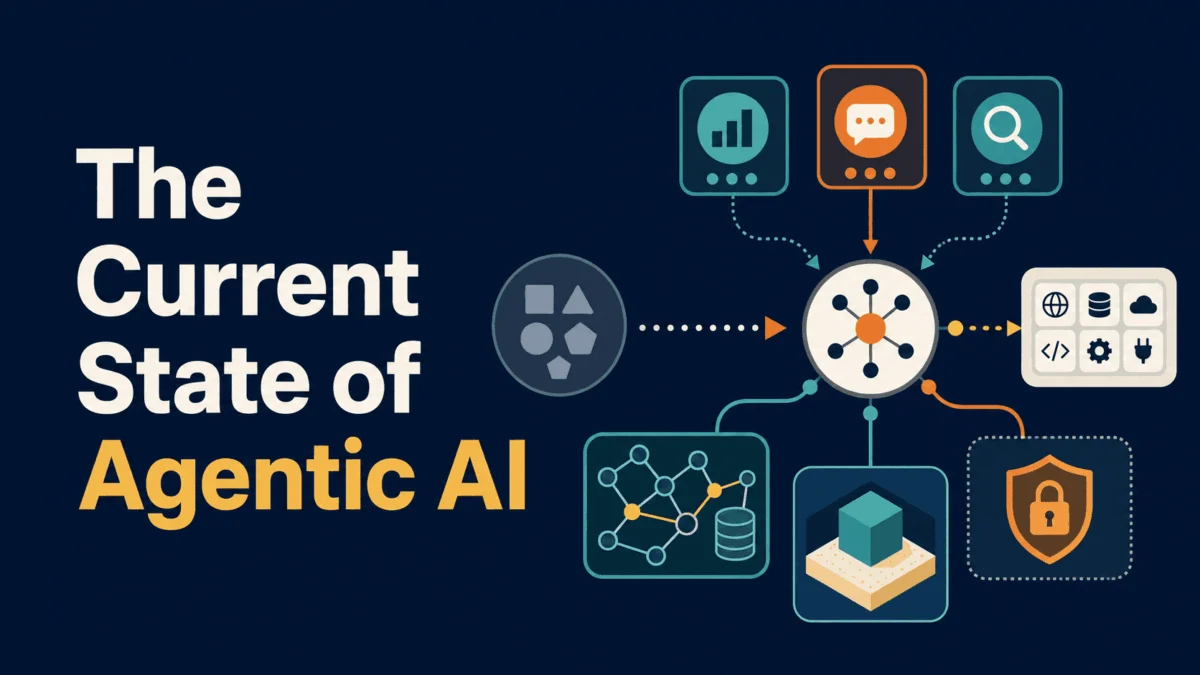
As the cognitive overhead of individual agents has decreased, the complexity of the tasks assigned to them has increased. This has led to the "Swarm" architecture, which mirrors the transition from monolithic software to microservices. Rather than a single "General Practitioner" agent equipped with 50 different tools, production systems now utilize a collection of smaller, highly specialized agents that communicate via standardized handoff protocols.
A typical enterprise swarm in mid-2026 consists of several distinct roles:
- The Triage Agent: A high-speed, lower-cost model that classifies user intent and routes the request to the appropriate specialist.
- Specialist Agents: Narrowly scoped agents (e.g., a "PostgreSQL Specialist" or a "Pandas Analyst") that possess deep context for a specific domain but no knowledge of others.
- The Synthesis Agent: A high-reasoning model that gathers the outputs from various specialists to form a coherent final response.
The benefits of this "stateless-per-agent, stateful-across-the-system" approach are manifold. It allows for "Lean Context Windows," where each agent only receives the data necessary for its specific task, reducing the risk of the "lost in the middle" phenomenon. Furthermore, it enables "Heterogeneous Modeling," where a developer might use a massive frontier model for the Triage and Synthesis steps while using smaller, open-source models for the specialized execution nodes.
Standardization through the Model Context Protocol (MCP)
Until recently, the integration of AI agents into corporate databases and third-party APIs was a manual, error-prone process. Every tool required a custom JSON schema and bespoke error-handling logic. The emergence of the Model Context Protocol (MCP) as an industry standard has resolved this friction.
MCP acts as a universal adapter, similar to how USB standardized hardware connections. Under this protocol, data sources (such as GitHub, Slack, or a corporate SQL server) run their own MCP servers. These servers automatically expose their tools and resources to any connecting agent in a format the agent inherently understands.
According to a 2026 industry report, the adoption of MCP has reduced the "time-to-integration" for new enterprise AI tools from weeks to hours. It has also improved security by separating the "execution environment" from the "reasoning environment." When an agent uses an MCP tool, the actual API call or database query is executed on the MCP server, not within the agent’s primary process, providing a critical layer of isolation.
Continuous Learning and the Memory Graph
One of the most persistent hurdles in agentic AI was the "Goldfish Effect"—the tendency for agents to forget past interactions once a session ended. By mid-2026, this has been addressed through the implementation of "Memory Graphs."
Unlike traditional vector databases, which rely on simple similarity searches, Memory Graphs use graph databases (such as Neo4j) to store entities and their relationships. A specialized "Memory Agent" runs asynchronously alongside the main swarm. Its sole purpose is to observe the swarm’s trajectory, extract persistent facts (e.g., "The user prefers Q2 data in a bar chart format"), and update the central graph.
This architectural pattern allows for "Context Engineering" over "Prompt Engineering." When a user returns to the system, the Triage Agent queries the Memory Graph to "rehydrate" the swarm with relevant historical context. This results in a system that appears to learn and adapt over time without the astronomical cost of fine-tuning the underlying foundation models.
The Expanded Attack Surface: Security in the Age of Swarms
The transition to multi-agent swarms has introduced a new class of security vulnerabilities, most notably "Lateral Swarm Movement." In a monolithic system, a prompt injection attack was limited to the single model’s output. In a swarm, if a "Reader Agent" is compromised by a malicious email, it can use the "Handoff Tool" to pass that malicious instruction to a "Database Agent."
Security experts have identified three primary defense layers now being integrated into production swarms:
- Sandboxed Execution: All tool calls, particularly those involving code execution (Python/SQL), occur in ephemeral, isolated containers.
- Human-in-the-Loop (HITL) Triggers: High-privilege tools, such as those that can delete data or send external communications, require a cryptographic signature from a human operator before the swarm can proceed.
- Policy-Based Routing: The orchestration layer now includes a "Policy Guard" that inspects handoff commands. If the Triage Agent attempts to hand off a sensitive financial task to an unauthenticated specialist agent, the system terminates the request.
Industry reactions to these threats have been swift. Chief Information Security Officers (CISOs) at major financial institutions have reported that they now treat agent "handoff tokens" with the same level of scrutiny as administrative SSH keys.
Broader Impact and the Path Forward
By mid-2026, agentic AI has matured into a stable engineering discipline. The "hype" of 2023 has been replaced by a rigorous focus on system reliability, observability, and cost-efficiency. Organizations are no longer asking if an agent can perform a task, but how a swarm of agents can perform that task at scale while maintaining data integrity.
The economic implications are significant. The "AI Orchestrator" has become one of the most sought-after roles in the technology sector, requiring a blend of traditional systems architecture, security expertise, and linguistic intuition. As these systems become more resilient and specialized, the "barrier to agency" continues to drop, allowing even small enterprises to deploy sophisticated, autonomous workflows that were previously the sole domain of tech giants.
The path forward lies in the continued refinement of these swarms. As standardization through MCP becomes near-universal and native reasoning models continue to decrease in cost, the focus will shift toward "Agentic Governance"—the legal and ethical frameworks required to manage millions of autonomous micro-decisions happening every second across the global economy. For now, the blueprint is clear: the future of AI is not a single, smarter brain, but a well-orchestrated, secure, and specialized collective.