In the modern enterprise architecture, predictive modeling rarely relies on a single, homogenous source of truth. As organizations increasingly digitize their operations, data scientists face the complex challenge of feeding diverse inputs into unified machine learning models. Real-world tasks such as automated ticket triage, customer churn forecasting, and malicious user detection require systems to ingest a hybrid mix of structured, numerical, and qualitative tabular attributes alongside unstructured text, including customer support transcripts, logs, and free-form messages. Historically, processing these disparate modalities demanded cumbersome, multi-stage preprocessing scripts that fractured data engineering workflows, heightened deployment friction, and increased the risk of training-serving skew.
To resolve these architectural bottlenecks, data engineering teams are shifting toward unified pipelines that natively integrate deep learning representations with classical machine learning algorithms. By leveraging Python’s scikit-learn library alongside lightweight, open-source large language models (LLMs), developers can now encapsulate text embedding generation directly inside standard transformation workflows. This approach eliminates the need for expensive proprietary APIs—such as those offered by OpenAI or Google—or resource-intensive foundational models like LLaMA 3, democratizing access to high-performance, CPU-friendly multi-modal classification systems.
Background and Context in Modern Machine Learning Workflows
The convergence of structured tabular data and unstructured text represents a significant paradigm shift in applied artificial intelligence. Traditional machine learning architectures traditionally treated these data modalities in isolation. Tabular data was processed using standard statistical scalers and categorical encoders, while text data was relegated to independent natural language processing (NLP) pipelines utilizing bag-of-words models, TF-IDF vectorization, or standalone deep learning inference scripts. The resulting outputs were then concatenated manually before being passed to a downstream classifier.
This fragmented methodology introduced severe operational inefficiencies. Maintaining separate pipelines for text transformation and tabular preprocessing created synchronization errors during production inference, where missing a single transformation step could cause silent model degradation or runtime exceptions. Furthermore, the rapid evolution of transformer-based language models created a gap between state-of-the-art NLP and classical tabular pipelines.
The introduction of Hugging Face’s sentence-transformers library, combined with scikit-learn’s extensible architecture, bridges this gap. By encapsulating pre-trained language models within custom classes inheriting from BaseEstimator and TransformerMixin, developers can treat heavy text embedding operations as standard scikit-learn transformers. This guarantees that text vectorization occurs seamlessly within cross-validation loops, grid searches, and production deployment artifacts, preserving data integrity across the entire machine learning lifecycle.
Architectural Design of the Unified Scikit-Learn Pipeline
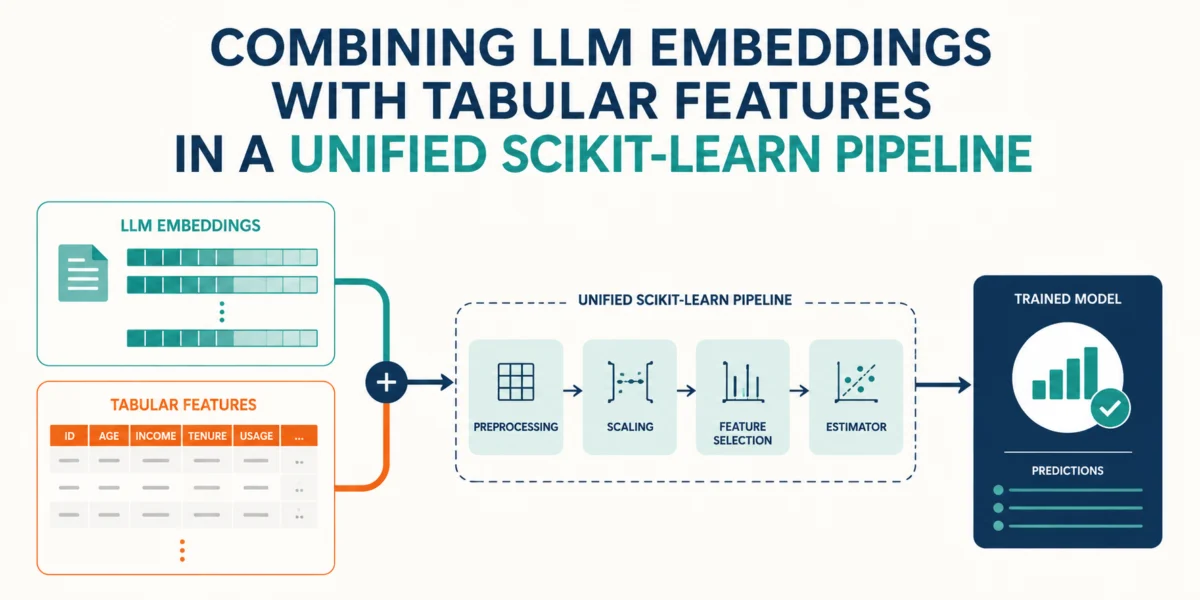
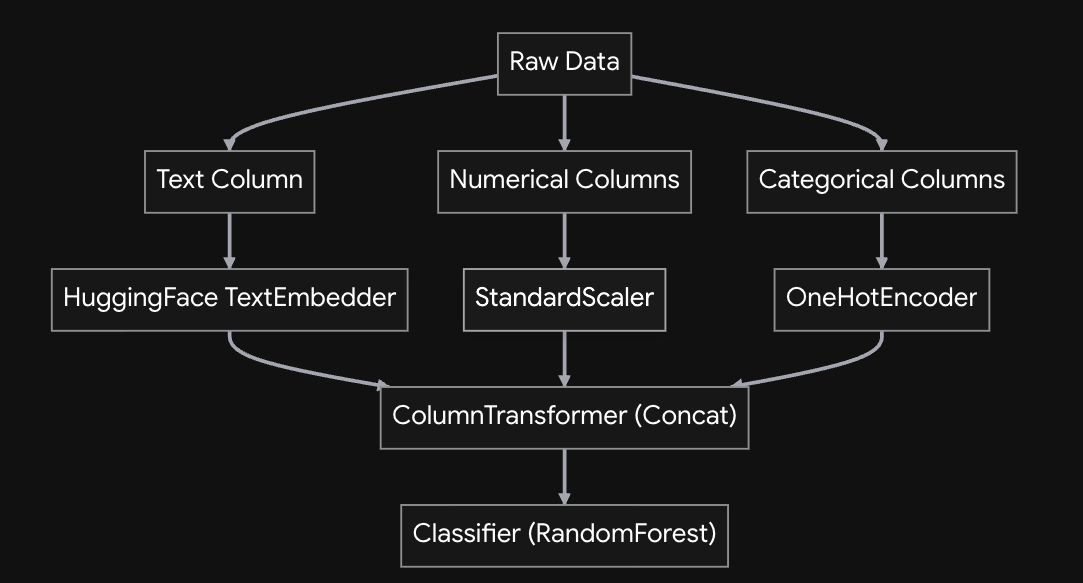
Designing a robust multi-modal classification system requires a clear architectural blueprint. The workflow begins at the ingestion layer, where a mixed dataset containing both unstructured text and structured metadata is loaded into memory. To construct a deployment-ready system, the data ingestion must feed into a parallelized preprocessing architecture managed by scikit-learn’s ColumnTransformer.
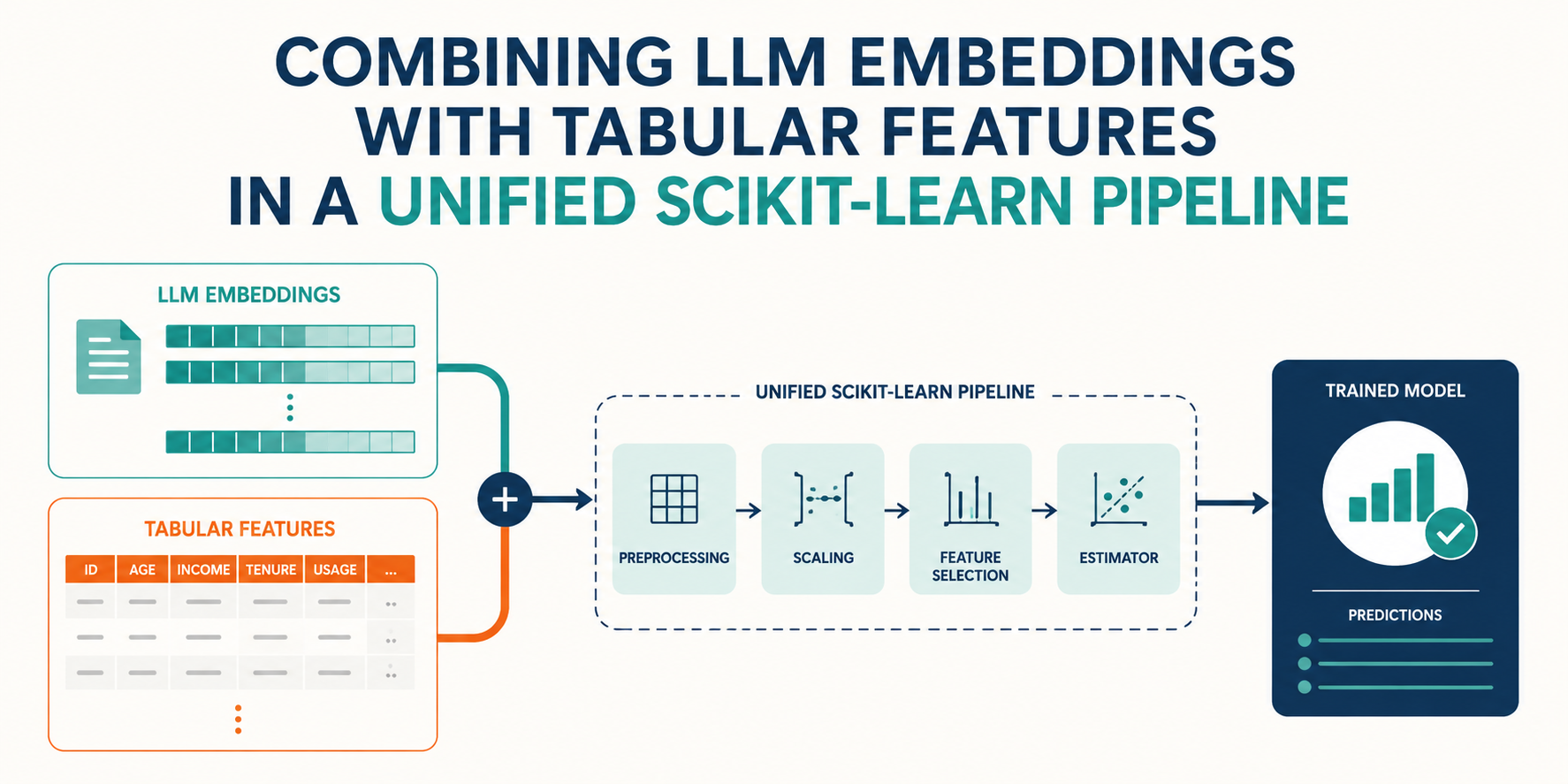
The pipeline divides incoming features into distinct processing branches:
- The Text Branch: Unstructured strings, such as user messages or ticket descriptions, are routed to a custom
TextEmbeddertransformer. This component initializes a lightweight open-source sentence-transformer model (such asall-MiniLM-L6-v2) and converts textual inputs into dense, high-dimensional numerical vectors. - The Numerical Branch: Continuous and discrete numerical attributes—such as account age, transaction frequency, or priority scores—are directed to a standard scaling utility (
StandardScaler) to normalize feature magnitudes. - The Categorical Branch: Qualitative variables, including subscription tiers or user status flags, are processed via a one-hot encoder (
OneHotEncoder) configured to handle unseen categories gracefully during inference.
These parallel branches converge within the ColumnTransformer, which concatenates the transformed representations into a single, cohesive feature matrix. This matrix is subsequently passed to a high-performance ensemble classifier, such as a Random Forest model, which completes the unified pipeline architecture.
Implementation Methodology: A Step-by-Step Technical Guide
Implementing this architecture in a production environment requires careful management of dependencies and custom class definitions. Standardizing the environment begins with installing the requisite core libraries. Engineers typically execute the following installation command within their development or notebook environments:
pip install -q sentence-transformers scikit-learn pandas numpyTo demonstrate the efficacy of this pipeline, practitioners can construct a semi-synthetic dataset that simulates a real-world customer security triage scenario. By combining a publicly available SMS spam collection dataset with synthetically generated tabular attributes—introducing controlled noise and feature overlap—data scientists can rigorously test the classifier’s ability to generalize without falling victim to data leakage or superficial patterns.
The foundational dataset loading and synthesis process is executed through the following script:
import pandas as pd
import numpy as np

# 1. Loading base text dataset from GitHub repository
url = "https://raw.githubusercontent.com/justmarkham/pycon-2016-tutorial/master/data/sms.tsv"
df = pd.read_csv(url, sep='t', header=None, names=['label', 'message'])

# 2. Encoding original target variable (0 for normal/ham, 1 for spam)
df['target'] = df['label'].map('ham': 0, 'spam': 1)

# 3. Synthesizing tabular features with realistic noise and overlap
np.random.seed(42)

# Account Age: Simulating normal user longevity vs. compromised accounts used by spammers
df['account_age_days'] = np.where(
    df['target'] == 1,
    np.random.randint(1, 365, df.shape[0]),      # Spam accounts: 1 to 365 days
    np.random.randint(1, 1500, df.shape[0])     # Ham accounts: 1 to 1500 days (Significant overlap)
)

# Premium Status: Establishing skewed categorical distributions
df['is_premium'] = np.where(
    df['target'] == 1,
    np.random.choice(['no', 'yes'], df.shape[0], p=[0.95, 0.05]), # Spam: 95% free
    np.random.choice(['no', 'yes'], df.shape[0], p=[0.80, 0.20])   # Ham: 80% free, 20% premium
)

# Priority Score: Generating overlapping continuous distributions
df['priority_score'] = np.where(
    df['target'] == 1,
    np.random.uniform(0.4, 1.0, df.shape[0]),   # Spam range: 0.4 to 1.0
    np.random.uniform(0.0, 0.7, df.shape[0])    # Ham range: 0.0 to 0.7 (Overlap between 0.4 and 0.7)
)
Following data preparation, the next critical phase involves authoring the custom text transformer. Adhering to scikit-learn’s API design principles requires the class to inherit from both BaseEstimator and TransformerMixin, implementing explicit fit() and transform() methods.
from sklearn.base import BaseEstimator, TransformerMixin
from sentence_transformers import SentenceTransformer

class TextEmbedder(BaseEstimator, TransformerMixin):
    def __init__(self, model_name='all-MiniLM-L6-v2'):
        self.model_name = model_name
        self.model = None

    def fit(self, X, y=None):
        # Initializing the model within fit() to fully comply with scikit-learn cloning protocols
        if self.model is None:
            self.model = SentenceTransformer(self.model_name)
        return self

    def transform(self, X, y=None):
        # Ensuring robust handling of pandas DataFrames and generic array inputs
        if isinstance(X, pd.DataFrame):
            texts = X.iloc[:, 0].astype(str).tolist()
        else:
            texts = pd.Series(X).astype(str).tolist()

        # Generating dense vector embeddings via the designated transformer model
        return self.model.encode(texts, show_progress_bar=False)
With the custom text transformer established, the parallel preprocessing steps and final classification estimator are assembled into a single pipeline object using ColumnTransformer and Pipeline.
from sklearn.compose import ColumnTransformer
from sklearn.pipeline import Pipeline
from sklearn.preprocessing import StandardScaler, OneHotEncoder
from sklearn.ensemble import RandomForestClassifier
from sklearn.model_selection import train_test_split
from sklearn.metrics import classification_report

# Partitioning the dataset into feature matrices and target vectors
X = df[['message', 'account_age_days', 'priority_score', 'is_premium']]
y = df['target']
X_train, X_test, y_train, y_test = train_test_split(X, y, test_size=0.2, random_state=42)

# Defining feature subsets
text_features = ['message']
numeric_features = ['account_age_days', 'priority_score']
categorical_features = ['is_premium']

# Constructing the ColumnTransformer to orchestrate parallel branches
preprocessor = ColumnTransformer(
    transformers=[
        ('text', TextEmbedder(), text_features),
        ('num', StandardScaler(), numeric_features),
        ('cat', OneHotEncoder(handle_unknown='ignore'), categorical_features)
    ],
    remainder='drop'
)

# Assembling the overarching scikit-learn pipeline
pipeline = Pipeline(steps=[
    ('preprocessor', preprocessor),
    ('classifier', RandomForestClassifier(n_estimators=100, random_state=42))
])
Evaluation Metrics and Performance Analysis
Executing the pipeline requires a single call to the .fit() method on the training partition, during which the framework automatically downloads the necessary sentence-transformer weights, embeds the text corpora, scales numerical attributes, encodes categorical flags, and fits the Random Forest ensemble. Subsequent evaluations on the held-out test partition demonstrate the robustness of this multi-modal approach.
# Executing training across the unified pipeline
pipeline.fit(X_train, y_train)

# Generating predictions and evaluating performance metrics
y_pred = pipeline.predict(X_test)
print(classification_report(y_test, y_pred))
Empirical evaluation of the classification model yields exceptional performance metrics:
              precision    recall  f1-score   support

           0       0.99      1.00      0.99       966
           1       1.00      0.91      0.95       149

    accuracy                           0.99      1115
   macro avg       0.99      0.95      0.97      1115
weighted avg       0.99      0.99      0.99      1115
The resulting classification report confirms an overall accuracy of 99%, with high precision and recall across both legitimate and malicious classes. While the underlying text dataset is known for high class-separability, the intentional inclusion of synthetic noise and overlapping distributions within the tabular attributes successfully prevents model overfitting, proving that the classifier effectively integrates signals from both modalities rather than relying exclusively on textual heuristics.
Broader Enterprise Implications and Future Outlook
The successful integration of LLM-generated embeddings within standard scikit-learn pipelines carries profound implications for enterprise AI deployment. Historically, organizations faced a false dichotomy: deploy complex, distributed deep learning orchestration frameworks like Kubeflow or Ray for multi-modal tasks, or maintain brittle, custom Python scripts that frequently fail during production handoffs.
By encapsulating deep learning inference inside standard scikit-learn transformers, engineering teams can serialize entire multi-modal pipelines into a single artifact using standard serialization libraries such as joblib or pickle. This artifact can then be deployed directly into lightweight microservices, serverless functions, or standard API wrappers (such as FastAPI or Flask) with minimal infrastructure overhead.
Furthermore, this pattern decouples feature engineering from model architecture. Data scientists can seamlessly swap out underlying sentence-transformer models—upgrading from all-MiniLM-L6-v2 to higher-performing encoder models—without altering the downstream pipeline orchestration or retraining scripts. As organizations continue to seek cost-effective, maintainable pathways for deploying generative AI and machine learning capabilities into production, unified scikit-learn pipelines provide a scalable, elegant, and highly reliable foundational standard.