











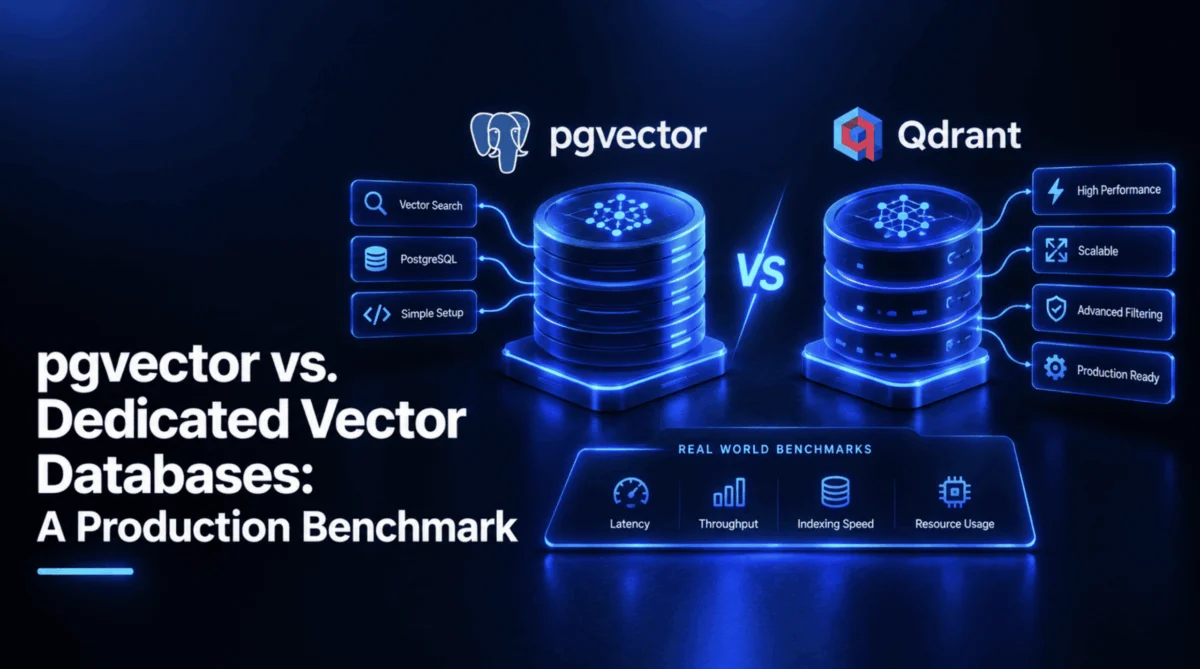
The architectural debate surrounding data persistence for modern artificial intelligence applications has intensified as organizations transition from experimental prototypes to enterprise-scale production systems. Engineering teams frequently deploy pgvector as an extension within their existing PostgreSQL instances, performing relational operations and high-dimensional similarity searches in a unified environment. However, as dataset sizes expand into tens of millions of records, software vendors increasingly advocate for migrations to dedicated vector database services. This empirical analysis examines the operational realities, performance metrics, and architectural trade-offs between PostgreSQL with pgvector and specialized vector engines such as Qdrant, utilizing verified benchmark data to separate marketing claims from measured technical capabilities.
Evolution of Vector Search Infrastructure
The integration of vector embeddings into mainstream data systems accelerated alongside the widespread adoption of large language models, retrieval-augmented generation architectures, and semantic search pipelines. Historically, similarity search relied on specialized libraries or standalone engines detached from core transactional databases. This separation introduced systemic complexities, requiring engineers to maintain dual data stores, implement custom synchronization mechanisms, and navigate distributed network topologies to execute straightforward queries combining structured metadata filters with vector distances.
The introduction of pgvector altered this paradigm by embedding high-dimensional vector types and indexing methodologies directly inside PostgreSQL. By leveraging existing relational schemas, developers could execute transactional updates, scalar filtering, and approximate nearest-neighbor searches within a single ACID-compliant database transaction. Conversely, dedicated vector databases—including Qdrant, Pinecone, Weaviate, Milvus, and ChromaDB—were architected from inception as specialized storage engines. These platforms prioritize distributed scalability, advanced payload filtering, and native vector optimization, trading operational simplicity for dedicated performance characteristics.
Technical Architecture: Embedded Extensions vs. Purpose-Built Services
Evaluating these two paradigms requires examining their underlying operational structures. PostgreSQL with pgvector functions as an extension of a general-purpose relational database. Embeddings reside in the same physical tables as standard relational attributes, utilizing native SQL syntax and standard database connection pools. It supports multiple precision formats—including single-precision, half-precision, binary, and sparse vectors—alongside core distance metrics such as L2 distance, inner product, cosine distance, L1 distance, and Hamming distance.
In contrast, dedicated vector databases operate as independent microservices or distributed clusters with proprietary storage engines and indexing pipelines. For instance, Qdrant is written in Rust and optimized for rapid memory management and complex JSON payload filtering. Milvus utilizes a distributed, GPU-accelerated architecture designed for massive, billion-scale enterprise workloads. Weaviate integrates native vectorization models and hybrid BM25 lexical search capabilities, while Pinecone delivers fully managed, multi-tenant cloud operations aimed at minimizing operational overhead. These divergent architectures impose distinct operational footprints regarding backup procedures, scaling strategies, and hardware resource allocation.
Empirical Performance Benchmarks at Scale
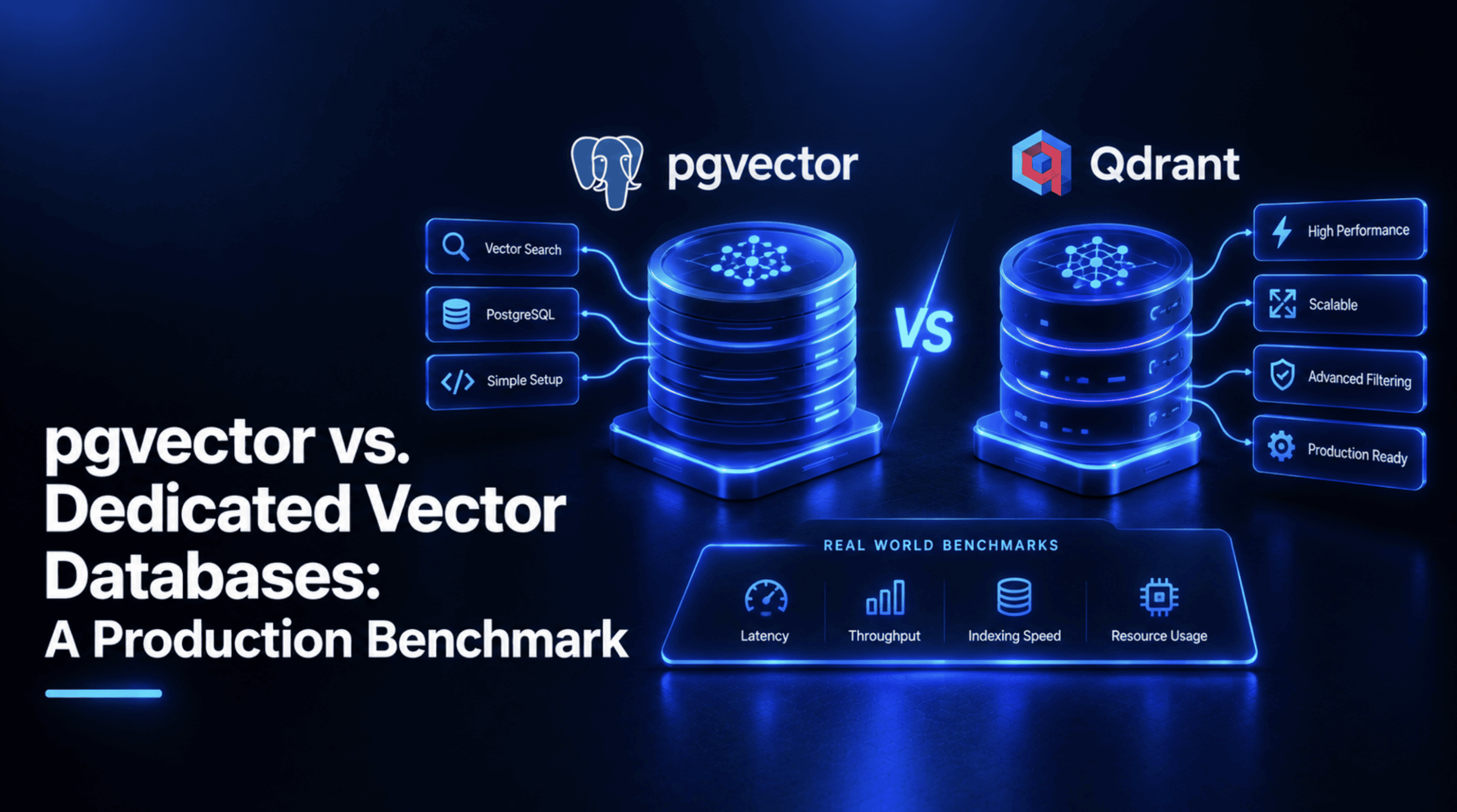
To evaluate these platforms beyond lightweight development environments, industry benchmarks conducted on standardized hardware provide critical insight into throughput, latency, and resource utilization. Independent evaluations comparing PostgreSQL equipped with pgvector and pgvectorscale against Qdrant on identical AWS infrastructure—specifically r6id.4xlarge instances featuring 16 vCPUs and 128GB of RAM—utilizing a dataset of 50 million Cohere embeddings at 768 dimensions reveal nuanced operational trade-offs.
Performance metrics established at a 99% recall threshold demonstrate that the PostgreSQL extension configuration achieved an average throughput of 471.57 queries per second (QPS), significantly outperforming Qdrant’s measured throughput of 41.47 QPS. However, Qdrant maintained an advantage in tail latency stability. Qdrant recorded a 99th percentile (p99) latency of 38.71 milliseconds, compared to 74.60 milliseconds for the PostgreSQL configuration. Furthermore, Qdrant completed the initial index construction for the 50-million-vector dataset in approximately 3.3 hours, whereas the PostgreSQL ecosystem required 11.1 hours to build equivalent structures.
When recall requirements were adjusted to 90%, PostgreSQL with pgvectorscale scaled its throughput to 1,589.79 QPS with a p50 latency of 9.54 milliseconds, while Qdrant achieved 360.81 QPS with a p50 latency of 4.74 milliseconds. These findings indicate that neither architecture maintains an absolute superiority across all operational dimensions; rather, performance profiles depend heavily on concurrency demands, indexing parameters, and acceptable tail latency thresholds.
Operational Implications and Production Selection Criteria
Choosing between an integrated extension and a dedicated vector database requires a structured evaluation of organizational constraints, workload characteristics, and long-term scalability objectives.
Organizations operating at scales under 5 to 10 million vectors frequently find pgvector sufficient for production workloads. This approach eliminates the necessity of provisioning, monitoring, and securing an additional database cluster. Furthermore, applications requiring strict transactional consistency—such as simultaneously updating a relational record and its corresponding vector representation within a single atomic transaction—benefit immensely from the ACID guarantees inherent to PostgreSQL. Engineering teams already proficient in PostgreSQL administration can deploy vector search capabilities without acquiring specialized database management expertise.
Conversely, dedicated vector databases become increasingly compelling under specific operational requirements. Massive datasets exceeding hundreds of millions or billions of vectors typically necessitate distributed architectures capable of horizontal sharding and specialized hardware acceleration. Applications bound by strict tail-latency service-level agreements under heavy concurrent filtered workloads may leverage the optimized memory structures of purpose-built engines. Additionally, enterprises seeking fully managed, zero-infrastructure operations without internal database tuning resources often prioritize cloud-native services.
Future Outlook for Data Architecture
The convergence of relational and vector workloads reflects a broader industry trend toward unified data persistence layers. As database extensions evolve to incorporate advanced indexing techniques—such as streaming disk-based approximate nearest-neighbor algorithms—the performance gap between general-purpose and specialized systems continues to narrow. Engineering leadership must base architectural decisions on empirical workload analysis, concurrency testing, and total cost of ownership rather than generalized industry assumptions. By aligning technical requirements with the demonstrated capabilities of each platform, organizations can construct resilient, high-performance infrastructure capable of sustaining next-generation artificial intelligence applications.