The pursuit of image sharpness is a fundamental pillar of professional photography, yet the physical mechanics of camera operation are frequently overlooked in favor of gear-centric solutions. While modern advancements in optical image stabilization (OIS) and in-body image stabilization (IBIS) have drastically improved the success rate for handheld photography, these technologies function as supplements to, rather than replacements for, foundational physical technique. Achieving consistent clarity, especially when utilizing telephoto focal lengths or wide apertures where the plane of focus is narrow, requires a disciplined approach to human ergonomics and kinetic stability.

The Physics of Stability and the Reciprocal Rule
The historical benchmark for handheld photography is the "reciprocal rule," which posits that to avoid motion blur, a photographer’s shutter speed should be at least the inverse of the focal length—for example, 1/50th of a second for a 50mm lens. However, this guideline assumes a baseline level of stability that many practitioners fail to maintain.
Micro-tremors caused by human physiology—such as the rhythmic expansion of the chest during breathing and the natural sway of the musculoskeletal system—introduce blur that software post-processing cannot rectify. Advanced stabilization systems may grant a photographer three to five additional stops of light, but they operate within specific mechanical limits. When those limits are exceeded, the photographer’s body becomes the primary variable in the equation. By transforming the body into a "human tripod," one can significantly exceed the limitations of both the reciprocal rule and electronic stabilization.

Chronology of Technique Development
The evolution of handheld photography techniques tracks closely with the development of smaller, more portable camera bodies. In the early 20th century, the advent of the Leica 35mm camera forced photographers to move away from the heavy, tripod-dependent view cameras of the era. This necessitated the development of the "tucked elbow" stance, a method that became standard doctrine in photojournalism throughout the mid-century.
As digital sensors have become more sensitive to pixel-level motion blur, the importance of these physical anchors has intensified. Modern instructional curricula now emphasize that stabilization is not a set-and-forget feature, but a dynamic relationship between the photographer’s stance, their respiratory cycle, and the environmental surfaces available for support.

Core Ergonomic Strategies for Sharpness
1. The Tucked-Elbow Stance
The most prevalent error in handheld photography is the "elbows-out" posture. When arms are extended and unsupported, the camera becomes a pendulum, amplifying every minor tremor in the torso. By tucking the elbows firmly against the ribcage, the camera is anchored to the body’s center of gravity. This position requires the left hand to be positioned beneath the lens barrel rather than gripping the side. This provides a direct support structure that minimizes downward torque, which is particularly vital when using heavy, professional-grade zoom lenses.
2. Utilizing Environmental Anchors
In low-light environments where shutter speeds must necessarily dip, physical bracing is mandatory. Professional photographers often scan their environment for "immobile infrastructure"—doorframes, walls, pillars, or sturdy furniture. By pressing the shoulder or the elbow against these surfaces, the photographer creates an artificial anchor that eliminates the micro-movements inherent in a free-standing human frame. Even when vertical surfaces are unavailable, pressing a camera or elbow against a low-lying object, such as a railing or a vehicle hood, provides a measurable increase in stability compared to standing unsupported.

3. The "Elbow Shelf" Technique
When no external support exists, the body can be configured to support itself. By bringing the left arm across the chest and gripping the right shoulder, the photographer creates a rigid "shelf" for the camera to rest upon. This technique effectively locks the camera in place, restricting the range of motion for the hands. While this limits the ability to adjust the zoom or focus ring once the shot is composed, it provides an invaluable advantage for long-duration shooting, where muscle fatigue typically causes a degradation in image quality over time.
4. The Super Squat: Flat-Footed Stability
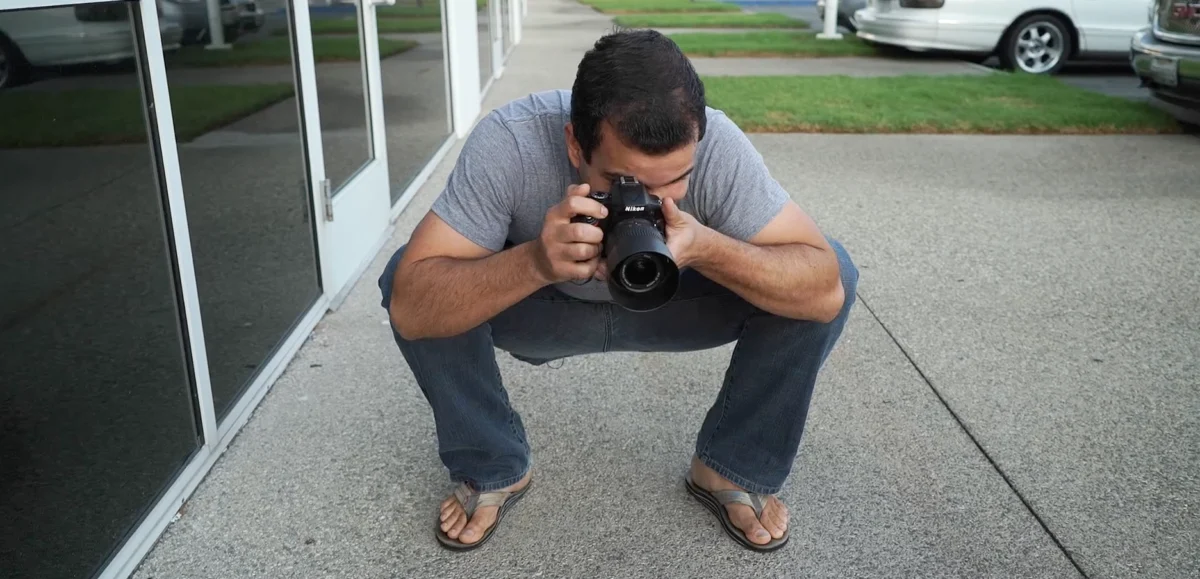
Lowering one’s center of gravity is a standard tactical move for stability. However, many photographers incorrectly squat on the balls of their feet, which creates an inherently unstable base. A proper "super squat" requires the feet to be planted firmly flat on the ground. By resting the elbows on the knees, the photographer creates a triangular base that is remarkably resistant to lateral movement. This position is frequently used in high-stakes photojournalism for low-angle shots where speed and stability are required simultaneously.

Respiratory Regulation and Muscle Tension
A frequently overlooked aspect of handheld sharpness is respiratory control. A common instinct is to hold one’s breath to "stop moving," but this causes muscles to tighten and begin to tremble due to oxygen deprivation. Data suggests that the most stable moment in the respiratory cycle is the natural pause at the end of a slow, controlled exhalation. By timing the shutter release to coincide with this pause, a photographer can achieve a degree of stillness that is unattainable when the breath is held forcefully.
Analysis of Implications for Digital Imaging
The shift toward high-resolution sensors—some exceeding 60 megapixels—has made the consequences of poor technique more apparent than ever. At high resolutions, even the slightest vibration is magnified, leading to "soft" images that fail to utilize the full potential of the sensor.

Industry professionals emphasize that the integration of these techniques is not a matter of aesthetics, but a matter of technical necessity. When comparing images taken with and without these methods at identical, slow shutter speeds, the difference in "keeper rate" is often statistically significant. While image stabilization is an invaluable tool, it cannot compensate for improper weight distribution or the lack of a stable base.
Professional Perspectives on Equipment Management
Related to physical technique is the management of camera accessories. Straps, while necessary for security, can act as a detriment to stability if allowed to hang loosely, creating a pendulum effect that introduces vibration. Many photographers adopt the practice of wrapping the strap around the wrist or keeping it taut against the body to dampen potential oscillations.

Furthermore, the transition to portrait orientation poses a unique challenge to the "tucked-elbow" rule. The use of vertical battery grips has become standard practice in professional photography not only for battery longevity but for the ergonomics of stability. By providing a secondary shutter button in a vertical orientation, these grips allow the photographer to maintain a consistent, stable, and tucked-elbow posture regardless of how the camera is rotated.
Conclusion: The Synthesis of Technique and Technology
The modern photographer must view stability as a multi-layered process. The foundation begins with the body’s physical interaction with the environment—the stance, the grip, and the breathing pattern. The second layer involves the strategic use of existing architecture to further solidify that base. The final layer is the technological intervention provided by modern stabilization systems.

When these elements are synthesized, photographers can consistently capture sharp, high-fidelity images in conditions that were once deemed impossible for handheld work. Mastering these six techniques is not merely an exercise in photography 101, but a fundamental transition from amateur operation to professional, reliable output. As the industry continues to push the boundaries of low-light performance and sensor resolution, the human element of camera operation remains the ultimate limiting factor, and the most critical variable in the pursuit of the perfect frame.