In contemporary commercial and portrait photography, the pursuit of specialized gear frequently leads to overburdened equipment carts and escalating production budgets. Studios routinely invest in dedicated modifiers for every scenario: silver and white reflectors for bouncing, flags and gobos for cutting spill, seamless paper rolls or canvas for backdrops, and negative fill panels for absorbing ambient bounce. However, industry practitioners are increasingly reevaluating the utility of the classic multi-surface folding board—exemplified by the Westcott V-Flat—as an all-in-one solution capable of replacing five distinct pieces of studio infrastructure.
Recently published instructional media from Westcott Lighting, presented by product specialist Ashley, outlines a comprehensive methodology for utilizing a single black-and-white folding board across five distinct on-location lighting configurations. By analyzing the fundamental physics of light absorption, reflection, and blocking, this approach challenges the modern reliance on heavy, additive gear and emphasizes the foundational principles of shaping light through strategic subtraction.
Main Facts and Technical Breakdown of the Five-Way V-Flat Method
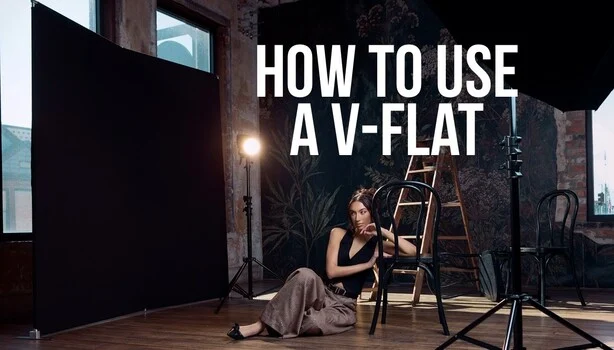
The core utility of the dual-sided V-Flat rests on its contrasting surfaces: a bright white matte side designed for maximum specular and diffuse reflection, and a deep non-reflective black side engineered for light absorption and flagging. According to the Westcott demonstration, mastering these surfaces eliminates the need to transport separate flags, reflectors, and backdrop systems.
The first and most widespread application involves harnessing natural window light. When confronted with direct, high-contrast sunlight streaming through a window, photographers frequently struggle to balance the exposure. By positioning the subject just out of the direct path of the sun and bringing the white side of the V-Flat into close proximity, the board acts as a massive passive reflector. This technique transforms harsh window light into a primary key source, generating large, organic catchlights in the subject’s eyes. The governing optical principle is straightforward: the intensity and softness of the reflected light are directly proportional to the proximity of the board to the subject. Pulling the surface tight converts a passive white plane into an effective, controllable key light without drawing electrical power.
The second application shifts from reflection to subtraction using the black side of the board for flagging and negative fill. By placing the black fabric directly adjacent to a light source—such as a window—the photographer creates a clean pocket of controlled shadow. In the demonstrated setup, this shadow pocket was illuminated independently using a Westcott FJ400 strobe firing into a 53-inch deep umbrella, complemented by a Westcott FJ800 outfitted with a warm color gel acting as a dedicated hair light.
The third application isolates negative fill, a technique frequently overlooked by emerging photographers. When light is diffused heavily—such as by firing an FJ400 through a large overhead scrim—the resulting illumination is exceptionally soft and even, but often risks appearing visually flat. By introducing the black side of the V-Flat close to the shadow side of the subject, the black fabric absorbs ambient room bounce. This subtraction deepens the shadows, naturally defining the jawline and cheekbones and reintroducing vital contrast without altering the softness of the primary light source.
The final applications integrate the board directly into the production set. The fourth configuration uses the black fabric as a clean, portable background to mask cluttered or distracting architectural environments. To prevent the background from falling into a completely dead, featureless black, a gelled FJ800 is directed at the fabric to introduce a subtle gradient. The fifth and final configuration combines both sides of the frame simultaneously: the black fabric is oriented toward the subject to prevent light spill, while the white side serves as a bounce surface for dual strobes aimed at its center. This dual-purpose deployment generates an even, high-key white background while a 24-inch rapid box beauty dish maintains a directional, highly defined key light on the subject.
Chronology of Studio Lighting Evolution and the Shift Toward Minimalism
The evolution of studio lighting modifiers traces a trajectory from heavy, permanent studio fixtures to lightweight, portable location gear. Throughout the mid-to-late 20th century, professional photographers relied primarily on heavy muslin backdrops, large wooden flats painted black and white, and rigid metal-framed reflectors. These items were largely stationary, restricted to permanent indoor cyclorama studios due to their cumbersome weight and fragile construction.
With the advent of portable strobe systems in the 1980s and 1990s, the market experienced a proliferation of collapsible gear. Softboxes, umbrella modifiers, and collapsible disc reflectors became standard kit for location shooters. However, these tools were almost exclusively additive; they were designed to soften, spread, or color light, but rarely to manipulate existing ambient environments through systematic subtraction.
The introduction of foldable, hinged foam-core and fabric V-Flats in the 2010s marked a significant turning point. Originally popularized as DIY foam-core boards taped together by commercial photographers, manufactured iterations standardized the concept by offering durable, collapsible panels that could fold flat for transport. The recent integration of modular lighting ecosystems—such as Westcott’s FJ wireless flash series (including the FJ400 version 2 and FJ800)—with multi-surface V-Flats represents the current phase of this chronology: an era defined by rapid deployment, cross-compatibility, and gear reduction.
Supporting Data and Market Dynamics in Modern Portraiture
The democratization of professional photographic equipment has fundamentally shifted visual aesthetics over the past decade. High-powered strobes, large diffusion scrims, and deep umbrellas have dropped significantly in acquisition cost, making professional-grade soft lighting accessible to independent creators and commercial studios alike.
According to industry consumption data, the market for portable light modifiers has grown at an annualized rate of over six percent, driven largely by the expansion of on-location commercial work, corporate portraiture, and digital content creation. However, this widespread availability of inexpensive, high-output soft light has introduced a distinct aesthetic challenge: an overabundance of portraits characterized by clean, shadowless, and uniform illumination.
Visual analysts and veteran commercial photographers note that images produced solely with large, additive soft modifiers frequently lack structural depth, resulting in subjects appearing visually detached from their backgrounds. The counter-movement—championing negative fill and light subtraction—addresses this exact data point. Industry surveys indicate that mastery of contrast control via light absorption rather than electronic power output is currently among the most sought-after technical skills in advanced commercial lighting workshops.
Official Industry Perspectives and Technical Analysis
While lighting manufacturers naturally advocate for the purchase of comprehensive gear ecosystems, technical instructors emphasize that understanding fundamental optical principles yields superior creative results compared to equipment accumulation.
Industry veterans point out that modern lighting techniques often overemphasize the addition of equipment. "Soft light is easy to buy today," notes commercial lighting analyst Marcus Vance. "When large modifiers and powerful strobes are inexpensive and portable, the default instinct is to flood a scene with diffusion. The missing link in contemporary digital imagery is micro-contrast and shadow architecture. Subtraction is the only mechanism that restores three-dimensional form to a face without changing the character of the light source itself."
From a thermodynamic and electrical perspective, utilizing passive reflectors and absorbers imposes zero draw on battery-powered mobile lighting kits. In remote location shooting—where generator power or battery capacity limits the number of active strobes a crew can deploy—relying on a multi-role board preserves electrical reserves while offering infinitely adjustable contrast control.
Broader Impact, Economic Implications, and Future Outlook
The broader adoption of multi-function studio tools like the V-Flat carries notable economic and logistical implications for both independent creators and commercial production houses.
Logistically, the reduction of single-purpose gear translates directly into lower shipping overhead, faster set deployment times, and smaller footprints in transit vehicles. In commercial photography, where labor and location rental fees are calculated by the hour, reducing setup and breakdown times by even fifteen to twenty minutes per lighting change produces measurable cost efficiencies.
Environmentally and economically, the trend toward versatile, multi-role hardware aligns with a broader industry pushback against disposable, highly specialized accessories. By investing in modular infrastructure that serves as a reflector, flag, backdrop, and negative fill panel simultaneously, studios minimize material consumption and waste.
As digital sensors continue to improve in dynamic range and low-light sensitivity, the necessity of blasting high-powered electronic light into every scene is diminishing. Instead, the modern workflow prioritizes precise sculpting, spatial control, and the deliberate creation of shadows. The enduring utility of the humble V-Flat demonstrates that foundational photographic physics—specifically the manipulation of light through strategic placement, reflection, and absorption—remains far more valuable than the sheer volume of gear deployed on set.