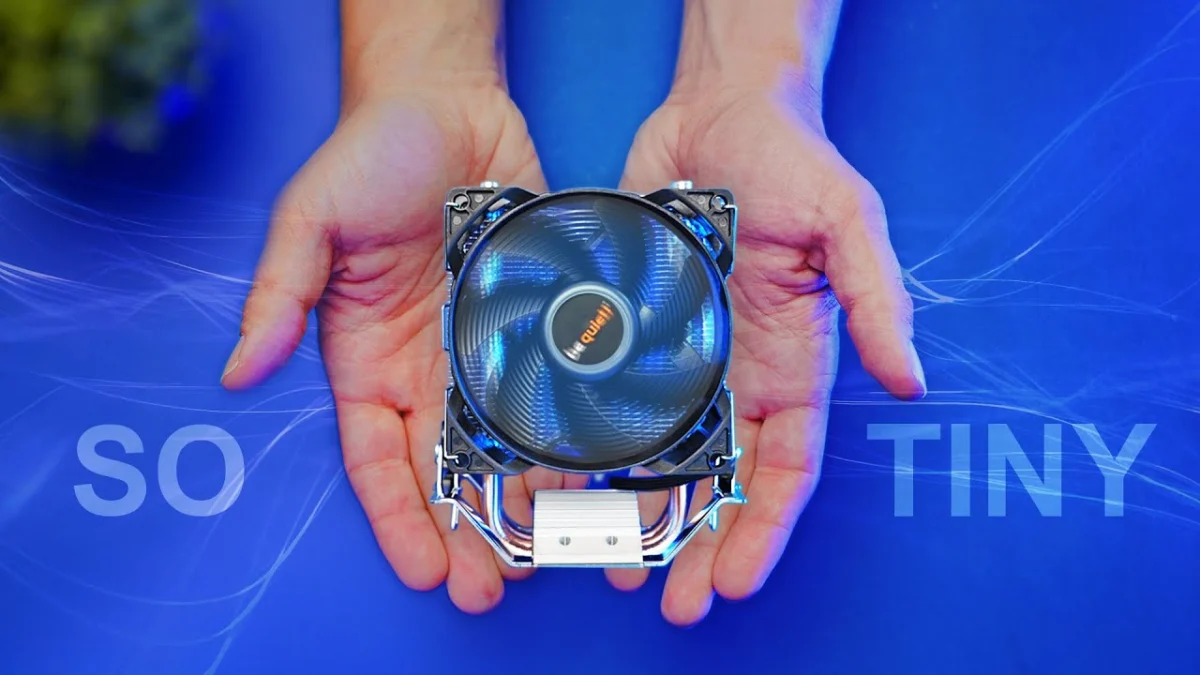
The modern personal computer hardware market is frequently characterized by a relentless pursuit of scale. High-end processors from both AMD and Intel demand increasingly aggressive thermal solutions, leading to the proliferation of massive 140mm dual-tower air coolers and complex liquid All-In-One (AIO) loops that dominate enthusiast builds. Yet, a significant portion of the consumer base utilizes mainstream processors that do not require such extreme hardware. Recognizing this gap, cooling manufacturer be quiet! has released the Pure Rock Slim 2, a compact 92mm tower cooler retailing at an aggressive MSRP of $25. Designed to balance broad motherboard compatibility, whisper-quiet operation, and surprising thermal efficiency, this budget-friendly heatsink challenges the notion that effective cooling requires a substantial financial and spatial investment.
Main Facts and Market Positioning
The be quiet! Pure Rock Slim 2 enters a highly competitive entry-level CPU cooling segment historically populated by legendary budget staples such as the Cooler Master Hyper 212 series. Measuring just 135mm in height, 82mm in depth, and 97mm in width, the cooler is engineered specifically for space-constrained environments, such as small form factor (SFF) cases like the popular Cooler Master NR200, which enforce strict height limitations on CPU heatsinks.
Priced at $25, the cooler aims to democratize access to efficient thermal dissipation without forcing users to sacrifice RAM clearance or compromise on acoustic performance. Despite its diminutive footprint, the unit incorporates three 6mm copper heat pipes featuring Heatpipe Direct Touch (HDT) technology, paired with a dense aluminum fin array and be quiet!’s signature 92mm Pure Wings 2 fan.
Chronology and Development of the Pure Rock Series
The evolution of the Pure Rock Slim line reflects shifting consumer demands within the PC building ecosystem. The original Pure Rock Slim established a baseline for compact cooling, but changing socket standards and the explosion of AMD’s Ryzen market share necessitated a redesign.
With the launch of the Pure Rock Slim 2, be quiet! introduced subtle yet impactful physical and mechanical revisions. The manufacturer extended the rear fin array slightly to maximize surface area contact with airflow. More critically, the company overhauled the mounting mechanism to better accommodate current platform architectures. Recognizing AMD’s market dominance, be quiet! pre-installed the AMD mounting bracket straight out of the box, streamlining the installation process for AM4 and AM5 platforms. For Intel users, the transition requires a brief swap to alternate brackets, utilizing a modified push-pin retention system tailored for LGA sockets.
Supporting Data, Specifications, and Thermal Performance
In empirical testing, the Pure Rock Slim 2 delivers performance metrics that frequently challenge larger, more expensive 120mm competitors. At a standard 95W thermal load, the cooler operates with exceptional acoustic efficiency. Driven by a Pulse Width Modulation (PWM) signal, the 92mm Pure Wings 2 fan operates up to 2,300 RPM. Remarkably, the fan’s acoustic profile is exceptionally subdued; decibel testing reveals that the fan hits the testing environment’s minimum noise floor at 70% speed, topping out at a modest 40 decibels under maximum load. This acoustic restraint grants the Pure Rock Slim 2 a distinct advantage over louder, entry-level rivals.
When subjected to a 125W thermal load—pushing near the cooler’s official 130W TDP (Thermal Design Power) threshold—the unit maintains structural thermal integrity. Comparative benchmarking indicates that the Pure Rock Slim 2 matches the cooling performance of the legacy Noctua NH-U12S up to a 37-decibel threshold and consistently edges out the Cooler Master Hyper 212 Evo across various test parameters. However, pushing the heat load to 150W reveals the physical limitations of a 92mm form factor, where the cooler quickly reaches its maximum thermal capacity, underscoring that extreme overclockers and high-wattage enthusiasts will still require larger, multi-fan cooling towers or liquid solutions.
Industry Reception and Pricing Logistics
While the official manufacturer’s suggested retail price is set at $25, the product’s market availability has experienced minor friction common to newly released PC components. Third-party marketplace sellers on platforms like Amazon and Newegg occasionally inflate prices or capitalize on initial supply constraints, requiring consumers to exercise diligence to secure the unit at its intended price point.
Despite minor logistical hurdles regarding third-party pricing, industry analysts and hardware reviewers have broadly praised the unit’s value proposition. The combination of tool-friendly installation, zero RAM interference—even on fully populated motherboard memory slots—and class-leading acoustic performance makes it a standout option for budget-conscious builders.
Broader Impact and Implications for Budget PC Builders
The introduction of refined ultra-compact coolers like the Pure Rock Slim 2 highlights a broader shift in hardware design philosophy: performance-per-dollar and spatial efficiency are becoming paramount for the average consumer. As high-efficiency mid-range processors from both Intel and AMD continue to dominate system integrator builds and home offices, the necessity of bulky, oversized cooling towers is shrinking.
For the vast majority of users who engage in standard productivity tasks, content consumption, and moderate gaming at standard TDP thresholds, massive heatsinks are increasingly becoming redundant. By distilling high-end engineering principles into a $25, 92mm package, be quiet! has established a new benchmark for accessible, quiet, and reliable thermal management, proving that effective engineering is measured by capability rather than sheer physical scale.