The landscape of artificial intelligence development has undergone a fundamental transformation over the past twenty-four months, moving away from the era of brute-force orchestration toward a more sophisticated, decentralized architecture known as agentic swarms. By mid-2026, the industry has largely abandoned the fragile prompt-chaining methods that characterized early 2024, opting instead for native reasoning models and standardized communication protocols. This shift represents a transition from "prompt engineering" to "system architecture," where the primary challenge for developers is no longer forcing a model to think, but rather designing the infrastructure in which specialized digital entities interact.
The Obsolescence of Orchestrated Reasoning Loops
In the early stages of agentic AI development, engineers relied heavily on external frameworks to simulate complex thought processes. Techniques such as ReAct (Reasoning and Acting), Plan-and-Execute, and Reflexion were the industry standards. These patterns required significant "scaffolding"—code-heavy loops that forced a large language model (LLM) to critique its own work, plan steps sequentially, and correct errors in a recursive fashion. While groundbreaking at the time, these methods were notoriously brittle, suffering from high latency and significant token overhead.
As of 2026, foundation models have integrated "System 2" thinking—slow, deliberate reasoning—directly into their core architectures. Modern models now utilize hidden reasoning tokens and internal test-time compute to explore multiple solution branches before generating a final response. This internal self-correction mechanism has rendered many external orchestration frameworks redundant. Current production systems have shifted the orchestration layer’s focus away from "thinking" and toward routing, state management, and environment execution. In this new paradigm, the model handles the cognitive loop internally, while the engineer builds the secure "sandbox" in which the agent operates.
From Monolithic Agents to Agentic Swarms
One of the most significant shifts in AI architecture is the move away from the monolithic, "do-everything" agent. Throughout 2024 and 2025, a common failure point in AI deployments was the "tool bottleneck," where a single model was connected to dozens of disparate APIs and tools. This often led to context window saturation and a high rate of tool-calling errors.
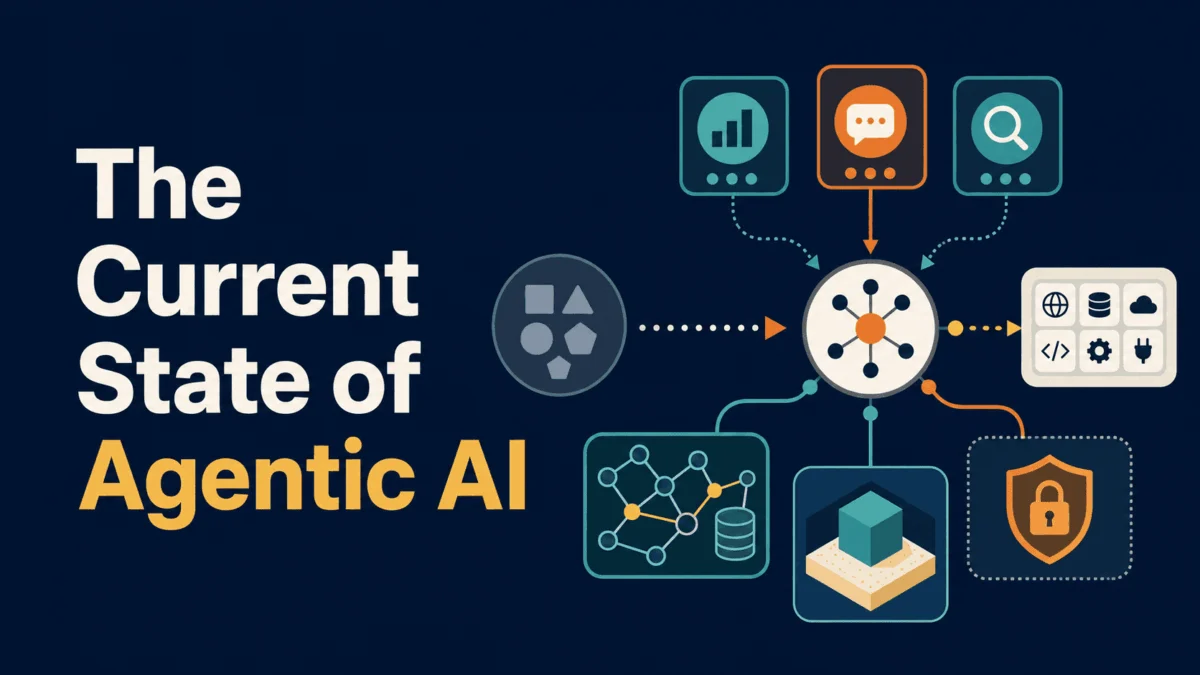
By mid-2026, the industry has pivoted toward "Agentic Swarms"—collections of smaller, highly specialized agents that communicate through standardized protocols. This microservices-inspired approach allows for better testing, easier updates, and significantly improved reliability. Instead of a single agent attempting to write SQL, analyze data, and generate reports, a modern swarm utilizes a tiered structure:
- Triage Agents: These serve as the entry point, analyzing user intent and routing requests to the appropriate specialist.
- Specialist Agents: These are narrow-scope entities, such as a "PostgreSQL Specialist" or a "Python Data Analyst," which possess only the tools and system prompts necessary for their specific domain.
- Synthesis Agents: These gather the outputs from various specialists to form a cohesive final response for the user.
Data from recent enterprise implementations suggests that swarm architectures can reduce error rates by as much as 40% compared to monolithic agents. By keeping the context window of each individual agent lean, developers can also utilize smaller, faster models for specific tasks, reserving the most powerful (and expensive) models for high-level routing and final synthesis.
The Standardization of Agency via Model Context Protocol (MCP)
A major hurdle in the early adoption of AI agents was the "integration tax"—the immense effort required to connect a model to real-world data sources like GitHub, Slack, or corporate databases. Previously, this required writing custom JSON schemas and handling complex HTTP request-response cycles for every new tool.
The emergence of the Model Context Protocol (MCP) has revolutionized this process. As an open standard, MCP acts as a universal adapter between AI models and external data. In the current 2026 ecosystem, MCP allows for a clear separation of concerns. Instead of hardcoding API keys into an agent’s environment, the agent connects to an isolated MCP server. The server automatically exposes available tools and resources to the agent, handling the execution internally.
This standardization has led to a marketplace of pre-built MCP servers. Enterprises can now plug a standardized "Salesforce MCP Server" or a "Cloud Infrastructure MCP Server" into their agentic swarms with minimal configuration. This has effectively shifted the engineering burden from writing API wrappers to managing the security and access permissions of the MCP servers themselves.
Chronology of the Agentic AI Revolution (2023–2026)
To understand the current state of the industry, it is essential to review the timeline of these technological milestones:
- Early 2023: The rise of autonomous agent experiments (e.g., AutoGPT, BabyAGI). These demonstrated the potential of agents but lacked the reliability for production use.
- Late 2023 – Early 2024: The introduction of "Agentic Workflows." Frameworks like LangChain and LlamaIndex popularized the use of external loops for reasoning and tool calling.
- 2025: The "Standardization Wave." The Model Context Protocol (MCP) was introduced, and major cloud providers began offering managed multi-agent orchestration platforms. Native reasoning models began to replace external ReAct loops.
- Mid-2026: The "Swarm Era." Production AI systems are now characterized by decentralized, specialized agents using internal reasoning tokens and persistent memory graphs.
Continuous Learning through Memory Graphs
A persistent challenge for AI agents has been the lack of long-term memory. Early agents were largely stateless, meaning they could not "learn" from previous interactions or refine their strategies over time without manual fine-tuning—a process too slow and expensive for most applications.
The solution in 2026 involves the use of "Memory Graphs." This architecture separates the stateless execution of the agent from a stateful, system-level memory layer. Typically powered by graph databases like Neo4j, these memory systems work as follows:
As a swarm executes a task, a dedicated "Memory Agent" runs asynchronously in the background. Its role is to observe the interaction, extract key facts, and update a persistent graph of knowledge. When a user returns with a new request, the system retrieves the relevant context from the graph and injects it into the agent’s prompt. This allows the system to compound knowledge and improve its performance without requiring the underlying model to be retrained.
Security and the Threat of "AIjacking"
The shift to multi-agent swarms and standardized protocols has not come without new risks. The expanded attack surface of a swarm presents a unique security challenge known as "AIjacking" or indirect prompt injection.
In a swarm environment, a vulnerability in one agent can lead to a lateral move through the entire system. For example, if an "Email Reader Agent" encounters a malicious instruction embedded in an email, it might be tricked into passing that instruction to a "Database Specialist Agent." Because these agents trust the "handoff" mechanism of the swarm, the malicious instruction can pivot through the architecture to gain unauthorized access to sensitive data.
In response, security architects in 2026 have implemented three primary defensive layers:
- Veto Agents: Specialized agents that monitor the communication between other agents, looking for signs of adversarial intent or policy violations.
- Isolated MCP Servers: Ensuring that tools with "write" access are strictly separated from agents that process untrusted external data.
- Human-in-the-Loop (HITL) Triggers: Mandatory manual approval steps for high-stakes actions, such as executing a financial transaction or deleting a database record.
Industry Impact and Broader Implications
The maturation of agentic AI has significant implications for the global workforce and the software industry. Recent industry reports indicate that nearly 65% of software development cycles now involve "agent-first" design patterns, where the initial architecture is built around how AI agents will interact with the code.
Furthermore, the "agentic microservices" model has allowed companies to scale their AI capabilities more efficiently. By deploying specialized swarms, organizations can address complex problems in legal analysis, medical diagnostics, and financial forecasting with a level of precision that was impossible with the monolithic models of 2024.
However, this evolution also demands a new set of skills from the workforce. The role of the AI engineer has shifted toward "system orchestration," requiring deep knowledge of distributed systems, security protocols, and data architecture. As the technology continues to advance, the focus will likely remain on refining the "social" dynamics of these agent swarms—optimizing how they communicate, collaborate, and learn from one another in a safe and transparent manner.
The path forward for agentic AI is clear: the most successful systems will not be the ones with the largest models, but those with the most resilient, specialized, and well-integrated swarms. For developers and enterprises alike, the goal is to move beyond simple automation and toward building truly intelligent, adaptive systems that can operate autonomously within the complex constraints of the real world.