The field of machine learning is witnessing a fundamental transition in how structured data is processed, as a new class of pretrained transformers known as tabular foundation models begins to outperform the gradient-boosted decision trees that have dominated the industry for over a decade. Recent evaluations on the TabArena benchmark, a primary community standard for tabular data, reveal that every single-model entry outperforming the most advanced tuned gradient-boosted decision tree (GBDT) configurations is now a tabular foundation model. This shift marks the end of an era where manual hyperparameter tuning and gradient-based training were the default requirements for high-performance spreadsheet analysis. These models, often referred to as "tabular LLMs," apply the principles of in-context learning to predict missing columns or labels in a zero-shot manner, mimicking the way a traditional large language model completes a sentence.
The Rise of Tabular Foundation Models
For the past ten years, the consensus among data scientists was that for tabular data—the kind found in Excel spreadsheets and SQL databases—gradient-boosted trees like XGBoost, LightGBM, and CatBoost were unbeatable. Unlike image recognition or natural language processing, where deep learning took over years ago, tabular data lacked the inherent structure that made early neural networks efficient. However, the emergence of tabular foundation models (TFMs) has inverted this narrative.

These models are not traditional large language models (LLMs) that read text; rather, they are "table-native" transformers. They are pretrained on millions of synthetic tables generated by random structural causal models—mathematical graphs that simulate cause-and-effect relationships. This pretraining allows the models to learn a general-purpose procedure for identifying patterns within a table, regardless of the specific column names or data types. When presented with a new table, these models do not require a training phase. Instead, they use the provided data as "context" to make predictions on unseen rows in a single forward pass.
Chronology of Development and the TabArena Benchmark
The development of these models has moved at an accelerated pace over the last four years, leading to the current state of the TabArena leaderboard.
- 2022: The TabPFN Milestone: Researchers introduced TabPFN (Tabular Probability Frequency Network), establishing that a transformer could perform in-context learning on small tables by treating the training set as a prompt.
- 2023–2024: Scaling and Open Weights: The SODA team at Inria developed TabICL and its successor, TabICLv2, focusing on scaling these models to handle larger datasets and more features while maintaining open-source accessibility.
- 2025: Real-Data Pretraining: New entries like RealTabPFN and TabDPT began incorporating real-world datasets into their pretraining corpus, further pushing the boundaries of accuracy, though introducing concerns regarding benchmark contamination.
- Mid-2026: The TabFM Era: Google Research released TabFM, a zero-shot foundation model that currently sits at the top of the TabArena leaderboard, significantly outperforming previous single-model entries.
The TabArena benchmark itself consists of 51 curated datasets ranging from binary classification to complex regression tasks. It utilizes an Elo rating system—similar to that used in chess—to rank models. In this system, a standard Random Forest model is anchored at 1000 Elo. Current data shows that while a fully tuned and ensembled LightGBM reaches approximately 1432 Elo, TabICLv2 reaches 1590 Elo, and Google’s TabFM exceeds 1700 Elo.

Technical Architecture of Tabular Foundation Models
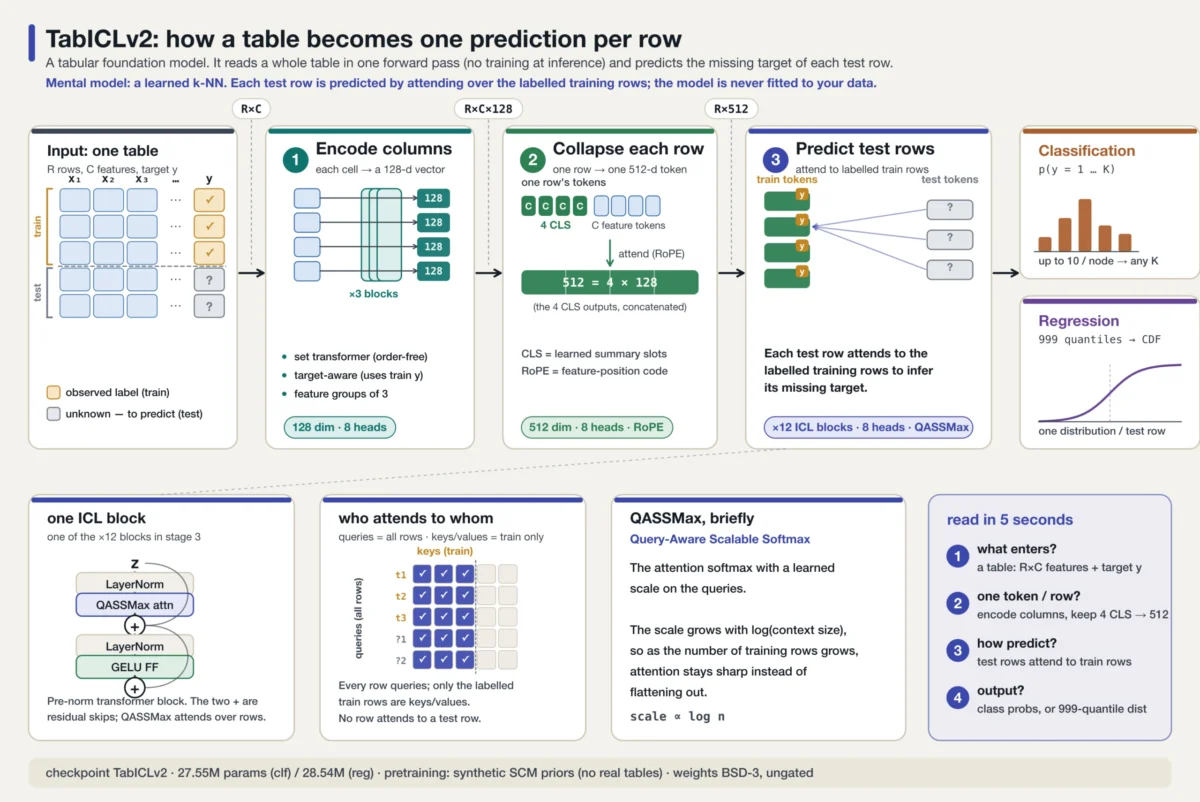
To understand why these models are suddenly successful, one must look at the internal architecture of a leading example like TabICLv2. Unlike a text-based LLM, which processes a vocabulary of words, a tabular foundation model must handle an infinite variety of numerical and categorical inputs.
Stage 1: The Column Transformer
The model first employs a set transformer that reads down each column. Its purpose is to learn the distribution of values within that specific feature. For instance, the number "450" means something different in a "Postcode" column than it does in a "Price" column. This stage generates an embedding for each cell that reflects its relative position within its own column’s distribution.
Stage 2: The Row Transformer
Once each cell is embedded, the model looks across the rows. It uses learned query tokens to collapse a row of varying features into a single, fixed-length vector. This ensures that the model can handle tables with any number of columns without needing to be redesigned.

Stage 3: In-Context Learning Blocks
The final stage is where the actual prediction occurs. The model uses attention mechanisms to allow unlabelled "test" rows to "attend" to labelled "train" rows. It effectively performs a sophisticated, learned version of a k-nearest-neighbors search. It identifies which training rows are most similar to the test row and reads off the answer, weighted by that similarity. This entire process happens during inference; no gradients are updated, and no traditional "training" occurs on the user’s specific data.
Supporting Data: Performance and Cost Efficiency
One of the primary arguments in favor of traditional GBDTs has been their computational efficiency. However, recent audits suggest that tabular foundation models are becoming increasingly competitive in terms of serving costs.
- Fitting Speed: Traditional GBDTs require a hyperparameter search that can take hours. In contrast, TabICLv2’s "fitting" stage is merely storing the context, taking roughly 4 seconds per 1,000 rows.
- Inference Speed: TabICLv2 has a median prediction time of 0.38 seconds per 1,000 rows on a GPU. This is faster than a tuned-and-ensembled LightGBM, which averages 2.64 seconds per 1,000 rows.
- Monetary Cost: In an independent audit conducted on an AWS A10G instance, a full sweep of all 51 datasets in the TabArena benchmark cost just over $2.00 and was completed in approximately 2.1 hours.
While GBDTs still hold an advantage in CPU-only environments—where CatBoost can serve 1,000 rows in 0.08 seconds—the gap in accuracy often justifies the shift to GPU-based foundation models for high-stakes applications.

Official Responses and the Contamination Debate
The rapid rise of these models has sparked a debate within the machine learning community regarding data provenance and benchmark integrity. As accuracy gains are increasingly linked to the inclusion of real-world data in pretraining, the risk of "leakage"—where a model has already seen the test data during its training phase—has grown.
The developers of TabICLv2 have maintained a strict "synthetic-only" pretraining regime to ensure their results are untainted. In contrast, newer models like RealTabPFN-2.5 disclose that they pretrain on thousands of real-world datasets sourced from OpenML and Kaggle. While these teams employ rigorous deduplication pipelines to remove benchmark datasets from their training sets, some researchers argue that these gains should be viewed as "upper bounds" rather than pure zero-shot performance.
Industry analysts suggest that the "cleanest" provenance remains with models trained purely on structural causal models (SCMs). Google’s TabFM also claims a synthetic-only pretraining strategy, which makes its 123-Elo lead over other models particularly significant, although the lack of a formal technical paper for TabFM has led to calls for greater transparency from the Google Research team.

Strategic Analysis: The Regime Map
Despite the dominance of foundation models on the leaderboard, they are not a universal replacement for trees. A detailed regime analysis reveals specific scenarios where GBDTs remain superior.
The Dimensionality Threshold:
Foundation models currently struggle with very high-dimensional data. In datasets with more than 100 features, GBDTs won nearly 85% of the head-to-head matches. For example, on the Bioresponse dataset, which contains 1,776 features, traditional trees outperformed TabICLv2 by a significant margin.
The Scale and Cardinality Factor:
When dealing with massive row counts (over 20,000) combined with high-cardinality categorical variables (features with thousands of unique text labels), GBDTs like CatBoost still hold the edge. The win rate for foundation models slides from 89% on small datasets to roughly 64% on large-scale industrial datasets.

Broader Impact and Industry Implications
The shift toward tabular foundation models suggests a looming change in the standard data science workflow. The "AutoML" pipelines of the future may move away from searching for the best tree parameters and toward "routing" mechanisms.
A "router" system evaluates a dataset and decides whether to send it to a foundation model or a GBDT. Research into these hybrid systems shows that "oracle routers"—which theoretically pick the best model for every dataset—could reach an Elo of 1707, far higher than any single model currently in existence. Even deployable routers, which use validation error to choose a model, are showing the ability to outperform individual foundation models by leveraging the complementary strengths of different architectures.
For organizations, this means that the barrier to entry for high-performance machine learning is lowering. A zero-shot model that requires no tuning allows smaller teams to achieve state-of-the-art results without the need for extensive computational resources or specialized expertise in gradient boosting. As these models continue to scale and handle higher dimensionality, the "default" answer for a new spreadsheet is no longer a tuned XGBoost model, but a single forward pass through a tabular transformer.