








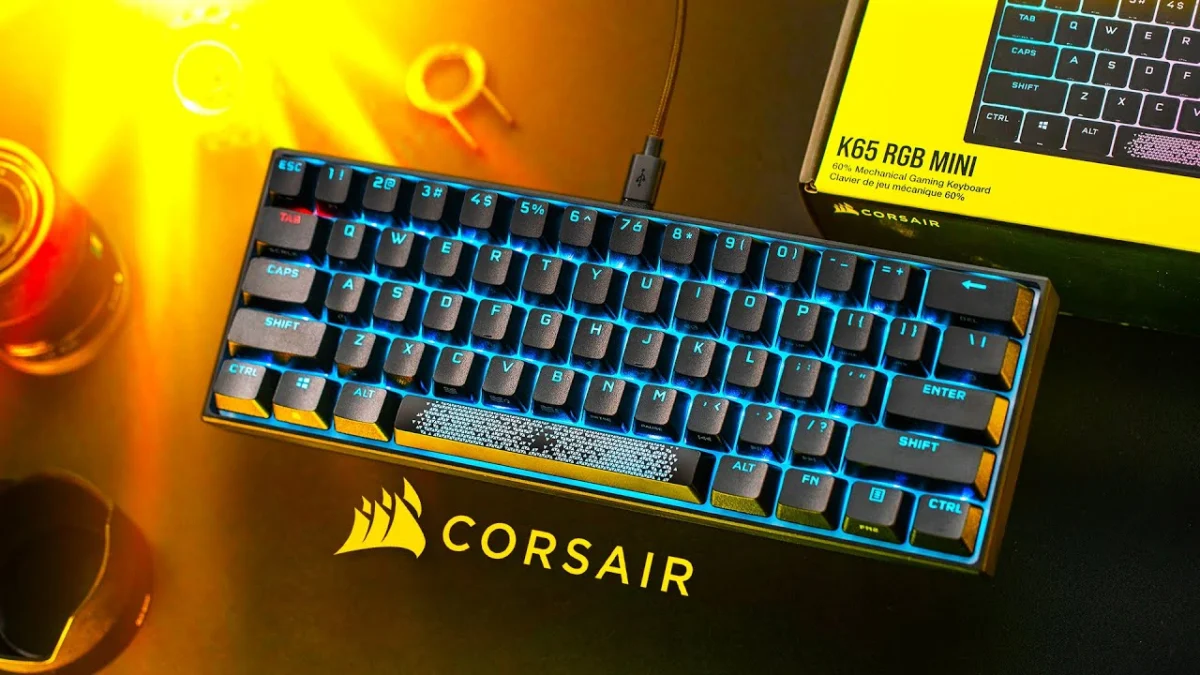
Corsair has officially entered the highly competitive 60% mechanical keyboard market with the release of the K65 RGB Mini. Long known for its full-sized, tenkeyless (TKL), and enthusiast-grade peripherals, the hardware manufacturer’s decision to scale down to a ultra-compact 60% layout marks a strategic shift in its product roadmap. Priced competitively at $110 USD, the new peripheral enters a crowded arena historically dominated by enthusiast brands like Ducky and major gaming competitors such as Razer.
The launch of the K65 RGB Mini reflects a broader industry trend toward minimalist desk setups. Over the past several years, mainstream gamers, content creators, and esports professionals have increasingly gravitated toward smaller form-factor keyboards to maximize mouse movement space and ergonomics. By introducing a mainstream product with wide retail distribution, Corsair aims to bridge the gap between niche enthusiast keyboards and mass-market availability.
Pricing, Positioning, and Market Competition
At $110 USD, the Corsair K65 RGB Mini positions itself directly against established heavyweights in the 60% category. Most notably, it matches the price point of the popular Ducky One 2 Mini. While Ducky products have traditionally required consumers to purchase through specialized channels or boutique retailers, Corsair leverages its extensive global supply chain and mainstream retail partnerships to offer broad accessibility to casual and competitive gamers alike.
Furthermore, Corsair undercuts the Razer Huntsman Mini, which retails for approximately $119 USD. This pricing strategy gives the K65 RGB Mini an initial commercial advantage in retail stores and online storefronts. However, market analysts note that breaking into the 60% segment requires more than competitive pricing; it demands a compelling feature set that appeals to a community accustomed to high levels of customization and build quality.
Design and Build Quality
The design philosophy behind the K65 RGB Mini balances minimalist aesthetics with structural durability. Out of the box, the keyboard features robust double-shot PBT keycaps with a textured finish designed to resist wear and shine over time. While the primary font used for alphabetic characters is clean and legible, the secondary numerics and symbols have drawn mixed reviews from typography enthusiasts due to their unconventional styling.
To maintain design cohesion with Corsair’s existing line of PC cases and cooling hardware, the spacebar features a distinct industrial ventilation pattern. Because of this intricate molding, the default spacebar is constructed from ABS plastic rather than PBT, though Corsair thoughtfully includes a plain, textured PBT replacement spacebar in the box for users who prefer uniform material consistency. An additional Corsair-branded novelty keycap is also provided.
The chassis itself abandons the traditional floating-key aesthetic seen on larger Corsair boards like the K70, opting instead for a slightly chunkier, low-profile plastic housing. A USB Type-C port sits centrally at the rear, accompanied by a detachable braided USB-C cable. While the inclusion of a detachable cable is a welcome modern standard, reviewers have noted that the bundled braided cable tends to kink easily.
Ergonomically, the keyboard lacks physical height-adjustable feet at the base, relying instead on a fixed natural incline supported by high-friction rubber pads. While the chassis angle is generally comfortable for standard typing and gaming postures, some users with specific ergonomic preferences may miss adjustable elevation. Additionally, the lower front edge of the case features unrefined, sharp boundaries just beneath the spacebar, which can occasionally cause discomfort or friction for users who rest their thumbs below the bottom row during extended typing sessions.
Layout and Secondary Functions
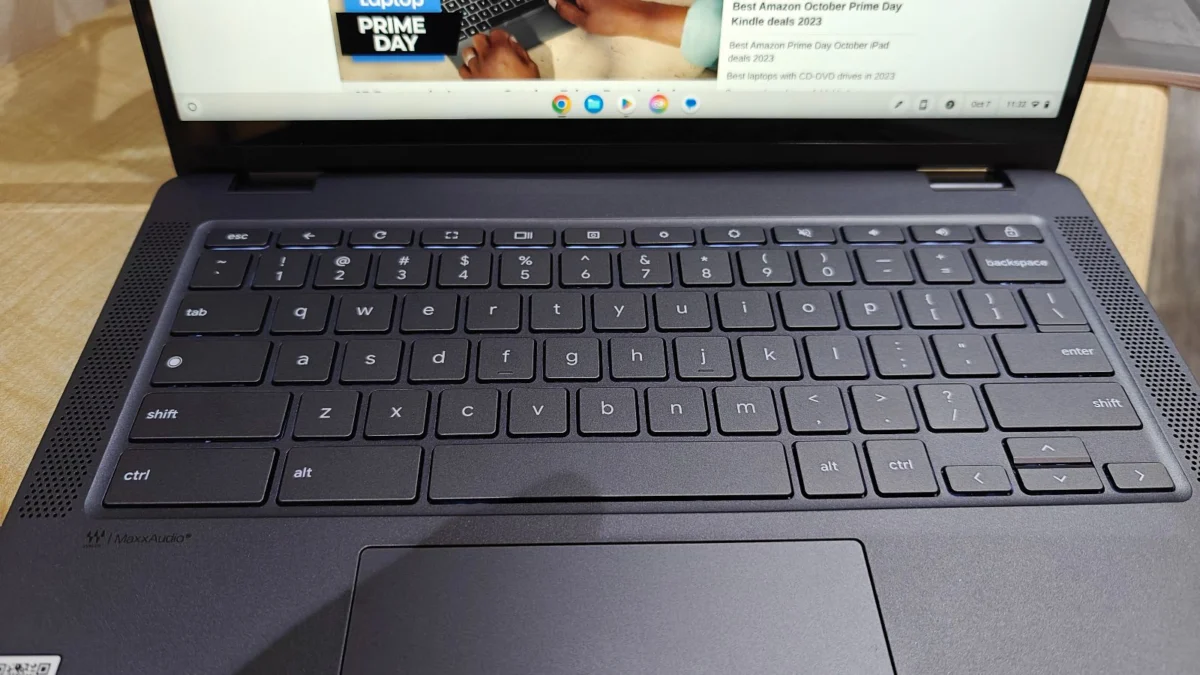
Due to the ultra-compact 60% form factor, the K65 RGB Mini omits dedicated arrow keys, a number pad, a navigation cluster (Page Up/Page Down, Insert, Delete), and the top row of function keys. To compensate for the physical space reduction, Corsair has integrated these missing inputs as secondary functions accessible via dual Function (Fn) keys located side-by-side on the bottom right of the board.
Through key combinations, users can access arrow navigation, media controls, macros, and standard F-keys. While transitioning from a TKL or full-sized keyboard requires an adjustment period, the onboard mapping quickly becomes second nature for users seeking to reclaim desk real estate. The primary advantage of this layout—as echoed by professional streamers and competitive gamers—is the significant reduction in physical footprint, allowing for wider mouse sweeps and improved ergonomic alignment during intense gaming sessions.
Mechanical Switches and Acoustic Performance
The K65 RGB Mini is offered in three distinct Cherry MX switch variants: Cherry MX Silent, standard Cherry MX Reds, and the high-speed Cherry MX Speed linear switches. Notably, the keyboard lacks hot-swappable switch sockets, meaning users are permanently locked into their initial switch choice unless they possess soldering equipment.
Evaluation of the Cherry MX Speed variant reveals a mixed performance profile. Engineered with a rapid 1.2mm actuation point, the switches are undeniably fast, making them well-suited for twitch-reaction gaming. However, typing smoothness falls short of expectations when compared to modern optical switches or competing linear offerings on the market. Reviewers noted a subtle scratchiness or "grindyness" during travel, accompanied by noticeable acoustic resonance and switch ping when bottoming out firmly.
On a positive note, the keyboard’s internal stabilizers represent a notable improvement over previous Corsair generations, offering a balanced and stable feel across larger keys like the spacebar and shift modifiers. Despite the acoustic ping, the board easily handles fast-paced gaming inputs without functional degradation.
AXON Technology and the 8,000Hz Polling Rate Debate
One of the most heavily marketed hardware features of the K65 RGB Mini is Corsair’s proprietary AXON hyper-processing technology, which enables an unprecedented 8,000Hz polling rate. While ultra-high polling rates have seen rapid adoption in high-end gaming mice—where sub-millisecond cursor updates provide tangible precision for professional first-person shooter (FPS) competitors—the practical utility of an 8,000Hz polling rate in a mechanical keyboard remains a subject of intense technical debate.
Mechanical keyboard switches inherently feature physical debounce delays and mechanical actuation travel times that operate on a different temporal scale than optical mouse sensors. While high-end optical keyboards, such as the Corsair K100 utilizing OPX switches, can theoretically benefit from accelerated polling, traditional mechanical switches may not saturate an 8,000Hz communication pipeline with meaningful data.
In performance testing, enabling the 8,000Hz polling rate via Corsair’s iCue software did not introduce a noticeable spike in CPU resource consumption during standard typing tasks. However, in-game benchmarks revealed a consistent, minor performance penalty: systems running the keyboard at 8,000Hz experienced an average drop of approximately three frames per second (FPS) in both average and 99th-percentile frame rates compared to a standard 1,000Hz setting. Corsair provides a built-in software warning regarding potential resource overhead when activating this mode, allowing users to manually dial back the polling frequency depending on their system specifications.
Software Integration via Corsair iCue
Management of the K65 RGB Mini’s lighting, key remapping, and hardware profiles is handled through Corsair’s overhauled iCue software suite. The redesigned user interface presents a simplified, streamlined dashboard that clearly organizes connected hardware components and profile settings.
Key assignments allow for straightforward macro creation, custom key remapping, and the establishment of hardware key assignments that persist on the keyboard’s onboard memory even when the iCue software is not actively running in the background. This onboard capability extends to lighting profiles, making it convenient for users who travel with their peripheral.
Lighting customization is handled through a layered system rather than individual key selection, enabling users to create complex visual themes—such as static accent lighting on WASD clusters paired with dynamic background animations like spiral rainbows. Additionally, the software allows users to customize the indicator color of the Windows lock function, providing clear visual feedback when system keys are disabled. Device settings house the controls for polling rate adjustment, LED brightness scaling, and firmware management.
Broader Industry Impact and Market Implications
Corsair’s entrance into the 60% keyboard market signifies a mature response to long-standing shifts in consumer preferences. By delivering a competitively priced, feature-rich device backed by a robust software ecosystem, Corsair successfully addresses a major gap in its product portfolio.
While the K65 RGB Mini faces minor criticisms regarding switch smoothness, edge ergonomics, and the practical necessity of an 8,000Hz polling rate, its aggressive pricing and widespread retail availability ensure that compact mechanical keyboards will reach an even broader consumer base. As the peripheral market continues to evolve toward minimalism and high-performance customization, Corsair’s inaugural 60% offering establishes a solid foundation for future iterations in the ultra-compact space.