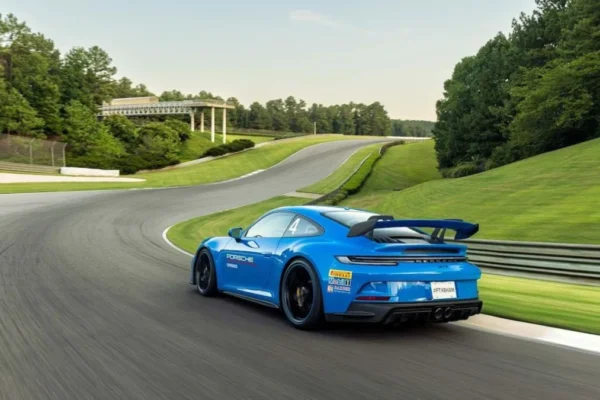




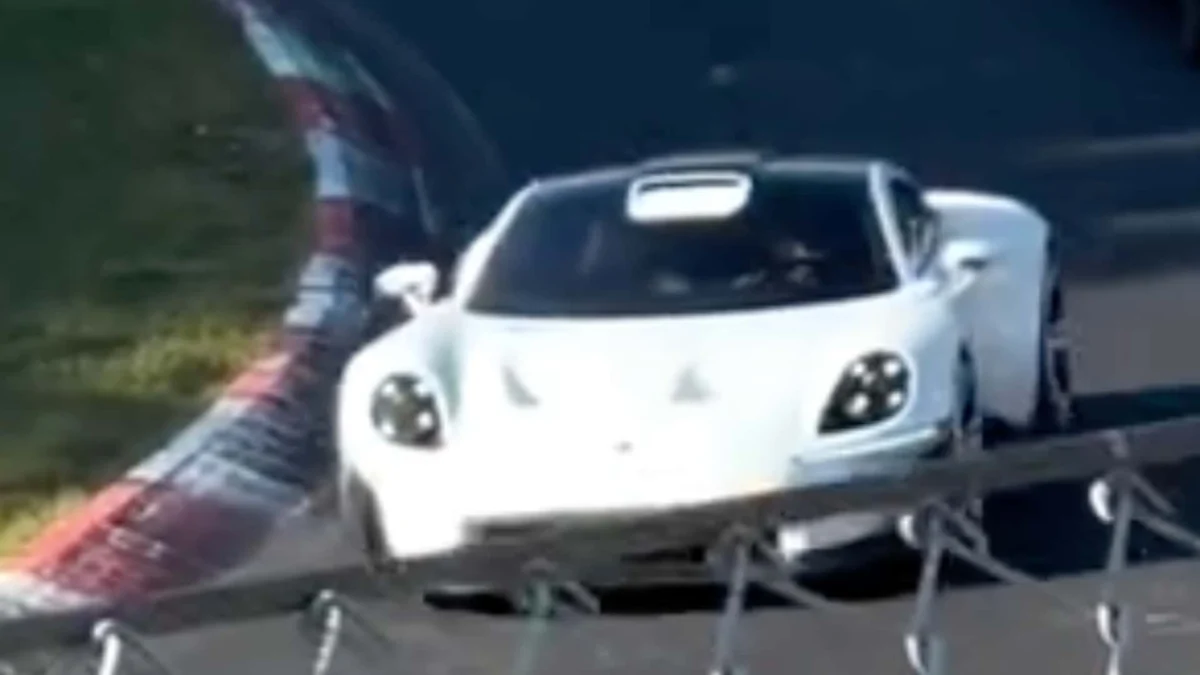
Less than a month after its high-profile debut, the Porsche Mission S supercar concept has been spotted at the legendary Nürburgring Nordschleife. The vehicle was captured on video by enthusiasts jb922_3rs and porsche.gt.br, providing the first glimpse of the "vision model" in a real-world, dynamic environment. The footage shows the supercar being trailed by a Mercedes-Benz van equipped with professional cinematography rigs, confirming that the visit to the "Green Hell" was orchestrated for marketing and promotional purposes rather than a performance-focused shakedown.
The appearance of the Mission S at the world’s most demanding circuit is significant, as the track is synonymous with Porsche’s internal development cycles. While the vehicle moved with purpose across the tarmac, the lack of aggressive driving or high-speed testing maneuvers suggested a carefully choreographed photoshoot intended to generate high-quality visual assets for future promotional campaigns.
The Mystery of the Powertrain
Despite its presence at the track, the mechanical heart of the Mission S remains shrouded in mystery. Porsche has maintained a strict silence regarding the technical specifications of the concept. However, the auditory profile of the vehicle, captured during its Nürburgring session, has fueled intense speculation within the automotive industry. Unlike the silent operation of current electric vehicle prototypes, the Mission S emits a distinct, powerful mechanical rumble.
Independent analysis of the engine notes has led many industry experts to speculate that the car utilizes a high-output internal combustion engine, potentially a flat-eight configuration. Given Porsche’s current engineering trajectory, it is highly probable that any such engine would incorporate advanced hybridization technology to meet modern efficiency standards while delivering the performance expected of a halo supercar. The shift from pure electric concepts to a hybrid-rumored supercar platform marks a potential pivot point for the Stuttgart-based manufacturer, signaling that while electrification is the company’s future, combustion still has a place in its high-performance lineup.
Chronology and Development Context
The timeline of the Mission S project has been remarkably compressed, reflecting the urgency with which Porsche is exploring its next flagship vehicle.
- Initial Concept Reveal: In early 2025, Porsche unveiled the Mission S to significant global acclaim. The vehicle was positioned as a design study, intended to bridge the gap between the heritage of the 911 and the high-performance innovations of the 917 and GT1.
- Public Feedback Phase: Following the debut, Porsche executives reported receiving "overwhelming" interest from prospective buyers. The sheer volume of inquiries regarding production availability forced the company to issue several public clarifications regarding the car’s status.
- The Nürburgring Photoshoot: Less than 30 days post-reveal, the vehicle was transported to the Nürburgring. This indicates that Porsche is prioritizing the creation of high-fidelity visual materials to maintain public interest while the internal development team continues to evaluate the car’s viability.
A Design Language for the Future
The Mission S represents a significant departure from the current Porsche design language, introducing a concept dubbed "Floating Volumes." This aesthetic philosophy focuses on aerodynamic efficiency and structural minimalism. By drawing inspiration from the iconic Porsche 959 and the endurance-racing pedigree of the 917, the design team has created a vehicle that feels both nostalgic and futuristic.
The interior continues this theme of focused, analog-forward engineering. In an era dominated by large, infotainment-heavy dashboard layouts, the Mission S prioritizes driver engagement. The cabin features a sparse, purposeful design that blends traditional analog gauges with subtle digital displays. This choice underscores Porsche’s intent to cater to purists who value tactile feedback and minimal distractions over the increasingly digitized experiences found in contemporary luxury vehicles.
Official Stance and Production Realities
Despite the excitement surrounding the car, Porsche has been categorical in its current stance: the Mission S is not scheduled for mass production. CEO Michael Leiters has characterized the vehicle as a "vision model," a tool designed to gauge market sentiment and test the scalability of a new super sports car platform.
"Customer demand will define what we build on this platform," Leiters stated in recent briefings. This policy of "demand-led development" suggests that while there is no current assembly line slated for the Mission S, the company is actively monitoring the potential for a limited-run or bespoke production vehicle.
Furthermore, the possibility of a manual transmission—a feature increasingly rare in the supercar segment—has been explicitly left on the table. Should the feedback from the enthusiast community remain consistently positive regarding a three-pedal setup, Porsche’s flexible platform architecture could theoretically accommodate such a request, providing a unique selling proposition in a market saturated with dual-clutch, paddle-shift transmissions.
Implications for the Porsche Brand
The decision to parade the Mission S at the Nürburgring, despite it being a non-production concept, is a calculated marketing maneuver. By associating the design study with the Nordschleife, Porsche reinforces its brand identity as the definitive manufacturer of high-performance driving machines. It serves as a reminder that regardless of the powertrain—be it hybrid or purely internal combustion—the core DNA of the vehicle remains rooted in track capability.
From an industry perspective, the Mission S acts as a bridge. As Porsche navigates the transition toward a more electrified portfolio, the Mission S serves as a buffer, assuring the core enthusiast base that the "Porsche experience"—characterized by sound, engagement, and extreme engineering—will persist.
The vehicle also underscores a broader industry trend: the "super-concept." Manufacturers are increasingly using these high-profile design studies not just to preview future tech, but to maintain brand prestige in a highly competitive market where rivals are constantly pushing the boundaries of performance and design.
Broader Market Analysis
If Porsche were to move forward with the production of the Mission S, it would occupy a space well above the current 911 hierarchy. This would pit the vehicle against the upper echelons of the hypercar market, including offerings from brands like Ferrari, McLaren, and Bugatti.
The economic implications are equally significant. A low-volume, high-price vehicle built on this platform would likely serve as a halo car, designed to boost the brand’s image and justify the development of high-cost, high-performance modular platforms that could later trickle down into the next generation of 911s or mid-engine sports cars.
While investors and analysts continue to watch the company’s push toward electrification, the Mission S acts as a reminder that Porsche’s heritage is built on the internal combustion engine. The ability to successfully balance the public’s desire for traditional supercars with the company’s mandated shift toward carbon neutrality will be the defining challenge for Porsche’s product development in the coming decade.
As of now, the Mission S remains a design study in the most literal sense. However, the fact that it is being filmed at the world’s most famous track suggests that Porsche is not yet done telling the story of this car. Whether it enters production as a limited-edition track weapon or remains a permanent fixture in the Porsche museum, the Mission S has already succeeded in its primary goal: sparking a global conversation about the future of the performance automobile.
The company is expected to release further information regarding its future sports car strategy in the coming months, though specific details about the Mission S remain speculative. For now, the automotive world must content itself with glimpses of the car on the track, waiting to see if this "vision" will eventually transition into a production reality.