










Owning a Porsche is a status symbol recognized globally, yet the chasm between owning a high-performance vehicle and possessing the technical expertise to operate it at its limit is significant. Recognizing this, Porsche Cars North America (PCNA) has announced a major expansion of its Porsche Track Experience (PTX) curriculum. By introducing two specialized courses—GT Drift and Masters GT—the company is shifting its focus toward professional-grade driver development, specifically utilizing the high-revving, track-oriented 911 GT3 platform. This strategic expansion reflects a growing consumer demand for experiential luxury, where the value lies not just in the hardware of the car, but in the mastery of the driver.
The Evolution of the Porsche Track Experience
The Porsche Track Experience has long served as the cornerstone of the brand’s customer engagement strategy. Since its inception, the program has evolved from basic performance driving clinics into a sophisticated tiered curriculum. Historically, the progression began with single-day introductory courses designed to familiarize drivers with the fundamental physics of mid-engine and rear-engine dynamics, eventually scaling up to three-day advanced courses held at premier circuits across North America.
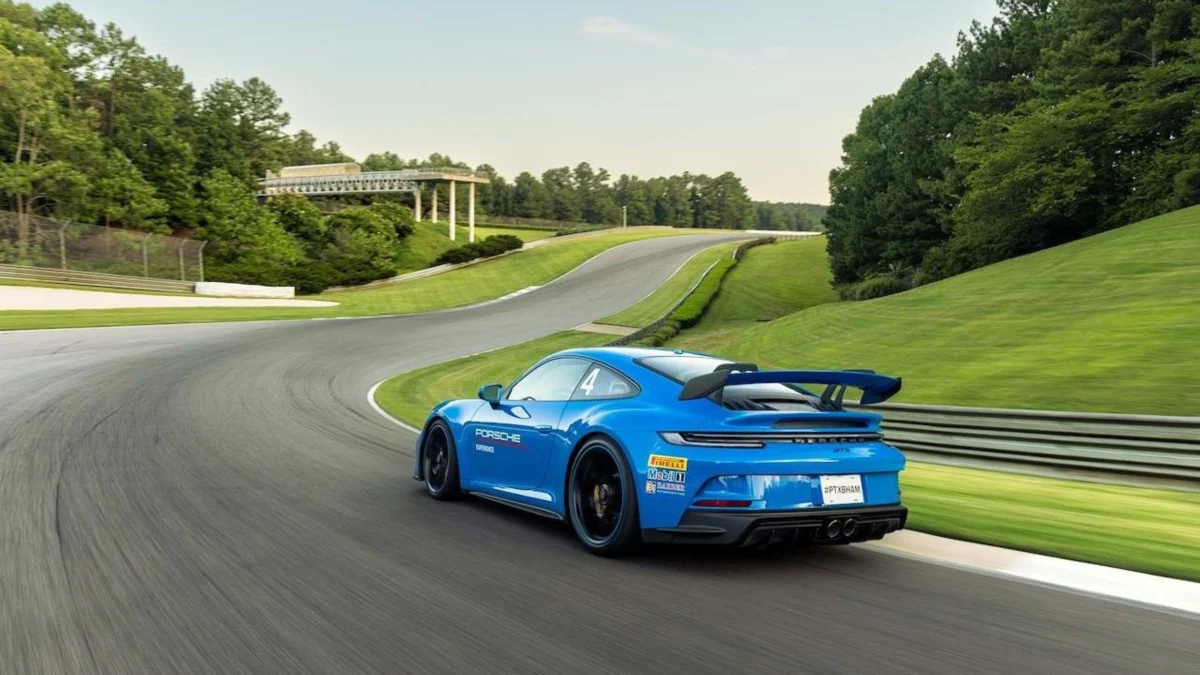
The integration of the 911 GT3 into these new modules marks a departure from standard fleet usage. The 911 GT3 is not a typical road car; it is a direct descendant of Porsche’s motorsport division, featuring a naturally aspirated 4.0-liter flat-six engine that revs to 9,000 rpm, a double-wishbone front suspension, and aggressive aerodynamics. By centering the new curriculum on this specific model, Porsche is effectively bringing a professional-grade race car experience to its enthusiast base.

GT Drift: Mastering Vehicle Dynamics
The first of the new offerings, GT Drift, is a half-day intensive program designed to demystify the art of oversteer. Priced at $1,500, the course targets the gap between standard road driving and high-performance car control.
The curriculum begins in a traditional classroom setting, where instructors provide a theoretical foundation in vehicle dynamics, specifically focusing on weight transfer, yaw rate, and slip angles. Once the participants move to the tarmac, the focus shifts to the skid pad—a controlled environment where the consequences of losing traction are minimized. Under the guidance of professional instructors, students engage in technical exercises including trail braking, rotation management, and sustained drifting. The objective is to teach drivers how to manage a car when the front and rear axles are no longer tracking in the same direction, a skill that significantly enhances a driver’s confidence and reaction time in emergency situations.
Masters GT: The Pinnacle of Driver Development
For the most dedicated enthusiasts, Porsche has introduced the Masters GT program. This is a three-day advanced driving course that serves as the new ceiling of the PTX portfolio. Unlike the entry-level or mid-tier classes, Masters GT is an invitation-only program, restricted to graduates of the existing Masters RS course.
The $23,000 price point for the Masters GT program underscores its exclusivity and the level of personalized instruction involved. The schedule is rigorous:

- Day One: Hosted at the Barber Proving Grounds, this day is dedicated to high-speed vehicle control, refining inputs, and mastering the complex geometry of track driving.
- Days Two and Three: The training shifts to the full racetrack. Participants alternate between open lapping sessions and forensic data review. Using advanced telemetry systems, instructors analyze the driver’s braking points, throttle application, and steering inputs, providing immediate, granular feedback.
This curriculum is designed to mimic the professional development path of race car drivers, emphasizing data-driven improvement over subjective "seat-of-the-pants" driving.
Industry Context and Strategic Implications
The expansion of PTX arrives at a time when the automotive industry is undergoing a paradigm shift. As autonomous driving technologies and electrification become more prevalent, the role of the "driver’s car" is being redefined. Porsche’s investment in these programs suggests a long-term commitment to internal combustion performance and the preservation of driving as a skilled hobby rather than a mundane utility.
Timo Resch, President and CEO of Porsche Cars North America, emphasized the importance of this experiential approach. "Nothing compares to the experience of driving a Porsche with the beating heart of a race car," Resch stated. "The 911 GT3 doesn’t just promise, but delivers a motorsport-derived driving experience, one that’s rooted in real-world competition. The best way to truly appreciate what makes a GT3 special is from behind the wheel, and there is no better place to do that than on a racetrack with professional instruction."
From a market perspective, this move serves three primary functions:

- Brand Loyalty: By fostering a community of skilled drivers, Porsche deepens the emotional connection between the consumer and the brand.
- Product Validation: Exposing potential buyers to the absolute limits of the 911 GT3 in a controlled environment is an effective sales tool. It validates the high engineering costs associated with Porsche’s GT-line vehicles.
- Safety Advocacy: While the courses focus on performance, they inherently improve safety by teaching participants how to handle a vehicle in extreme, low-grip scenarios.
Analysis of the Competitive Landscape
Porsche is not the only manufacturer to recognize the value of track-based customer experiences. Brands such as Ferrari (Corso Pilota), BMW (M Track Days), and Mercedes-AMG (Driving Academy) all maintain robust programs. However, Porsche’s strategy of utilizing the 911 GT3—a car that is widely considered the benchmark for track-day enthusiasts—gives them a unique competitive advantage.
The inclusion of data telemetry in the Masters GT course positions Porsche closer to professional motorsport training than most other OEM-sponsored track days. By integrating performance data analysis, Porsche is catering to a demographic that values technical accuracy and continuous improvement.
The Future of Performance Driving
As the automotive sector moves toward 2030, the ability to operate high-performance vehicles will likely become an increasingly niche skill set. By formalizing this training through the PTX, Porsche is essentially creating a "Porsche University" for its customers. The investment of $23,000 for a three-day course is significant, but it reflects the cost of high-level professional coaching, track access, insurance, and the wear-and-tear on a fleet of high-performance vehicles.
The expansion into these specific training modules signifies that Porsche is not merely selling machines; they are selling a lifestyle centered around technical mastery. For the modern luxury consumer, who is increasingly prioritizing experiences over physical assets, the PTX programs offer a tangible return on investment: the development of a skill set that lasts long after the track day has concluded.

As the program rolls out these new modules, industry observers expect the demand for spots to be high. Given the exclusivity of the Masters GT program, the barrier to entry serves as a filter that ensures a high standard of competence among the participants, maintaining the premium nature of the Porsche brand. Whether this will lead to further expansions—perhaps incorporating electric platforms like the Taycan or future hybrid variants—remains to be seen, but for now, the focus remains firmly on the mechanical purity and high-revving performance of the 911 GT3.