











The rapid commercial adoption of large language models (LLMs) has collided with a fundamental physical constraint of modern computer hardware: the speed at which data can move through memory. While tech giants and AI laboratories continuously scale up model sizes—pushing parameter counts into the hundreds of billions—users increasingly demand instantaneous responses. Applications ranging from real-time customer service agents and conversational coding assistants to autonomous robotic systems require sub-second latency to feel genuinely responsive.
However, standard autoregressive text generation relies on producing a single token at a time. This sequential bottleneck has historically limited inference throughput, forcing hardware compute units to sit largely idle while waiting for massive parameter weights to transfer from memory. To solve this dilemma, researchers and systems engineers have broadly embraced a clever acceleration paradigm known as speculative decoding. By altering the generation strategy rather than the model itself, speculative decoding achieves dramatic 2x to 3x speed improvements without altering the underlying mathematical distribution or degrading output quality.
The Core Bottleneck: Memory-Bandwidth Constraints in Modern GPUs
To understand why speculative decoding represents such a critical breakthrough, one must examine the operational mechanics of standard autoregressive generation. When an LLM processes a prompt and begins writing a response, it cannot generate the entire sequence simultaneously. Instead, it reads all preceding tokens, performs a massive matrix multiplication across its entire parameter set, and outputs precisely one new token. The model then appends this new token to the context window and repeats the entire cycle for the subsequent token.
The primary impediment here is not a lack of raw processing power. State-of-the-art accelerators, such as the NVIDIA H100 and newer enterprise hardware clusters, possess staggering computational capacity for matrix math. The constraint lies in memory bandwidth. An LLM’s billions of parameters must reside in High Bandwidth Memory (HBM). Before the processor can calculate even a single token, every single weight must be fetched from memory into the processor caches.
Because generating a single token requires reading the entire parameter set just to produce a few bytes of output, the GPU spends the vast majority of its operational cycle waiting for memory transfers rather than performing computations. Systems architects refer to this state as being "memory-bandwidth bound." Simply adding more raw compute capacity to a server yields diminishing returns because the pipe connecting memory to the processor is saturated. Overcoming this barrier required a fundamental rethink of how tokens are requested, generated, and verified.
The Evolution and Chronology of Speculative Decoding
The foundational mathematics underpinning speculative decoding were independently formalized by research teams in late 2022, notably detailed in breakthrough papers from Google Brain ("Fast Inference from Transformers via Speculative Decoding") and Stanford University ("Accelerating Large Language Model Decoding with Speculative Sampling"). Prior to these formal publications, the core concepts of draft-and-verify sampling existed in early academic literature concerning Markov Chain Monte Carlo (MCMC) methods, but applying them to deep autoregressive transformers proved transformative.
During 2023, as open-weight models like Meta’s LLaMA ecosystem democratized local and enterprise LLM deployment, speculative decoding transitioned from theoretical computer science papers into production-grade systems. Engineers quickly realized that standard inference pipelines were wasting substantial GPU cycles. By 2024, major open-source inference frameworks—including vLLM, Hugging Face’s Text Generation Inference (TGI), and llama.cpp—integrated speculative decoding as a native configuration option, allowing organizations to slash hosting costs and latency without retraining models or fine-tuning weights.
How the Speculative Loop Operates in Practice
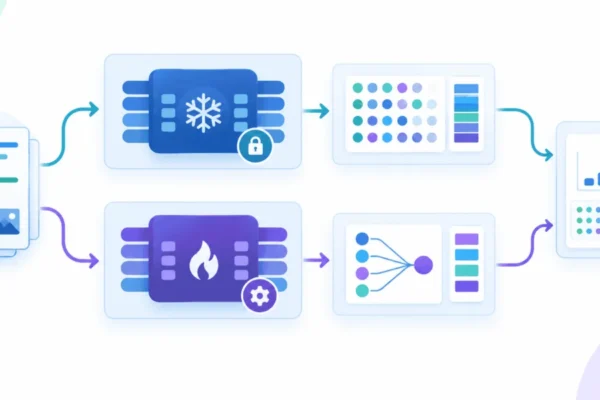
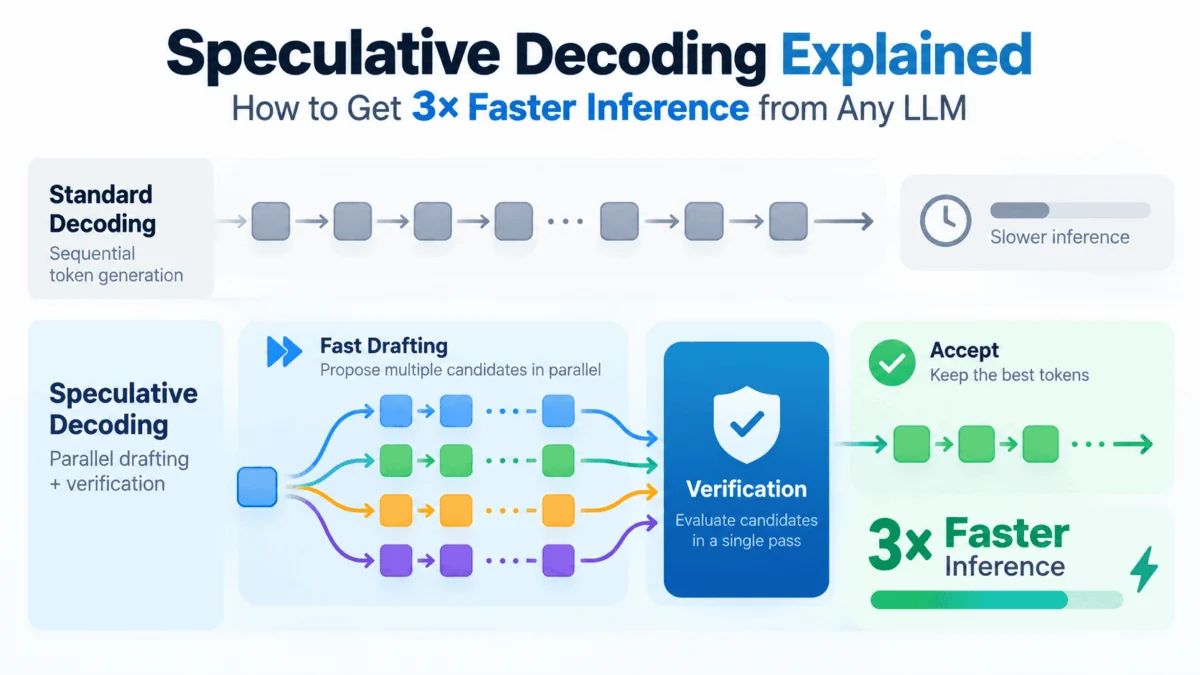
Speculative decoding circumvents the one-token-at-time trap by splitting the generation workload between two distinct entities: a fast, lightweight "draft model" and a powerful, authoritative "target model."
The process unfolds in a structured, multi-step loop:
- Drafting Candidate Tokens: The auxiliary draft model—often a smaller variant with a fraction of the parameters, or a specialized predictor—rapidly generates a short sequence of candidate tokens (typically four to eight tokens). Because of its compact size, the draft model moves through memory quickly, producing these speculative guesses at a fraction of the time and energy cost required by the target model.
- Parallel Verification: Once the candidate sequence is formed, it is handed off to the large target model. Instead of evaluating the tokens one by one, the target model processes the entire candidate batch in a single forward pass. Because modern GPUs are optimized for parallel matrix operations, evaluating a sequence of tokens takes only marginally longer than evaluating a single token.
- Probabilistic Acceptance and Correction: The target model scores each candidate token by comparing its own predicted probability distribution against that of the draft model. If the target model’s confidence matches or exceeds the draft model’s confidence, the token is accepted. If the draft model was overly confident about an improbable choice, the system executes a statistical sampling correction, rejecting the erroneous token and substituting a valid one derived from the target model’s true distribution.
This verification step is underpinned by rigorous statistical guarantees. The mathematical framework ensures that the final output sequence possesses an identical probability distribution to what the target model would have produced entirely on its own. There is no approximation of quality; the output remains pristine while generation velocity surges.
Quantifying the Performance Gains and Acceptance Rates
The real-world efficacy of speculative decoding hinges primarily on the "acceptance rate"—the percentage of draft tokens successfully validated by the target model. When deployed with well-matched model pairs (such as a 7B parameter draft model paired with a 70B parameter target model) on standard language tasks, acceptance rates routinely hover between 70% and 80%.
Under these optimal conditions, systems achieve end-to-end latency reductions that translate to a 2x to 3x increase in tokens generated per second. Tasks characterized by predictable syntax, repetitive structures, or domain-specific terminology—such as Python code completion, legal document drafting, and structured JSON generation—frequently yield even higher acceptance rates, pushing performance gains past the 3x threshold.
Conversely, in the worst-case scenario where the draft model’s initial tokens are immediately rejected, the system incurs a minor computational overhead. The time spent generating the draft tokens is wasted, and processing reverts to standard single-token decoding for that step. However, because verification is so efficient, this worst-case overhead results in a negligible performance penalty rather than catastrophic failure.
Advanced Paradigms: Moving Beyond the Two-Model Setup
While the classic formulation requires maintaining two separate models in GPU memory, recent algorithmic innovations have refined the approach to eliminate the need for a standalone draft model entirely.
Medusa, introduced by researchers in early 2024, modifies the architecture of the target model itself. By attaching multiple auxiliary prediction heads directly to the final transformer layer, the target model can simultaneously predict several future token positions in a single forward pass, eliminating external model overhead.
Similarly, Eagle (Extrapolation Algorithm for Greater Language-model Efficiency) shifts the prediction mechanism away from output tokens and into the target model’s internal hidden states. Because hidden states encapsulate richer semantic context, Eagle achieves higher acceptance rates on complex, creative writing tasks.
Meanwhile, Prompt Lookup Decoding approaches acceleration without any secondary neural network. By scanning the immediate input prompt and conversation history for recurring phrases or sequences, it uses exact string matching to draft candidate tokens. This heuristic approach proves remarkably effective for code editing and document summarization, where output text frequently echoes vocabulary present in the prompt.
Industry Implications and Production Trade-Offs
For enterprise practitioners and infrastructure engineers, speculative decoding has shifted from an experimental research technique to a standard deployment best practice. Frameworks like vLLM and Hugging Face TGI allow developers to enable speculative decoding via simple configuration flags, immediately reducing cloud infrastructure costs and improving user experience.
However, systems architects must carefully evaluate operational trade-offs. Speculative decoding excels in low-to-medium concurrency environments where users submit sequential requests and instantaneous time-to-first-token matters. In contrast, in massive, heavily batched production environments processing thousands of concurrent requests, speculative decoding can sometimes degrade overall throughput. The memory and compute resources required to draft and verify candidate tokens can crowd out space that would otherwise be utilized to process broader batch requests.
As artificial intelligence continues its transition from proof-of-concept deployments to ubiquitous enterprise infrastructure, inference optimization techniques like speculative decoding will remain vital. By bridging the gap between hardware memory limits and user expectations for real-time responsiveness, speculative decoding ensures that large language models can scale efficiently to meet the demands of the modern digital economy.