The rapid commercialization of generative artificial intelligence has introduced a lexicon of buzzwords, with "agent" rapidly emerging as the most ubiquitous and misunderstood term in software engineering. Across the technology sector, applications ranging from basic scripted document parsers to rigid automated cron jobs are routinely rebranded as autonomous agents. This semantic drift has created significant confusion for development teams, leading many organizations to deploy highly complex, unpredictable agentic systems for tasks that could be handled more reliably and economically by traditional deterministic architecture. To address this friction, software architects and machine learning engineers are increasingly adopting a foundational question before writing code: Can the sequence of execution be mapped out in advance?
The distinction between a structured AI workflow and an autonomous AI agent is not merely academic; it dictates cost structures, operational reliability, security parameters, and infrastructural overhead. As enterprises transition from experimental artificial intelligence proofs-of-concept to mission-critical production environments, defining these architectural boundaries has become a primary objective for engineering leadership. Industry analysts note that misapplying agentic frameworks where traditional pipelines suffice often results in inflated token expenditures, unpredictable error loops, and severe compliance vulnerabilities.
Understanding AI Workflows: Deterministic Pipelines with Cognitive Capabilities
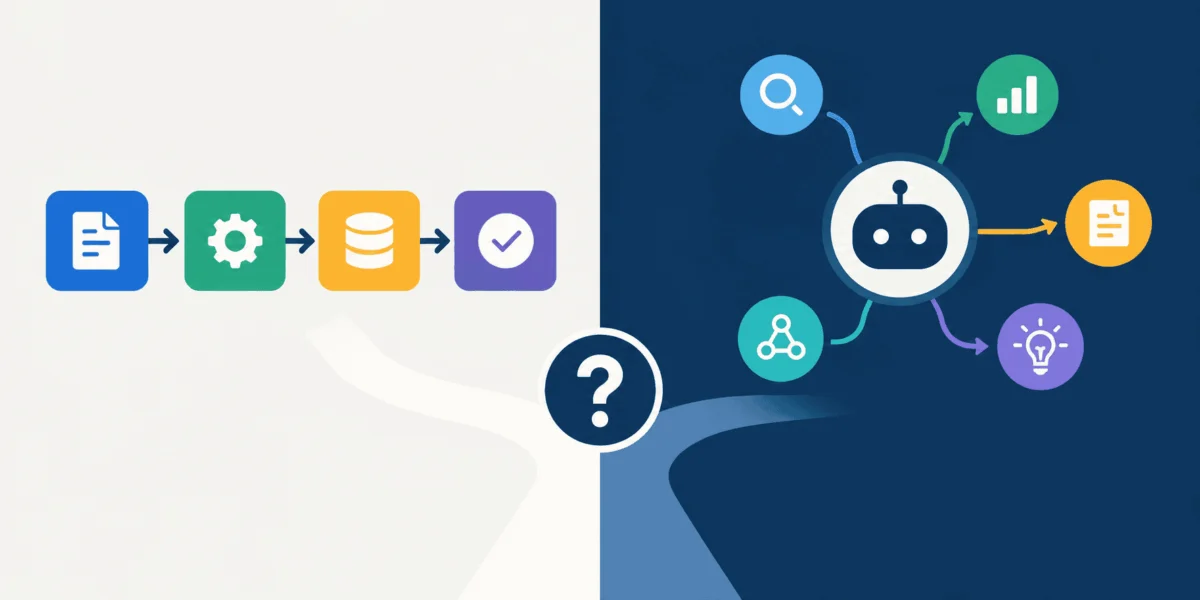
An AI workflow—frequently referred to in software engineering literature as a pipeline or chain—is defined by a control flow that is entirely fixed at design time. In this paradigm, developers predetermine the exact sequence of operational steps, branching logic, validation checks, and termination conditions before any runtime execution occurs. While these architectures frequently incorporate large language models (LLMs) or specialized computational tools within individual steps—thereby forming hybrid systems—the overarching journey from input to output remains invariant.
Consider, for example, a corporate customer refund processing system. Such a pipeline might ingest a support ticket, utilize an LLM to extract key transaction metrics, cross-reference company policy databases, execute a conditional logic check regarding transaction age, and ultimately trigger an automated ledger update. Although this architecture leverages advanced machine learning models to parse unstructured human language, it remains fundamentally a workflow. A systems architect could accurately draw the entire state transition diagram on a whiteboard before a single customer interaction takes place.
The primary advantage of the workflow model lies in its determinism. Because every possible path through the system is explicitly coded and accounted for during development, organizations retain tight control over execution behavior. This predictability is vital for industries bound by strict regulatory oversight, audit trails, and deterministic data handling mandates. Furthermore, workflows consume significantly fewer computational resources, executing within strict token budgets and predictable latency windows.
Understanding AI Agents: Dynamic Runtime Control and Adaptive Problem-Solving
Conversely, an autonomous AI agent represents a fundamentally different computational model. In an agentic architecture, control of the execution flow is handed over to the LLM at runtime. Given a high-level objective and access to a suite of external tools—such as database query interfaces, log analysis utilities, or API endpoints—the model dynamically determines its own sequence of actions. It decides which tools to invoke, in what order to execute them, and when the objective has been sufficiently satisfied. Crucially, agents possess the capability to evaluate intermediate observations, enabling them to backtrack, execute loops, or alter their strategic approach based on real-time discoveries.
The divergence between workflows and agents becomes apparent during complex, open-ended investigative tasks. For instance, diagnosing a sudden production outage in a cloud infrastructure environment requires navigating a vast, unpredictable problem space. When tasked with identifying the root cause of a sudden spike in checkout failures over a thirty-minute window, an agent cannot rely on a static flowchart.
During one operational incident, the agent might decide to query error rates, pivot immediately to inspecting recent code deployments, analyze specific stack traces, identify a failing database call, and verify real-time database latency. During a subsequent incident driven by an entirely different failure mode, the exact same agent might instead check error rates, segment the failures by geographic region, inspect content delivery network status, analyze Domain Name System error logs, and ultimately isolate a regional third-party internet service provider outage. Because the observation gathered from each action dictates the subsequent step, the control flow is fluid and emergent.
The Single Practical Test for Architectural Selection
To cut through marketing hype and prevent engineering over-engineering, industry veterans recommend a straightforward heuristic: Can a competent software engineer draw a complete, exhaustive flowchart of the task before the LLM ever executes?
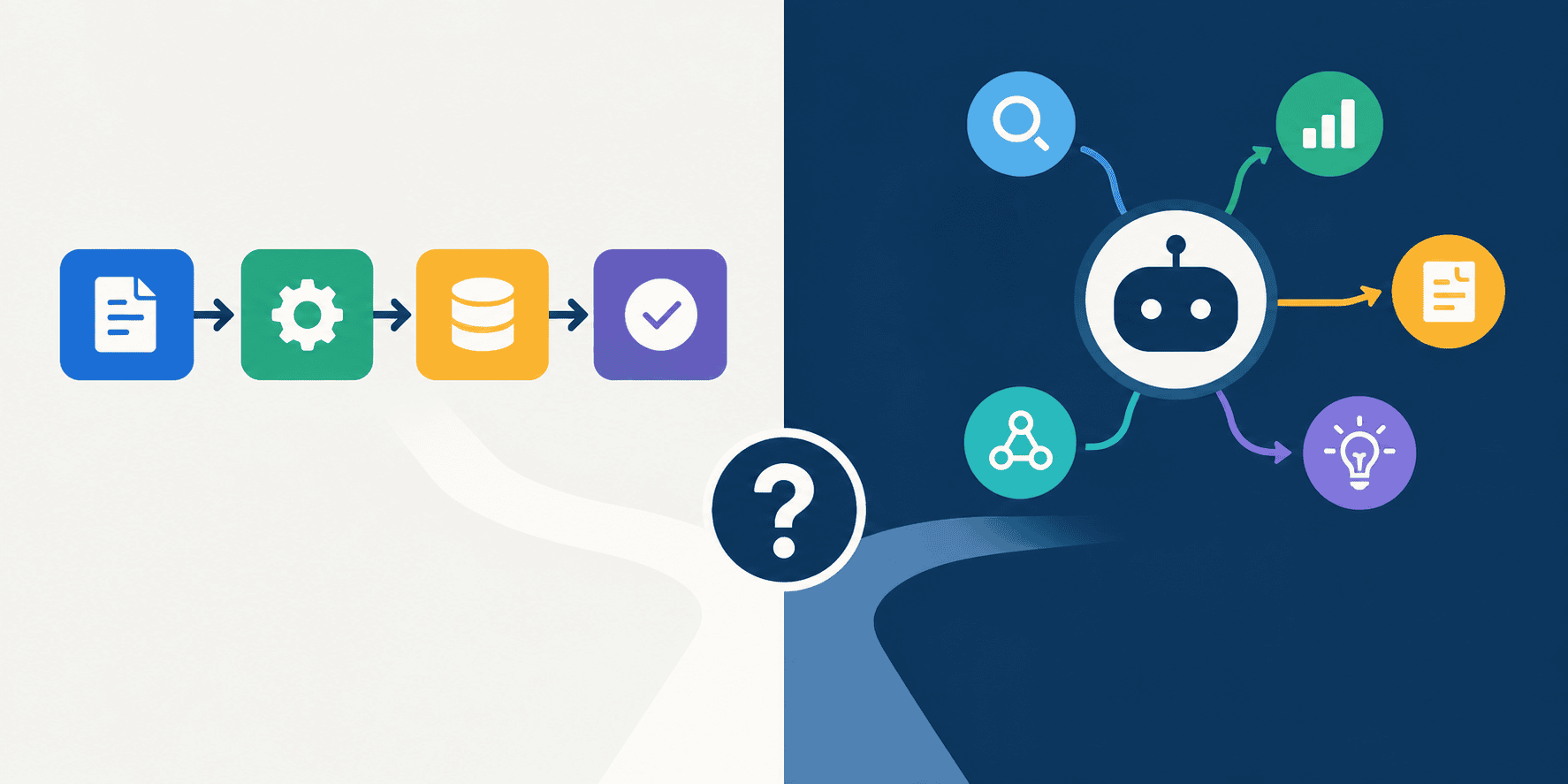
If the answer is affirmative, the task is inherently deterministic, and the application should be built as a workflow. If the process is open-ended and the correct sequence of actions can only be discovered dynamically while the system is actively running, an agentic framework is justified.
A prevalent misconception among emerging development teams is the false equivalence that workflows equal simplicity while agents equal sophistication. In practice, a production-grade workflow can be immensely intricate, incorporating multiple LLM calls, semantic vector search retrievals, sophisticated tool integration, automated retry logic, human-in-the-loop approval gates, and complex business rule validation. Conversely, a trivially simple system can be categorized as an agent if the language model retains the autonomy to choose its next operational step.
Comprehensive Evaluation Checklist for Engineering Teams
Before committing engineering hours to a specific architecture, technical leads should evaluate their use case against a rigorous set of operational criteria:
-
Predictability of Steps and Branches: If major operational steps and conditional branches can be comprehensively listed prior to runtime, the system should be designed as a workflow. Standardized data processing pipelines—such as parsing legal contracts, extracting predefined financial fields, validating formatting constraints, and persisting records to a relational database—benefit immensely from the rigidity and reliability of workflow structures.
-
Variability of Input Data: When incoming requests exhibit low variability and fit neatly within maintainable decision trees, workflows provide optimal performance. However, highly unstructured, unpredictable inputs—such as resolving ambiguous customer support complaints where the exact nature of the grievance is entirely unknown beforehand—may necessitate the dynamic reasoning capabilities of an agent.
-
Sensitivity to Volume, Cost, and Latency: Enterprise applications operating at massive scale must carefully manage computational overhead. Agents inherently require iterative reasoning loops and multiple sequential tool calls, driving up token consumption, API expenses, and end-to-end response latency. High-volume, low-latency applications—such as customer-facing frequently asked question bots or routine transaction processors—should prioritize workflows. Agents are best reserved for high-value, lower-frequency tasks where extended compute time and exploration costs are justified, such as deep security forensics or strategic business research.
-
Compliance, Auditing, and Deterministic Execution: Regulated industries—including finance, healthcare, and legal services—frequently demand identical execution pathways for every transaction to satisfy compliance audits. Workflows guarantee that user data traverses a audited, repeatable path. If an application requires strict adherence to documented verification protocols, a workflow is mandatory.
-
Incremental Architectural Complexity: Engineering best practices dictate starting with the simplest viable architecture. Development teams should initially deploy a structured workflow enhanced with targeted LLM judgment calls at specific decision nodes. For example, a customer service architecture can utilize a fixed pipeline that classifies an incoming issue using an LLM, references corporate policy, evaluates eligibility via structured logic, and processes a refund. If this hybrid model successfully handles production traffic, introducing an autonomous agent introduces unnecessary complexity.
Broader Industry Implications and Future Outlook
The maturation of generative artificial intelligence development frameworks highlights a broader industry shift toward pragmatic engineering over speculative adoption. Early enterprise implementations of artificial intelligence frequently suffered from high failure rates, driven largely by the misapplication of autonomous agents to constrained business processes. By establishing rigorous boundaries between deterministic workflows and dynamic agents, organizations are discovering that hybrid architectures—pipelines anchored by deterministic controls but augmented with cognitive model intelligence—offer the optimal balance of autonomy, reliability, and cost-efficiency.
As enterprise toolsets evolve, software architects emphasize that the choice between an agent and a workflow is not a permanent binary choice, but rather a spectrum. Many sophisticated platforms now feature modular designs where deterministic workflows delegate specific, bounded sub-tasks to specialized micro-agents only when contextual ambiguity requires dynamic problem-solving. Ultimately, disciplined engineering dictates starting with constrained architectures, measuring operational bottlenecks rigorously, and escalating to autonomous agents exclusively where open-ended exploration is mathematically and operationally required.