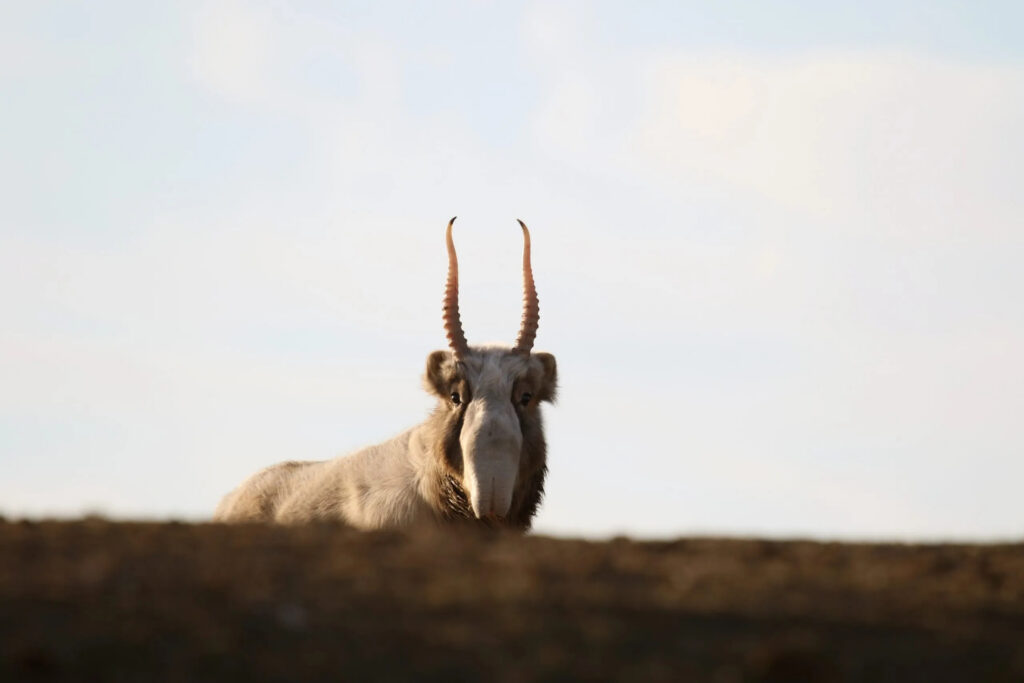
The rugged landscapes of western Kazakhstan offer a striking glimpse into an ancient ecosystem that has largely vanished across the rest of the globe. Skidding off the paved network and onto a web of tire-tracked mud paths, researchers and conservationists regularly navigate the vast, wind-swept expanse of the Eurasian steppe. Flanking these primitive trails are parallel pathways carved by generations of migratory wildlife. Through binoculars, observers can witness an extraordinary wildlife spectacle: hundreds of saiga antelope piercing the frigid Siberian winds, their distinctive, bulbous snouts filtering the air as they sprint across the desolate plains.
As a freedom-loving animal that has roamed Central Asia since time immemorial, the saiga (Saiga tatarica) represents a living link to the Pleistocene epoch. These resilient ungulates once shared a landscape dominated by woolly mammoths, saber-toothed cats, and giant deer with twelve-foot antlers—outliving them all. When early human caravans first navigated this unforgiving terrain, they often relied on saiga herds to guide them through habitable corridors and water sources. Today, however, these prehistoric nomads face unprecedented modern fragmentation, prompting an ambitious conservation initiative led by local and international organizations to restore their ancient migratory pathways.
The Rutting Season and Biological Significance
The timing of field audits conducted by conservation groups, such as the Association for the Conservation of Biodiversity of Kazakhstan (ACBK), is meticulously planned to coincide with the saigas’ annual rutting season. This critical window occurs in late autumn and early winter, marking a period of intense social gathering and biological activity. Antelopes from across the region converge in massive, single-file lines before establishing breeding territories on the open steppe.
For male saigas, the rut is an exhaustive display of physical prowess. Males engage in aggressive headbutting contests and territorial strutting to attract female onlookers, expending so much energy that many succumb to extreme physical exhaustion and starvation. Females, meanwhile, assess potential mates based on several indicators of fitness, most notably the size of the male’s floppy, elongated nose.
The saiga’s trunk-like snout is an evolutionary marvel essential for survival in the semidesert climate. During the dusty summer months, the nose functions as an internal filter, trapping particulate matter before it reaches the lungs. In the dead of winter, the complex nasal cavity warms the frigid, sub-zero air before it enters the respiratory system. Because a larger snout correlates with superior physiological resilience, males actively accentuate this feature during seasonal displays, driving the continuation of the species through harsh environmental extremes.
Historical Context and the Nomadic Heritage of the Steppe
The human history of this region is deeply intertwined with the rhythms of migration. The very word "Kazakh" is widely believed to derive from the Turkic root qaz, meaning "wanderer" or "vagabond." For millennia, human nomadic communities migrated seasonally between high-altitude summer pastures and sheltered winter valleys, gathering periodically for cultural festivals and trade.
These historical transit corridors formed the foundational arteries of the Great Silk Road—not a singular highway, but a dynamic network of pathways connecting reliable stopover points. The fertile banks of the Ural River, which serves as the natural geographical boundary between Europe and Asia, became a critical transcontinental crossroads. Strategic settlements along the river provided weary caravans with rest, public baths, and supplies before they pressed onward.
Throughout these centuries of human empire-building—from Turkic tribes and the conquests of the Genghis Khan era to the administration of the Russian Empire—saigas remained an integral part of the regional consciousness. Cave paintings dating back to the seventh century BCE depict the antelope as elusive, resilient symbols of the harsh terrain.
However, the twentieth century brought a drastic disruption to this ancient way of life. Under the Soviet Union, mandatory sedentarization policies forced nomadic human populations into agricultural settlements. This top-down modernization effort sought to eliminate perpetual motion, yet much of the steppe soil proved entirely unsuitable for crop cultivation. While human societies largely transitioned to sedentary, urban lifestyles, the saigas maintained their ancient migratory instincts, setting the stage for severe ecological conflict as modern infrastructure expanded.
Infrastructure Expansion and the Threat of Fragmentation
In recent decades, the rapid expansion of industrial infrastructure has severely compromised the saigas’ ability to roam. Roads, railways, and border fences now crisscross the Eurasian steppe, fragmenting once-contiguous populations into isolated groups.
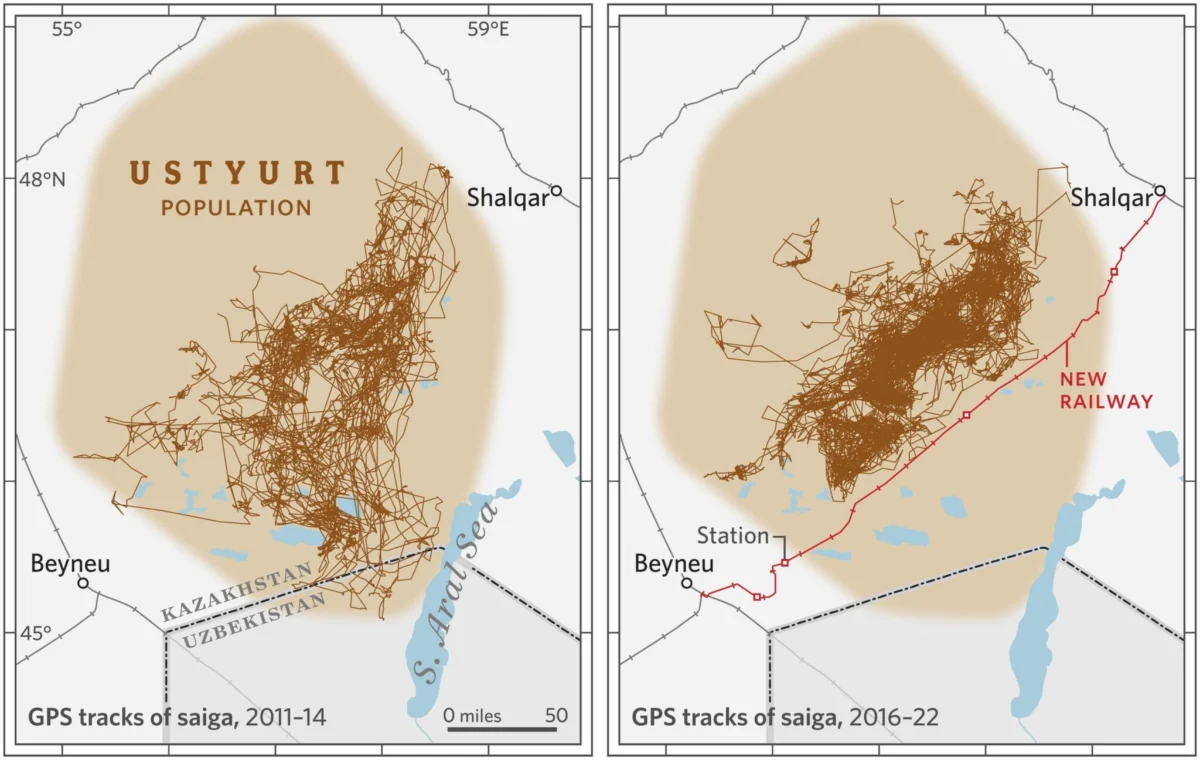
Data compiled by ACBK researchers utilizing GPS-collared saigas illustrate the devastating impact of linear infrastructure. Prior to the construction of a major railway in 2014, saiga herds routinely migrated hundreds of miles between Kazakhstan and Uzbekistan, tracking seasonal shifts in vegetation and water availability. Post-construction tracking data revealed a stark behavioral shift: animals trapped on the northern side of the tracks paced despondently against the barrier, unable to reach traditional grazing grounds that withered to the south.
Wildlife experts note that such physical interruptions can trigger a total collapse in spatial knowledge. Much like human nomads who lost connection to ancestral migration routes following forced sedentarization, young saigas learn survival skills—including optimal feeding grounds, shelter locations, and avoidance zones—through active observation and participation in herd movements. When migratory routes are severed, generational knowledge fades, threatening the long-term viability of the species.
Conservation Strategies and Cross-Border Collaboration
To mitigate the fragmentation of saiga habitats, conservationists have deployed targeted technological and infrastructural solutions. ACBK, in partnership with the Kazakh government, has designed and constructed specialized saiga-friendly crossing points along railway corridors. These features incorporate sloping dirt ramps that match the elevation of the tracks, creating the visual illusion of a natural gap in the barrier. Additionally, strategically placed cattle-guard fences keep trains and ungulates separated at intersections, preventing collisions while preserving passage.
International cooperation has proven equally vital. ACBK has collaborated with Uzbek authorities to modify rigid border security infrastructure. Traditional barbed-wire walls have been replaced with X-shaped barricades that successfully restrict vehicular traffic while maintaining sufficient clearance for saigas to migrate freely across international borders.
These proactive management strategies have yielded measurable results in stabilizing regional populations following near-catastrophic declines caused by historical poaching and disease outbreaks. By restoring functional connectivity across the landscape, conservationists aim to rebuild the ecological trust necessary for the antelope to reclaim their historic range.
Broader Implications for Conservation and Ecology
The ongoing efforts to protect the saiga antelope highlight broader lessons in modern conservation biology. As human development continues to encroach upon the world’s remaining grasslands and steppes, maintaining ecological connectivity is essential for the survival of migratory species.
The plight of the saiga serves as a poignant reminder of the intricate dependencies binding wildlife to their native landscapes. Observers on the remote Kazakh steppe, watching thousands of ungulates traverse the frozen crust, witness a living landscape that predates recorded human history. Preserving this dynamic requires balancing modern economic development with the preservation of ancient migratory pathways, ensuring that the saiga remains a enduring symbol of freedom on the Eurasian plains.