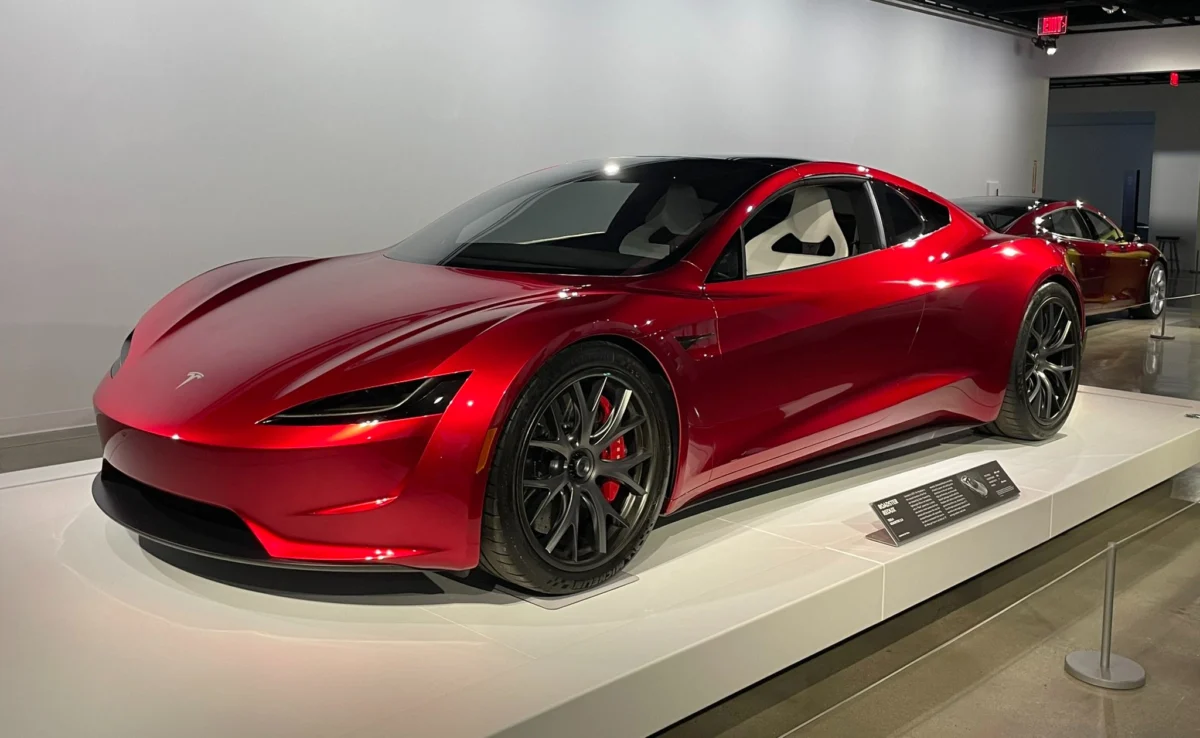
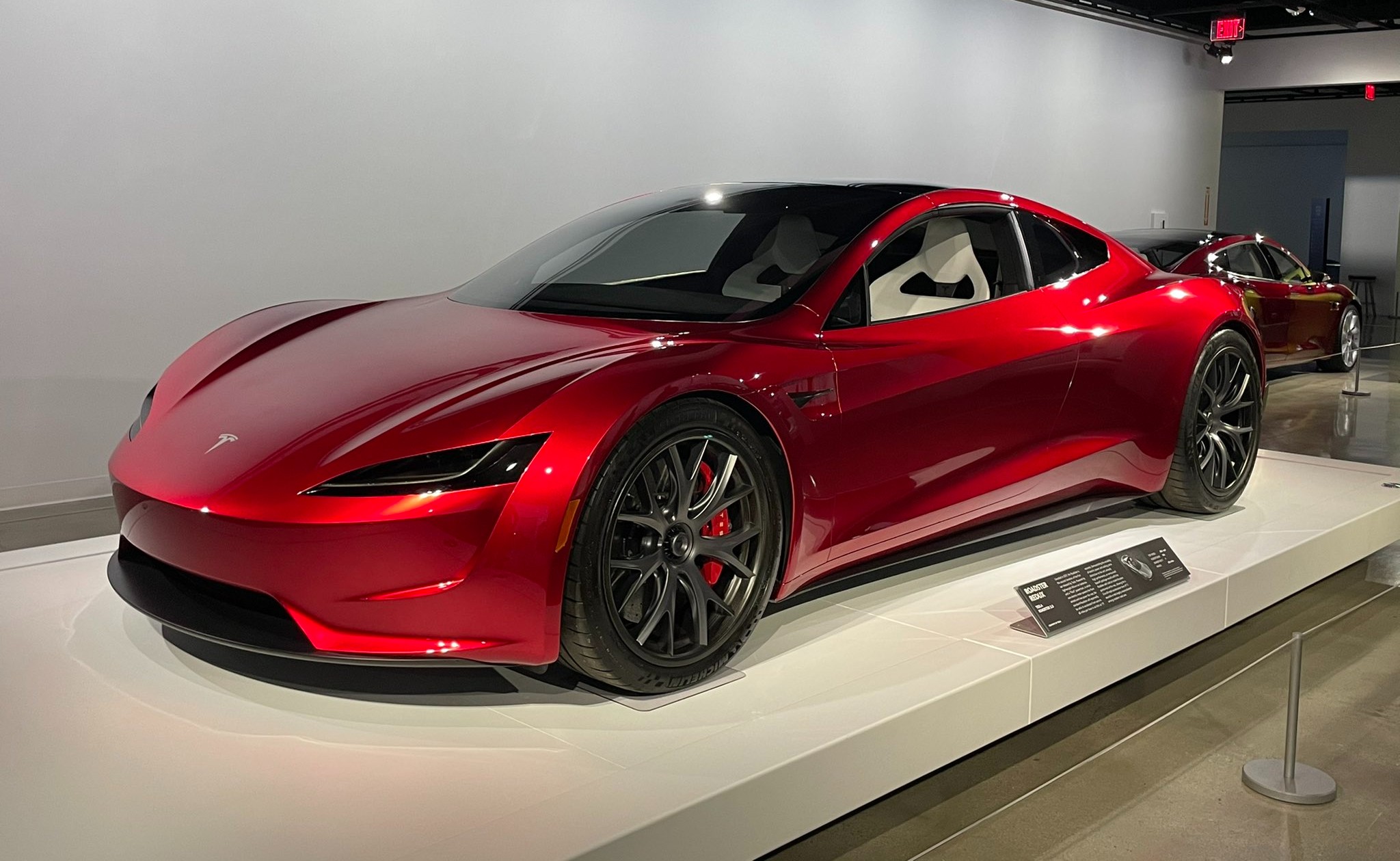
Ahead of its highly anticipated and repeatedly delayed public unveiling, Tesla’s next-generation Roadster has secured a crucial piece of intellectual property designed to bridge the gap between astronomical straight-line performance and real-world vehicle control. Officially granted by the United States Patent and Trademark Office on September 29, a new filing titled "Electric Car Fan" outlines an active aerodynamic system engineered to generate massive downforce independently of vehicle speed. This engineering solution targets one of the most persistent physical limitations facing ultra-high-performance electric vehicles: putting immense, instantaneous motor torque onto the pavement before passive aerodynamic wings and diffusers become effective.
The patent publication arrives mere weeks before Tesla’s scheduled Roadster launch event. That presentation faced an unexpected setback when adverse weather conditions forced a postponement, highlighting the strict outdoor operational requirements mandated for the vehicle’s debut. As industry analysts and automotive enthusiasts await a rescheduled date, this newly revealed patent offers a technical glimpse into how Tesla intends to manage the unprecedented physical forces generated by a production car projected to achieve a sub-two-second zero-to-sixty-miles-per-hour acceleration time and a top speed exceeding 250 miles per hour.
The Aerodynamic Challenge of High-Performance Electric Vehicles
Internal combustion supercars and hypercars have long relied on passive aerodynamic components—such as splitters, large rear wings, and venturi tunnels—to generate downforce. These elements are highly effective at maintaining high-speed stability on a race track or highway. However, they share a fundamental mechanical limitation: they depend entirely on ambient airflow rushing over and under the vehicle’s body to create suction and downward pressure.
At a standstill, during launch, in slow-speed corners, or under heavy braking from modest velocities, passive aerodynamics provide virtually no structural assistance. For traditional gasoline-powered vehicles, this limitation is partially mitigated by the gradual spooling of turbochargers and the time required for an engine to reach its power band.
Electric vehicles, by contrast, deliver maximum torque instantaneously to all driven wheels. Without sufficient tire load at zero speed, this instantaneous power often results in immediate wheel slip, wasting valuable energy and degrading acceleration times. While traction control software can modulate power delivery to prevent wheelspin, managing power electronically does not increase physical grip. Tesla’s "Electric Car Fan" patent seeks to bypass this aerodynamic dead zone by actively pulling air beneath the chassis, forcing the vehicle downward regardless of whether it is stationary or moving at top speed.
Engineering Mechanics of the Patented Fan System
According to documentation within the patent filing, the system utilizes a series of electrically driven ducted fans powered directly by the vehicle’s high-voltage propulsion battery. Typically depicted as a row of four axial fans integrated into the rear diffuser, the hardware operates via a continuous channel of airflow.
An underbody inlet positioned between the rear wheels captures air flowing beneath the chassis. This air is routed through internal ducts before being expelled through a wider outlet housed within the rear diffuser. Vertical strakes divide the fan assembly, organizing the airflow and maximizing the pressure differential between the underside of the car and the atmosphere above.
Crucially, the system is designed to be dynamically modulated by the vehicle’s central control unit. Unlike static body modifications that generate a constant aerodynamic drag penalty—reducing efficiency and top-end range on long highway drives—Tesla’s active fans can ramp up to maximum output during hard launches, tight cornering maneuvers, and heavy braking applications. Once the vehicle achieves velocities where traditional wings and diffusers become effective, the electric fans can power down or turn off entirely, minimizing parasitic drag and preserving the vehicle’s battery range.
Historical Precedents and Regulatory Hurdles in Motorsport
The concept of utilizing mechanical fans to pull an automobile toward the pavement is not entirely new to automotive engineering, though its implementation in modern production vehicles remains exceedingly rare. The most famous historical precedent occurred in Formula 1 racing with the debut of the Brabham BT46B "fan car" during the 1978 Swedish Grand Prix. Designed by Gordon Murray, the Brabham utilized a large rear-mounted fan driven by the engine to evacuate air from beneath the skirted chassis, creating a massive vacuum effect.
Driver Niki Lauda famously drove the BT46B to a dominant victory in its single race appearance before fierce protests from rival constructors led to its immediate ban by the sport’s governing body. Officials ruled the mobile aerodynamic device violated regulations prohibiting movable aerodynamic devices designed primarily to influence downforce, cementing the fan car as one of the most controversial and effective engineering designs in motorsport history.
While Formula 1 regulations strictly outlaw active suction devices, road-legal hypercar manufacturers have occasionally explored similar concepts. Notably, the Gordon Murray Automotive T.50 incorporates a rear-mounted 400mm fan inspired by the BT46B to boundary-layer control and reduce drag, though it operates under different parameters than Tesla’s battery-powered patent. Tesla’s application differs by relying purely on high-voltage electric actuation and integrating the system directly into the vehicle’s electronic stability and traction control algorithms.

Broader Implications for the Tesla Roadster Launch
The timing of the patent publication underscores the protracted development timeline of the second-generation Roadster. Originally unveiled as a concept in November 2017 with an initial production target of 2020, the project has experienced multiple delays as Tesla prioritized scaling high-volume vehicle lines such as the Model Y and engineering the Cybertruck.
Chief Executive Officer Elon Musk has frequently teased extraordinary performance specifications for the production variant, including an optional "SpaceX package" incorporating cold-gas thrusters arranged around the perimeter of the vehicle. Musk has previously suggested that these compressed-air thrusters could dramatically enhance braking, cornering limits, and acceleration, and even allow the vehicle to hover temporarily under specific conditions.
The integration of an active underbody fan system aligns with this philosophy of pushing boundary-layer physics in automotive design. By combining high-voltage ducted fans with potential cold-gas thruster technology, Tesla appears to be engineering a vehicle that relies as much on aerospace principles as traditional automotive dynamics.
Engineering Challenges and Production Realities
Automotive industry analysts caution that holding a granted patent does not guarantee immediate commercial implementation in a production vehicle. Packaging four high-flow electric fans within the strict spatial constraints of a rear diffuser introduces significant engineering hurdles, particularly regarding thermal management, acoustic noise control, and debris ingestion.
Operating high-RPM axial fans in close proximity to road surfaces exposes the hardware to moisture, road salt, small rocks, and particulate matter. Designing a filtration and ducting system robust enough to withstand harsh road environments without adding excessive weight or mechanical complexity represents a major challenge for Tesla’s engineering teams. Furthermore, the acoustic profile of multiple high-voltage fans operating at high rotational speeds must be modulated to comply with international vehicle noise regulations, which strictly limit exterior sound emissions even for high-performance sports cars.
Despite these potential hurdles, the granting of the patent illustrates Tesla’s ongoing commitment to solving the unique mechanical challenges of electric vehicle dynamics. As the automotive industry transitions further into electrification, traditional metrics of performance are shifting from internal combustion efficiency to thermal management, software integration, and active vehicle control. Whether the production Tesla Roadster ultimately deploys the "Electric Car Fan" system on public roads will depend on the finalization of its hardware architecture, regulatory approvals, and the successful resolution of packaging and acoustic constraints. For now, the patent provides a clear technical window into the engineering ambitions driving Tesla’s flagship performance halo.