










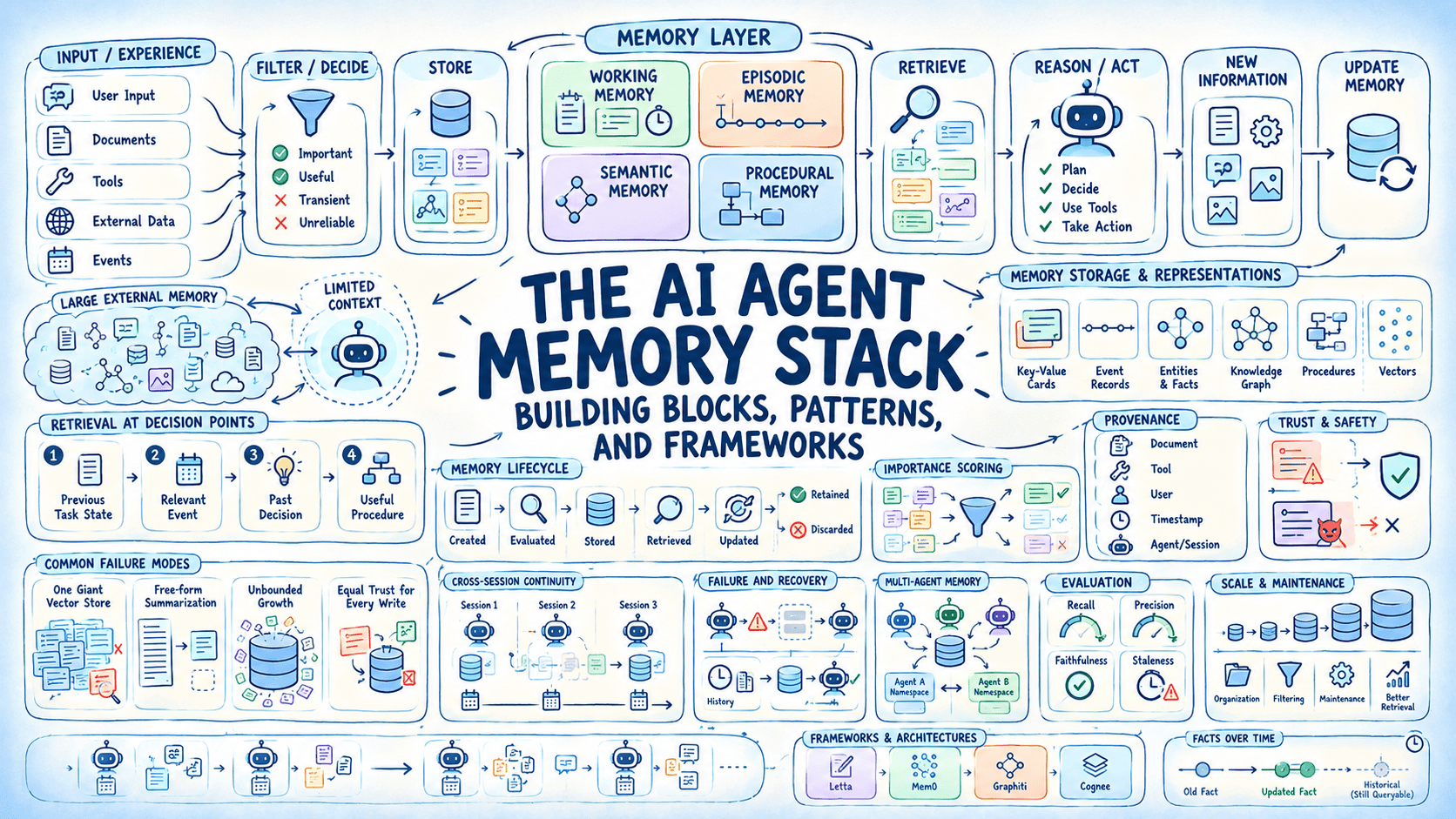
The rapid evolution of artificial intelligence has shifted industry focus away from isolated, single-turn prompts toward autonomous AI agents capable of executing complex, multi-day workflows. While foundational language models remain fundamentally stateless—treating each API call as an isolated event—advanced enterprise deployments require systems that can retain context, learn user preferences, and preserve the trajectory of past tasks. To bridge this gap, engineers are rapidly adopting specialized architectural patterns known collectively as the AI agent memory stack.
This comprehensive technical analysis explores how modern AI systems store, retrieve, and manage data at scale, examining the fundamental building blocks of memory, proven design strategies, and the structural trade-offs of leading frameworks.
The Core Problem: Stateless Models in Stateful Workflows
Large language models process text exclusively within the strict parameters of their active context windows. Once a request concludes, all intermediate reasoning, temporary variables, and contextual nuances are erased. While this architecture functions exceptionally well for straightforward, transactional queries, it presents a severe operational bottleneck for autonomous agents.
AI agents tasked with conducting multi-step research, maintaining continuous customer service interactions, or managing software development lifecycles must track previous actions to avoid redundant operations. Without an external memory layer, an agent operating over a multi-day span would systematically regress, losing track of discovered insights, user constraints, and failed experimental paths.
To overcome these limitations, modern system architects separate persistence from computation. By offloading data storage outside the model’s immediate context window and creating programmatic pipelines for dynamic retrieval, developers can build agents that exhibit persistent, adaptive behavior.
Taxonomy of Agent Memory: Types and Structural Layers
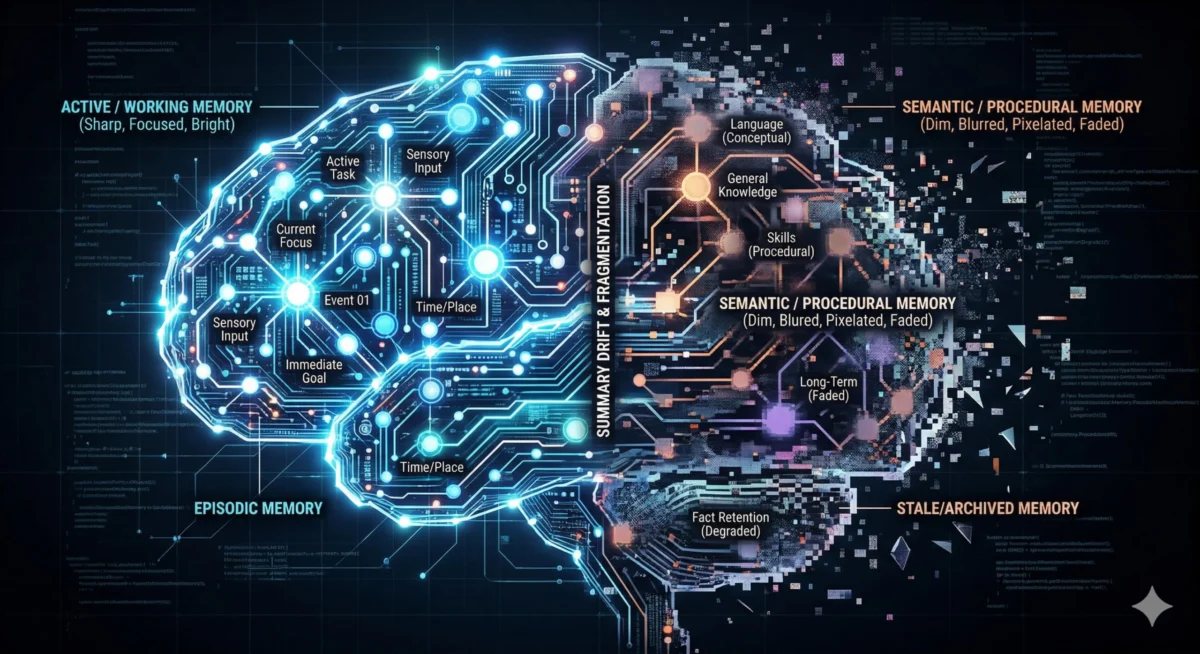
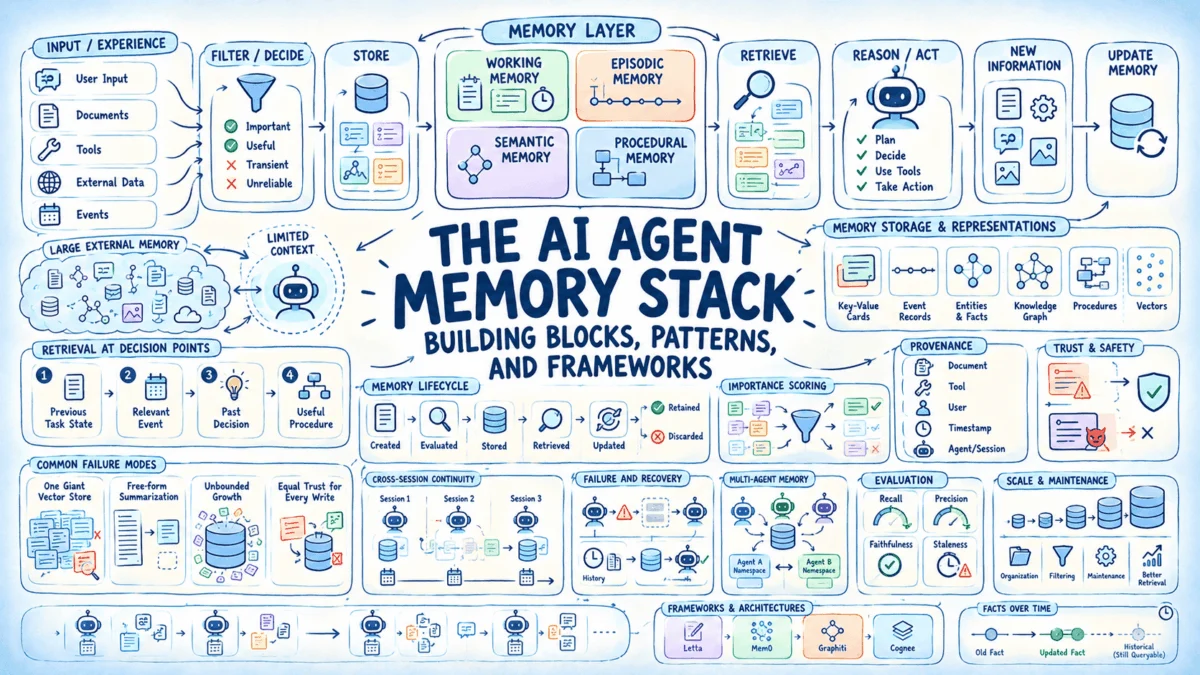
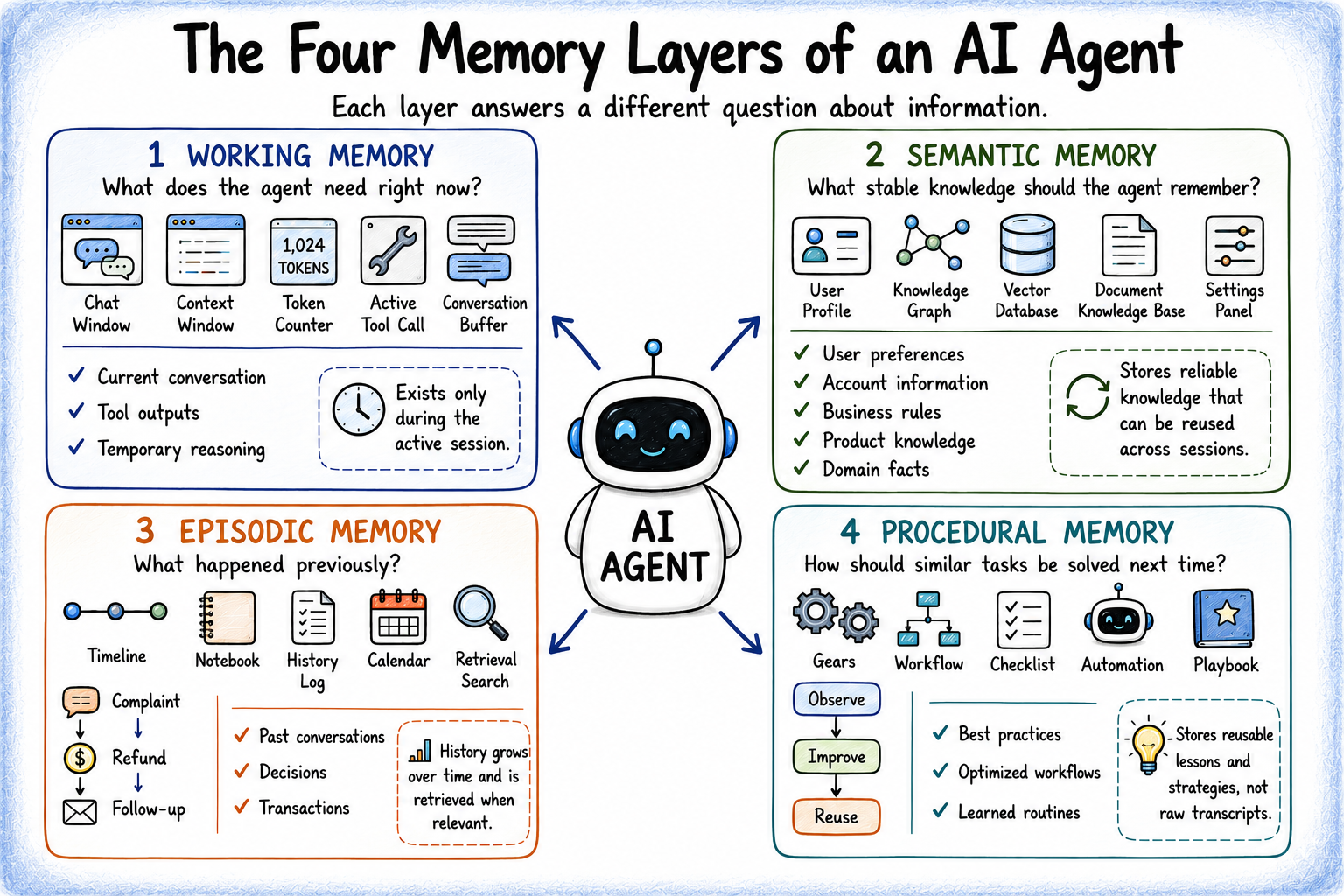
Effective agent memory is not a monolithic database; rather, it is a multi-tiered architecture categorized by specific functional roles, storage models, and retrieval methodologies. Industry standards generally divide agent memory into four distinct classifications: working, episodic, semantic, and procedural.
Working memory serves as the immediate scratchpad for active task states. Typically housed in volatile, short-lived key-value stores or held directly within the context window, it preserves intermediate results required for immediate calculations.
Episodic memory captures historical experiences, documenting what happened during past interactions, specific task runs, and historical decisions. Often implemented via time-ordered logs or vector-based similarity search engines, episodic memory allows an agent to recall how it successfully solved a similar problem weeks prior.
Semantic memory preserves structured facts, entity definitions, and user preferences. Unlike episodic logs which grow by appending new records, semantic memory is characterized by continuous updates and entity modifications. It is typically managed through attribute-based key-value stores or knowledge graphs.
Finally, procedural memory encodes operational strategies—specifically, how to execute processes, recognize known failure modes, and apply successful action patterns. This category is frequently instantiated through structured prompt templates or model fine-tuning.
Chronology and Evolution of Agent Memory Management
The discipline of agent memory engineering has undergone a distinct evolutionary arc alongside the maturation of large language models. In the early stages of generative AI development, memory was largely restricted to basic conversation buffers, where chat histories were simply concatenated into the prompt until token limits were breached.
As developers attempted more sophisticated autonomous workflows, basic concatenation proved insufficient, leading to the rapid adoption of vector embeddings and retrieval-augmented generation (RAG) pipelines around 2022 and 2023. While vector stores allowed agents to query large document repositories, treating all memory as a flat semantic search space introduced severe relevance and hallucination issues.
By 2024 and 2025, the industry recognized that flat vector architectures could not adequately model complex entity relationships or track temporal changes in facts. This realization spurred the development of hybrid architectures combining vector retrieval, relational databases, and bi-temporal knowledge graphs. Today, state-of-the-art agent memory engineering focuses on automated consolidation, self-editing text blocks, and structured multi-agent synchronization layers.
Comparative Analysis of Memory Framework Architectures
To operationalize these memory types, developers increasingly rely on specialized frameworks that make distinct architectural compromises regarding storage, retrieval, and maintenance. Four prominent frameworks currently dominate the enterprise landscape: Letta, Mem0, Graphiti, and Cognee.
Letta utilizes a self-editing memory model where the agent is granted direct programmatic access to rewrite its own text blocks. When the underlying language model identifies a factual contradiction or a shift in user requirements, it directly updates the relevant memory block, mimicking human-like internal monologue updates.
Mem0 approaches memory through an optimized vector-based infrastructure featuring entity-aware retrieval mechanisms. Rather than relying on naive similarity searches, Mem0 structures incoming data around specific entities, allowing new memories to integrate cleanly alongside historical records.
Graphiti introduces a bi-temporal knowledge graph architecture. By establishing typed relationships between discrete entities and tracking the exact timelines during which facts remain valid, Graphiti can invalidate outdated relationships while preserving a historically queryable audit trail.
Cognee constructs multi-layered representations by passing source data through an advanced extraction pipeline that simultaneously populates graph, vector, and relational database layers. This multi-modal approach enables systems to execute both precise relational queries and broad semantic searches depending on the immediate requirements of the agent.
Strategic Design Patterns and Common Pitfalls
Building reliable agent memory systems requires rigorous adherence to proven design patterns, as well as an acute awareness of common architectural traps. Industry practitioners frequently encounter several failure modes when scaling memory stores.
One prevalent anti-pattern involves embedding every single interaction into a singular, undifferentiated vector store. While straightforward to implement, this approach frequently retrieves information that possesses high semantic similarity to a query while lacking operational relevance to the immediate task. Furthermore, flat vector stores struggle to accurately represent complex, multi-faceted relationships between discrete entities.
Another recurring pitfall is the reliance on free-form text summarization for memory compression. As long-running agents accumulate data, automated summarization routines often strip away vital numerical constraints, specific edge cases, or conditional exceptions that become critical later in the workflow. Moreover, uncritical summarization can occasionally codify an unverified or hallucinated statement into long-term memory as an established fact.
Unbounded memory growth without active lifecycle maintenance represents a third major vulnerability. Without automated pruning, categorization, and expiration policies, irrelevant historical entries compete directly with actionable data during retrieval phases, degrading performance and exponentially increasing operational costs.
Finally, security analysts warn against trusting every write operation equally. In enterprise environments where agents ingest data from untrusted external sources—such as public web pages or user-submitted inputs—unvalidated memory writes introduce severe memory poisoning vulnerabilities. Malicious actors can deliberately inject false information into an agent’s persistent memory store, successfully subverting future operations.
Implications for Enterprise Deployments and Multi-Agent Systems
As organizations scale artificial intelligence from isolated developer prototypes to interconnected multi-agent ecosystems, memory engineering becomes a foundational determinant of system reliability. In multi-agent architectures, where distinct specialized agents collaborate on shared deliverables, synchronized memory management is mandatory to prevent operational drift and conflicting actions.
Industry experts emphasize that future advancements in agent autonomy will rely heavily on robust evaluation frameworks designed to measure memory fidelity, retrieval precision, and long-term consistency. Standardized benchmarks assessing how effectively an agent retains instructions over thousands of execution steps are rapidly becoming standard components of enterprise AI validation pipelines.
Ultimately, selecting an appropriate memory strategy requires balancing operational complexity, latency requirements, and financial constraints. By intentionally separating working, episodic, semantic, and procedural memory layers—and implementing strict validation and maintenance protocols—organizations can build resilient, highly autonomous AI agents capable of executing sophisticated, long-horizon enterprise tasks.