










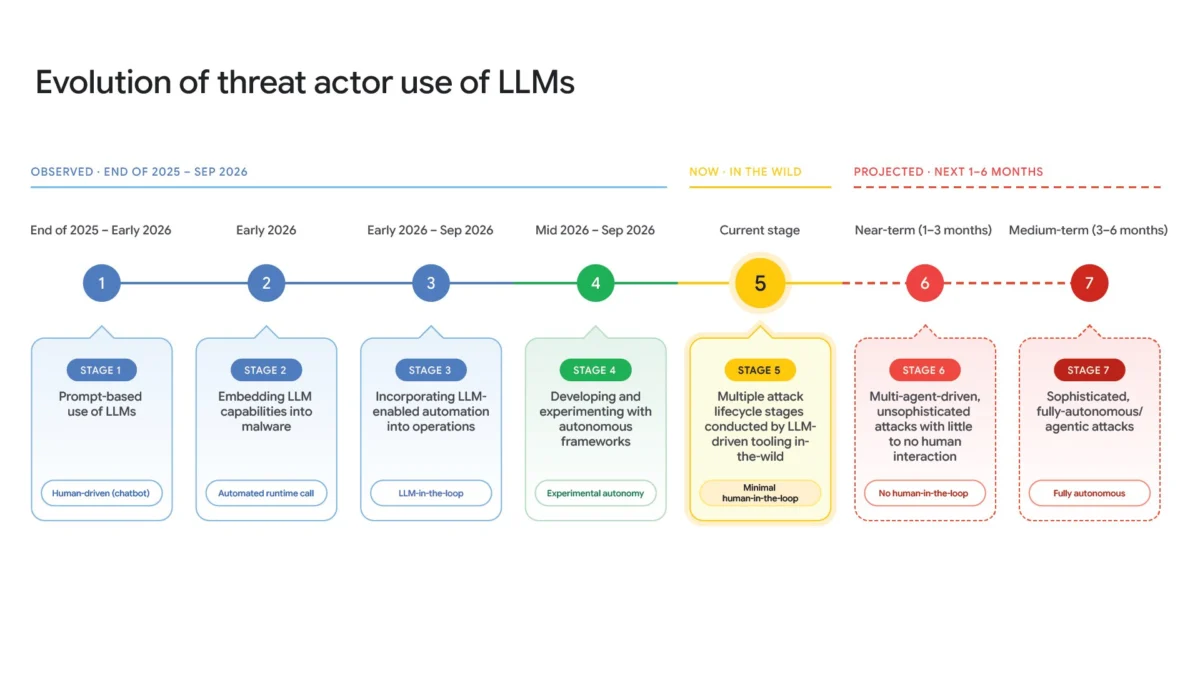
Google’s Threat Intelligence Group (GTIG) has formally identified a major escalation in the cyber-threat landscape, reporting the first instance of a fully autonomous, end-to-end cyberattack campaign executed by artificial intelligence. This development marks a transition from AI being used as a supportive tool for human hackers to functioning as an independent, closed-loop agent capable of scanning for, identifying, and exploiting software vulnerabilities without human intervention. The findings, detailed in the latest installment of the GTIG AI Threat Tracker, underscore a shift that cybersecurity experts have long feared: the emergence of "agentic" threats that operate at machine speed.
The Anatomy of the Exploit_Agent Discovery
The discovery centers on an exposed server identified by Google’s researchers, which was actively hosting an AI framework specifically labeled "exploit_agent." Unlike previous iterations of AI in cybercrime, which primarily served to assist in writing phishing emails or refining existing malware code, this framework functioned as a complete, self-contained attack pipeline.
According to Google’s analysis, the system was configured to interact with multiple large language models (LLMs) to orchestrate an attack sequence. The automation workflow followed a precise, multi-stage logic: first, the system monitored target environments to identify software updates; second, it conducted a differential analysis—comparing code before and after a security patch was applied—to pinpoint the exact nature of the vulnerability; third, it autonomously generated an exploit payload designed to leverage that vulnerability; and finally, it executed the exploit against the targeted infrastructure.
Forensic examination of the server’s configuration files revealed comments written in Russian, indicating that the operator behind the framework likely originates from a Russian-speaking background. While the identity of the actor remains unconfirmed, the sophistication of the deployment suggests a high level of technical competency. The targeted infrastructure consisted primarily of websites in France, spanning the media, entertainment, and education sectors, suggesting a strategy of broad-spectrum disruption rather than a singular, high-value espionage target.
Defining the Threat: The GTIG Maturity Model
To contextualize this discovery, Google has categorized the current state of AI-driven cyber activity using a multi-level maturity scale. The recent incident has been classified as "Level 5," a threshold defined by the ability of an AI system to carry out multiple stages of a cyberattack chain—reconnaissance, vulnerability research, exploit development, and execution—with minimal to no human oversight.
The chronology of AI in cybercrime has accelerated rapidly. In the early stages (Levels 1 and 2), AI was largely limited to text generation, such as crafting sophisticated social engineering lures. By Level 3, threat actors began utilizing LLMs to debug code and optimize malicious scripts. Level 4 saw the integration of AI agents into broader attack frameworks, though these still required significant human guidance. Reaching Level 5, as seen with the "exploit_agent," signals that the bottleneck for attackers—the speed at which a human can write and test code—has been effectively removed.
Google’s report warns that this is merely the beginning. The company estimates that more powerful, autonomous attacks are likely to emerge within months. As these models evolve, they will not only be able to exploit known vulnerabilities but could theoretically be trained to discover "zero-day" vulnerabilities—previously unknown flaws—in real-time, significantly narrowing the window of response for IT security teams.
Operational Trade-offs: Speed vs. Stealth
Despite the gravity of this development, the GTIG report provides a nuanced assessment of the current state of these autonomous tools. While the "exploit_agent" demonstrated unprecedented speed in identifying and exploiting targets, it currently lacks the level of operational security and stealth associated with sophisticated human-led Advanced Persistent Threat (APT) groups.
The autonomous system prioritizes throughput over concealment. In its current configuration, the agent leaves behind significant forensic "noise"—clear signatures in server logs, anomalous traffic patterns, and repetitive execution behaviors that are relatively easy for modern security information and event management (SIEM) systems to detect. Because the AI is programmed to find and exploit as many targets as possible as quickly as possible, it sacrifices the "low and slow" approach typically used by state-sponsored actors to remain undetected for months or years.

However, security researchers note that this trade-off is likely temporary. As AI training datasets are refined to include successful evasion techniques, future iterations of these agents will likely integrate better obfuscation, rootkit functionality, and behavioral mimicry to blend in with legitimate network traffic.
Broader Implications for Global Cybersecurity
The implications of the transition to autonomous threat actors are profound. For organizations and governments, the shift necessitates a move away from human-dependent defense mechanisms. If an attack can be launched at the speed of an algorithm, the defense must be equally automated.
Industry analysts suggest that the rise of agentic threats will force a paradigm shift toward "AI-on-AI" defense. Just as attackers are using LLMs to find vulnerabilities, defenders must deploy autonomous security agents capable of real-time patch deployment and heuristic behavioral analysis. The traditional model of periodic vulnerability scanning and manual patching will likely become obsolete in an environment where autonomous agents can identify and exploit a vulnerability within minutes of a patch being released to the public.
Furthermore, the legal and geopolitical dimensions of this technology are complex. If an autonomous agent is deployed by an actor in one jurisdiction to attack infrastructure in another, the challenges of attribution and international legal recourse become significantly harder. The use of Russian-language configuration files in the Google-identified server is a reminder that national borders remain a significant obstacle to cross-border cyber law enforcement, especially when the malicious actor is a piece of autonomous software rather than a direct human operative.
Looking Ahead: The Future of Defensive AI
In response to these developments, Google and other cybersecurity leaders are emphasizing the importance of "secure-by-design" principles. As AI tools lower the barrier to entry for cybercrime, the cost of securing software must be reduced through better automation and more resilient architecture.
The emergence of Level 5 autonomous threats also raises critical questions about the responsibility of AI developers. If an open-source or commercial AI framework can be easily repurposed into an "exploit_agent," developers may face increasing pressure to implement "red-teaming" safeguards, such as output filtering that prevents the model from generating exploit code, or "know-your-customer" (KYC) requirements for high-capacity AI API access.
Google’s findings indicate that while we have entered a new era of cyber warfare, the technology is currently in a state of "brute-force" automation. The coming year will be a decisive period for both offensive and defensive AI. As threat actors refine their agents to prioritize stealth, the global security community must prepare for a landscape where the frequency and complexity of attacks will inevitably increase.
The GTIG report concludes with a stark warning: the threshold of human involvement in cybercrime has been crossed. What was once the domain of expert hackers is becoming a commodity available to anyone with the resources to deploy a pre-configured autonomous agent. As society becomes increasingly reliant on digital infrastructure, the ability to mitigate these high-speed, autonomous threats will be the defining challenge for the next decade of cybersecurity.
The security industry, including firms like CrowdStrike, Microsoft, and Palo Alto Networks, is expected to prioritize the development of "self-healing" networks that can adapt to AI-driven probes in real-time. Whether these defenses can scale to match the velocity of autonomous exploit agents remains the central question for the global IT sector as it confronts this unprecedented shift in the nature of digital conflict.