The automotive landscape is undergoing a profound transformation, moving away from traditional internal combustion engine commercial fleets toward flexible, software-defined electric architectures. Stepping firmly into this evolving market segment, South Korean automaker Kia has officially pulled the covers off its largest all-electric commercial van to date: the PV7. Making its worldwide premiere at the prestigious IAA Transportation 2026 exhibition in Hanover, Germany, the PV7 represents the second major milestone in Kia’s ambitious Platform Beyond Vehicle (PBV) business strategy. Following closely on the heels of its smaller sibling, the PV5—which has already established itself as a commercial favorite in European markets—the PV7 aims to capture a significantly larger share of the global light commercial vehicle (LCV) and multi-passenger transport sectors.
Built from the ground up to address the complex demands of modern logistics, passenger shuttles, and customized conversion businesses, the PV7 is much more than a traditional van. It is a modular, high-technology workspace on wheels designed to scale seamlessly across global markets starting in late 2027.
Chronology and Strategic Evolution: From CES Concepts to Hanover Debut
The journey of the PV7 to the global stage has been carefully calculated by Kia’s corporate leadership as part of a broader pivot toward sustainable mobility solutions and specialized transport vehicles. The foundational philosophy of Kia’s PBV strategy was first broadcast to the public during the Consumer Electronics Show (CES) in January 2024, where executives outlined a vision for purpose-built vehicles that could radically alter how businesses transport goods and people. At that time, initial concepts of the vehicle hinted at a robust commercial footprint, though engineering teams continued to refine its dimensions and capabilities over the subsequent two years.
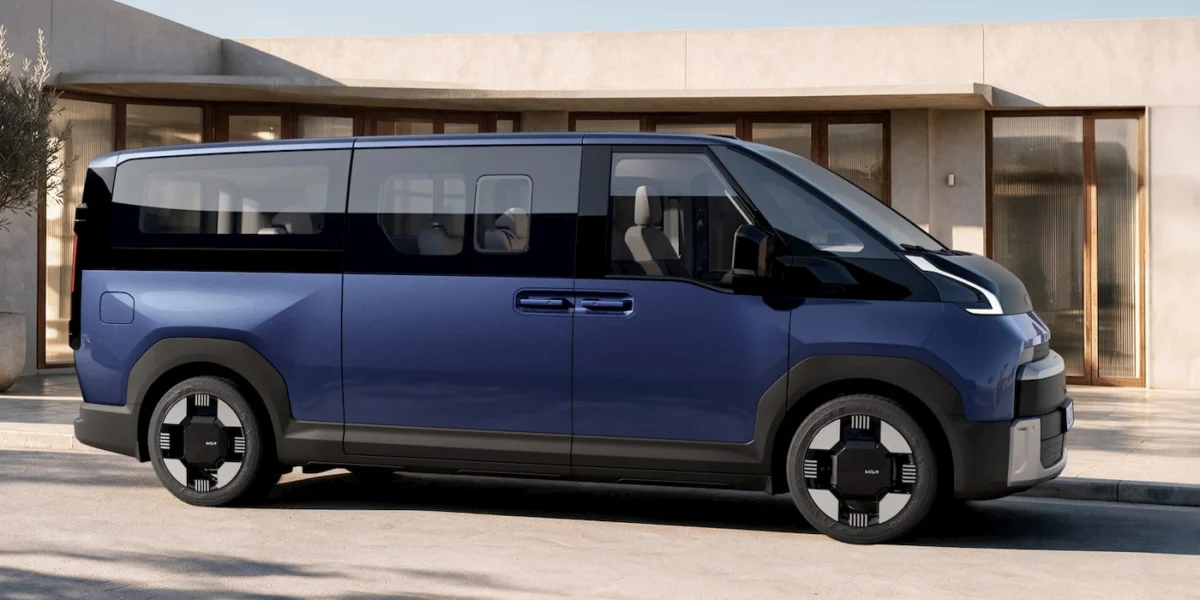
![Kia’s new EV van is over 17.5 ft long and can haul 9 people or lots of cargo [Images]](https://electrek.co/wp-content/uploads/sites/3/2026/09/Kia-PV7-EV-van-images.jpeg?quality=82&strip=all&w=1400)
By mid-2026, momentum had accelerated drastically. Kia’s smaller offering, the PV5, successfully launched across European territories, quickly claiming the title of the region’s best-selling small electric van due to its practical packaging and competitive pricing. Building upon this market validation, Kia timed the official physical debut of the larger PV7 for the IAA Transportation event in Hanover on a Monday in September 2026. This industry-leading exhibition served as the ideal backdrop to showcase commercial viability to fleet managers, logistics operators, and international media. Following its grand unveiling in Germany and Korea, the automaker has mapped out a disciplined rollout strategy, targeting commercial availability in both regions by the second half of 2027, with subsequent expansions into global markets slated for the months and years that follow.
Platform Architecture and Technical Specifications
At the mechanical heart of the Kia PV7 lies the advanced E-GMP.S dedicated electric vehicle platform, a specialized variant of the acclaimed Electric Global Modular Platform adapted specifically for commercial applications. This architecture utilizes a flat-floor layout that maximizes interior volume while preserving structural integrity and safety standards.
Performance metrics for the PV7 are tailored to handle heavy-duty commercial workloads without sacrificing efficiency. The vehicle comes standard with a front-wheel-drive (FWD) configuration, though engineers have confirmed that an all-wheel-drive (AWD) variant is currently in development to address adverse weather conditions and rugged terrain requirements. Depending on the chosen configuration, the front electric powertrain is capable of outputting up to 268 horsepower (200 kW) alongside a robust 309 lb-ft (420 Nm) of torque, providing ample grunt for fully loaded transport duties.
Energy storage is managed through two distinct nickel-cobalt-manganese (NCM) battery pack options: a standard variant and a larger long-range pack. The larger 96.2 kWh battery, paired with the Long Range Cargo configuration, delivers an estimated all-electric driving range exceeding 460 kilometers (approximately 285 miles) based on the Worldwide Harmonised Light Vehicles Test Procedure (WLTP) cycle.
![Kia’s new EV van is over 17.5 ft long and can haul 9 people or lots of cargo [Images]](https://electrek.co/wp-content/uploads/sites/3/2026/09/Kia-PV7-EV-debut.jpeg?quality=82&strip=all)
Charging infrastructure compatibility is another strong suit of the E-GMP.S platform. Thanks to its native 800-volt electrical architecture, the PV7 can support ultra-fast DC charging speeds. When plugged into a compatible 350 kW DC fast charger, the vehicle’s battery can replenish its energy state from 10% to 80% in approximately 25 minutes, minimizing vehicle downtime and maximizing operational productivity for fleet operators. Furthermore, the inclusion of Vehicle-to-Load (V2L) capabilities transforms the van into a mobile power generator capable of running external tools, worksite electronics, or camping equipment directly from the vehicle’s main battery pack.
Dimensions, Seating, and Cargo Versatility
One of the most striking aspects of the Kia PV7 is its sheer physical presence, which outclasses several prominent competitors in the electric van segment. The PV7 Passenger and Cargo models measure 5,350 mm (17.55 feet) in length, 1,995 mm in width, and 1,990 mm in height, anchored by a generous wheelbase of 3,500 mm. To put these measurements into perspective, the PV7 is considerably larger than the PV5 Passenger model—which spans 4,695 mm in length with a 2,995 mm wheelbase—and even surpasses the dimensions of the initial concept vehicle displayed at CES 2024, which measured 5,270 mm long. When compared directly against industry rivals like the long-wheelbase Volkswagen ID. Buzz, which measures 4,962 mm long with a 3,239 mm wheelbase, the PV7 offers a substantially larger footprint for cargo and passengers alike.
The Cargo variant of the PV7 is configured to maximize volumetric efficiency. It is available in traditional two- and three-seat configurations, delivering up to 6.1 cubic meters of cargo space in standard configurations, while a High Roof variant expands that volume to an impressive 8 cubic meters. Maximum payload capacities range up to 1,165 kg (2,568 lbs) for the Long version and up to 1,200 kg (2,645 lbs) for the compact model. Additionally, the PV7 Long features a low loading height of just 550 mm and has been specifically engineered to accommodate up to three standard Euro pallets (measuring 800 x 1,200 mm). A dedicated heavy-loading driving mode is built into the vehicle’s software suite to dynamically optimize powertrain performance and suspension response when carrying maximum weight. Buyers can also customize access via full-open twin-swing tailgate doors or a conventional lift-up tailgate.
For passenger transport, the PV7 offers extraordinary flexibility. The global model is designed to comfortably accommodate up to nine passengers, while the domestic market in South Korea will receive an expanded layout capable of seating up to eleven. The seven-seat variant features Long-Rail Easy Remove Seats, allowing fleet operators and families to quickly alter interior seating arrangements. Meanwhile, the nine-seat iteration can be ordered with or without a fourth row of seating, catering directly to the shuttle, hospitality, and rental car markets.
![Kia’s new EV van is over 17.5 ft long and can haul 9 people or lots of cargo [Images]](https://electrek.co/wp-content/themes/ninetofive/dist/images/google-preferred-source-badge-dark.png)
High-Tech Cabin and Advanced Artificial Intelligence Integration
Inside the cabin, the PV7 bridges the gap between rugged commercial utility and consumer-grade luxury. Following the design language established by the PV5, the interior features Hyundai Motor Group’s advanced Pleos Connect infotainment system, housed across prominent 12.9-inch and 14.6-inch digital displays.
Operating on an Android Automotive OS backbone, the user interface mimics the intuitive nature of a modern smartphone, featuring downloadable applications, over-the-air update capabilities, and highly customizable home screens. A standout technological inclusion is Gleo AI, an integrated artificial intelligence companion embedded within the vehicle’s operating system. Gleo AI acts as an in-car virtual assistant capable of processing complex natural language voice commands, retrieving real-time logistics data, managing navigation routes, and controlling climate or vehicle comfort settings without requiring the driver to take their eyes off the road.
Future Roadmap: 23 Variants and Market Implications
Kia’s vision for the PV7 extends far beyond basic passenger and cargo configurations. The automaker has confirmed plans to roll out a staggering 23 distinct PV7 variants over the next few years. This comprehensive lineup will encompass various iterations of Cargo (compact, long, and high roof), Passenger (compact and long), a dedicated Chassis Cab platform, and a wide array of specialized conversion models tailored for municipal, medical, and recreational applications.
While official pricing for the PV7 will be announced closer to its commercial launch window, the vehicle’s positioning suggests it will remain aggressively competitive against traditional internal combustion and emerging electric competitors. For context, pricing for the smaller PV5 in its domestic Korean market starts at approximately 45.9 million won ($34,000 USD) for the Passenger variant and 41 million won ($30,300 USD) for the Cargo Compact, while European pricing for the PV5 Passenger five-seater begins around €38,390 ($44,200 USD). Given the larger dimensions and advanced capabilities of the PV7, it is expected to command a modest premium over its smaller sibling.
![Kia’s new EV van is over 17.5 ft long and can haul 9 people or lots of cargo [Images]](https://electrek.co/wp-content/themes/ninetofive/dist/images/google-preferred-source-badge-light.png)
The introduction of the PV7 arrives at a critical juncture for the commercial transport sector. As urban centers increasingly implement strict low-emission zones and corporate fleets face aggressive decarbonization mandates, the demand for versatile, long-range electric commercial vehicles has never been higher. By offering a modular "top hat" architecture on a scalable skateboard platform, Kia is positioning itself not merely as a vehicle manufacturer, but as an integral infrastructure partner for logistics firms and passenger transport networks worldwide. If the PV5’s early success in Europe is any indication, the larger PV7 could prove to be a transformative commercial asset for the brand as it aggressively expands its footprint across the global light commercial vehicle landscape.