The gaming landscape has seen a significant shift toward the "bullet heaven" or "survivor-lite" genre since the explosive success of Vampire Survivors. Today, developer Randwerk has officially entered this competitive market with the launch of Wanderburg into early access. The title distinguishes itself from traditional top-down shooters by introducing a modular construction mechanic, where players operate a mobile, medieval castle tank that expands in size and tactical capability as they progress through the game’s roguelike environments.
Core Mechanics and Gameplay Innovations
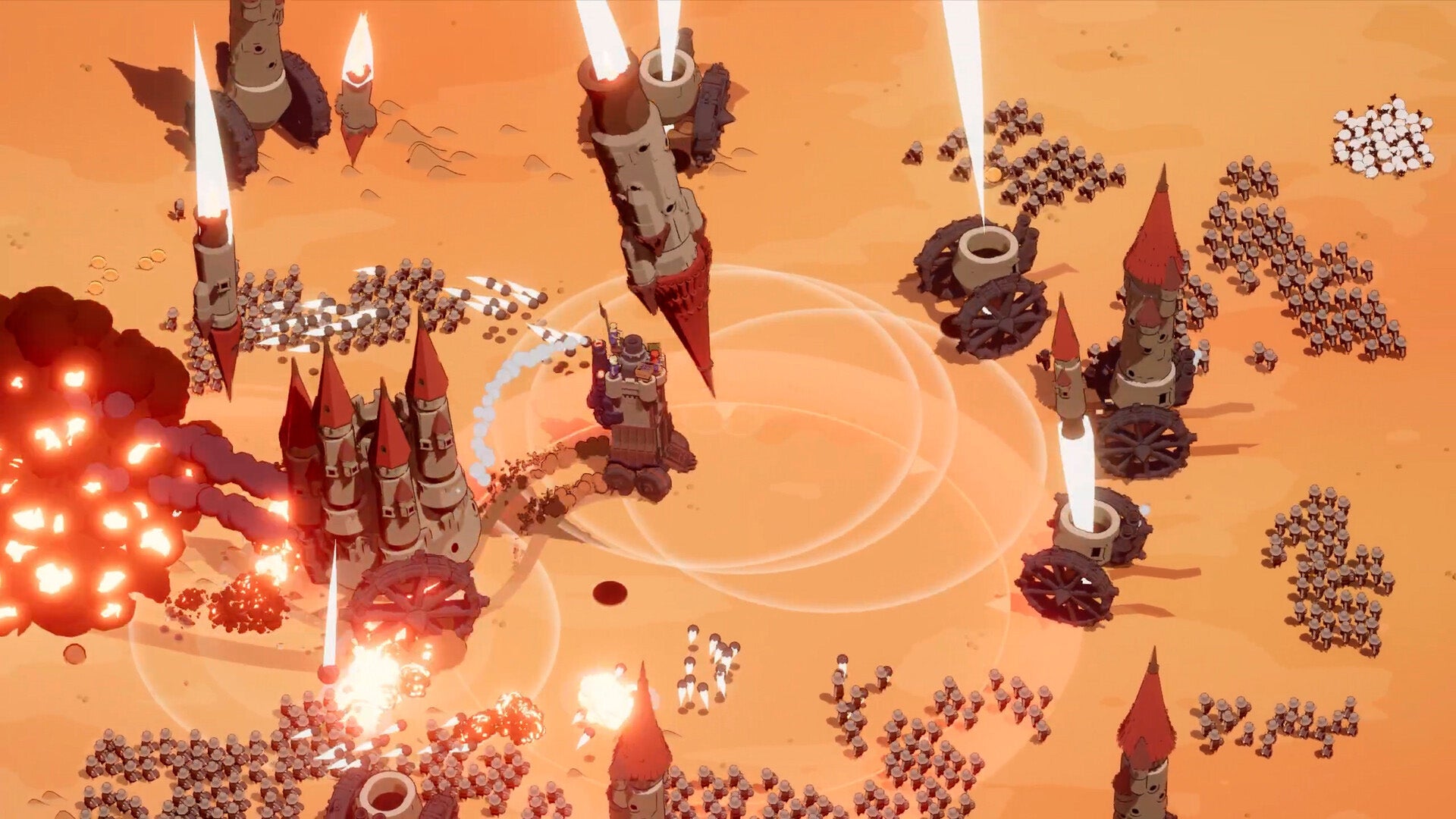
At its fundamental level, Wanderburg tasks players with the survival of a mobile fortress. Unlike stationary tower-defense titles or fast-paced character-based arena survivors, Wanderburg requires players to manage a structure that is physically growing. The game begins with a modest, singular defensive platform—often equipped with a basic cannon—and tasks the player with navigating hostile terrain to harvest resources and neutralize rival fortifications.
The primary gameplay loop revolves around a unique growth mechanic. Players expand their castle by collecting environmental resources, which include, in a whimsical turn, the acquisition of livestock such as sheep and cattle. This process of "hoovering" resources provides the necessary materials to attach new modules to the castle structure. These modules vary significantly in function; players can construct barracks to deploy autonomous troops, mount heavy artillery such as giant hammers or advanced cannons, and modify the mobility of the castle itself by swapping traditional wheels for mechanical legs.
The aesthetic and physics of the game deserve note for their impact on the player experience. The mobile fortresses exhibit a "bouncy" or precarious movement pattern, creating a visual sensation that the entire structure is on the verge of toppling over. This adds a layer of kinetic tension to the combat, as players must balance their offensive output with the structural stability of their expanding base.
The Evolution of the Bullet Heaven Genre
The bullet heaven genre, characterized by overwhelming numbers of enemies and automated attack systems, has evolved rapidly since the mid-2020s. Following the massive influence of Vampire Survivors, developers began experimenting with the genre’s rigid templates. Wanderburg follows this trend by injecting structural management into the survival formula.
In historical context, the "survivor" genre grew out of traditional roguelikes but stripped away complex inventory management in favor of visceral, screen-filling chaos. Wanderburg represents the next phase of this evolution: hybridity. By merging the roguelike progression system—where players choose upgrades at level-up milestones—with building-simulation elements, the game addresses the criticism that many titles in the genre lack depth beyond their core combat loop.
Chronology and Early Access Roadmap
The development of Wanderburg has been a focused effort by the team at Randwerk. Following initial internal testing and a series of promotional reveals that highlighted the game’s unconventional "castle tank" premise, the title is now available to the public.
The early access phase, which begins today, is projected to last between six and 12 months. This timeframe is consistent with industry standards for indie titles seeking to balance initial feature sets with community-driven refinement. The roadmap for this period includes:
- Phase One (Launch – Month 3): Focus on stability, performance optimization, and gathering player feedback regarding balance in the early-game progression.
- Phase Two (Month 4 – Month 8): Expansion of the module library, including new defensive structures, weaponry, and locomotion options.
- Phase Three (Month 9 – Full Release): Integration of endgame content, potential meta-progression systems, and a final pass on the campaign structure.
Randwerk has explicitly stated that their decision to utilize the early access model is rooted in a desire to iterate based on player performance metrics and community requests. This collaborative approach is intended to ensure that the "bouncy" physics and modular construction feel satisfying for a broad range of playstyles.
Supporting Data and Market Context
The success of the survivor genre is backed by significant market performance data. Titles similar to Wanderburg have consistently ranked among the top-selling indie games on digital storefronts like Steam. According to market analysts monitoring the indie gaming sector, games that offer a "high-chaos, low-friction" experience have seen a 30% increase in average player retention over the past 24 months.
However, the genre is also facing market saturation. With dozens of similar titles released monthly, the "moat" or competitive advantage for a developer is no longer just the core gameplay, but the unique "hook." Wanderburg’s hook—the literal construction of a mobile castle—positions it as a tactical alternative to games that focus solely on character stats and cooldown reduction.
Strategic Implications of Modular Design
From a design perspective, the decision to allow modularity in a roguelike structure introduces a complex challenge for the developers: systemic balance. By allowing players to swap wheels for legs or add heavy barracks to a structure, the developers must ensure that no single build becomes significantly more powerful than others, a concept known as "build homogenization."
Analysts observing the title suggest that the modularity may allow for a high "skill ceiling." While a casual player might stick to a standard configuration, a high-level player could potentially optimize their castle’s weight distribution, center of gravity, and defensive coverage to survive significantly longer. This potential for deep optimization is expected to drive engagement within the community, as players compare their most efficient "castle builds" online.
Official Stance and Future Outlook
While Randwerk has not released a comprehensive post-mortem or deep-dive into the development struggles of Wanderburg, the documentation provided at launch reflects a project that is confident in its niche. The developers have emphasized that while the core loop—collect, build, defend—is fully functional, the current iteration is essentially a "work-in-progress" framework.
The lack of a "moat"—or, more literally, the inability to defend one’s castle with traditional water-based barriers—is a design choice that highlights the game’s focus on mobile, rather than static, defense. By forcing the player to remain in constant motion, Randwerk effectively removes the "turtle" strategy, keeping the pace of the game high and the pressure on the player constant.
As the game enters the wider marketplace, the industry will be watching to see how quickly the developers can translate community feedback into tangible updates. The success of the early access phase will depend heavily on the frequency of content drops and the responsiveness of the development team to player-identified bugs or balance issues.
Conclusion
Wanderburg offers a fresh, albeit chaotic, take on the survivor genre by placing the player in charge of a mobile, modular medieval fortress. By eschewing the standard "hero character" model in favor of a construction-based approach, Randwerk has carved out a unique space for itself in a crowded market. Whether the game can sustain its momentum through the planned 12-month early access period remains to be seen, but the initial premise—the joy of building a precarious, tank-like castle and using it to lay waste to rival forces—presents a compelling value proposition for fans of the genre.
For those interested in exploring the game, Wanderburg is available for purchase and immediate download on the Steam storefront. As the roadmap progresses, the developers are expected to maintain active communication channels with the player base, ensuring that the final, 1.0 version of the game represents the collective vision of both the creators and the community.