The annual release of Apple’s flagship wearable technology lineup has once again sparked debate among consumers, fitness enthusiasts, and tech analysts regarding where to invest their hard-earned money. With the concurrent rollout of the Apple Watch Ultra 4 and the Apple Watch Series 12, Apple has introduced a product ecosystem that is simultaneously remarkably similar at its core and starkly different at its margins. While both devices operate on the same foundational architecture—sharing the powerful S11 system-in-package (SIP) chipset, watchOS software, and a nearly identical suite of health sensors—they cater to fundamentally different demographics through divergent hardware implementations, pricing tiers, and durability profiles.
Understanding the distinction between these two smartwatches requires a meticulous examination of how their physical builds, power efficiencies, software capabilities, and pricing structures align with user needs. Having undergone rigorous, side-by-side testing—wearing both units simultaneously across various environmental conditions—tech and fitness analysts have mapped out over 50 comparative metrics to determine where the divergence truly matters.
Pricing Structure and Market Positioning
For the vast majority of consumers, the purchasing decision begins and ends with the price tag. The base model pricing strategy establishes a clear divide between the mainstream consumer-focused Series 12 and the rugged, expedition-grade Ultra 4.
The Apple Watch Series 12 enters the market with a starting price of $399 for the 42mm aluminum edition, while the larger 46mm aluminum variant is priced at $449. Consumers seeking cellular connectivity within the aluminum lineup will pay an additional $100, bringing the 42mm and 46mm cellular models to $499 and $549, respectively. Apple also offers premium casing materials for the Series 12, with titanium editions priced at $699 (42mm) and $749 (46mm), and ceramic editions commanding $899 (42mm) and $949 (46mm). Notably, all titanium and ceramic variants of the Series 12 come standard with cellular capabilities.
In contrast, the Apple Watch Ultra 4 adopts a more streamlined purchasing model. Retailing at a flat base price of $799, the Ultra 4 comes exclusively in a 49mm titanium case and includes built-in 5G cellular connectivity as a standard feature. Consequently, while the entry-level Ultra 4 is essentially double the price of the base Series 12, that financial gap narrows significantly when buyers begin configuring the Series 12 with premium materials, larger case sizes, and cellular integration.
Hardware Disparities: Rugged Endurance Versus Sleek Versatility
While the software experience across both watches is nearly indistinguishable, the hardware tells a completely different story. The physical differences are permanent, dictating everything from battery life and structural durability to specialized capabilities like deep-sea diving and satellite communication.
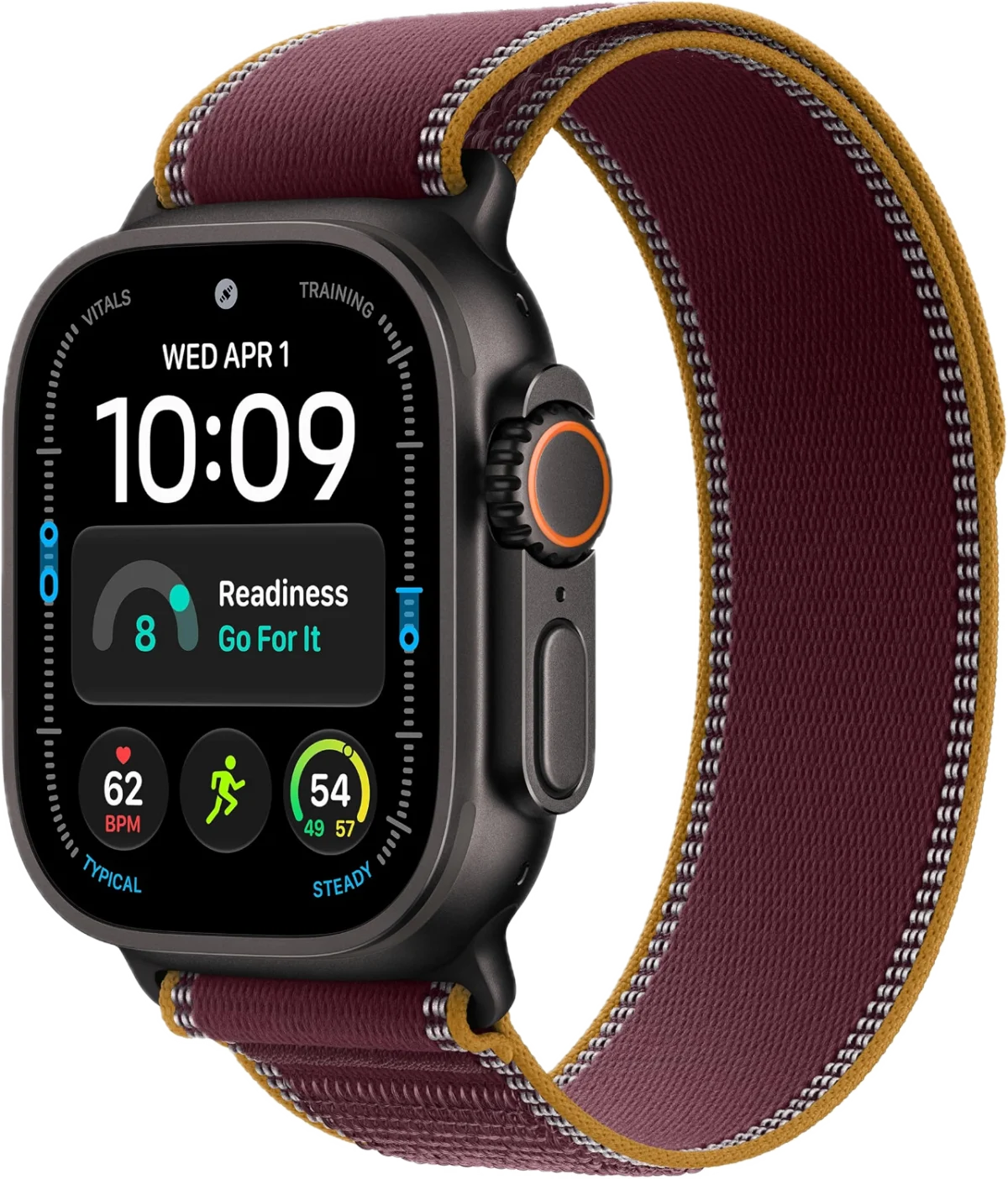
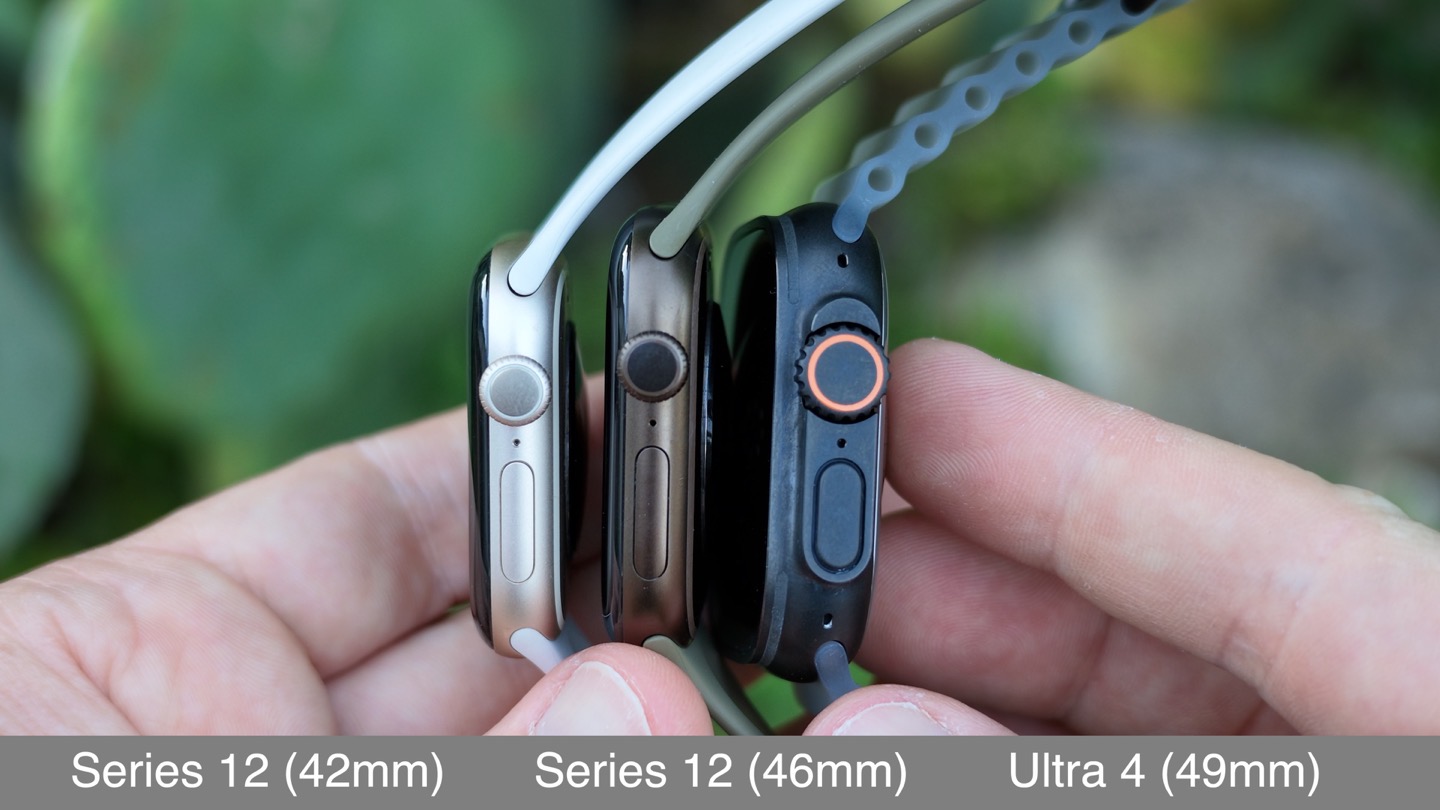
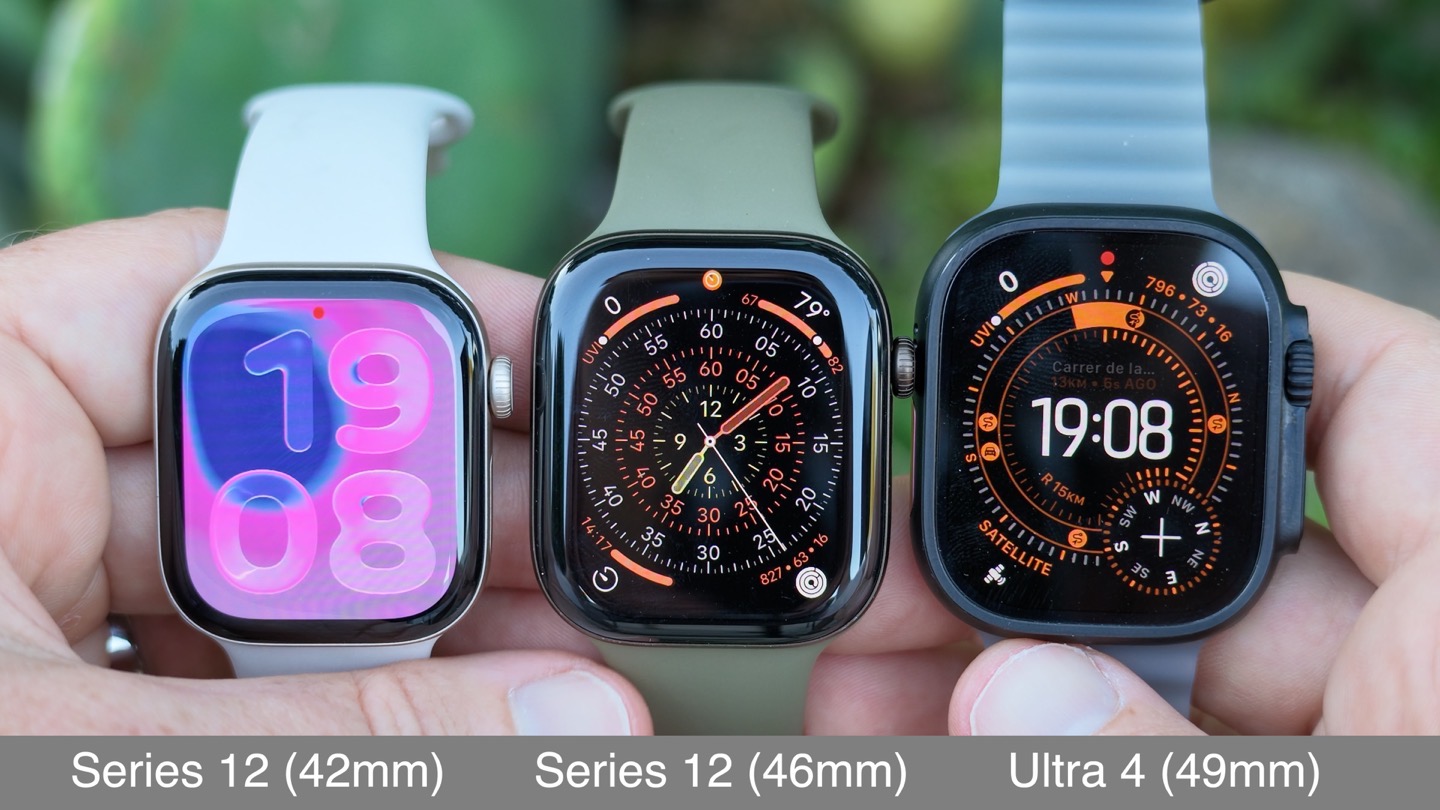
The Apple Watch Ultra 4 is built around a robust 49mm natural or black DLC-coated titanium case featuring a flat sapphire crystal display that achieves a peak brightness of 3,000 nits. It incorporates a physical action button for immediate workout initiation, a guard around the Digital Crown, and is certified to military standard MIL-STD 810H. Furthermore, the Ultra 4 boasts a wide operating temperature range of -4°F to 113°F (-20°C to 45°C) and an expanded altimeter range spanning from -1,600 feet to 29,500 feet (-500 meters to 9,000 meters).
Conversely, the Apple Watch Series 12 is offered in more compact 42mm and 46mm case sizes with curved edge glass. The base models utilize lightweight aluminum paired with CeramicShield 2 glass—which Apple notes is 60% tougher than previous iterations—while higher-end tiers offer titanium and ceramic configurations. The Series 12 display reaches a maximum brightness of 2,000 nits, which, while lower than the Ultra 4, remains exceptionally legible in direct sunlight. However, the Series 12 operates within a narrower temperature window of 32°F to 95°F (0°C to 35°C) and supports an altimeter range restricted to 0 feet to 10,000 feet.
Power Management and Battery Efficiency

Battery longevity remains one of the most critical dividing lines between the two devices. In real-world usage scenarios, the Apple Watch Ultra 4 delivers approximately 2.5 days of regular operation, translating to an official rating of 50 hours, which extends up to 84 hours when utilizing Low Power Mode. For outdoor fitness tracking, the Ultra 4 provides 18 hours of continuous GPS tracking, which can be stretched to 25 hours in Extended GPS mode and up to 45 hours in Max Extended GPS mode.
The Apple Watch Series 12, constrained by its thinner 9.7mm profile compared to the Ultra 4’s 12mm thickness, delivers roughly 1 to 1.5 days of real-world use, translating to an official rating of 24 hours of standard battery life and 38 hours in Low Power Mode. Its dedicated outdoor GPS tracking capability is rated at 10 hours, with Apple leaving extended GPS metrics officially unclaimed for the smaller device. Both models support rapid charging technologies, capable of delivering roughly 80% charge in 30 to 45 minutes, and both can accumulate enough power for a full night of sleep tracking in just five minutes of charging.
Connectivity, Sensors, and Specialized Capabilities
The Ultra 4 sets itself apart through advanced hardware integration designed for extreme environments. It features multiband (dual-frequency) GPS/GNSS, providing superior trajectory tracking in dense urban canyons or heavily wooded trails compared to the regular GPS/GNSS found on the Series 12.
Additionally, the Ultra 4 includes two-way satellite messaging capabilities—introduced in previous Ultra iterations—which encompass emergency SOS via satellite, off-grid text messaging, and FindMy location sharing. This capability is currently supported for emergency use across approximately 17 countries, including the United States, Canada, and parts of Europe, though satellite text messaging support varies by region.
For aquatic enthusiasts, the Ultra 4 features water resistance up to 100 meters and is equipped with a certified depth gauge capable of measuring down to 40 meters (131 feet), making it fully compliant with the EN13319 standard for scuba diving when paired with apps like Oceanic+. The Series 12, by contrast, is water resistant to 50 meters and features a depth gauge limited to 6 meters (20 feet), rendering it suitable for snorkeling and recreational swimming but uncertified for scuba diving.
Safety and audio hardware also differ significantly. The Ultra 4 incorporates an 86dB emergency siren designed to attract attention in rescue scenarios, a feature entirely absent from the Series 12. Furthermore, the Ultra 4 utilizes a three-microphone array and dual speakers for enhanced wind cancellation and call clarity, whereas the Series 12 relies on a single microphone and speaker setup, though real-world audio playback volume tests reveal minimal perceptible differences between the two.
Shared Software Ecosystem and Core Intelligence
Despite the physical hardware variances, Apple has ensured that software parity remains remarkably high across the entire 2026 wearable lineup. Both the Apple Watch Ultra 4 and the Apple Watch Series 12 operate on watchOS 27 and are powered by the S11 SIP chipset featuring a dedicated 4-core Neural Engine.
This shared computational foundation ensures that users of both devices enjoy the exact same health, fitness, and smart features. Both watches incorporate the updated heart rate sensing system, advanced heart rate variability (HRV) recording, newly implemented Readiness Scores, Sleep Apnea detection, wrist temperature monitoring, electrocardiogram (ECG) functionality, blood oxygen monitoring, and hypertension detection capabilities.
Smart features are similarly mirrored. Both devices support offline Siri functionality driven by the neural engine, gesture controls such as Double Tap and Wrist Flick, 64GB of internal storage, and the newly launched Audio Intelligence suite—which includes Instant Shazam, Sound Recognition, and upcoming additions like Siri Recap and Siri Rewind. In the fitness domain, both models provide full access to Workout Buddy, offline topographic maps, Backtrack routing, and the comprehensive array of standard workout profiles housed within the Workout app.
Minor software distinctions are primarily cosmetic or interface-driven. The Ultra 4 exclusively features the Modular and Waypoints watch faces, along with a dedicated Night Mode that shifts the display palette to red for low-light legibility. Additionally, the Ultra 4 permits up to seven configurable data fields within a single sport mode screen—utilizing the Action button for Precision Start functionality—whereas the Series 12 is capped at six data fields and relies on a standard three-second countdown before initiating workouts.
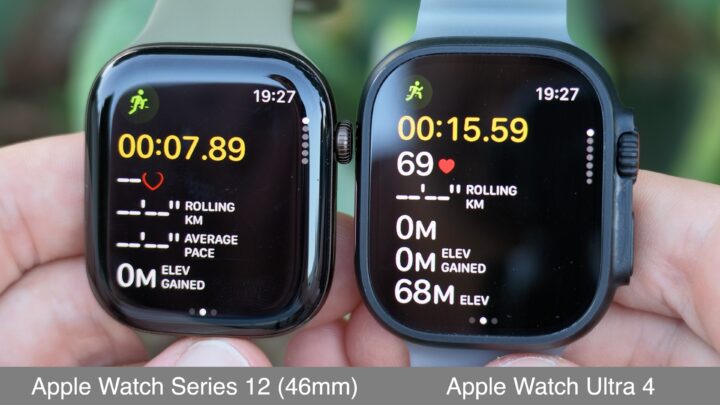
Implications for Consumers
The decision between the Apple Watch Ultra 4 and the Apple Watch Series 12 ultimately hinges on lifestyle requirements rather than technological capability. Consumers who prioritize a lightweight, slim profile, refined aesthetics, and everyday smart notifications will find the Series 12 to be a comprehensive and cost-effective daily driver. Conversely, endurance athletes, backcountry explorers, scuba divers, and users who demand multi-day battery reliability without daily charging routines will find the premium investment in the Apple Watch Ultra 4 to be a necessary and functional upgrade. By maintaining software parity while diverging sharply on physical endurance, Apple has clearly delineated its consumer tech offerings from its professional-grade expedition gear.