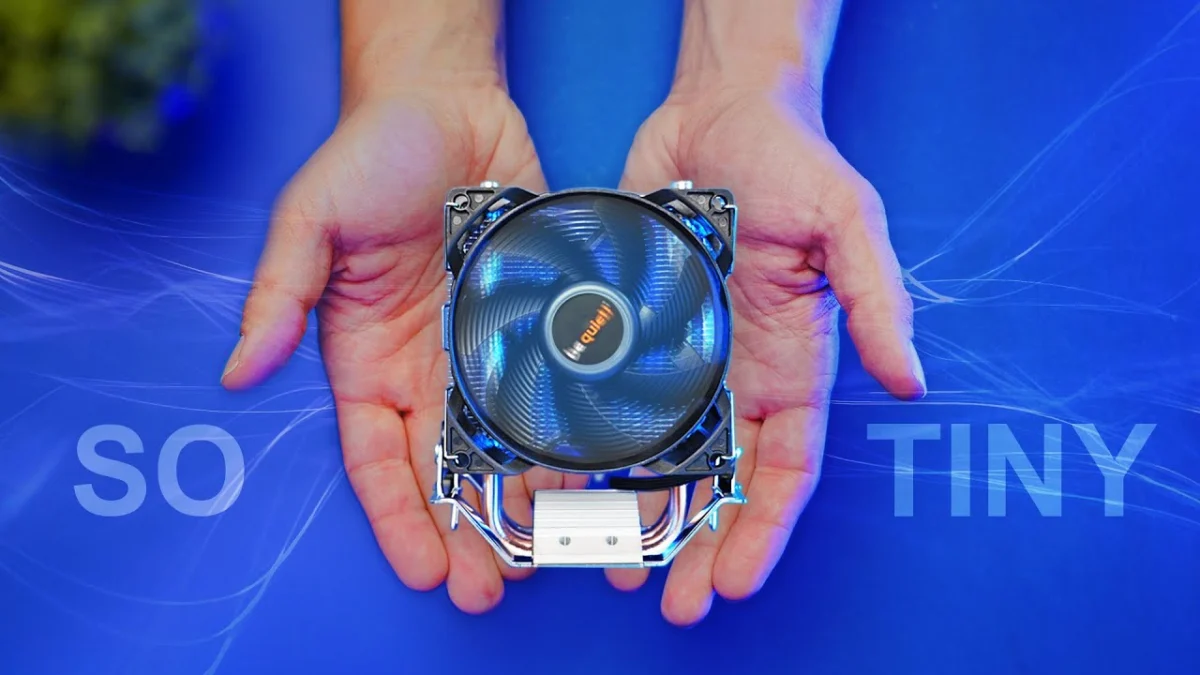
The landscape of CPU cooling has long been dominated by two extremes: the bulky, high-performance air coolers and liquid cooling solutions designed for enthusiasts, or the often-underwhelming stock coolers bundled with processors. However, a recent offering from German manufacturer be quiet! is challenging this paradigm, presenting a compelling case for a compact, cost-effective solution that defies its modest price point. The be quiet! Pure Rock Slim 2, an iteration of their popular Pure Rock Slim series, has emerged as a significant contender in the budget cooling segment, demonstrating that ample thermal management and quiet operation are achievable without a premium price tag or an expansive footprint. This article delves into the specifications, performance, and market implications of this 92mm CPU cooler, which has garnered attention for its ability to deliver surprising efficiency at an official retail price of just $25.
The Evolving CPU Cooling Market: A Shift Towards Efficiency and Compactness
For decades, CPU cooling has been a critical aspect of PC building, directly impacting system stability, longevity, and performance. Early processors often ran hot, necessitating rudimentary heatsinks and fans. As CPU architectures advanced and core counts increased, so did power consumption and thermal design power (TDP), pushing the boundaries of cooling technology. This led to the proliferation of larger air coolers, featuring elaborate fin arrays, multiple heatpipes, and substantial fan sizes (commonly 120mm and 140mm), exemplified by models like the Cooler Master Hyper 212 Evo or be quiet!’s own Dark Rock Pro 4. Simultaneously, the advent of All-in-One (AIO) liquid coolers offered an alternative, often delivering superior thermal performance in a more aesthetically pleasing package, albeit at a higher cost and with greater installation complexity.
However, a parallel trend has been gaining momentum: the rise of Small Form Factor (SFF) PCs. These compact systems, often built into cases like the Cooler Master NR200, demand components that maximize space efficiency without sacrificing performance. Traditional large air coolers or even many AIOs prove incompatible with the stringent height and clearance restrictions of SFF enclosures. This niche, once underserved, is now a crucial segment of the market, driving innovation in component miniaturization. The Pure Rock Slim 2 directly addresses this demand, offering a cooling solution that prioritizes compatibility and efficiency within confined spaces.
The budget segment of the CPU cooler market, typically ranging from $20 to $50, has historically been a battleground for entry-level tower coolers and improved versions of stock cooling solutions. Many manufacturers have offered 92mm coolers over the years, but few have managed to combine the robust build quality, quiet operation, and thermal performance typically associated with premium brands at such an aggressive price point. The Pure Rock Slim 2’s entry is particularly noteworthy given current market conditions, where supply chain disruptions and increased demand have often led to inflated prices for PC components, sometimes exacerbated by third-party resellers.
Unpacking the Pure Rock Slim 2: Design and Features
At its core, the be quiet! Pure Rock Slim 2 is a compact tower-style CPU cooler designed for broad compatibility and efficient operation. Measuring a mere 135mm in height, 82mm in depth, and 97mm in width, it is significantly smaller than the ubiquitous 120mm tower coolers. This diminutive size is not merely a design choice but a strategic engineering decision aimed at maximizing compatibility with a wider range of PC cases, particularly those with restrictive CPU cooler height limits, such as many SFF cases where a 155mm clearance is often the maximum. For instance, the popular Cooler Master NR200, which can accommodate coolers up to 155mm, often excludes even compact 120mm coolers like the Hyper 212 series, making the Pure Rock Slim 2 a viable alternative.
The cooler’s design is elegantly minimalistic yet functional. It features a dense fin array, optimized for heat dissipation, coupled with three 6mm copper heatpipes. These heatpipes utilize a direct touch base (HDT) design, meaning they make direct contact with the CPU’s integrated heat spreader (IHS), facilitating more efficient heat transfer away from the processor. This HDT technology, often found in higher-end coolers, is a significant inclusion at this price point. The base comes with pre-applied thermal compound, simplifying the installation process for users, though care must be taken not to disturb it before mounting.
Cooling is provided by a 92mm be quiet! Pure Wings 2 fan, a model renowned for its quiet operation. While its maximum rotational speed of 2300 RPM might seem high compared to larger 120mm fans, the Pure Wings 2 series is specifically engineered for low noise output. This fan plays a crucial role in the cooler’s ability to maintain competitive thermal performance without generating excessive acoustic distraction, a hallmark of be quiet! products.
Compared to its predecessor, the original Pure Rock Slim, the Slim 2 features subtle but impactful refinements. The fin array has been slightly extended at the rear, potentially offering minor improvements in surface area for heat dissipation. The base plate has also seen minor modifications. However, the most significant changes, according to the manufacturer, lie in the fan and a completely revised installation process, which has been streamlined for user convenience.
Streamlined Installation and Broad Compatibility
One of the standout features of the Pure Rock Slim 2 is its user-friendly installation process, which has been significantly improved from previous iterations. be quiet! has clearly prioritized ease of use, particularly for systems utilizing AMD processors. The AMD mounting bracket comes pre-installed, a thoughtful touch acknowledging the widespread popularity of AMD’s Ryzen platform. This means for most AMD users, the cooler can be mounted almost immediately with minimal effort.
The installation for AMD systems leverages the stock mounting hardware that comes standard with virtually every AMD motherboard. Users simply need to prepare the cooler by adjusting the brackets, align it with the motherboard’s retention clips, and then secure it by pushing down on each side until it clicks into place. While this clip-on method isn’t a screw-down mount and allows for a slight degree of movement, be quiet! has engineered it to ensure adequate mounting pressure for effective thermal contact. This approach offers remarkable simplicity, contrasting sharply with more complex mounting systems found on some other coolers.
For Intel systems, the process involves removing the pre-installed AMD brackets via two screws and substituting them with the Intel-specific brackets. Notably, be quiet! has opted to use the traditional Intel pushpin installation method for this cooler. While this method is lauded for its ease of use and tool-free application, it has historically been criticized for sometimes offering inconsistent mounting pressure compared to screw-down solutions. Despite this, for a cooler in this price bracket, the pushpin system is a common and generally acceptable compromise for mainstream users.
Beyond the ease of installation, the Pure Rock Slim 2 excels in system compatibility. Its narrow profile ensures excellent memory clearance, even when all RAM slots are populated with tall heat spreader modules. This is a common issue with larger tower coolers, where the fan or heatsink can overhang the RAM slots, necessitating low-profile memory or careful planning. The Slim 2 completely circumvents this problem, offering both vertical and memory clearance advantages that are invaluable in compact builds.
Performance Benchmarks: Punching Above Its Weight
The true test of any CPU cooler lies in its performance under load, encompassing both its thermal dissipation capabilities and acoustic profile. The be quiet! Pure Rock Slim 2, despite its size and price, delivers results that challenge many larger and more expensive competitors.
Acoustic performance is a critical aspect where be quiet! consistently excels, and the Pure Rock Slim 2 is no exception. Testing reveals that the 92mm Pure Wings 2 fan is remarkably quiet. At 70% fan speed, it registers at the minimum noise floor of typical testing environments, making it virtually inaudible. Even at its maximum speed of 2300 RPM, the fan only reaches approximately 40 decibels (dBA). To put this into context, many 120mm fans on larger coolers often exceed this noise level at comparable cooling loads. This exceptional quietness gives the Pure Rock Slim 2 a significant advantage, particularly for users who prioritize a silent computing experience.
Thermal performance benchmarks illustrate the cooler’s surprising efficiency. When tested at a 95W TDP, a common thermal load for many mainstream CPUs, the Pure Rock Slim 2 demonstrates strong competition against established coolers. It approaches the cooling performance of the Noctua NH-U12S, a premium 120mm cooler, while maintaining lower noise levels than the Cooler Master Hyper 212 Evo, another popular entry-level 120mm option. This is a remarkable feat for a cooler costing a fraction of these alternatives.
Pushing the envelope further, the cooler was tested at 125W, which is very close to its stated maximum TDP threshold of 130W. Even at this demanding wattage, the Pure Rock Slim 2 holds its own impressively. Repeated tests consistently showed it matching the thermal performance of the NH-U12S up to 37 dBA and outright surpassing the Hyper 212 Evo across various load levels in this high-wattage scenario. These results underscore the cooler’s capability to handle a substantial thermal load, making it suitable for a wide range of processors, including many mid-range to upper-mid-range CPUs from both Intel and AMD.
However, like any cooler, the Pure Rock Slim 2 has its limits. When subjected to an extreme thermal load of 150W, the cooler quickly reaches its thermal capacity. At this wattage, the fan ramps up significantly, and temperatures become unmanageable, indicating that a larger cooling solution would be necessary for high-end, heavily overclocked, or power-hungry CPUs that routinely exceed 130W TDP. This limitation is entirely expected for a cooler of its size and price, and it does not diminish its impressive performance within its intended operating range.
Implications and Market Positioning
The be quiet! Pure Rock Slim 2’s emergence at its $25 price point carries significant implications for various segments of the PC building market.
For budget PC builders, this cooler represents an almost unbeatable value proposition. It offers performance far exceeding that of basic stock coolers and often outperforms more expensive entry-level aftermarket options. For a modest investment, builders can significantly improve thermal management and reduce noise levels, leading to a more stable and enjoyable computing experience. This is particularly crucial for systems built around popular mid-range processors, where every dollar counts.
In the Small Form Factor (SFF) PC market, the Pure Rock Slim 2 is a game-changer. Its compact dimensions make it compatible with a vast array of SFF cases that struggle to accommodate larger coolers. The excellent memory clearance further simplifies component selection for SFF builds, where space is always at a premium. For users who prefer air cooling over the complexities and potential failure points of AIOs in SFF builds, this cooler offers a highly effective and reliable solution.
The cooler also poses a challenge to established entry-level aftermarket coolers. Products like the Cooler Master Hyper 212 Evo, which have long been default recommendations, now face stiff competition from a smaller, quieter, and often more affordable alternative. While the 212 Evo may offer slightly better cooling at very high wattages, the Pure Rock Slim 2’s overall package of price, size, noise, and performance makes it a compelling choice for the vast majority of mainstream users.
From a manufacturer’s perspective, be quiet! has strategically positioned the Pure Rock Slim 2 to capture a significant share of the value and compact cooling market. By incorporating technologies found in their higher-end products into a budget-friendly package, they demonstrate a commitment to performance across their entire product line. The revised, user-friendly installation process is also a testament to their understanding of consumer pain points and a move to enhance the overall user experience.
The price controversy surrounding its release, where third-party sellers attempted to inflate prices, highlights the demand and perceived value of this cooler. However, diligent searching can still yield the Pure Rock Slim 2 at its official $25 price, making it one of the most cost-effective solutions from a reputable brand.
Conclusion: A Small Cooler with a Big Impact
The be quiet! Pure Rock Slim 2 stands as a testament to efficient engineering and thoughtful product design. It shatters the misconception that effective CPU cooling necessitates large, expensive, or complex solutions. For an official retail price of just $25, this compact 92mm cooler delivers a trifecta of benefits: excellent thermal performance, remarkably quiet operation, and broad compatibility due to its diminutive size and streamlined installation.
Its ability to match or even outperform larger, more expensive competitors like the Noctua NH-U12S and Cooler Master Hyper 212 Evo at mainstream thermal loads, all while maintaining superior acoustics, makes it a highly recommended solution for a wide range of PC users. Whether for a budget-conscious build, a space-restricted Small Form Factor system, or simply for anyone seeking a quiet and efficient cooler without breaking the bank, the Pure Rock Slim 2 presents an exceptionally compelling argument.
While it naturally reaches its thermal limits with extreme 150W+ processors, for the majority of users and CPUs on the market today, the Pure Rock Slim 2 offers an almost perfect balance of cost, performance, and practicality. It challenges consumers to look beyond the physical size of a cooler and consider the holistic value it brings, proving that sometimes, the most impactful solutions come in the smallest packages.