
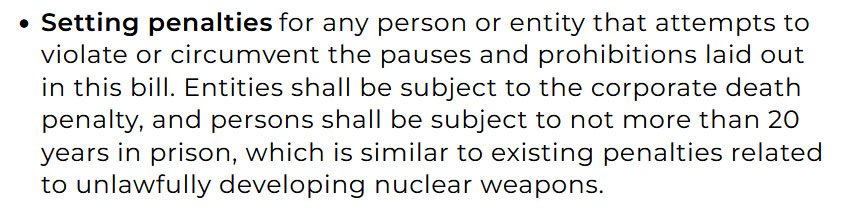
In what political analysts are calling one of the most aggressive and far-reaching regulatory challenges to the modern technology sector, U.S. Senators Bernie Sanders and Greg Casar have formally introduced the Ban Artificial Superintelligence Act. The newly unveiled legislation seeks to implement an immediate, temporary pause on advanced artificial intelligence development while establishing a comprehensive legal framework to prohibit the creation of artificial superintelligence (ASI). With criminal penalties extending up to 20 years in prison for entities and developers who violate these proposed restrictions, the bill equates the illicit engineering of a rogue superintelligent machine with the unauthorized design of a nuclear weapon.
The introduction of the bill arrives at a pivotal juncture in human history, characterized by an unprecedented acceleration in computational power, massive corporate investments, and growing anxiety among scientists, ethicists, and policymakers regarding the long-term trajectory of machine intelligence. As artificial intelligence systems rapidly evolve from narrow task-oriented models to systems displaying generalized reasoning capabilities, the debate over how to govern technology that could potentially outpace human control has transitioned from academic forums to the halls of the United States Congress.
The Legislative Framework and Proposed Penalties
The Ban Artificial Superintelligence Act is designed to fundamentally alter the speed and direction of technological research in the United States. According to the legislative text, the bill’s primary mechanism is a government-mandated pause on the training and scaling of advanced foundation models that cross specific compute and capability thresholds.
To enforce these sweeping restrictions, the legislation proposes the creation of a brand-new, cabinet-level federal agency. This hypothetical body would be charged with the singular mission of safeguarding the public from existential and societal risks posed by advanced automation. Its responsibilities would include monitoring high-performance computing clusters, auditing frontier AI laboratories, and prosecuting violations of the superintelligence prohibition.
The penalties outlined in the bill are intentionally severe to deter reckless development. Developers, corporate executives, or independent researchers found guilty of intentionally violating the freeze or attempting to engineer artificial superintelligence face felony charges carrying prison sentences of up to 20 years. By imposing penalties historically reserved for the proliferation of weapons of mass destruction, the lawmakers are signaling that they view the unchecked expansion of frontier AI not merely as a commercial risk, but as a paramount national security threat. Furthermore, the legislation calls for aggressive international diplomacy, urging the executive branch to pursue bilateral and multilateral treaties to ensure that the ban on artificial superintelligence is adopted globally, preventing foreign actors from bypassing U.S. restrictions.

The Shifting Landscape of Industry Sentiment
One of the most paradoxical elements of the current regulatory debate is the evolving stance of prominent technology executives. Historically, Silicon Valley has fiercely resisted government intervention, lobbying aggressively against compliance burdens that might stifle innovation or slow down time-to-market. However, the discourse surrounding artificial intelligence has experienced a profound shift.
High-profile industry leaders—including OpenAI CEO Sam Altman, Anthropic CEO Dario Amodei, and tech entrepreneur Elon Musk—have repeatedly voiced profound concerns regarding the existential risks associated with advanced artificial intelligence. While these executives have not explicitly endorsed the draconian prison sentences proposed by Senators Sanders and Casar, their public warnings about the potential for loss of human control over superintelligent systems have inadvertently aligned with the narrative pushed by progressive lawmakers.
This convergence of concern has created an unusual political dynamic. While libertarian and pro-business factions in Congress traditionally oppose heavy-handed regulation, the explicit acknowledgement of catastrophic risk by the architects of the technology themselves has given lawmakers fresh ammunition to pursue aggressive oversight. Critics of the bill, however, argue that these safety pronouncements from industry giants may stem from ulterior motives. Some analysts suggest that established tech leaders are financially and computationally positioned to weather a government-mandated pause, effectively using regulation to pull up the ladder behind them and handicap emerging competitors who lack the resources to navigate a bureaucratic compliance maze.
Economic Realities and the Financial Burden of AI Infrastructure
Beyond existential philosophy and national security concerns, the Ban Artificial Superintelligence Act taps into growing anxieties regarding the economic sustainability of the current artificial intelligence boom. The race toward artificial general intelligence (AGI) and subsequent superintelligence requires astronomical capital expenditures. Major technology firms are spending hundreds of billions of dollars constructing massive data centers powered by tens of thousands of specialized accelerators, such as Nvidia’s H100 and subsequent architectures.
Recent analyses from financial institutions paint a daunting economic picture for these massive outlays. Research published by firms like J.P. Morgan indicates that the current infrastructure buildout will require hundreds of billions of dollars in annual revenue just to deliver a modest return on investment. To make these capital expenditures financially viable, the tech industry would need to extract recurring subscription fees from a vast majority of the global population on a scale never before seen in consumer technology.
As private investors begin to question the timeline to true profitability, some market observers speculate that tech executives may quietly welcome a transition from commercially funded development to a state-sponsored paradigm. By framing advanced AI as a matter of national defense requiring government intervention, the industry could theoretically pivot toward a publicly funded "Manhattan Project II" model, shifting the financial risk of ongoing research and infrastructure maintenance onto taxpayers while retaining proprietary control through government contracts.
Political Obstacles and Bipartisan Hurdles
Despite the gravity of the proposals, the Ban Artificial Superintelligence Act faces a steep uphill battle in Congress. The legislation is widely characterized by policy analysts as the most extreme and restrictive AI-related bill introduced to date. It is expected to encounter fierce opposition from a diverse coalition of lawmakers, including enterprise-supporting Democrats who champion technological innovation as an economic engine, and free-market Republicans who historically oppose the creation of new cabinet-level federal agencies and stringent corporate mandates.
Nevertheless, the traditional lines of political alignment are blurring. National security hawks within the Republican party are increasingly viewing technological dominance over rival nations—specifically China—as a vital priority, which could lead to complex legislative compromises. While a complete ban on advanced development may be politically unviable in the near term, the willingness of lawmakers to draft legislation carrying severe criminal penalties indicates that the era of unfettered, self-regulated artificial intelligence development is coming to a close.
Implications for the Future of Global Technology
The introduction of the Ban Artificial Superintelligence Act marks a defining moment in the governance of emerging technologies. It forces a direct confrontation between two competing visions for the future: one driven by the ethos of rapid commercial expansion and competitive technological supremacy, and another rooted in the precautionary principle, which demands absolute containment of risks that could threaten human civilization.
As the debate moves forward, the tech industry, legal scholars, and government officials will be forced to grapple with complex definitions of what constitutes "artificial superintelligence" and where the boundary lies between beneficial automation and existential peril. Whether or not Sanders and Casar’s legislation successfully navigates the legislative process, it has permanently shifted the baseline of the political conversation, ensuring that the development of artificial intelligence will remain one of the most intensely scrutinized and regulated frontiers of the twenty-first century.