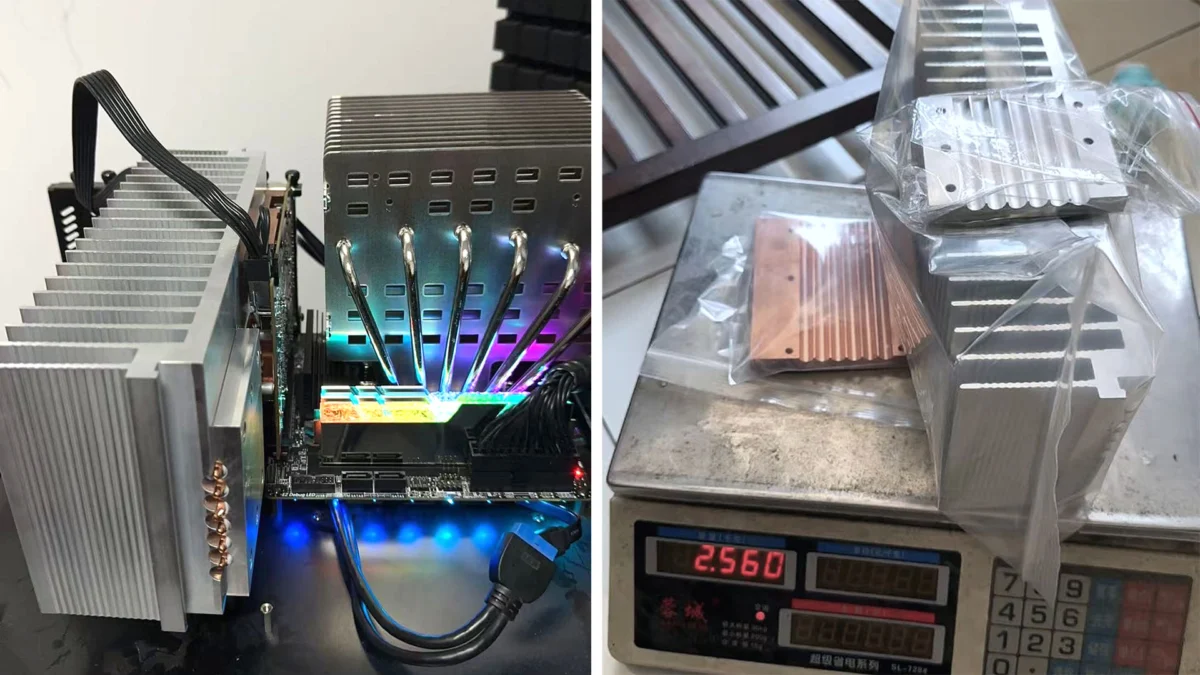
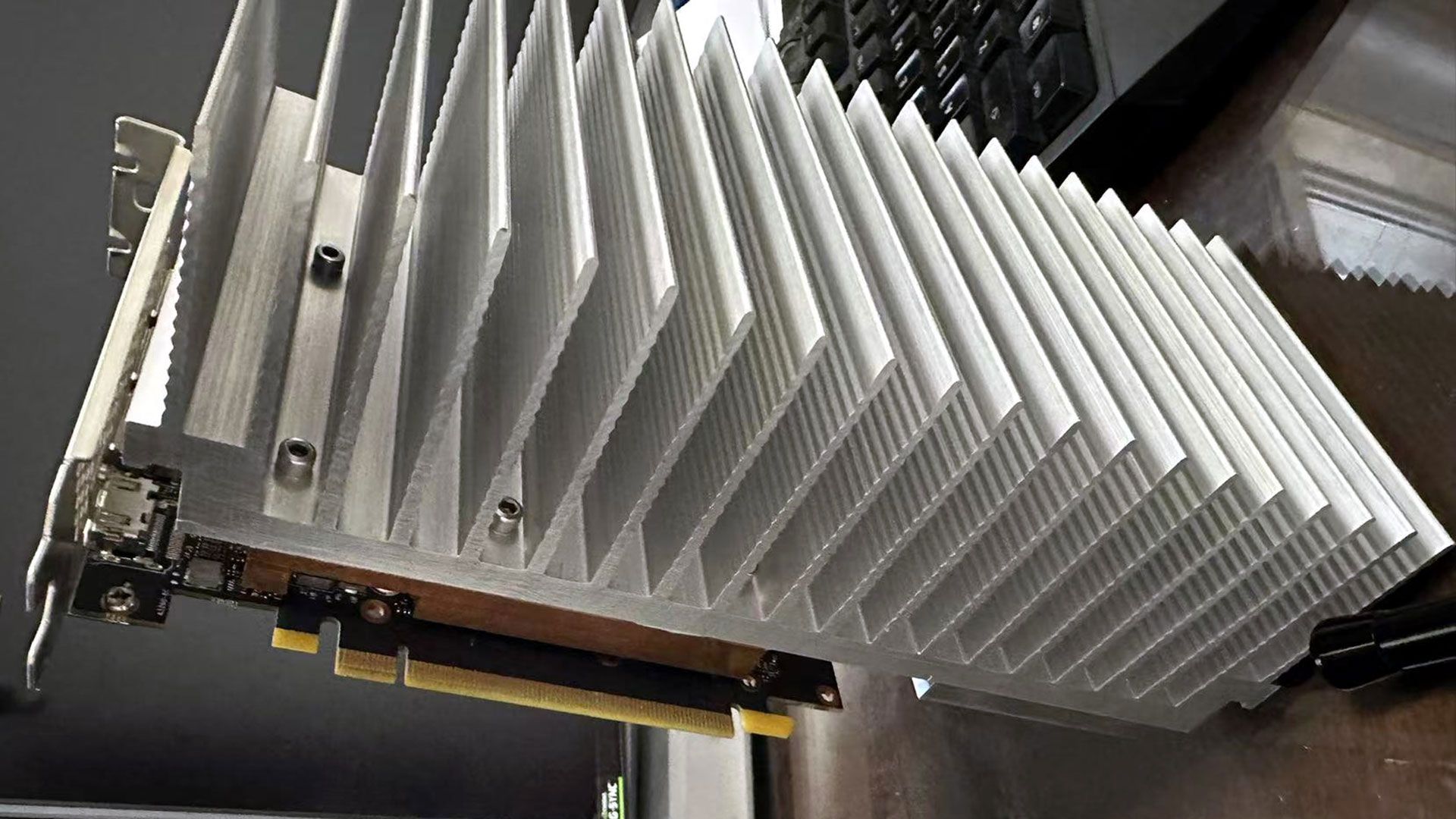
A notable achievement in PC hardware modification has emerged from the enthusiast community, with Bilibili user NexFrame successfully engineering a fully passive cooling system for an Nvidia GeForce RTX 4060 graphics card. This bespoke creation represents a significant leap for silent computing, challenging the long-standing dominance of lower-power solutions like the Palit GeForce RTX 3050 KalmX 6GB, which, as of 2026, remains a benchmark for commercially available passive GPUs. NexFrame’s innovative design involves a substantial, finned aluminum heatsink meticulously bolted onto the RTX 4060, demonstrating a clear ambition to deliver high-performance gaming in a completely fanless environment.
NexFrame, a burgeoning entity with a discernible focus on passive PC systems, has garnered attention through their Bilibili channel, where their bio (as per machine translation) highlights a dedication to fanless solutions. While detailed specifications regarding the custom-built passive RTX 4060 remain somewhat limited, the physical manifestation of the project is undeniable: a robust 5.5-pound (2.5 kg) aluminum heatsink now forms the core of the GPU’s thermal management. This considerable mass is crucial for dissipating the heat generated by a modern graphics processing unit without the aid of active airflow. The primary objective of such a design is to eliminate the acoustic footprint typically associated with high-performance computing, providing users with a truly silent operation.
The Challenge of Passive GPU Cooling
Passive cooling, a method that relies entirely on natural convection and radiation to dissipate heat, presents a formidable engineering challenge, especially for components as thermally demanding as modern GPUs. Unlike active cooling systems that use fans to force air over heatsinks, passive solutions must maximize surface area and conductive efficiency to shed heat into the ambient environment. This often necessitates significantly larger and heavier heatsinks, which can introduce complexities related to physical integration, weight distribution, and compatibility with standard PC chassis.
The Nvidia GeForce RTX 4060, released in June 2023, is based on the Ada Lovelace architecture and is designed primarily for mainstream 1080p gaming. Its official Total Graphics Power (TGP) is typically rated around 115W, with some custom models drawing slightly more, up to approximately 120W under full load. While considerably more power-efficient than previous generations, dissipating 115W passively requires a meticulously designed thermal solution. This power envelope places the RTX 4060 firmly in the mid-range performance category, making NexFrame’s fanless implementation particularly noteworthy given the thermal output involved.
Performance Under Scrutiny: Data Discrepancies and Promising Temperatures
Observations from NexFrame’s Bilibili video, specifically a system monitor window captured during a gaming session, provide initial insights into the custom RTX 4060’s performance. The GPU reportedly operated at a core temperature of 58 degrees Celsius (°C), with a hotspot temperature reaching 71°C. Crucially, the fan speed was registered at 0 RPM, confirming the passive operation. These temperatures are remarkably low for a passively cooled GPU under gaming load, often rivaling or even surpassing those achieved by actively cooled cards. Typically, a passively cooled component is expected to run hotter than its actively cooled counterpart, making these reported figures particularly impressive if accurate.
However, a significant discrepancy arises from the reported power consumption. The system monitor indicated the GPU was drawing an astonishing 198W. This figure is considerably higher than the standard 115W to 120W TGP for an actively cooled RTX 4060. Such an elevated power draw would make the observed temperatures even more extraordinary, bordering on implausible for a purely passive setup without extreme environmental controls or an impossibly efficient heatsink. Experts in PC hardware suggest that this reported 198W figure is likely a misreporting or an anomaly within the monitoring software. It is more probable that the GPU was operating closer to its rated TGP, perhaps with some minor undervolting or power limit adjustments to optimize for passive cooling. If the actual power consumption was indeed around 115-120W, the temperatures of 58°C and 71°C hotspot represent an exceptional feat of passive thermal engineering.
The Precedent: Commercial Fanless GPUs and the Market Gap
The market for commercially available passive graphics cards has historically been limited, primarily to lower-power models. For years, solutions like the Palit GeForce RTX 3050 KalmX 6GB, announced in early 2024 with a TGP around 70W, have been considered the pinnacle of what manufacturers are willing to offer in a fanless configuration. Prior to this, passive GPUs were often restricted to entry-level cards or specialized industrial applications where noise reduction was paramount over raw graphical horsepower.
The reluctance of major manufacturers to produce high-performance passive GPUs stems from several factors:
- Thermal Management Complexity: Dissipating significant heat (e.g., 100W+) without fans requires massive heatsinks, which are costly to produce and integrate.
- Physical Constraints: Such large heatsinks often make the cards extremely bulky, potentially occupying multiple expansion slots and adding considerable weight, which can strain PCIe slots.
- Niche Market: The demand for truly fanless high-performance systems, while growing, remains a niche compared to the broader gaming market that prioritizes maximum performance and accepts fan noise.
- Performance Compromise: Achieving stable passive cooling often requires the GPU to operate at lower clock speeds or power limits than its actively cooled counterparts, which can deter performance-focused consumers.
NexFrame’s DIY project directly addresses this market gap, demonstrating that with ingenuity and specialized design, a mid-range gaming GPU like the RTX 4060 can indeed be operated passively. This pushes the boundaries of what enthusiasts might expect from future commercial offerings, potentially signaling to manufacturers a viable, albeit niche, demand for more powerful fanless options.
A Holistic Approach: Passive CPU Cooling
NexFrame’s commitment to silent computing extends beyond the GPU, as the images shared also reveal a passively cooled CPU. The system integrates a hexacore Intel CPU paired with a Noctua NH-P1 Passive CPU cooler. The Noctua NH-P1, launched in late 2021, is a renowned commercial passive cooler designed specifically for low-noise and fanless operation. During independent review testing, the NH-P1 has proven capable of maintaining stable temperatures for CPUs consuming up to 75W over extended periods. In NexFrame’s setup, the system monitor indicated the CPU was drawing between 35W and 50W, a power range well within the NH-P1’s impressive thermal dissipation capabilities.
This dual-passive cooling strategy for both the CPU and GPU underscores NexFrame’s dedication to creating an entirely silent computing experience. By eliminating both the primary sources of noise in a typical gaming PC, the builder has crafted a system that offers an unparalleled level of acoustic tranquility.
The Enduring Allure of Silent PCs
The pursuit of passively cooled PCs is a long-standing fascination for a significant segment of PC enthusiasts. The primary driver is the desire to eliminate what is arguably the most pervasive and often irritating component of a modern computer: fan noise. A standard gaming PC is a symphony of whirring parts, with fans integrated into the CPU cooler, the GPU shroud, the power supply unit (PSU), and strategically placed throughout the case for overall airflow. Even advanced liquid cooling systems, while often marketed as "quiet," still rely on fans to cool the radiators attached to their CPU or GPU blocks.
The appeal of a truly silent computing experience is multifaceted:
- Enhanced Immersion: For gamers, the absence of fan noise allows for deeper immersion into game worlds, with only in-game audio to contend with.
- Professional Environments: For audio engineers, video editors, or professionals requiring focused concentration, a silent workstation is invaluable.
- Home Theater PCs (HTPCs): Passive systems are ideal for living room HTPCs, where any noise can detract from the entertainment experience.
- Dust Reduction: Fewer moving parts means less airflow actively pulling dust into the system, potentially reducing maintenance and increasing component longevity.
- Reliability: The elimination of mechanical fans removes a common point of failure in PC systems.
The creation of a passive RTX 4060 system by NexFrame not only showcases individual ingenuity but also highlights the enduring demand for such serene computing environments.
Technical Challenges and Trade-offs
While NexFrame’s achievement is commendable, it also underscores the inherent challenges and trade-offs associated with high-performance passive cooling:
- Size and Weight: The 5.5-pound heatsink is a testament to the sheer physical mass required. Such a heavy component can put significant stress on a motherboard’s PCIe slot and may require additional support structures within the PC case.
- Cost of Customization: Designing and fabricating such a specialized heatsink is not inexpensive, making these solutions often more costly than their actively cooled counterparts.
- Airflow Dependency: Even a "passive" system often benefits from some degree of natural convection within the PC case, or a case specifically designed to aid heat dissipation (e.g., cases with large external heatsink fins, like those from Streacom, which were designed to cool up to 600W). Without proper case design, ambient heat can build up, diminishing the passive cooler’s effectiveness.
- Potential Performance Throttling: While NexFrame’s reported temperatures are excellent, achieving them might involve a slight reduction in boost clocks or power limits to prevent thermal throttling under sustained heavy loads. This is a common trade-off in passive designs to ensure stability.
Broader Implications for the PC Industry
NexFrame’s DIY passive RTX 4060 system carries several broader implications for the PC hardware industry:
- DIY Innovation as a Catalyst: The project serves as a powerful reminder of the innovation that flourishes within the enthusiast community. Such grassroots developments often push the boundaries of what is considered possible and can inspire commercial manufacturers to explore new product categories.
- Market Signal for Manufacturers: The strong community reaction to such projects indicates an untapped market demand for more powerful fanless solutions. As GPU power efficiency continues to improve with each generation (a trend evident in Nvidia’s Ada Lovelace architecture), the feasibility of commercially viable mid-to-high-end passive GPUs may become more attractive.
- Influence on Design Philosophy: Even if full passive cooling for high-end components remains a niche, the pursuit of silence influences mainstream product design. Manufacturers are increasingly focusing on quieter fan designs, semi-passive modes (where fans only spin up under load), and overall acoustic optimization, demonstrating a clear shift towards more user-friendly, less noisy computing experiences.
- Sustainability Considerations: While the initial reported 198W draw is likely an error, optimized passive systems, when running at their intended lower TGP, can contribute to slightly lower overall system power consumption and reduced material waste from fewer moving parts over time.
In conclusion, NexFrame’s successful implementation of a passive Nvidia GeForce RTX 4060 system is a remarkable feat of engineering. Despite the unresolved discrepancy in reported power consumption, the demonstrated thermal performance at 0 RPM is a significant milestone for silent computing. It not only provides a compelling proof-of-concept for high-performance passive cooling but also reinvigorates discussions around the commercial viability and future potential of fanless PC hardware, reminding the industry of the enduring desire for a truly peaceful computing experience.