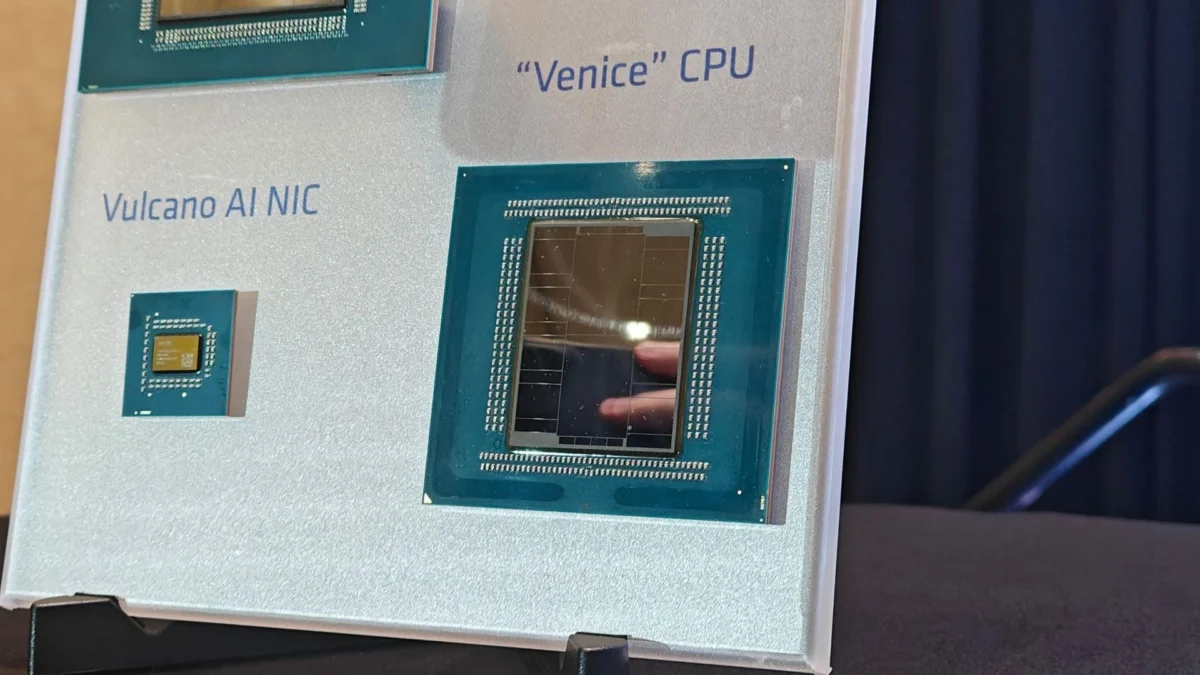
Following the initial launch of AMD’s EPYC ‘Venice’ processors in July, Advanced Micro Devices has reinforced its performance leadership claims with the release of a comprehensive white paper detailing its upcoming generation of server chips. While the overarching performance narrative remains consistent with previous announcements, the newly published documentation provides granular insights into the architectural advantages, testing methodologies, and direct competitive benchmarks that position AMD favorably against major rivals such as NVIDIA and Intel in the enterprise data center market.
According to the newly released technical data, AMD maintains that a high-frequency, 96-core EPYC Venice processor delivers approximately a 20 percent performance advantage over NVIDIA’s 88-core Vera CPU. This specific metric was measured using the rigorous SPEC CPU 2026 Integer Rate test, an industry-standard benchmark suite designed to evaluate the integer compute performance of computer systems under heavy, multi-threaded workloads. Beyond this headline-grabbing comparison, the comprehensive white paper dives deep into the underlying Zen 6 architecture, shedding light on how AMD has optimized power efficiency, core scaling, and memory subsystems to dominate next-generation enterprise computing environments.
Background Context and Architectural Evolution
The server processor landscape is undergoing a massive transformation, driven by the explosive growth of artificial intelligence, cloud computing, and high-performance computing (HPC) workloads. Competitors are racing to deliver higher core counts, faster memory interfaces, and superior energy efficiency to meet the demands of modern data centers.
AMD’s EPYC line has steadily gained market share from Intel Xeon processors over the past several years, largely due to its innovative chiplet design and aggressive generational improvements. The introduction of the EPYC ‘Venice’ architecture represents the next logical step in this evolution. Built on the Zen 6 microarchitecture, Venice pushes the boundaries of silicon engineering by offering configurations scaling up to an astonishing 256 cores, supported by a massive 1024MB of L3 cache, 16-channel memory architecture, and robust clock speeds reaching up to 5GHz.
This architectural leap is designed to address the increasing bottleneck of memory bandwidth in multi-core processors. As data centers handle larger datasets for AI inference, database management, and cloud virtualization, the ability to feed data rapidly to hundreds of CPU cores becomes paramount. The inclusion of 16-channel memory support in the Venice platform is a direct response to these demands, ensuring that high core counts are not artificially constrained by memory starvation.
Chronology of the EPYC Venice Rollout
The deployment and public disclosure schedule for the EPYC Venice platform highlights AMD’s calculated approach to capturing enterprise market attention:
- July: AMD officially launches the EPYC ‘Venice’ CPU family, offering initial performance previews and highlighting its monumental generational leap—claiming up to a 3.4x performance increase over competing Intel Xeon hardware and a decisive edge over NVIDIA’s server offerings.
- Interim Period: Industry analysts, enterprise clients, and hardware enthusiasts await empirical verification of these claims, as third-party testing environments and specialized corporate workloads require deeper documentation.
- Friday: AMD releases an extensive architectural white paper detailing the underlying metrics of the Venice lineup. This document specifically focuses on the SPEC CPU 2026 Integer Rate benchmarks, substantiating the prior claims of a 20 percent performance delta over NVIDIA’s Vera processor.
Detailed Performance Metrics and Competitive Landscape
The core of AMD’s recent disclosure revolves around comparative benchmarking against NVIDIA’s Vera CPU architecture. In the SPEC CPU 2026 Integer Rate test, the 96-core EPYC Venice configuration demonstrated a 20 percent throughput advantage over the 88-core NVIDIA Vera. Integer performance is a critical metric for enterprise applications, web servers, database indexing, and compiler operations, making this advantage highly relevant for enterprise procurement teams.
Furthermore, when stacking the flagship 256-core EPYC Venice variant against legacy and current-generation Intel Xeon competition, AMD’s white paper reiterates performance leaps of up to 3.4 times in select intensive workloads. These figures underscore the widening gap in core density and raw compute efficiency between AMD and its traditional x86 rival, while also establishing a formidable benchmark against NVIDIA’s expanding portfolio of proprietary server processors.
The incorporation of up to 1024MB of L3 cache plays a pivotal role in these benchmark results. By keeping larger working sets of data closer to the execution cores, the processor minimizes latency associated with fetching data from main system memory. This cache hierarchy, combined with the sheer bandwidth afforded by 16-channel memory, allows the Venice platform to maintain high operational frequencies—peaking at 5GHz—even under heavy thermal and electrical loads.
Industry Implications and Market Analysis
The release of the architectural white paper is not merely a marketing exercise; it serves as a critical resource for enterprise IT decision-makers, hyperscale cloud providers, and system integrators who must plan their hardware refresh cycles years in advance.
- Enterprise Procurement Decisions: Large data center operators rely heavily on standardized benchmarks like SPEC CPU to project Total Cost of Ownership (TCO). A 20 percent performance advantage in integer operations translates directly to fewer physical servers required to handle equivalent workloads, saving on floor space, power, and cooling infrastructure.
- The x86 vs. ARM/Proprietary Rivalry: While Intel remains AMD’s historic x86 rival, the inclusion of NVIDIA’s Vera in AMD’s direct comparisons highlights a shifting battlefield. As NVIDIA aggressively expands its footprint from GPUs into integrated CPU-GPU server ecosystems (such as its Grace and Vera platforms), AMD is proactively positioning EPYC as the superior standalone host processor for complex, compute-heavy deployments.
- Ecosystem Readiness: Detailed white papers signal to software developers and operating system vendors that the Zen 6 architecture is maturing and ready for ecosystem optimization. Ensuring that compilers, virtualization layers, and enterprise databases are fully optimized for 16-channel memory and massive core counts is essential for realizing the performance gains advertised by AMD.
Conclusion and Outlook
As the enterprise hardware market looks toward the widespread commercial deployment of systems powered by EPYC Venice, AMD’s transparency regarding benchmark conditions helps build confidence among enterprise buyers. By backing up its July launch claims with rigorous documentation, the company has provided a clear technical justification for its performance leadership assertions.
While independent third-party validations will ultimately dictate the real-world success of the platform once hardware reaches customer data centers, the architectural specifications and initial benchmark disclosures suggest that AMD is well-prepared to defend and expand its market share in the high-stakes server CPU arena.