The rollout of Meta One marks a significant strategic shift for the tech giant, introducing a tiered subscription model across its dominant ecosystem of social media and messaging applications. Following initial announcements and preliminary testing phases earlier in the year, Meta has officially deployed these paid bundles to the public. The structured tiers—tailored for everyday individuals, AI power users, content creators, and corporate entities—are designed to extract greater economic value from platforms that currently serve billions of monthly active users globally. This commercial evolution reflects broader industry trends where major technology firms seek diversified revenue streams beyond traditional digital advertising, placing advanced generative artificial intelligence and professional management tools directly behind paywalls.
Background Context and Evolution of the Subscription Strategy
The groundwork for Meta One was laid months prior, originating from strategic revelations made by company executives in May. During initial disclosures, Meta outlined plans to test granular, platform-specific upgrades under monikers like Facebook Plus, Instagram Plus, and WhatsApp Plus. Spearheaded largely by product leadership, including Meta’s Head of Product Naomi Gleit, these early iterations were positioned as avenues to enhance user expression and connectivity.
At the onset of those early trials, pricing structures were established to test consumer appetite for marginal enhancements. WhatsApp Plus emerged as the entry-level offering priced at $2.99 per month, while Facebook and Instagram Plus tiers were pegged slightly higher at $3.99 monthly. These foundational packages introduced features aimed at aesthetic personalization and content visibility, such as enhanced, vibrant animations for Story reactions—including the coveted "Super Heart"—and weekly "spotlight" mechanisms designed to organically boost the reach and view counts of individual posts.

As consumer testing progressed, internal metrics and user feedback encouraged the company to consolidate these fragmented offerings into a unified architecture. The culmination of this development is the newly minted Meta One framework, which scales from basic aesthetic enhancements to heavy computational AI power and robust business management suites.
Chronology and Timeline of the Rollout
The deployment of Meta One follows a deliberate, multi-phase trajectory engineered to minimize service disruption and gauge market reception:
- May: Meta publicly unveils its preliminary app subscription plans, signaling a strategic pivot toward paid consumer features and testing Facebook, Instagram, and WhatsApp Plus iterations.
- Summer: Regional and closed beta tests are conducted to evaluate feature adoption, specifically regarding AI media generation tools and basic monetization features for creators.
- September 15: Meta officially launches the comprehensive Meta One subscription plans worldwide, establishing distinct tiers for individuals, AI enthusiasts, creators, and business enterprises.
- Post-Launch Phase: Integration of advanced capabilities, such as the round-the-clock Meta Business Agent on WhatsApp, becomes globally available to subscribers of professional tiers.
Breakdown of Subscription Tiers: Core, Premium, Max, and Expert
The Meta One ecosystem is meticulously segmented to address vastly different user profiles, ranging from casual consumers seeking advanced customization to commercial enterprises requiring round-the-clock automation and operational security.

For individuals and AI power users, Meta has introduced the Core and Premium tiers. These specific packages are engineered to deliver compute-intensive artificial intelligence capabilities that exceed the standard, free-tier offerings. Subscribers gain expanded creative freedom through enhanced media generation tools powered by Meta AI. Furthermore, in-app generative capabilities—such as the advanced "Restyle" feature on Instagram—are unlocked, allowing users to dramatically transform their visual content through sophisticated machine learning models.
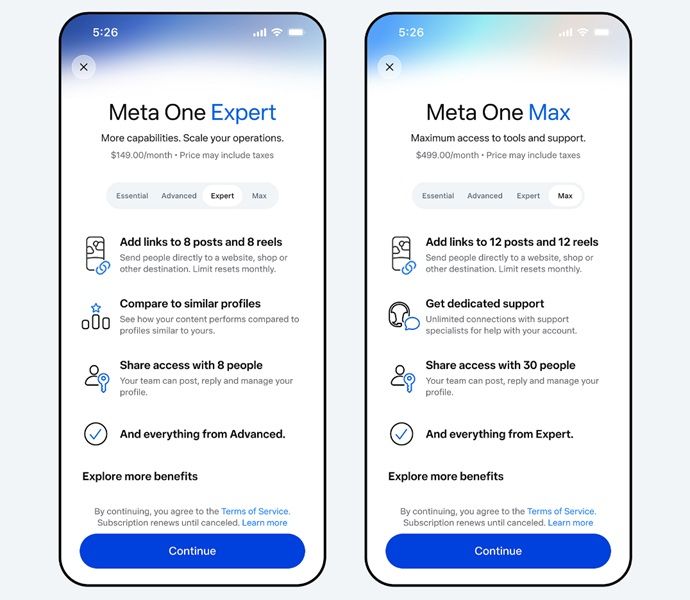
Conversely, the upper echelons of the Meta One architecture—comprising the Max and Expert plans tailored for creators and small businesses—pivot away from pure consumer entertainment toward professional utility. Starting at $14.99 per month, these commercial plans integrate essential growth and management tools directly into the native applications, removing the historical friction of managing separate, dedicated business portals.
Key Features for Creators and Businesses
For emerging creators and small business owners, the Meta One business and creator tiers introduce a suite of operational enhancements designed to streamline audience acquisition and brand protection:
- Enhanced Profiles: Subscribers receive upgraded profile layouts that place critical conversion metrics—such as official websites, operating hours, and physical brick-and-mortar business locations—front and center.
- Automated Engagement: The system automatically dispatches follow invitations to distinct accounts that actively interact with a creator’s published content, complemented by prominent, high-visibility "follow buttons" embedded directly within Reels.
- Verified Status and Security: Subscribers receive a verified verification badge across platforms, a dedicated verified business channel on WhatsApp, and robust anti-impersonation protection protocols to safeguard brand integrity.
- Meta Business Agent: Perhaps the most technologically significant inclusion for commercial users is 24/7 access to the Meta Business Agent via WhatsApp. This automated assistant handles customer inquiries, manages scheduling, and provides operational support around the clock.
Analysis of Implications and Market Reception
Industry analysts observing the rollout of Meta One point to a broader economic imperative: social media conglomerates are reaching saturation points in user growth within developed markets, necessitating alternative avenues for monetization. By tiering access to computational resources—particularly generative AI—Meta is testing the willingness of consumers to pay directly for digital utility rather than solely subsidizing services through personal data and targeted advertising.
However, market reception remains mixed, particularly regarding lower-tier consumer offerings. Critics and digital culture commentators have questioned the intrinsic value proposition of paying nominal monthly fees—such as $4 for aesthetic animations or exclusive Story reactions. While power users, influencers, and corporate entities running active commercial operations can easily justify subscription costs as a standard operational expense tied to customer acquisition, the average consumer may find it difficult to rationalize paying for features that were historically accessible without charge.
Conversely, the inclusion of enterprise-grade tools like the Meta Business Agent and automated follow mechanics represents a tangible value add for small businesses. By centralizing customer relationship management and verification security within familiar messaging and social applications, Meta effectively lowers the technological barrier to entry for digital entrepreneurship.
Looking Forward
As Meta One embeds itself into the digital routines of billions of global users, the ultimate success of the initiative will hinge on continuous feature expansion and perceived utility. If the compute-intensive AI capabilities offered in the Premium tiers continue to evolve and deliver undeniable creative or professional advantages, subscription models could become an entrenched pillar of Meta’s business model. As user adoption data accumulates in the coming quarters, the tech industry will closely monitor whether everyday consumers are willing to embrace the subscription era for social media, or if these paid tiers will ultimately find their most sustainable footing strictly within the creator and enterprise economies.