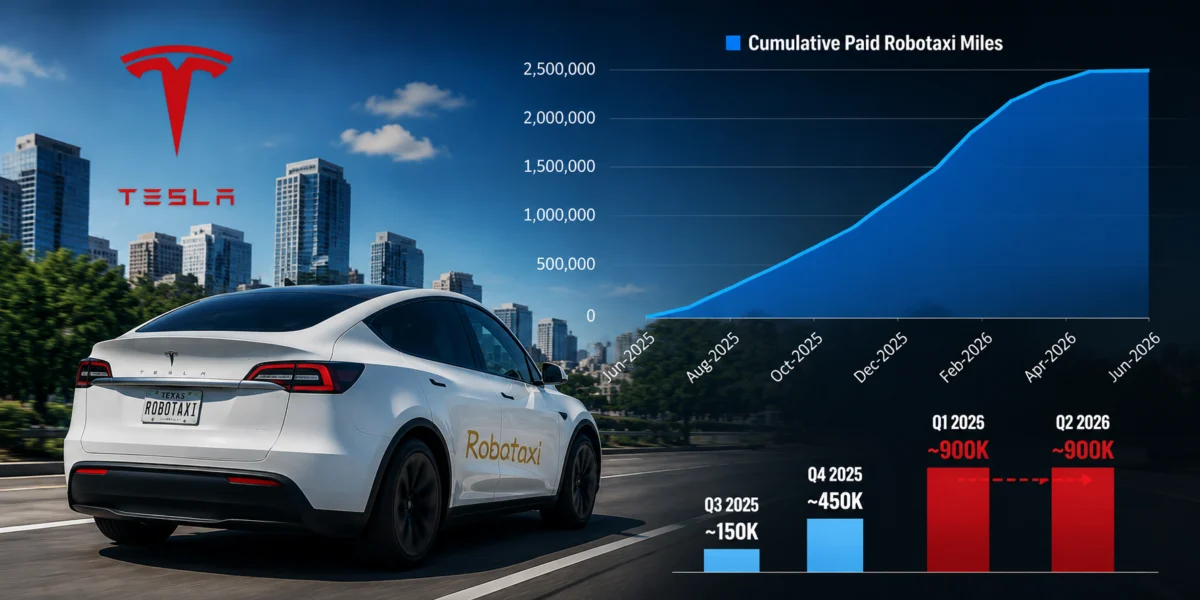
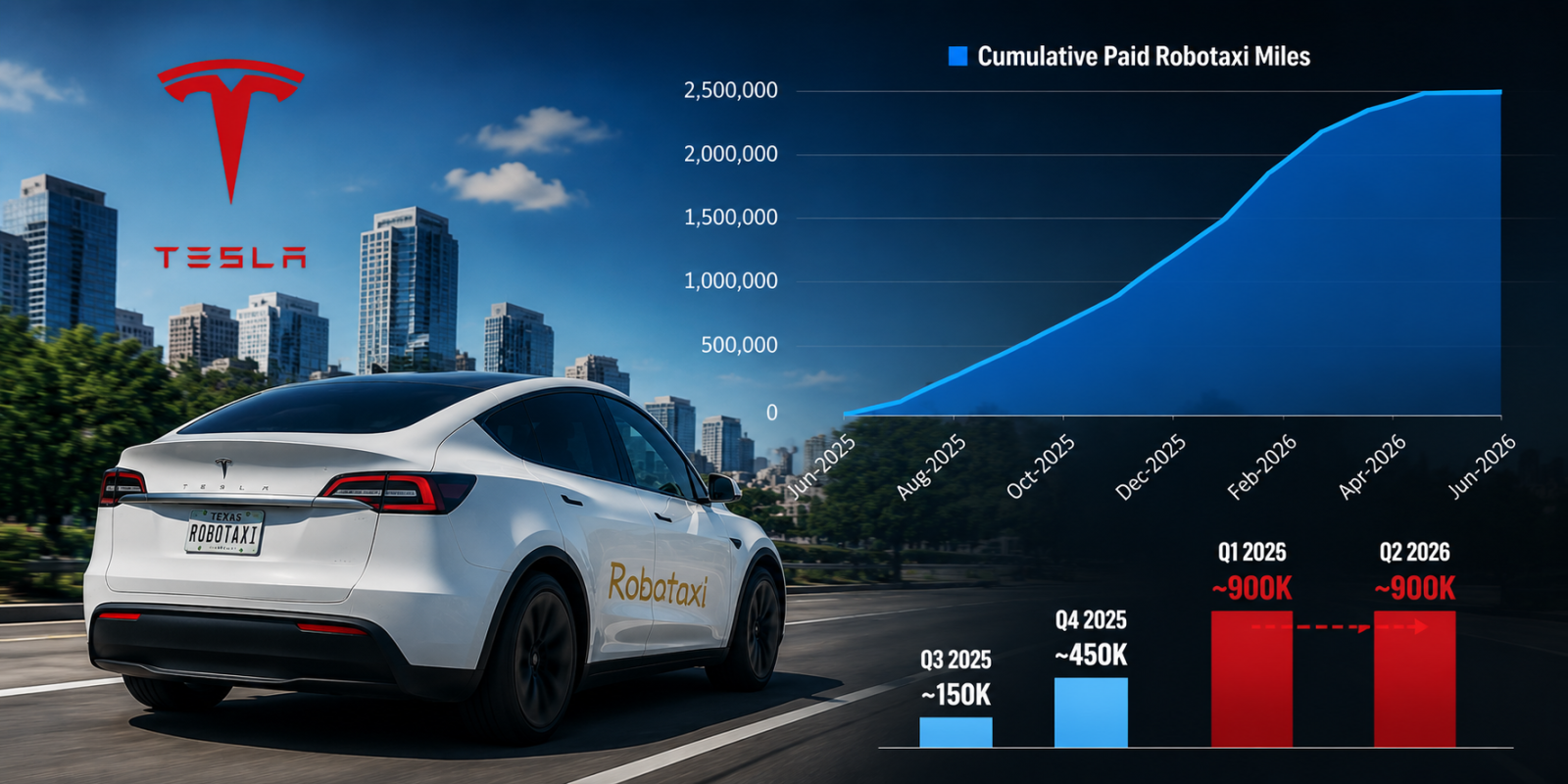
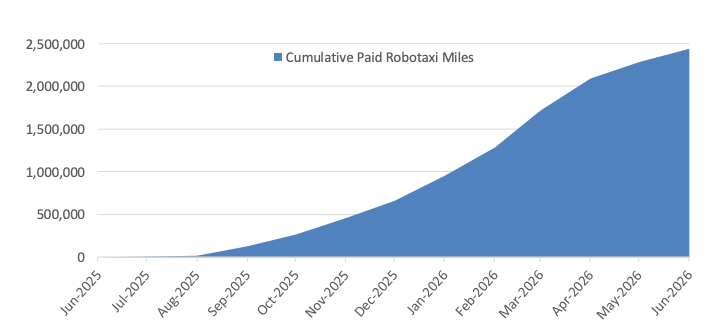
Tesla informed its shareholders this week that its Robotaxi service is experiencing expansion, a claim that is directly contradicted by the company’s own data. A closer examination of a cumulative "paid Robotaxi miles" chart presented in Tesla’s Q2 2026 update reveals a stark reality: growth in the service has effectively plateaued, rather than accelerated as suggested by the upward-sloping line. While the cumulative total surpassed 2.4 million miles, a quarterly breakdown of the figures paints a significantly different picture, indicating a stagnation in the rate of expansion.
Deconstructing the Cumulative Chart: A Closer Look at Tesla’s Robotaxi Performance
The allure of a cumulative chart for investors lies in its inherent upward trajectory. Such charts are designed to showcase continuous progress, with a line that consistently slopes towards the top-right. This presentation, while visually appealing, can obscure critical nuances of quarter-over-quarter performance. To truly understand the momentum of Tesla’s Robotaxi service, it is essential to analyze the miles added within each specific three-month period.

When Tesla’s own data is dissected in this manner, a less optimistic trend emerges. In the second quarter of 2026, the Robotaxi service reportedly added approximately 900,000 paid miles. This figure is identical to the miles added in the first quarter of 2026, indicating a complete lack of acceleration in the service’s expansion during that period. This stagnation, hidden within the broader cumulative total, suggests that the service’s growth has indeed stalled.
The Reality of Quarterly Performance: From Ramp-Up to Plateau
The period leading up to late 2025 and early 2026 demonstrated a discernible ramp-up in paid Robotaxi miles. However, this momentum appears to have dissipated in the first half of 2026. The fact that Q2 2026 saw no increase in paid miles compared to Q1 2026 is a significant indicator that the rate of growth has not only failed to accelerate but has also plateaued. This is a crucial distinction for investors attempting to gauge whether the Robotaxi service is on a path to significant scaling or if it has reached a developmental plateau.
A deeper dive into the Q2 2026 data reveals an even more concerning trend when broken down month by month. The cumulative chart suggests that approximately 500,000 of those miles were logged in April alone. However, the pace significantly decelerated in May and June, with the fleet adding only about 200,000 miles per month during those two months. This indicates that the Robotaxi service did not maintain a steady pace of 900,000 miles per quarter. Instead, it experienced a strong start in April, followed by a decline, resulting in a run-rate closer to 600,000 miles per quarter. This deceleration in the latter half of Q2 signifies that Tesla’s Robotaxi service was growing at a slower pace as the quarter concluded, directly contradicting the company’s assertion of "expansion."
Geographic Expansion vs. Operational Scaling: A Misleading Metric
Tesla’s response to this apparent slowdown in operational mileage has been to expand the geographical footprint of its Robotaxi service. On July 21, 2026, just prior to its earnings report, the company announced the addition of service areas in Tampa and Orlando, Florida, alongside its existing operations in Austin and Dallas, Texas. However, the number of vehicles deployed in these new locations was not disclosed.
This strategy of adding more dots on a map has not translated into an increase in active vehicles or operational throughput. The active unsupervised fleet across all four cities—Austin, Dallas, Tampa, and Orlando—remains remarkably small, hovering around 21 vehicles. This number is a stark contrast to the ambitious projections often associated with autonomous ride-sharing services. Austin, which was once the flagship operational hub for Tesla’s Robotaxi, peaked at approximately 25 vehicles in late April but has since seen a reduction to about 17 vehicles. Reports from May 2026 already indicated a shrinking Robotaxi fleet, a trend that appears to be reflected in the stagnant quarterly mileage figures for Q2. Spreading a fleet of roughly two dozen vehicles across four metropolitan areas, rather than concentrating them in one, creates a more visually appealing map but does little to enhance the service’s overall operational capacity or customer experience. The throughput of the service has, therefore, not demonstrably increased.
The Persistent Need for Human Oversight: A Differentiator from True Autonomy
A critical aspect of Tesla’s Robotaxi service, and one that distinguishes it from competitors like Waymo, is the continued reliance on human safety monitors. In California, every "Robotaxi" ride operates with a Tesla employee physically present in the vehicle, acting as a safety monitor. This is not a fleet operating autonomously; rather, it is a supervised pilot program that passengers pay to use.
In stark contrast, Waymo, a subsidiary of Alphabet, is currently conducting hundreds of thousands of paid, genuinely driverless rides weekly across multiple U.S. cities, with no human presence in the vehicle. The cumulative 2.4 million miles accumulated by Tesla’s Robotaxi service since its inception represents a fraction of the mileage Waymo completes in a matter of weeks. This significant gap highlights the stage of development where Tesla’s Robotaxi currently resides—a supervised, paywalled pilot program—and underscores the challenge Tesla faces in convincing investors to overlook this disparity while emphasizing a seemingly upward-trending cumulative metric.
Electrek’s Analysis: A Test Program Masquerading as Scaled Expansion
The data presented and analyzed by Electrek corroborates ongoing reports: Tesla’s Robotaxi service is not currently scaling in a meaningful operational sense. For the time being, it functions as a paid fare service within a test program. Tesla’s strategic choice to highlight a cumulative chart is a testament to its understanding that such a presentation offers the most favorable view of a business that has ceased to grow quarter-over-quarter.
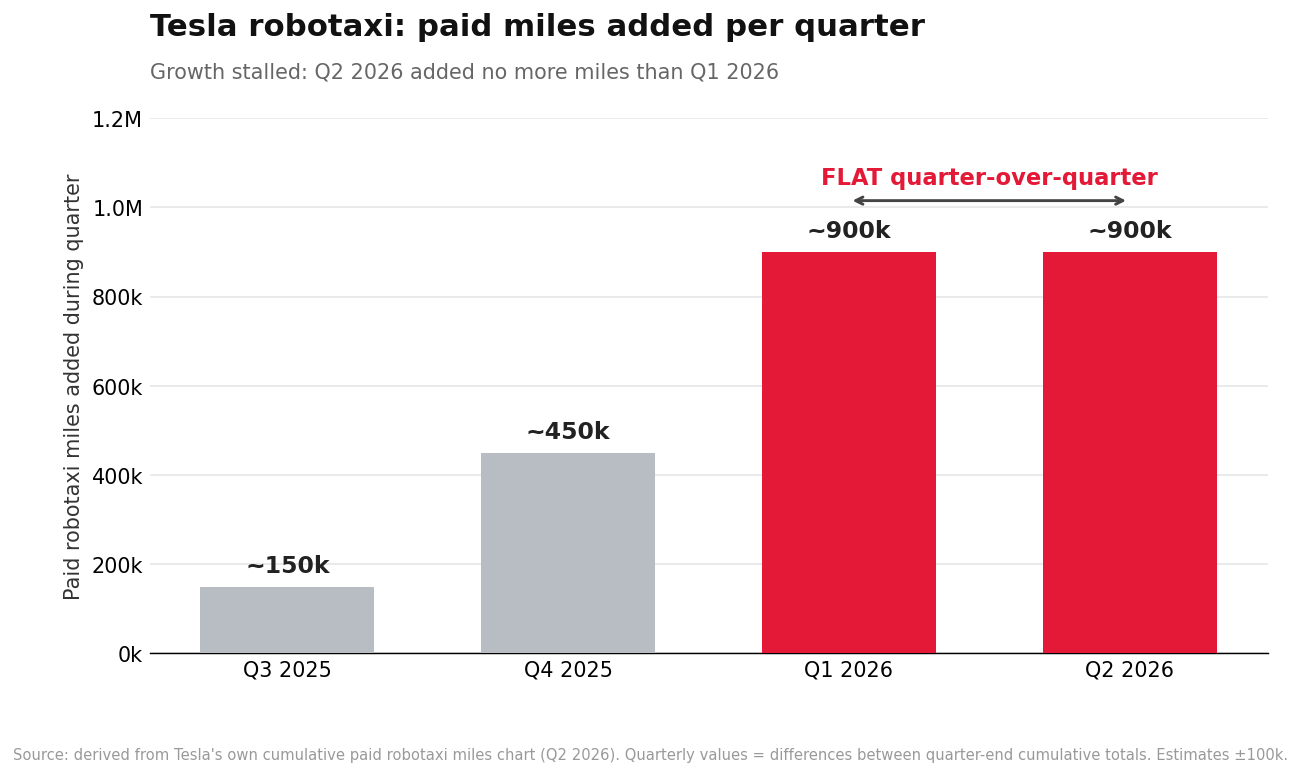
The moment this cumulative data is translated into the metric that truly signifies business performance—paid miles added per quarter—the narrative of "expansion" unravels. The figures for Q1 and Q2 2026 are identical. Furthermore, the active fleet has reportedly decreased since April, and the vehicles continue to require human oversight. The addition of new cities on a presentation slide does not alter these fundamental realities.
Elon Musk, Tesla’s CEO, has repeatedly missed his own short-term Robotaxi deployment targets over the past three earnings reports. Shareholders have voiced their concerns and sought explanations during the Q&A sessions of these earnings calls. The chart presented in the Q2 2026 update offers an answer, albeit one that requires careful interpretation. Tesla has previously made ambitious promises of having a million robotaxis on the road. Until the curve representing paid miles added per quarter begins to trend upwards again, instead of settling into a consistent, linear slope, the claim of "expansion" remains unsubstantiated by the available data.
The pertinent question for Tesla’s next earnings call will be: if the fleet is purportedly growing and the service area has quadrupled, why did the second quarter of 2026 add the exact same mileage as the first quarter? This question cuts to the core of the company’s operational performance and its ability to deliver on its autonomous driving promises.
Background and Timeline of Tesla’s Robotaxi Development

Tesla’s journey into the realm of autonomous ride-sharing has been a long and often publicly debated one. The company’s ambition for a "Robotaxi" service, capable of generating significant revenue and transforming transportation, has been a recurring theme in its investor communications for years.
- Early Promises and Vision: As far back as 2016, Elon Musk indicated that Tesla vehicles would be capable of full self-driving by the end of that year, enabling them to operate as autonomous taxis. These initial projections proved overly optimistic.
- Full Self-Driving (FSD) Development: Tesla has been developing its Full Self-Driving (FSD) software, a suite of advanced driver-assistance features, for nearly a decade. The FSD Beta program allows select Tesla owners to test the software on public roads, often with human supervision.
- The "Robotaxi" Concept Refined: In recent years, Tesla has increasingly focused on the "Robotaxi" aspect, envisioning a future where owners could contribute their vehicles to a shared autonomous fleet, generating income when not in personal use.
- Limited Deployments and Testing: Actual deployments of Tesla’s Robotaxi service have been confined to a few select locations, primarily Austin and Dallas, Texas, and more recently, Tampa and Orlando, Florida. These operations have been characterized by a small number of vehicles and, crucially, the requirement for safety drivers in most, if not all, instances.
- Q2 2026 Update and Data Analysis: The Q2 2026 earnings report presented a cumulative mileage chart that, upon deeper analysis by publications like Electrek, revealed a plateau in quarterly growth, raising questions about the actual expansion of the service.
Implications for Tesla and the Autonomous Vehicle Industry
The apparent stagnation in Tesla’s Robotaxi operational mileage has several implications:
- Investor Confidence: For investors who have bought into Tesla’s vision of a dominant autonomous ride-sharing future, this data presents a challenge. The discrepancy between stated expansion and actual operational growth could lead to increased scrutiny and a reevaluation of future revenue projections from this segment.
- Competitive Landscape: The performance of Tesla’s Robotaxi service is being closely watched in the context of established players like Waymo. Waymo’s ability to conduct a high volume of genuinely driverless rides underscores the technological and operational hurdles Tesla still needs to overcome. The gap in real-world deployment and autonomy is significant.
- Technological Hurdles: The continued need for safety monitors suggests that Tesla’s FSD technology, while advanced, may not yet be robust enough for fully unsupervised operation in diverse real-world conditions. Overcoming these remaining technological challenges is critical for scaling the service.
- Regulatory Environment: The regulatory landscape for autonomous vehicles is complex and evolving. Tesla’s approach, which often involves deploying advanced software to a broader user base for testing, differs from the more controlled, geographically limited rollouts of some competitors. This could impact future regulatory approvals.
As Tesla continues to navigate the development and deployment of its Robotaxi service, the focus will undoubtedly remain on its ability to translate its technological advancements into tangible, scalable, and truly autonomous ride-sharing operations. The data from Q2 2026 suggests that this transition is proving to be a more protracted and challenging endeavor than initially presented.