







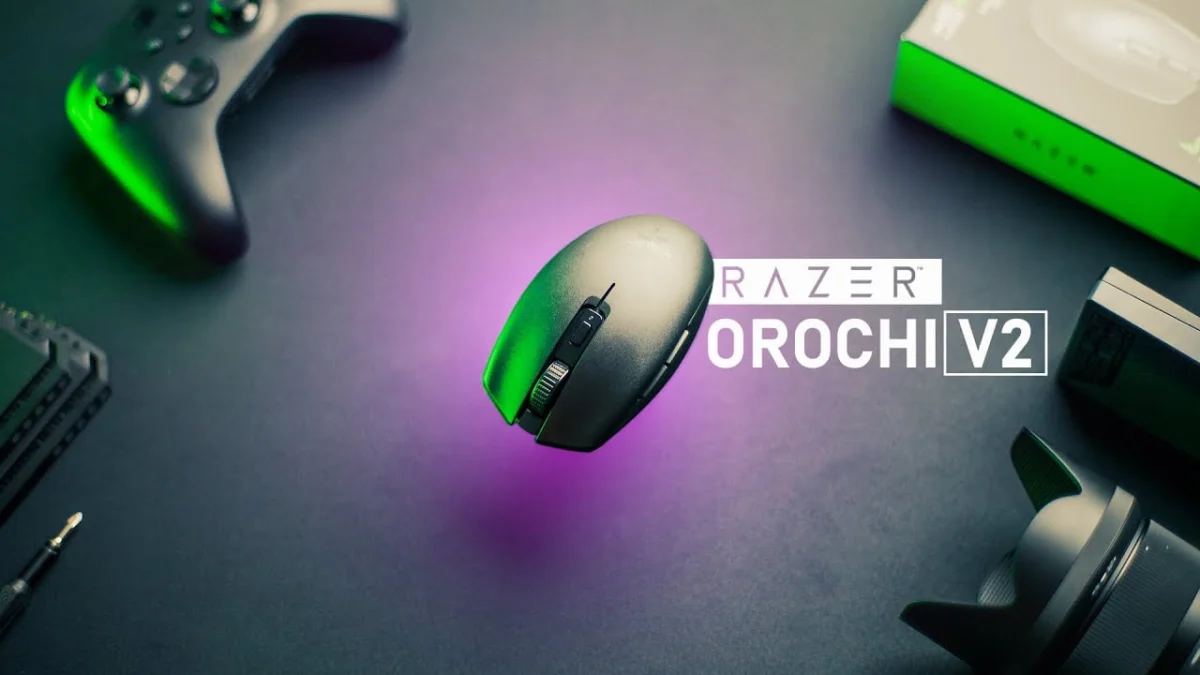
The peripheral market has long been dominated by a select few lightweight, budget-friendly wireless mice, chief among them being the Logitech G305 and SteelSeries Rival 3 Wireless. However, the introduction of the Razer Orochi V2 represents a significant shift in the portable gaming mouse segment. Priced competitively at $69 USD, Razer’s latest offering aims to disrupt the status quo by combining dual-connectivity features, a robust mechanical switch architecture, and an impressively lightweight chassis that targets both mobile productivity users and competitive esports enthusiasts alike. As manufacturers increasingly focus on eliminating the traditional compromises associated with wireless peripherals—such as latency, excessive weight, and poor battery longevity—the Orochi V2 arrives as a comprehensive engineering solution designed to future-proof the sub-$100 gaming mouse category.
To understand the positioning of the Orochi V2, one must look at the broader industry trend toward ultra-lightweight, battery-flexible peripherals. Historically, budget wireless mice forced consumers to choose between heavy AA battery configurations that ruined weight distribution or fragile honeycomb shell designs prone to structural flexing and dust accumulation. Razer’s development team deliberately bypassed the honeycomb trend, opting instead for a solid shell construction that maintains structural integrity while keeping the base weight down to 58 grams without batteries. By engineering a hybrid battery compartment that accommodates either a standard AA or a lighter AAA cell, Razer has addressed a longstanding consumer demand: granular weight tuning without the need for magnetic accessory systems or expensive rechargeable internal lithium-ion packs that degrade over time.
From a chronological perspective, the release of the Orochi V2 follows years of iterative refinement in sensor technology and power efficiency. Razer’s integration of the 5G Advanced Optical Sensor—capable of up to 18,000 DPI—demonstrates the trickle-down effect of high-end sensor engineering into more affordable price brackets. Furthermore, the decision to utilize second-generation Razer mechanical switches (co-developed with Kailh, designated as GM 4.0 switches rated for 60 million clicks) instead of optical switches highlights a pragmatic engineering compromise. While optical switches offer faster actuation, their higher electrical draw would have severely compromised the Orochi V2’s exceptional battery longevity, which reaches up to 950 hours on Bluetooth and over 400 hours on a 2.4GHz wireless connection.
Design, Build Quality, and Ergonomics
The structural integrity of the Razer Orochi V2 defies expectations typically associated with removable-shell peripherals. Unlike competitors that suffer from creaking or loose tolerances where the top cover meets the chassis, the Orochi V2 utilizes a secure magnetic and mechanical latching system that ensures a solid feel across the entire gripping surface. The absence of perforations or honeycomb cutouts appeals directly to users concerned about environmental debris entering the mouse body, ensuring long-term durability.
Ergonomically, the mouse departs from the ultra-compact philosophy of the Razer Viper Mini, favoring a more contoured profile that borrows structural cues from the Logitech G305. The inclusion of a pronounced thumb curvature and a supportive rear hump accommodates a variety of grip styles, particularly claw and fingertip grips for users with small-to-medium hand dimensions. The dimensions are optimized to allow precise fine-tuning of micro-adjustments using the pinky and ring fingers, a crucial factor in high-precision tracking scenarios.
Weight Distribution and Battery Versatility
Weight balancing in wireless mice has traditionally been hindered by fixed internal battery placements. The Orochi V2 resolves this limitation through its dual-battery slot architecture, which supports both AA and AAA cells positioned at an angle optimized for center-of-gravity distribution.
| Battery Type | Total Mouse Weight | Operational Balance Profile | Estimated 2.4GHz Battery Life |
|---|---|---|---|
| None (Chassis Only) | 58 grams | Extremely front/center neutral | N/A |
| AAA Lithium | ~69 grams | Slightly rear-biased | ~400+ hours |
| AA Alkaline/Lithium | ~73 grams | Perfectly centered | ~425 hours |
Data compiled from hardware evaluations indicates that while the AAA configuration yields a marginally lighter overall mass, the default AA configuration achieves the most harmonious weight distribution for rapid tracking and vertical flick movements.
Connectivity and Multi-Device Integration
In terms of connectivity, the Orochi V2 features dual-mode functionality, supporting both HyperSpeed 2.4GHz wireless via a USB dongle and Bluetooth 5.0. This dual-protocol approach allows professionals to maintain a low-latency connection to a primary desktop gaming rig while pairing seamlessly with a laptop for productivity tasks on the go.
A notable technological inclusion is Razer’s multi-device pairing support through a single USB dongle. Enabled via Razer Synapse software, this feature allows users to connect both a compatible wireless keyboard and the Orochi V2 mouse to a single receiver, conserving valuable USB ports. While industry analysts note that multiplexed 2.4GHz signals can occasionally introduce minor interference or polling rate stutter in hyper-competitive environments, the feature represents a crucial step forward in desktop cable management and hardware standardization.
Sensor Performance and Customization Options
Performance-wise, the Razer 5G Advanced Optical Sensor delivers zero smoothing, filtering, or acceleration. Users can utilize Razer Synapse to calibrate surface tracking and adjust the lift-off distance down to 1 millimeter, a feature heavily favored by low-sensitivity players who frequently reposition their mice during extended gaming sessions.
Beyond internal hardware, Razer has introduced unique external personalization avenues. For a $20 premium ($89 total), consumers can order the Orochi V2 with customized top shells featuring bespoke artistic designs directly from the manufacturer, bypassing third-party skin vendors. Additionally, Razer has launched universal anti-slip grip tapes priced at $10. These modular, reusable adhesive strips can be cut and applied not only to the Orochi V2’s chassis but also to keyboards, controllers, and other peripherals, offering tactile enhancement without permanent modification.
Market Implications and Industry Outlook
The commercial implications of the Razer Orochi V2 extend far beyond a single product launch. By pricing the mouse at $69 USD, Razer has effectively challenged the mid-tier hegemony established by Logitech’s G305 and SteelSeries’ Aerox lineup. The combination of extreme battery efficiency, modular weight tuning, and robust mechanical switches establishes a new benchmark for what consumers should expect from an affordable wireless gaming peripheral.
Industry observers suggest that the success of the Orochi V2 may compel competing hardware manufacturers to reconsider their reliance on integrated rechargeable batteries in lightweight segments, particularly as consumers increasingly prioritize longevity and user-serviceable components. By offering a product that balances competitive-grade sensor performance with multi-year battery lifespans, Razer has positioned the Orochi V2 not merely as a niche travel accessory, but as a primary desktop peripheral capable of satisfying the rigorous demands of both productivity professionals and competitive gamers.