










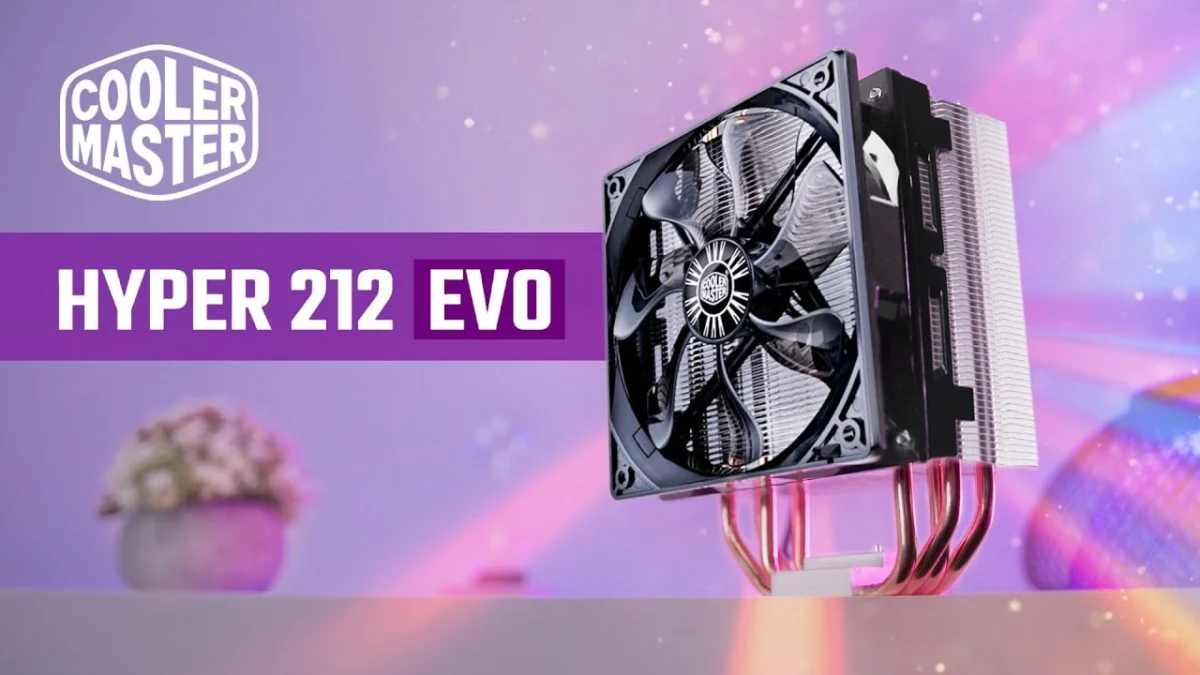
The personal computer hardware landscape of 2021 was defined by skyrocketing component costs, unprecedented supply chain shortages, and a relentless focus on high-end, premium hardware that frequently priced out mainstream consumers. Amid intense viewer requests to examine budget-conscious alternatives, hardware testing channels frequently turned their attention back to legacy components that shaped the industry. Among these, the Cooler Master Hyper 212 EVO remained a persistent subject of community inquiry. First introduced in 2012, this budget CPU air cooler established a benchmark for affordable thermal management, designed primarily as a robust replacement for stock box coolers rather than a direct competitor to high-end tower solutions. Nearly a decade after its initial market launch, testing the Hyper 212 EVO in a contemporary computing environment offers a critical look at how foundational engineering principles withstand the test of time against modern thermal loads.
Specifications, Pricing, and Foundational Design
The enduring appeal of the Cooler Master Hyper 212 EVO lies primarily in its exceptional price-to-performance ratio. Retailing consistently between $30 and $35 USD, the cooler occupies a critical entry-level tier that appeals to budget-conscious builders looking to step away from stock thermal solutions without making a significant financial commitment.
From a physical standpoint, the cooler maintains a standardized tower profile. With the stock fan installed, the dimensions measure 120mm in width, 158.5mm in height, and 77mm in depth. While these dimensions suggest reasonable compatibility across standard ATX and micro-ATX chassis configurations, the physical footprint often presents specific clearance challenges, particularly regarding memory modules and tight motherboard layouts.
The architectural design of the Hyper 212 EVO reflects the industry standards of the early 2010s, utilizing Heatpipe Direct Technology (HDT). This manufacturing approach places the copper heat pipes in direct contact with the CPU integrated heat spreader, aiming to accelerate thermal transfer at lower heat loads. While higher-end modern air coolers have largely shifted toward solid baseplates complemented by numerous heat pipes, HDT remains prevalent in entry-level segments due to its cost-effective production profile. The heat pipes route directly upward into a dense aluminum fin array, showcasing an unpretentious, straightforward engineering approach.
The stock fan included with the original EVO model is similarly utilitarian. Eschewing modern aesthetic trends such as addressable RGB lighting, the bundled fan operates at a maximum speed of 2,000 RPM, producing an acoustic output of approximately 36 dBA. Notably, the fan utilizes plastic mounting clips rather than traditional metal wire brackets. While conventional hardware enthusiasts often view plastic components with skepticism, these proprietary clips eliminate the common frustration of clips dislodging during installation and maintenance procedures.
Evolution of the Hyper 212 Lineage: Iterations and Variants
Over its ten-year market lifespan, Cooler Master systematically expanded and refined the Hyper 212 ecosystem, introducing several parallel iterations to address evolving hardware requirements. Understanding these variations provides essential context for modern buyers navigating the second-hand market or retail shelves.
The introduction of the Hyper 212 EVO V2 marked a significant generational update. Rather than completely replacing the original model, Cooler Master positioned the V2 alongside it as a parallel offering. The V2 addresses several legacy pain points, most notably through a redesigned, stepped-back heat pipe layout that guarantees uncompromised memory compatibility across virtually all mainstream motherboards. Additionally, the V2 incorporates an updated mounting mechanism designed to alleviate the installation friction inherent in the original design, paired with a revised SickleFlow series fan optimized for improved acoustic profiles and airflow efficiency at lower rotational speeds. Depending on regional distribution, the V2 typically commands a $15 to $20 price premium over the baseline EVO model—a substantial percentage increase within the strict confines of a budget component category.
Concurrently, the Hyper 212 Black Edition entered the market, offering an aesthetic overhaul with a gunmetal dark finish, an upgraded fan, and a larger base plate. While market pricing frequently aligns the Black Edition closely with the original EVO during promotional sales, user feedback has historically highlighted its mounting mechanism as a point of contention, leading many budget builders to prefer the simpler, albeit older, retention
systems of the baseline models.
The Installation Process: A Relic of Earlier Hardware Eras
While the thermal performance of the Hyper 212 EVO has proven resilient, the installation process distinctly exposes its decade-old heritage. Modern CPU coolers, particularly those from contemporary manufacturers, have largely streamlined mounting procedures to require minimal tools and effort. Conversely, installing the original Hyper 212 EVO on modern sockets—such as AMD’s AM4 platform—can present a complex and frustrating endeavor for builders.
The installation workflow begins by removing the stock AMD retention backplate and flipping the motherboard. Technicians must align Cooler Master’s metal backplate, ensuring proper orientation via green sticker indicators. Metal mounting studs are then fitted with plastic washers and threaded through the motherboard PCB into the backplate from the underside, requiring manual stabilization of the motherboard. Tiny, Lego-sized securing nuts must then be threaded onto the protruding studs. Overtightening these initial nuts frequently causes the opposite side of the backplate to lift, frustrating subsequent alignment steps.
Securing the assembly requires a specialized adapter tool provided by Cooler Master to tighten the nuts securely, a process often complicated by tight clearance margins around socket components. Furthermore, the securing bolts possess a tendency to pivot within their sockets, occasionally requiring a secondary technician or manual intervention behind the motherboard to hold the fasteners in place.
Fortunately, Cooler Master’s subsequent revisions, particularly the V2 and Black Edition models, largely resolved these assembly hurdles. For builders sensitive to installation friction, investing the modest price difference into a newer revision remains a strongly recommended strategy. Once the crossbar and heatsink assembly are finally dropped onto the CPU, the process requires careful, iterative tightening of individual screws to prevent the cooler from shifting across the thermal paste application.
Comprehensive Performance Testing and Thermal Analysis
To evaluate the thermal efficacy of the Cooler Master Hyper 212 EVO in a contemporary context, testing protocols must utilize hardware capable of replicating various operational workloads. Industry testing typically employs a closed-chassis configuration utilizing high-end processors, such as the AMD Ryzen 9 5950X, configured to operate under three distinct, controlled thermal loads: 95W, 125W, and 150W.
- 95 Watt Thermal Load: This tier simulates standard, stock-frequency operations typical of entry-level to mid-range central processing units.
- 125 Watt Thermal Load: This tier corresponds to moderately overclocked mid-range processors or higher-end silicon operating at stock configurations.
- 150 Watt Thermal Load: This tier represents an extreme thermal stress test that routinely overwhelms entry-level cooling solutions, serving as an absolute upper bound for baseline performance.
Comparative baselines traditionally include stock box coolers—such as the AMD Wraith Stealth and Wraith Spire—alongside high-end air cooling solutions like the Noctua NH-U12S and the Cooler Master Hyper 212 Black Edition. A strict thermal cutoff of 90°C is maintained across all evaluations, mirroring the threshold where modern processors engage power throttling via Precision Boost Overdrive (PBO).
At the 95W thermal load, the Hyper 212 EVO delivers surprisingly competitive results. While premium towers like the Noctua NH-U12S maintain a narrow 4°C temperature advantage at ultra-low fan speeds, the performance gap rapidly closes as acoustic profiles and fan speeds normalize. Notably, the legacy EVO model frequently matches or marginally outperforms its successor, the Black Edition, under identical 95W test parameters. Stock box coolers struggle significantly by comparison; while they generally prevent thermal throttling, they do so while operating at elevated temperature thresholds that offer minimal headroom for sustained workloads.
As the thermal load increases to 125W, the physical limitations of the legacy design begin to manifest. At lower fan speeds, the Hyper 212 EVO falls behind the Black Edition and the NH-U12S. Because the stock fan is optimized for higher rotational speeds, it must spin faster—and consequently produce higher decibel levels—to match the thermal dissipation of its premium competitors. Nevertheless, when evaluated against its modest $30 price point, the thermal efficiency delivered at 125W remains remarkably competitive for budget system integration.
At the aggressive 150W threshold, the baseline Hyper 212 EVO reaches its mechanical saturation point. Incable of transferring thermal energy away from the integrated heat spreader at the required rate, the cooler becomes overwhelmed even at maximum fan RPM. This outcome aligns with expectations, as a compact single-tower design engineered a decade ago was never intended to tame extreme, enthusiast-tier power draws.
Simulated V2 Performance and Analytical Implications
To approximate the performance enhancements introduced in the V2 iteration using the original hardware, testers frequently swap the stock fan with a modern Cooler Master SickleFlow fan matching the specifications of the V2 bundle. Implementing this updated airflow profile yields a consistent 2°C to 3°C reduction in operating temperatures at lower decibel levels under a 95W load. However, these performance gains plateau as fan speeds escalate, and the upgraded fan offers negligible mitigation when the core heatsink structure encounters overwhelming thermal loads at higher wattages.
This data underscores a broader implication for system integrators and budget-conscious builders: while iterative updates like the V2 offer tangible improvements in noise normalization, installation ease, and memory clearance, the fundamental thermodynamic architecture of the Hyper 212 series remains remarkably sound.
Broader Industry Impact and Conclusion
The longevity of the Cooler Master Hyper 212 EVO serves as a testament to efficient, foundational thermal engineering. Ten years after its commercial introduction, the cooler continues to provide viable, cost-effective cooling for mainstream processors, comfortably outperforming bundled stock solutions while maintaining an accessible price point that shields consumers from inflated hardware costs.
The product is not without notable drawbacks. The arduous, legacy-era installation process demands patience and carries a high risk of user frustration, representing a stark contrast to the tool-less, simplified mounting systems standard in contemporary hardware design. Furthermore, its capacity is strictly bounded by modern power-scaling trends in high-end computing.
Ultimately, for builders operating on strict financial constraints who are willing to navigate a difficult installation procedure, the Cooler Master Hyper 212 EVO retains its status as a legendary budget component. It demonstrates that effective thermal management does not invariably require premium expenditure, cementing its unique and enduring legacy within the personal computer hardware community.