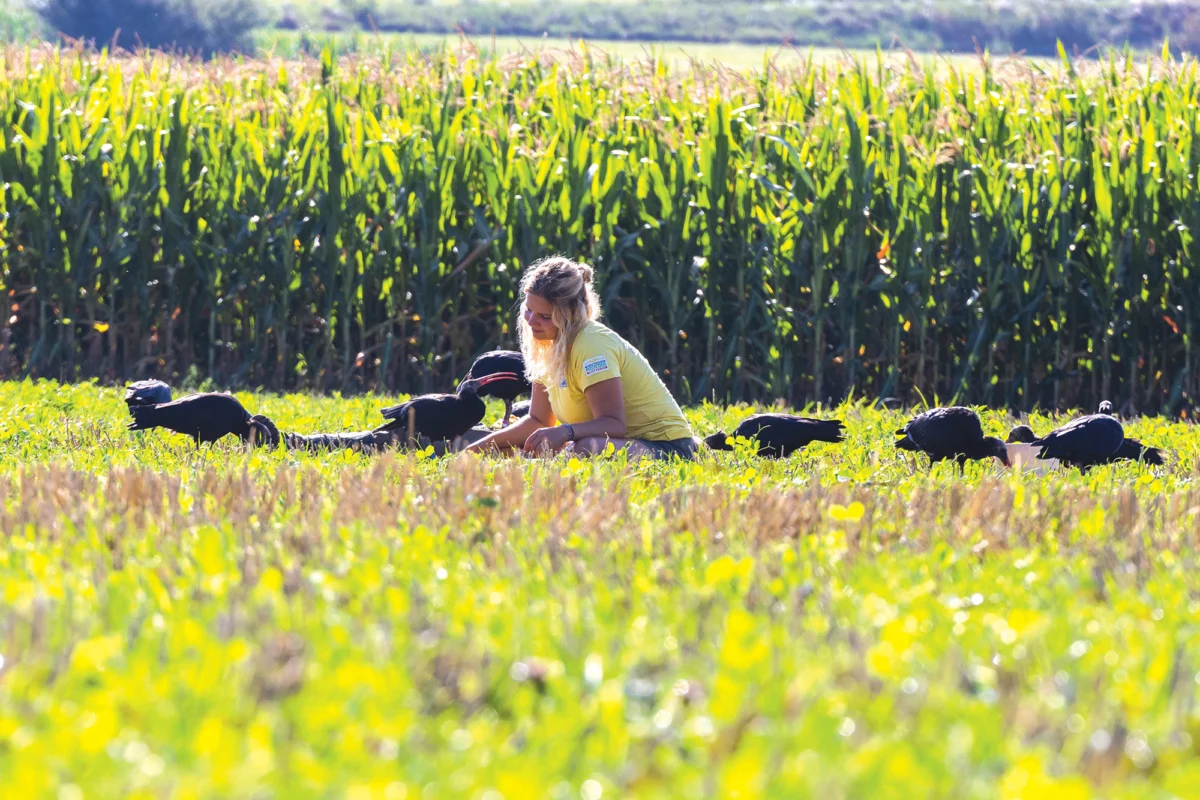
In a desperate battle against extinction, a dedicated team of maverick biologists is undertaking a monumental effort to guide the world’s rarest northern bald ibises to new migratory routes, offering a glimmer of hope for the survival of this critically endangered species. The initiative, spearheaded by organizations such as the Waldrappteam, involves intensive hand-rearing and sophisticated behavioral conditioning to teach young birds ancient migratory pathways that have been lost to generations of their kind.
The northern bald ibis (Geronticus eremita) was once a widespread species across Europe, North Africa, and the Middle East, celebrated in ancient Egyptian hieroglyphs and admired for its distinctive appearance and social behavior. However, by the mid-20th century, the wild population had dwindled to an alarmingly low number, primarily due to habitat loss, hunting, and pesticide use. The species was declared extinct in Europe in the 17th century, with the last wild sightings in Austria occurring even earlier. Today, the global wild population is estimated to be fewer than 300 individuals, making any conservation effort of paramount importance.
This ambitious project represents a significant departure from traditional conservation methods, which often focus on habitat restoration or captive breeding without actively reintroducing migratory behaviors. The biologists are essentially acting as foster parents, imprinting on the chicks and then guiding them on perilous journeys, leveraging technology and an intimate understanding of avian behavior.
The Genesis of a Rescue Mission
The operation detailed in recent reports centers on the painstaking work of individuals like Barbara Steininger, who at twenty-five years old, took on the role of a foster mother to northern bald ibis chicks. The commitment began in April 2023 at an aviary in southern Austria, a region characterized by rugged mountains and fertile valleys. Steininger described the profound nervousness she felt as she prepared to become a caregiver, especially for such vulnerable creatures.
"Just a few meters from an aviary in southern Austria, where the mountains are rough but the valleys lush and expansive, Barbara Steininger got nervous," the original report stated. "At twenty-five, Steininger was about to become a foster mom. Not an everyday occurrence, she said, ‘especially if your fosterlings are birds.’"
Upon receiving the featherless chicks, Steininger’s face lit up, signaling the commencement of a critical phase in the conservation effort. This initial cohort was just the beginning, with thirty-three more chicks to be raised.
A Mother’s Devotion: Hand-Rearing and Imprinting
From that chilly April day in 2023, Steininger and her colleague, twenty-eight-year-old Helena Wehner, became the sole caregivers for these fragile lives. Their role transcended mere feeding; it involved extensive nurturing, akin to human parental care. This included constant affection, words of encouragement, and what they described as "baby talk," all designed to foster a strong bond and facilitate imprinting.
The chicks were hand-fed eight times a day. Wehner elaborated on the specifics of their diet: "Just that it’s not breast milk or formula," she explained, but rather a specialized mixture of shredded beef hearts and mice. This meticulous attention to their nutritional and emotional needs is crucial for their survival and subsequent integration into the flock.
This profound level of devotion is reserved for the northern bald ibis, a species teetering on the brink of oblivion. The dedication of Steininger, Wehner, and their team highlights the extraordinary lengths to which conservationists are willing to go to save a species.
Relearning Ancient Journeys: The Core of the Initiative
The ultimate goal of this intensive hand-rearing is not just to increase the number of ibises, but to re-establish their migratory patterns. Historically, northern bald ibises undertook long-distance migrations, traveling from their breeding grounds in Europe to overwintering sites in North Africa. This knowledge of migratory routes has been lost over centuries due to the species’ decline.
The Waldrappteam, a key organization involved in this project, has been working for years to reintroduce these birds to their former European breeding grounds. Their methods involve using ultralight aircraft to lead the young birds on their first migration, a technique inspired by the work of animal behaviorists who have used similar approaches with other migratory species. The biologists, clad in distinctive white suits to mimic the appearance of adult ibises and avoid human imprinting, act as surrogate parents, guiding the birds with the aircraft and establishing a sense of direction and destination.
The process is fraught with challenges. The birds must navigate vast distances, overcome natural predators, and contend with adverse weather conditions. The success of each migration is a testament to the meticulous planning, the resilience of the birds, and the unwavering commitment of the human guides.
A Timeline of Recovery and Hope
The history of northern bald ibis conservation in Europe is a long and often disheartening one, marked by numerous attempts to reintroduce the species.
- Late 20th Century: The northern bald ibis is functionally extinct in Europe. Scattered wild populations persist in Morocco and Syria, but these are also under immense pressure.
- Early 2000s: The Waldrappteam initiates ambitious reintroduction programs, focusing on establishing breeding colonies in Austria and Germany. These efforts involve captive breeding and attempts at guided migration.
- 2010s: Early attempts at guided migration using ultralight aircraft show promise, with some birds successfully reaching wintering grounds in Italy. However, the success rates are modest, and many birds are lost to predation or navigational challenges.
- 2020s: The project intensifies, with increased focus on behavioral conditioning and optimizing migratory routes. The current effort, involving individuals like Steininger and Wehner, represents a refined approach, emphasizing imprinting and direct guidance from a younger age.
The current program aims to establish a viable migratory link between the Austrian breeding grounds and a suitable overwintering site, likely in Italy or Spain, where conditions are favorable and threats are minimized. The success of this initiative could serve as a blueprint for reintroducing other migratory species that have lost their ancestral routes.
Supporting Data: The Dire State of the Northern Bald Ibis
The urgency of this conservation effort is underscored by stark data:
- Global Population: Estimated at fewer than 300 individuals in the wild, primarily in Morocco.
- Historical Range: Once spanned from Southern Europe to North Africa and the Middle East.
- Threats: Habitat loss, hunting, pesticide poisoning, and disturbance at breeding sites.
- Extinction Status: Critically Endangered on the IUCN Red List.
- Reintroduction Success Rates: Historically low, with significant losses during migratory phases.
The reintroduction of migratory behavior is considered a critical component for long-term species survival, as it allows populations to exploit seasonal resources and avoid unfavorable conditions. Without this, captive-bred populations remain dependent on human intervention and are vulnerable to local threats.
Official Responses and Expert Opinions
Conservation organizations and wildlife experts have widely lauded the innovative approach of the Waldrappteam and similar initiatives. Dr. Eva Müller, a renowned ornithologist specializing in migratory birds, commented, "The dedication of these biologists is truly inspiring. Teaching a species to migrate again is an incredibly complex undertaking. It requires not only scientific expertise but also immense patience and a deep emotional connection to the animals."
She added, "The use of ultralight aircraft and surrogate parent behavior is a testament to our evolving understanding of animal cognition and behavior. If successful, this could be a game-changer for avian conservation globally."
Government wildlife agencies have also provided support, recognizing the importance of such projects in preventing irreversible biodiversity loss. While direct financial contributions may vary, collaborative efforts in monitoring, research, and habitat protection are often part of the broader support network.
Broader Impact and Implications
The success of this northern bald ibis reintroduction project carries significant implications beyond the species itself:
- Ecological Restoration: Re-establishing a migratory species can contribute to ecosystem balance, as these birds play a role in insect control and seed dispersal.
- Biodiversity Preservation: It offers a tangible example of how dedicated conservation efforts can pull a species back from the brink.
- Advancement of Conservation Science: The project pushes the boundaries of what is possible in rewilding and species recovery, particularly for migratory animals.
- Public Engagement and Awareness: The compelling narrative of these birds being guided by human foster parents can foster greater public interest and support for conservation initiatives.
- Economic Benefits: Successful reintroduction can lead to ecotourism opportunities and raise awareness about the value of natural heritage.
However, the challenges remain formidable. Predation, disease, climate change, and human encroachment continue to pose threats to migrating birds. Ensuring the long-term viability of the reintroduced population will require sustained efforts, including habitat protection at both breeding and wintering grounds, and ongoing monitoring.
The story of Barbara Steininger, Helena Wehner, and their thirty-five featherless charges is more than just a tale of animal care; it is a testament to human ingenuity, perseverance, and the profound ethical responsibility we have to protect the planet’s most vulnerable inhabitants. As these young ibises take their first tentative flights, guided by their human mothers and the hum of ultralight engines, they carry with them the hope for a future where the skies once again echo with the calls of the northern bald ibis. The journey is far from over, but with each successful migration, the possibility of this ancient species reclaiming its place in the wild grows stronger.