The competitive landscape of the central processing unit (CPU) market is fundamentally beneficial for consumers, fostering innovation, expanding choices, and driving down prices by preventing monopolistic control over performance. For an extended period, AMD’s Ryzen CPUs have exerted significant pressure on Intel, particularly in the laptop segment, prompting industry observers to keenly watch for Intel’s strategic response. While AMD’s ascendancy has been a compelling narrative, a sustained, one-sided contest ultimately stifles the rapid advancements that robust competition encourages. The launch of Intel’s 11th Gen Core H-series mobile processors signals a concerted effort to reverse recent trends and re-establish a formidable presence in the high-performance laptop sector, particularly targeting gaming and content creation segments.
The Shifting Sands of Laptop CPU Dominance
For several years, Intel has grappled with significant challenges in competing with AMD’s Ryzen CPU lineup across both desktop and mobile platforms. On the desktop front, Intel’s 10th and 11th generation offerings, such as Rocket Lake, were met with a mixed reception, often seen as a stopgap measure due to their reliance on an older manufacturing process paired with a new architectural design. The situation in gaming laptops, however, presented an even more pronounced struggle for Intel.
Intel’s 10th Gen Comet Lake-H processors found themselves consistently outmatched by AMD’s Ryzen Mobile 4000 and, subsequently, the highly acclaimed Ryzen Mobile 5000 series. AMD’s Ryzen Mobile chips, built on the efficient Zen 2 and Zen 3 architectures, delivered superior multi-threaded performance and impressive power efficiency, making them a compelling choice for a wide array of laptops, from ultrabooks to high-performance gaming machines. The primary factor preventing AMD from achieving complete market domination in the laptop space was persistent supply chain limitations, which made finding Ryzen-based laptops a challenge for consumers. This scarcity inadvertently created a strategic opening for Intel, offering a window to introduce a competitive architecture before AMD could fully ramp up its production and ubiquity.
Intel’s New Architectural Direction: Tiger Lake H45
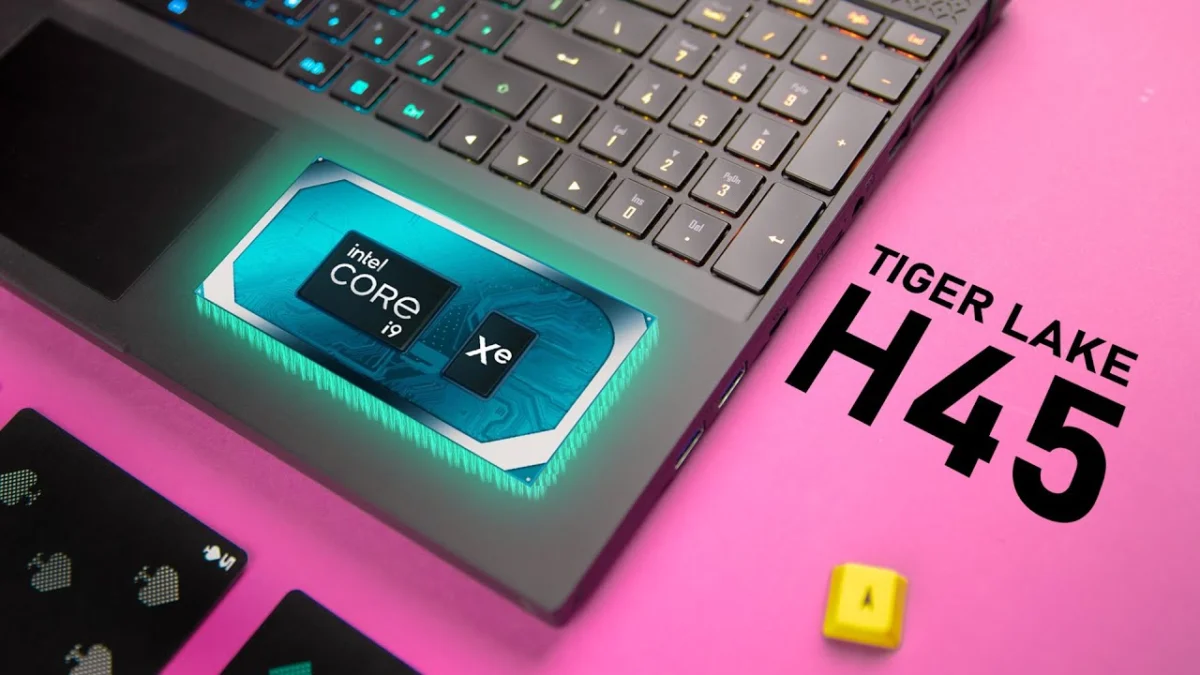
Seizing this opportunity, Intel has introduced its new Tiger Lake H-series processors, codenamed H45, marking a significant departure from its previous mobile offerings. Unlike the super-efficient Tiger Lake U-series found in ultrabooks or the moderately performing H35 models, the H45 variant represents a scaled-up iteration designed for demanding applications. This new series features up to 8 cores and 16 threads, complemented by significantly higher clock speeds, signaling a renewed focus on raw performance.
The foundation of the Tiger Lake architecture is a comprehensive overhaul, moving away from the iterated 14nm process that characterized many of Intel’s previous generations. Tiger Lake utilizes Intel’s advanced 10nm SuperFin manufacturing process, which offers substantial improvements in transistor performance and power efficiency. This process is paired with the new Willow Cove architecture, delivering enhanced IPC (Instructions Per Cycle) performance, and integrates new Xe-LP graphics. Early deployments of Tiger Lake in ultrabooks demonstrated excellent lightly-threaded performance, significantly improved integrated graphics capabilities, and better power efficiency, setting the stage for the more powerful H-series.
At CES earlier this year, Intel provided a tantalizing glimpse into the capabilities of its forthcoming high-performance mobile chips, teasing three critical specifications: 5GHz clock speeds, 8 physical cores, and 20 PCIe Gen4 lanes. These figures promised a substantial leap in performance and platform capabilities, and with the official launch of the 11th Gen Core H-series, Intel has delivered on these pledges.
The 11th Gen Core H-series Lineup: Specifications and Capabilities
The newly launched 11th Gen Core H-series processors are available in configurations ranging from 6-core/12-thread to 8-core/16-thread variants. All these parts are designed with a 45W Thermal Design Power (TDP), though the flagship HK model offers configurability up to 65W, allowing laptop manufacturers greater flexibility in performance tuning. The existing H35 CPUs will continue to serve lower-end or ultra-portable performance segments. Intel’s persistent use of a complex alphanumeric naming scheme, while familiar, continues to be a point of discussion regarding user clarity.

The undisputed centerpiece of this new lineup is the Intel Core i9-11980HK. This processor boasts 8 cores and 16 threads, capable of reaching an impressive 5.0GHz boost frequency on two cores and maintaining 4.5GHz across all 8 cores under optimal conditions. These clock speeds are particularly noteworthy for a mobile chip, rivaling the performance of some desktop CPUs, such as the Rocket Lake i7-11700K, which operates at a significantly higher TDP (125W+). Furthermore, the i9-11980HK is fully unlocked, allowing for overclocking via Intel’s Extreme Tuning Utility (XTU) for manual control or through the Speed Optimizer feature for an automated performance boost.
Positioned beneath the i9-11980HK are the Core i9-11900H and the Core i7-11800H, which are expected to be the more prevalent choices in mainstream gaming laptops. Both share the same 8-core/16-thread configuration as the flagship. The i7-11800H, in particular, emerges as a compelling option, offering performance that is only 7% to 9% slower than the i9-11980HK, suggesting a strong performance-to-price ratio for a wide range of users.
A consistent feature across all three 8-core Tiger Lake CPUs is the substantial 24MB of L3 cache. This is a notable increase even compared to desktop Rocket Lake CPUs, theoretically translating to improved performance in many applications by reducing memory latency. Intel also highlights a "Frequency at cTDP" column for the non-HK models, indicating base frequencies when configured to a 35W TDP, showcasing their adaptability for thinner designs. All new Tiger Lake H-series chips natively support DDR4-3200 memory, a welcome upgrade from the previous DDR4-2933 standard, contributing to overall system responsiveness.
The flexibility of these chips, with their configurable wattage, allows them to be integrated into the increasingly popular "thin enthusiast" laptop category. This enables manufacturers to pair high-end GPUs with powerful CPUs in chassis under 20mm thick, exemplified by models like the ASUS ROG Zephyrus G15. Such designs promise high performance without sacrificing portability, potentially making advanced gaming laptops more accessible and appealing.
Moving to the Core i5 segment, Intel offers two 6-core/12-thread models with competitive clock speeds. However, a strategic distinction is made through a reduction in L3 cache to 12MB—half that of the 8-core models. This decision is clearly aimed at segmenting the product stack, differentiating the i5 models from their higher-end counterparts. The primary difference between the two i5 models, the 11400H and the 11260H, lies in a marginal 50MHz difference in maximum integrated GPU frequency, which is unlikely to be a significant factor for users purchasing laptops with discrete graphics.
Integrated Graphics and Platform Innovations
While the primary focus of the H-series is on pairing with discrete GPUs, the integrated graphics capabilities are still noteworthy. Despite bearing the "UHD Graphics" moniker, these five processors leverage the same Xe-LP graphics architecture found across the Tiger Lake lineup, albeit scaled down to 32 Execution Units (EUs). This represents a significant reduction compared to the 48, 80, or 96 EU variants seen in quad-core Tiger Lake chips. This design choice, while potentially disappointing for those hoping for powerful integrated graphics in a thin-and-light without a discrete GPU, is pragmatic. An 8-core die with a full 96 EU IGP would result in an exceptionally large and costly chip. Intel’s conversations with OEM partners confirmed that these high-end Tiger Lake H-series processors would almost exclusively be paired with high-performance discrete GPUs, rendering a larger integrated graphics solution redundant for their target market.
The platform architecture supporting the 11th Gen Core H-series is where Intel introduces some of its most compelling innovations. Intel has adopted a full PCIe Gen4 architecture from top to bottom, dedicating 8 lanes directly to the discrete GPU. This is a critical development, as even AMD’s latest Ryzen Mobile 5000 series largely relies on PCIe Gen3 lanes to manage power consumption, including for storage solutions. The native support for Resizable BAR (Base Address Register) further enhances gaming performance by allowing the CPU to access the entire GPU frame buffer, indicating Intel’s strong focus on gaming optimization.
The processors feature 20 PCIe Gen4 lanes originating directly from the CPU. With 8 lanes allocated to graphics, the remaining 12 can be utilized for high-speed storage, including advanced RAID configurations. This capability opens up intriguing possibilities, such as PCIe Gen4 RAID arrays in gaming laptops, which could significantly benefit upcoming technologies like Microsoft DirectStorage. DirectStorage is a Windows API designed to reduce CPU overhead during the tens of thousands of I/O operations that modern games send to fast NVMe SSDs, potentially leading to faster load times and more seamless gaming experiences.
Beyond the CPU-bound lanes, an additional 24 PCIe Gen3 lanes are provided by the Platform Controller Hub (PCH), resulting in a grand total of 44 platform PCIe lanes. This extensive connectivity enables a wealth of peripheral and storage options, though its full utilization ultimately depends on laptop manufacturers’ design choices. Intel claims that even with a single PCIe SSD, the new platform delivers up to 80% higher bandwidth and 75% faster access times in real-world workloads compared to their previous high-end Comet Lake mobile platform, which was limited to PCIe Gen3 SSDs.
Another highlight of the new platform is native support for Thunderbolt 4. Debuting with Tiger Lake, Thunderbolt 4 offers a robust 40Gbps data transfer speed, enabling support for multiple high-resolution displays and high-speed external peripherals. A key feature of Thunderbolt 4 is its universal charging capability, with compatible laptops expected to support charging via the port. However, concerns remain about laptop designs that might dedicate a single high-speed port to charging, potentially limiting other high-speed connectivity options.

Finally, Tiger Lake H-series laptops will also feature native support for Killer WiFi 6E. This standard expands wireless connectivity into the 6GHz band, offering four times the amount of spectrum available compared to previous Wi-Fi standards. This translates to significantly more bandwidth, reduced congestion, and less interference, providing a superior wireless experience, especially in crowded network environments. While the widespread adoption of WiFi 6E among consumers and their routers is still in its early stages, its inclusion is a forward-looking step.
Performance Claims and Market Positioning
Intel’s internal benchmarks indicate substantial performance gains for the 11th Gen H-series, particularly in gaming, against both their previous generation and AMD’s best Ryzen 5000 Mobile chips. The flagship i9-11980HK demonstrates a clear advantage over its predecessor, the i9-10980HK. More importantly, Intel’s data shows the i9-11980HK significantly outperforming AMD’s Ryzen 9 5900HX in gaming, even when the Intel chip is paired with an NVIDIA RTX 3080 Mobile GPU running at a 10W lower Total Graphics Power (TGP). While AMD does offer a slightly higher-clocked Ryzen 9 5980HX, its marginal clock speed increase is unlikely to alter the overall competitive picture significantly.
Perhaps one of Intel’s most strategic performance demonstrations involved the Core i5-11400H. Intel claimed this mid-range processor could trade blows with the higher-end Ryzen 9 5900HS, despite having two fewer cores and being paired with an RTX 3060 GPU running at 15W less. While not an outright victory across all titles, this comparison suggests that the 11400H will be a highly capable gaming CPU, offering a much stronger alternative to AMD’s mainstream Ryzen 5 5600H.
In terms of content creation and productivity, Intel has presented claims of substantial percentage increases over its 10th-generation chips, focusing on average gains across various applications rather than specific benchmark scores. These improvements are consistent with the architectural advancements observed in earlier Tiger Lake iterations. While direct comparisons against AMD in these workloads require independent verification, even partial validation of Intel’s claims would signify a major step forward for competition in a segment where AMD has traditionally excelled.
Challenges and Outlook: The Path to Market Success
Despite the promising technical specifications and performance claims, the ultimate success of Intel’s 11th Gen H-series processors will hinge on several critical factors.
Pricing: AMD’s Ryzen Mobile chips have become incredibly competitive in terms of performance-per-dollar. For Intel-based laptops to gain traction, they cannot command a significant price premium. Manufacturers will need to price systems featuring the new H-series chips competitively against their Ryzen counterparts, especially as AMD continues to pair its mobile CPUs with high-end GPUs.
Laptop Design and Implementation: Raw CPU specifications are only one part of the equation. The actual user experience is heavily influenced by the overall laptop design, particularly thermal management. Inadequate cooling solutions can severely throttle CPU and GPU performance, leading to a subpar experience, as seen in past instances with devices like the MSI Bravo 15 or Dell G5 15 SE. Intel must collaborate closely with its OEM partners to ensure that laptops integrating the 11th Gen H-series are designed to effectively leverage the processors’ full performance potential without compromise.
Availability: Given the current global semiconductor shortages, the availability of these new chips will be paramount. If Intel can ensure a robust supply chain and get a significant volume of H-series laptops to market before the anticipated surge of Ryzen gaming laptops during the summer months, they could significantly disrupt AMD’s momentum.
Consumer Benefit: Ultimately, renewed and vigorous competition between Intel and AMD is a net positive for consumers. It drives both companies to innovate faster, offer more compelling products, and potentially reduce prices across the board. The back-and-forth rivalry ensures that customers have a broader array of choices, better performance, and more advanced features in their next gaming or high-performance laptop. The coming months are poised to be exceptionally dynamic for the laptop market as these new architectures vie for supremacy.