Published July 17, 2026 04:28 PM
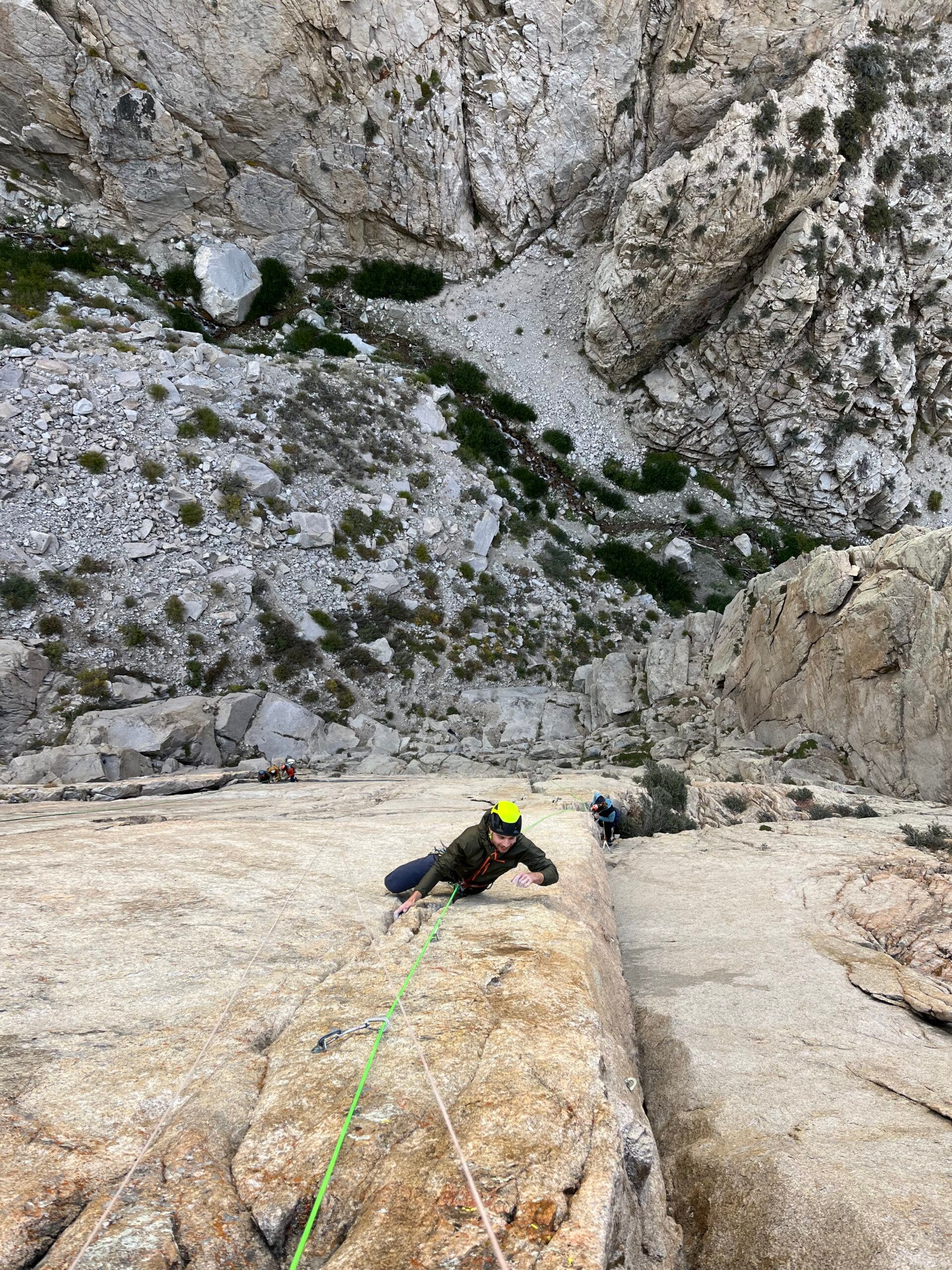
The conversation surrounding Patagonia’s Free Wall Kit is inextricably linked to the "fix and follow" climbing system it is designed to complement. Over the past decade, this innovative tactic has emerged as the preeminent method for tackling long, challenging multi-pitch routes, optimizing both climber comfort and athletic performance throughout demanding ascents. The "fix and follow" technique allows the lead climber, upon reaching an anchor, to secure a small pack and then fully relax. Meanwhile, their partner ascends the pitch on a top rope, managing their own safety through self-belay. While this strategy offers significant advantages, it’s important to acknowledge that there are legitimate scenarios where its application might not be suitable. Further exploration of these exceptions can be found in dedicated resources.
Josh Wharton, the visionary behind both this kit and the "fix and follow" methodology, profoundly impacted the author’s perspective on multi-pitch climbing. Wharton’s initial explanation of the technique revolutionized how large rock climbs were approached. The ability for the leader to rest at anchors, rather than continuously managing a top-rope belay for their partner, transformed arduous alpine epics into more enjoyable, akin to a day of cragging. This philosophy aligns with the fundamental joy of free climbing – maximizing enjoyment throughout the experience.
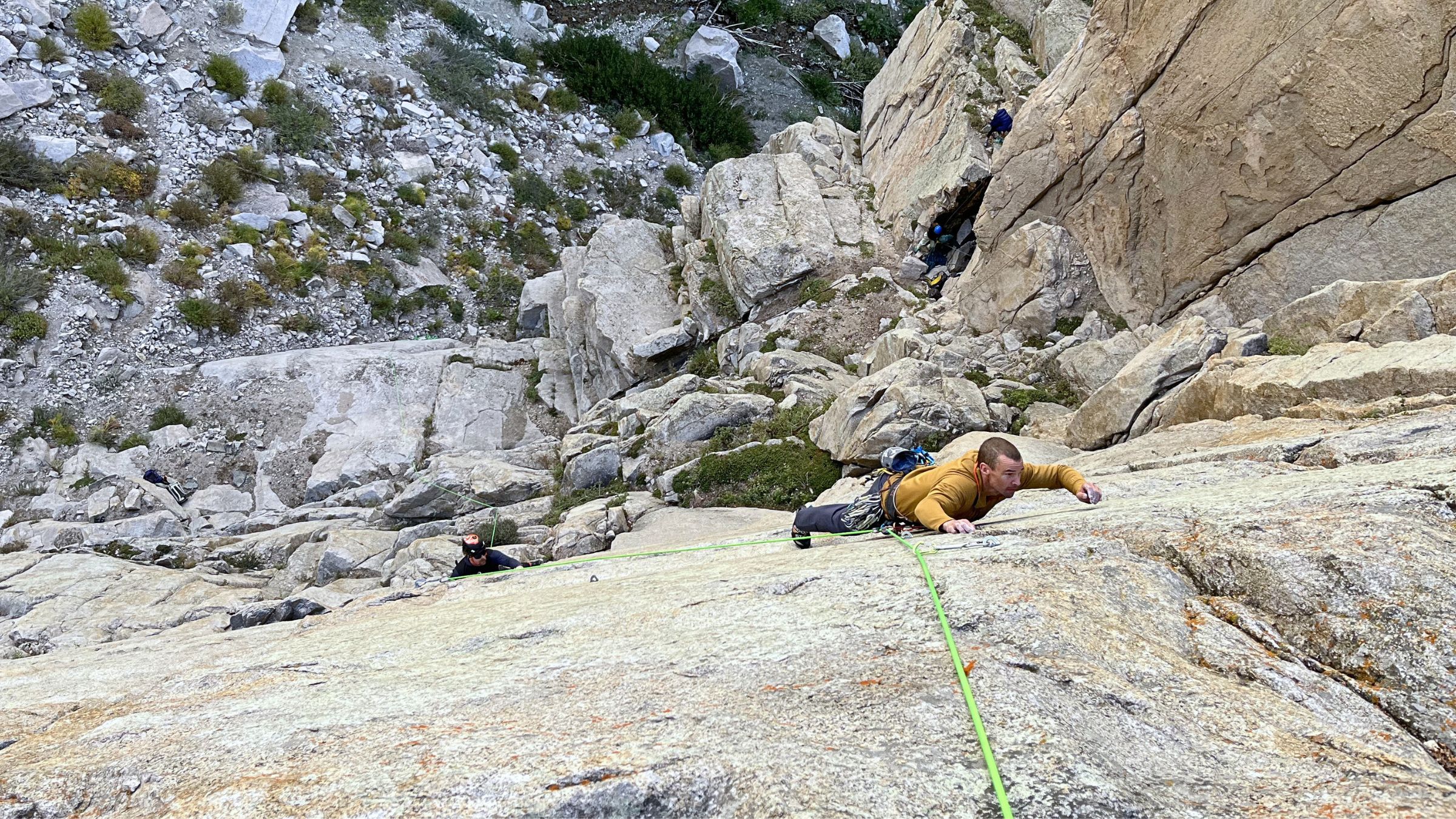
Just as "fix and follow" enhances multi-pitch climbing by reducing the burden of extensive rope work and belaying, the Free Wall Kit aims to elevate the experience further, contributing to what is often termed "Type 1 fun" – enjoyment during the activity itself. By ensuring both the leader and follower are adequately protected from the elements, warm, and well-nourished, the kit allows climbers to operate with a sense of freedom and unencumbered movement, as if they were on a short, accessible climb just a few bolts up a roadside crag.
The necessity of each of the six specific items within the Free Wall Kit is open to debate. However, the broader principles and design considerations behind the collection offer valuable insights for all climbers. When a climber of Wharton’s caliber, recognized as one of America’s most accomplished all-around climbers, offers guidance on appropriate attire and equipment for multi-pitch rock climbing, it is an opportunity worth heeding.
A Field-Tested Review of Patagonia’s Free Wall Kit
This comprehensive review delves into the individual components of Patagonia’s Free Wall Kit, examining their performance and suitability for the demands of modern multi-pitch rock climbing. The kit, conceived by Josh Wharton, represents a focused effort to enhance comfort, efficiency, and overall enjoyment on extended vertical endeavors.
Patagonia Free Wall Pack 44L
- Weight: 1,180g
- Volume: 44L
- Size: S, M, L (unisex)
Pros and Cons:
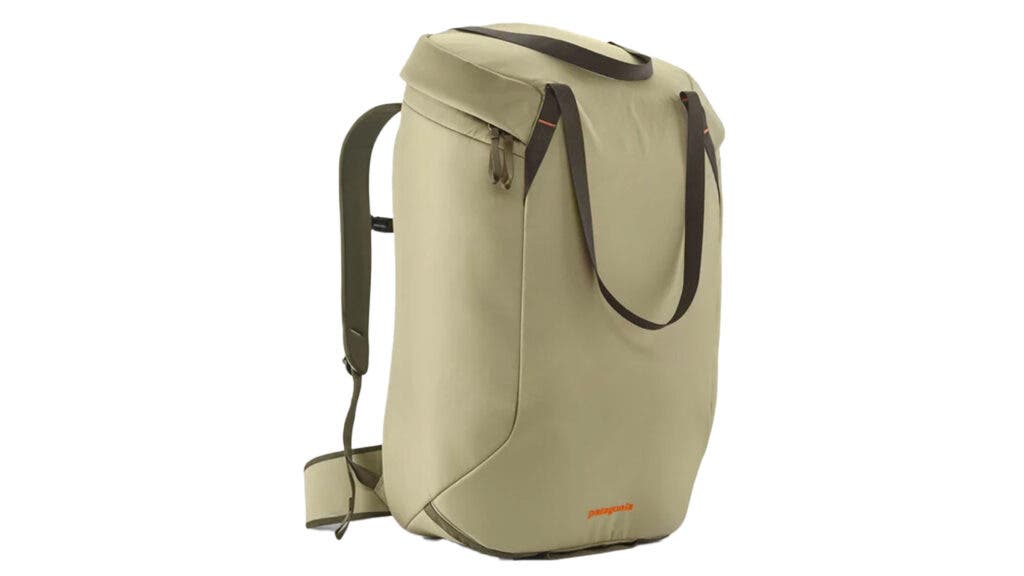
- Serves double-duty as a haul bag and an everyday crag pack.
- Color-coded pockets and clip-in loops facilitate efficient organization.
- Carrying system lacks sufficient support for extended approaches.
Testing of the Free Wall Pack involved a variety of challenging rock ascents. Tester Maury Birdwell utilized this "multi-pitch cragging pack" on demanding routes such as El Sendero Luminoso (5.12+; 455m) in Mexico’s El Potrero Chico, and the equally substantial King of Swords (5.12-) on the Diamond of Longs Peak. Concurrently, the author employed the pack on numerous ascents in western Canada, including the 160-meter Squamish classics The Gremlin (5.11d) and Babies in Kailand (5.11b).
In contrast to traditional big-wall haul bags, characterized by a single, monolithic compartment and perhaps a solitary zippered pocket, the Free Wall Pack is engineered with on-the-wall access as a primary consideration. It features two internal pockets, two gear loops – all four of which are color-coded to allow for personalized organization between climbing partners – and a capacious external pocket situated on the lid.
"Clipped off and hanging at a belay is where the pack truly shines," notes Birdwell. "It lays flat against the wall, and the lid design, coupled with the rigid structure, makes it easy to access the pack’s contents and locate necessary items."
Constructed from a highly durable, recycled nylon with a polyurethane coating and a DWR (Durable Water Repellent) finish, the Free Wall Pack demonstrated remarkable resilience during over 2,000 feet of steep hauling. Minor scuffs were the only evidence of its rigorous use. As with any haul bag, careful packing is advised to prevent sharp or hard objects from abrading the external fabric.
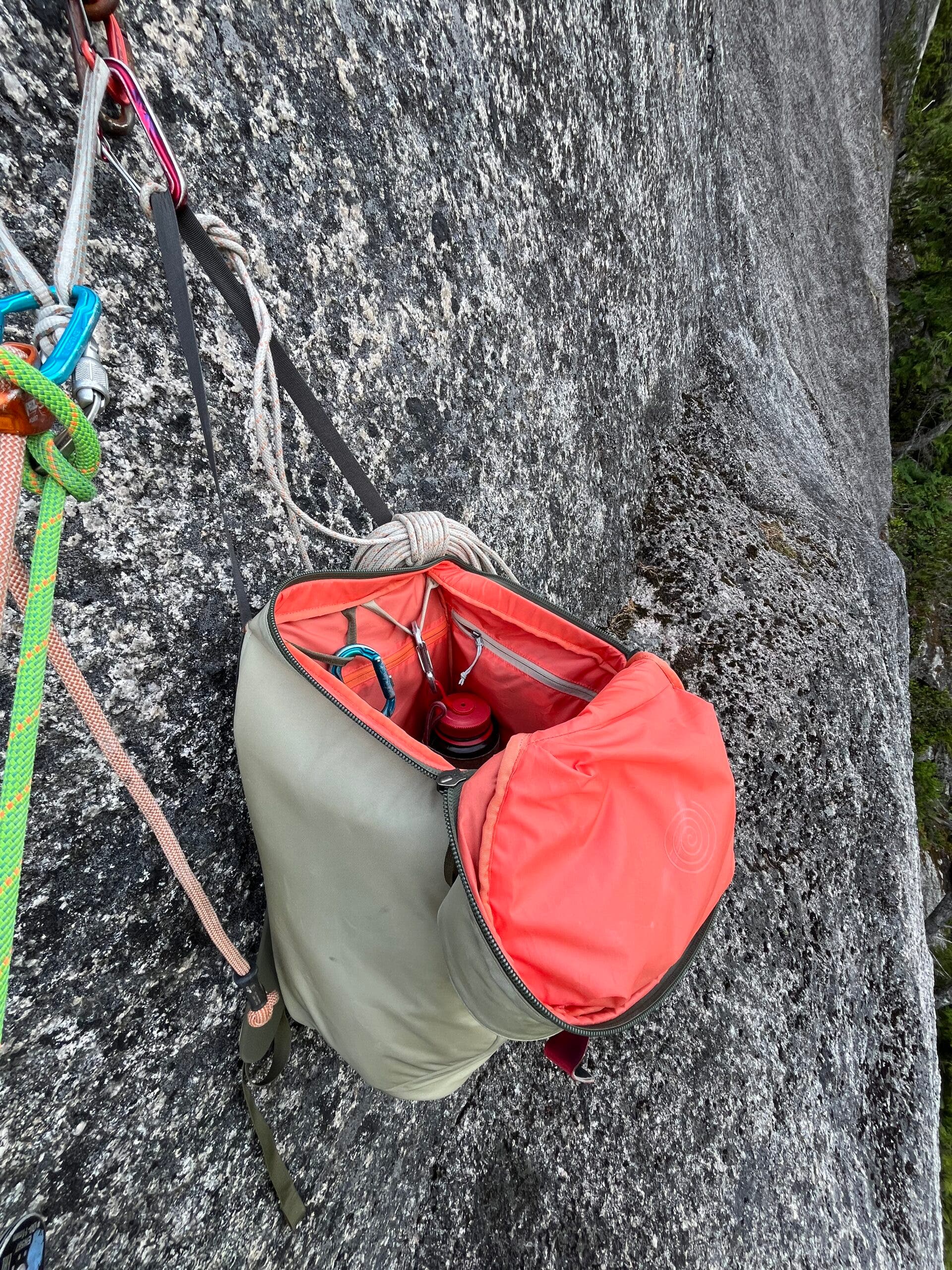
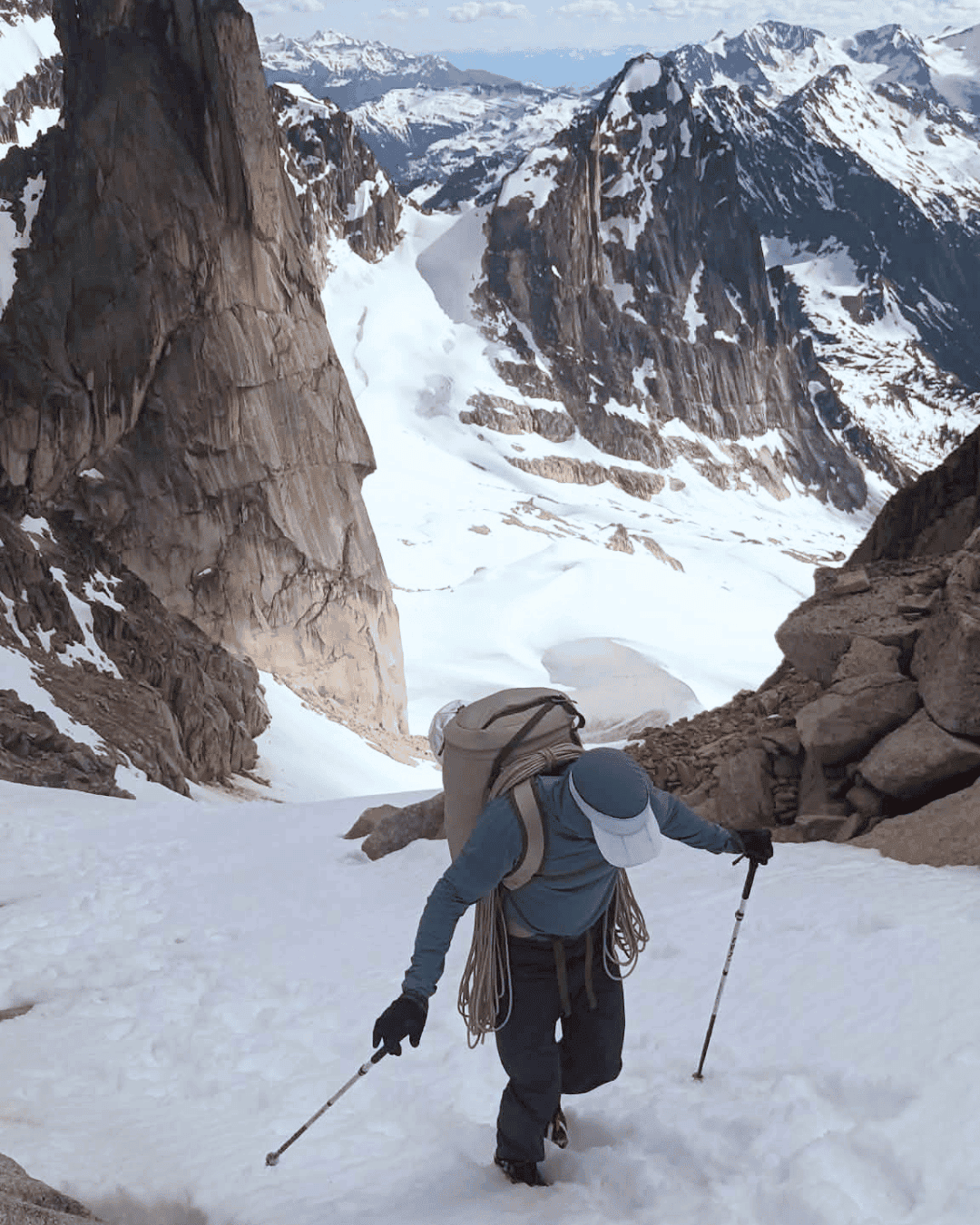
The primary limitation of the Free Wall Pack is its absence of a dedicated suspension system or substantial padding. While the minimalist design is understandable – a plush backpacking pack would indeed be cumbersome when hauled – the consequence is a pack that is less ideal for extended approaches away from the trailhead.
Several weeks prior, the author embarked on a six-hour trek into the Bugaboos’ East Creek basin, carrying bivouac gear, a substantial rack of climbing equipment, and provisions for a weekend expedition. Although shoulder fatigue began to manifest around the halfway point, the Free Wall Pack’s comfort level remained comparable to the ultralight alpine pack that had been the author’s winter companion. Furthermore, the pack seamlessly transitioned into a robust haul bag for the subsequent day’s ascent of the pristine splitter cracks of Fingerberry Jam (5.12-).
Bottom Line: The Free Wall Pack establishes a new benchmark for multi-pitch climbers who engage in bag-hauling and require rapid access to their gear.
Durable Down Parka
- Weight: 595g (men’s M); 507g (women’s M)
- Sizes: XS-XXL
Pros and Cons:
- Extremely durable face fabric.
- Respectable warmth-to-weight ratio.
- Drafty at belays due to the lack of a hem cinch.
- The hood cannot be tightened when not wearing a helmet.
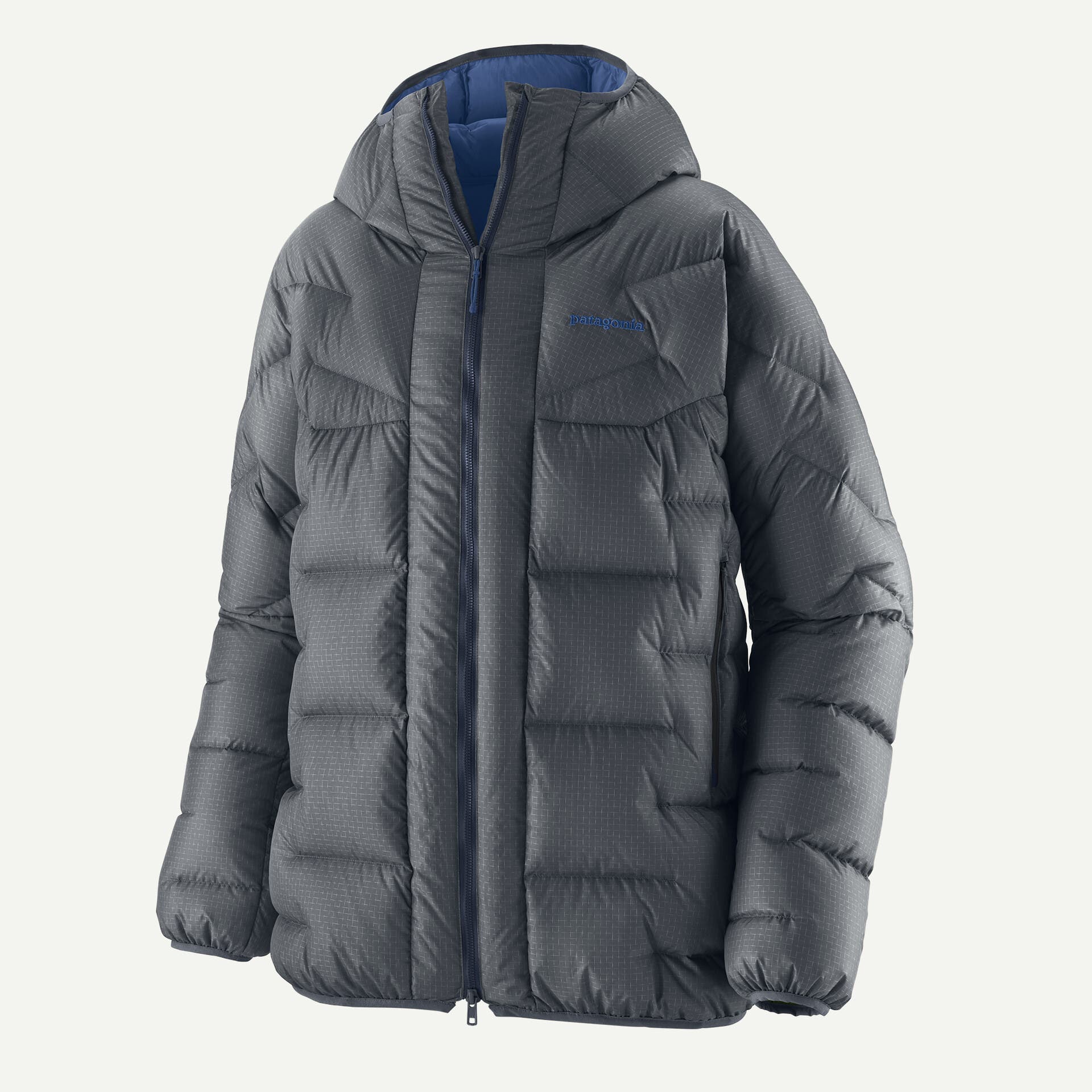
Upon initial wear, the Durable Down Parka felt like a favored garment. Its plush 800-fill down insulation, oversized fit, and soft interior fabric provided a comforting sensation. However, its performance was significantly tested in the exposed, wind-swept conditions of California’s Pine Creek Canyon, where its deficiencies became apparent.
The first gust of icy, upslope wind penetrated the parka, traveling between the jacket and the wearer’s back, inducing shivers. While positioned at the exposed second-pitch anchor of Stone’s Throw (5.11d; 170m) at Bighorn Wall, an instinctive reach for a hem-cinch cord was met with disappointment – no such feature was present. Similarly, a search for a chest pocket for belay glasses yielded no results.
Despite these shortcomings, the Durable Down Parka provided adequate warmth during belays on subsequent occasions, including mid-summer snowstorms, ice climbing excursions, and windy days at exposed rock crags. The parka’s innovative offset baffles effectively prevent down migration, thus maintaining consistent warmth, and its exceptionally tough face fabric offers protection against insulation loss even in the event of dynamic wall encounters. However, the minimalist design of the Durable Down Parka was a surprising contrast to the thoughtfully engineered Free Wall Pack, which appeared to prioritize user-friendliness above all else. While the addition of a chest pocket, hood cinch, and hem cinch would marginally increase the jacket’s weight, it would not detract from its status as a high-performance layer.
Bottom Line: The Durable Down Parka offers substantial warmth and exceptional durability, but its feature set left room for improvement, particularly given its intended application.
Houdini Rock Jacket & Pants
- Weight: 130g (men’s M jacket); 120g (women’s M jacket); 110g (unisex M pants)
- Sizes: XS-XXL
Pros and Cons:
- Exceptional warmth-to-weight ratio in windy conditions.
- Surprisingly durable for its weight.
- Half-length jacket zipper prevents pressure points under a harness.
- Zipped pant cuff allows for easy donning at hanging belays.
- Jacket is notably more expensive than comparable wind layers.
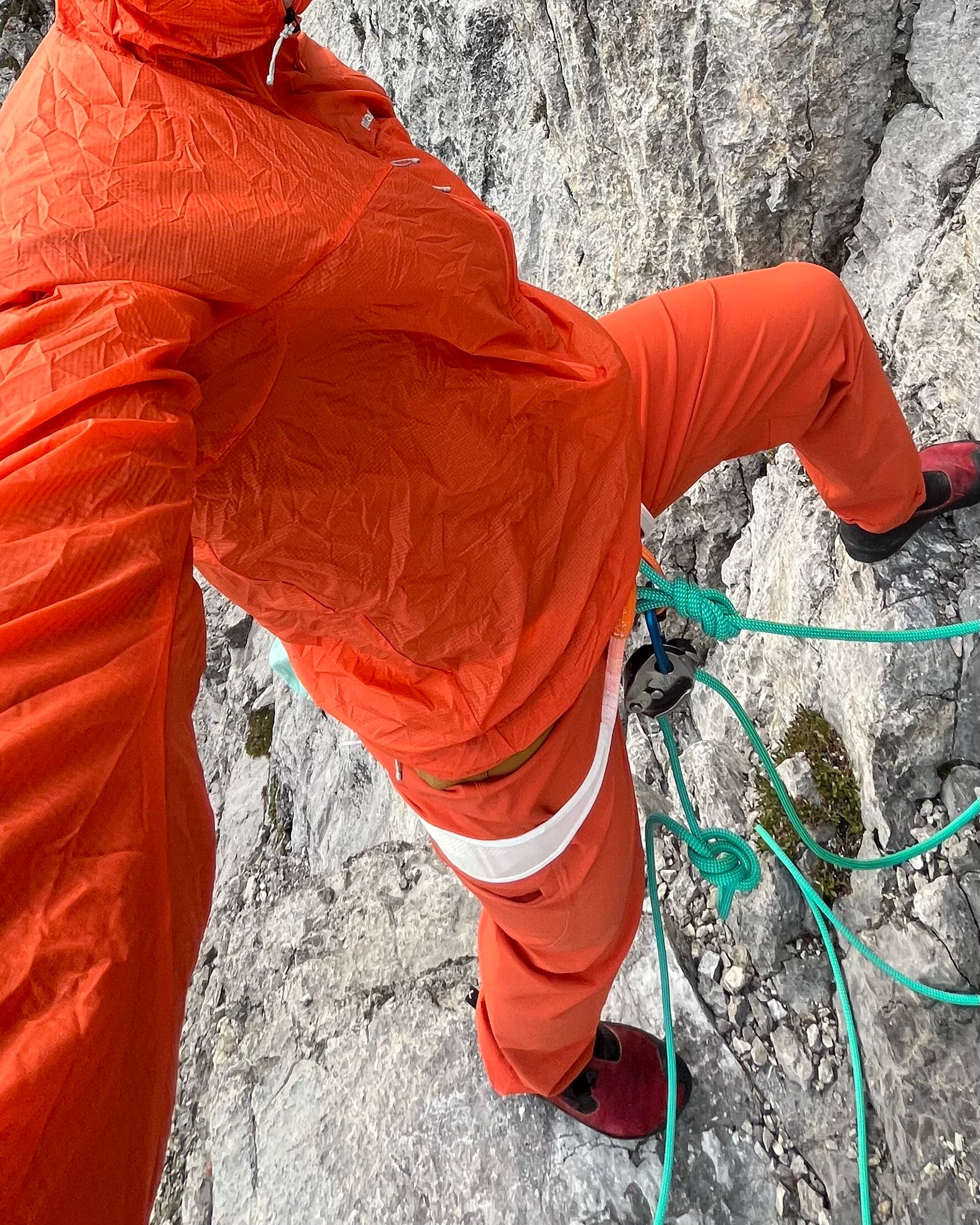
The Houdini Rock Jacket and Pants represent a critical starting point for all rock climbers, and indeed many alpinists, to understand Josh Wharton’s "dress code" for multi-pitch endeavors. Climbers typically do not embark on long routes with forecasts predicting torrential rain; therefore, a fully waterproof jacket is often an unnecessary burden. However, exposed cliffs are frequently subjected to powerful winds, and a lightweight wind layer can significantly enhance warmth with minimal added weight.
The Houdini Rock Pants emerge as the standout component of this pairing. While ice climbers often prioritize insulating their torsos and accept cold extremities, rock climbers similarly tend to focus on belay jackets while neglecting lower body warmth. The Houdini Rock Pant is arguably the single most recommended item from the entire Free Wall Kit.
Following a demanding lead of the intricate 5.11d second pitch of Fingerberry Jam (5.12-) in the Bugaboos, the author experienced a significant drop in body temperature. Gusting winds up to 30 mph and driving snowflakes obscured visibility. After quickly hauling up the pack, the author donned the Houdini Pants first, followed by the jacket. The immediate effect was a noticeable regulation of body temperature. The surprising level of protection offered by such lightweight garments was remarkable.
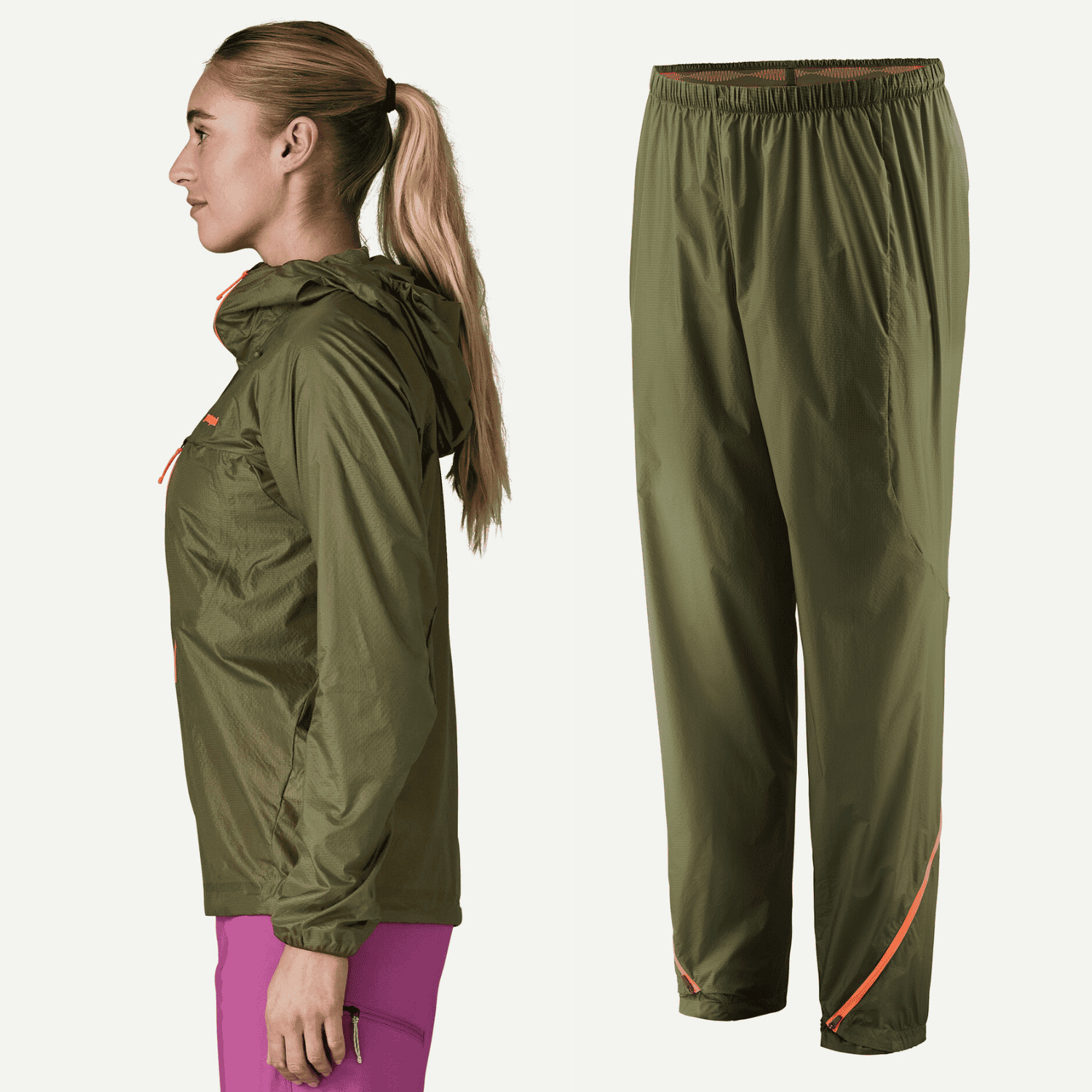
Although the Houdini Rock Pant is available only in a "unisex" cut, both male and female testers found the fit to be satisfactory. Tester Emilie Grenier noted that the pants’ relaxed fit was comparable to the Patagonia M10 pants, offering a wide range of motion and a secure fit over the hips thanks to an elasticated waistband.
The latest iteration of the Houdini Rock Jacket is constructed from the same robust 1.2-oz recycled nylon ripstop as previous versions, specifically tailored for multi-pitch rock climbing. The half-length zipper ensures pressure-point-free comfort when worn under a harness, and its accommodating cut around the shoulders allows for dynamic movement without restriction. While the Rock Jacket itself is excellent, its $199 price point is considered high for a wind layer. For cost-conscious climbers, purchasing the slimmer, regular Houdini Jacket (in a size larger) offers comparable wind protection, weight, and durability for approximately $80 less.
Bottom Line: The Houdini Rock Jacket and Pants represent an exceptional pairing for ultralight wind protection. While the standard Houdini Jacket can serve as a more economical alternative to the Rock Jacket, the Houdini Rock Pants are a uniquely specialized and highly recommended item.
R1 Ultralight Hoody
- Weight: 280g (men’s M); 220g (women’s M)
- Sizes: XS-XXL
Pros and Cons:
- Soft internal fabric provides excellent next-to-skin comfort.
- Two chest pockets offer convenient storage for essentials.
- The under-helmet hood limits its versatility.
- Not exceptionally durable.
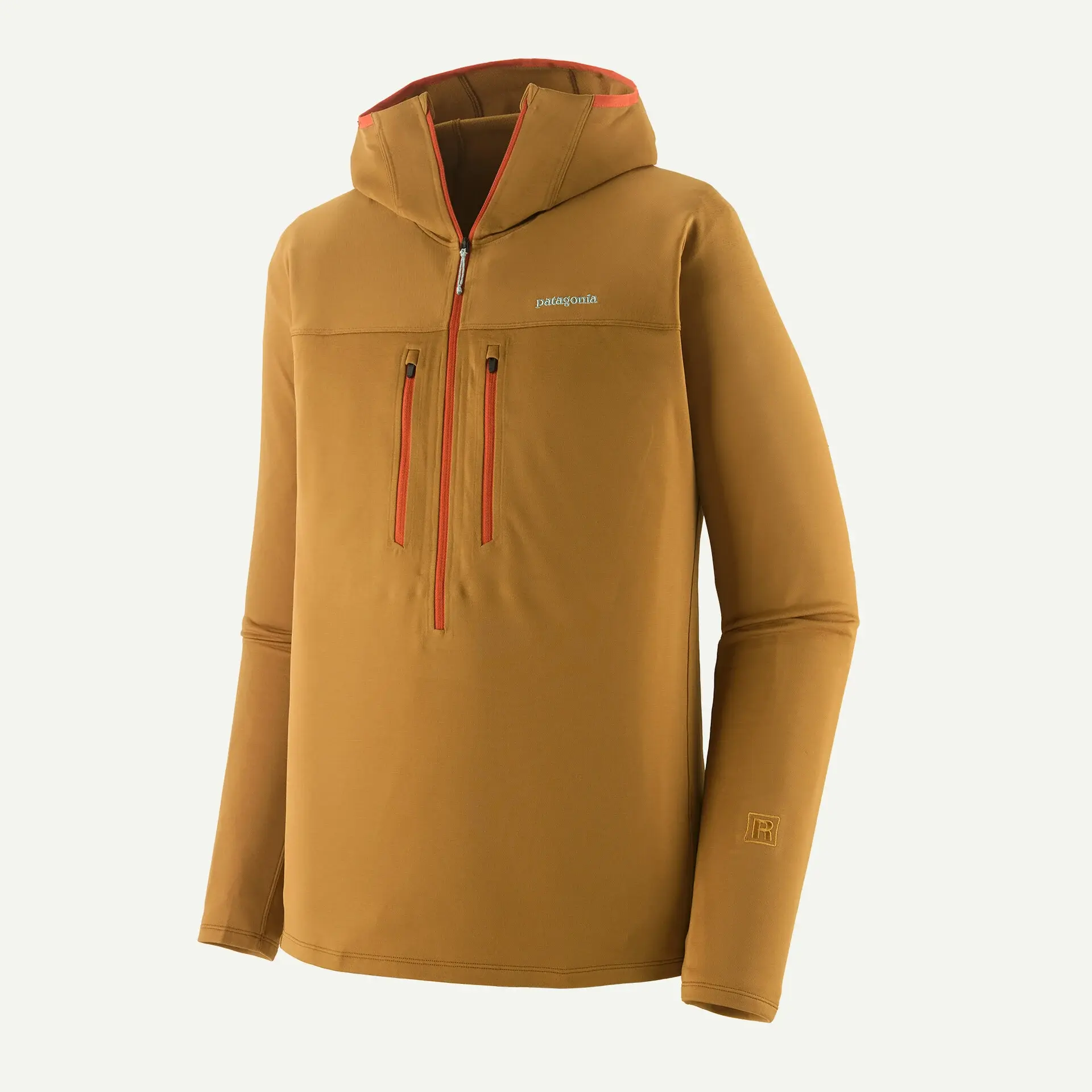
The R1 Ultralight Hoody is perhaps the least compelling item within the Free Wall Kit. It functions as a competent midlayer: soft against the skin, offering a balance of warmth and breathability, and comfortable under a harness due to its half-length zipper. However, it lacks the innovative spark found in other components of the kit. The hoody’s cuffs showed signs of pilling and tearing after only a few pitches involving wide cracks, and its snug, baselayer-like fit caused it to bunch uncomfortably when layered over a sun hoody. While sizing up could address sleeve length, it would exacerbate the fit issues.
The hood design, a common critique of Patagonia midlayers, proved frustrating. Engineered to fit snugly under a helmet, it forced a choice at the start of each pitch or belay: prioritize a warm head or a cool head. This design significantly diminishes its utility when thermoregulation is a primary concern.
Bottom Line: A decent midlayer for climbers who do not consistently wear helmets and primarily engage in crack climbing scenarios that do not involve larger sizes.
Free Wall Pants
- Weight: 380g (men’s M); 370g (women’s M)
- Sizes: 28-44 (men’s); 00-22 (women’s)
Pros and Cons:
- Excellent range of motion.
- Low-profile, adjustable waistbelt ensures comfort under a harness.
- No fly on the men’s model.
The Free Wall Pants come remarkably close to achieving perfection for alpine rock climbing, despite a minor disappointment. They are categorized as "alpine rock" pants because their relatively thick material, compared to favored mid-summer climbing pants, can lead to overheating in coastal environments like Squamish. However, in colder, more alpine conditions, such as those found near glaciers or dusty moraines, the pants excel. Their substantial fabric provides crucial warmth and exceptional durability, particularly beneficial in thrutchy wide cracks and for knee-barring techniques.
The inclusion of two thigh pockets, strategically placed to be accessible below a harness’s leg loop, and a rear pocket (though its utility is diminished when enabling high-stepping) makes these pants suitable for long approaches as well. The sole significant drawback is the absence of a fly on the men’s version, which can complicate matters considerably at a hanging belay. A similar consideration applies to the women’s model, where the addition of a crotch zip would enhance convenience.
Bottom Line: The Free Wall Pants are highly durable and mobile cold-weather rock climbing pants. For climbers who do not require a fly, they are an excellent choice.
Do You Really Need the Complete Free Wall Kit?
Even with the financial capacity to acquire the entire Free Wall Kit, a wholesale recommendation is not advisable. Certain adjustments would be necessary to optimize the full ensemble for all scenarios. However, the underlying principles and the types of garments and gear included offer substantial learning opportunities for any climber.
The Free Wall Kit’s components encourage a strategic approach to layering and equipment selection for multi-pitch climbing. The emphasis on specialized gear, such as the pack designed for on-wall access and the ultralight wind protection of the Houdini line, reflects a deep understanding of the unique demands of extended vertical ascents.
In conclusion, while the Free Wall Kit may not become the universal uniform for extended rock climbs, it represents a significant step forward in specialized apparel and gear. By focusing on functional design and the specific needs of multi-pitch climbers, Patagonia, with the input of individuals like Josh Wharton, has produced a collection that, even in its individual components, offers valuable solutions for those seeking to optimize their climbing experience. The core message is clear: invest in a capable haul bag, a warm jacket, and effective wind pants, and then prioritize getting out there and climbing.