









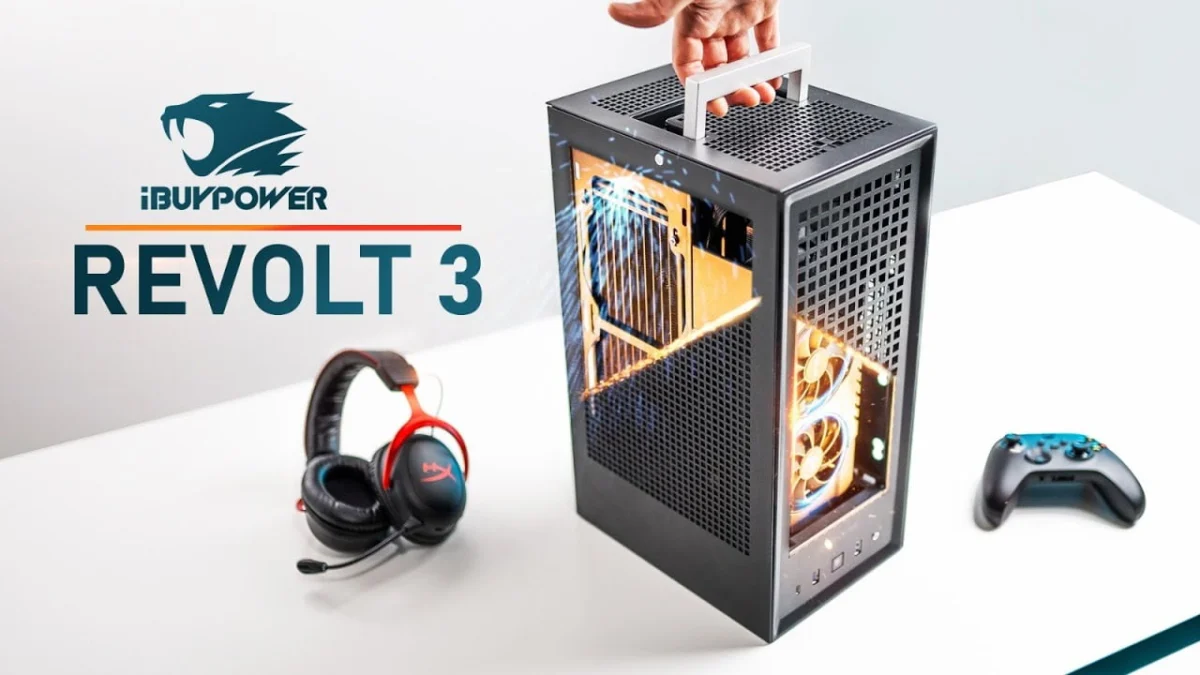
The hardware community is turning its attention toward a new entry in the compact form-factor market as iBUYPOWER, a prominent manufacturer of high-end custom gaming and production desktop systems, prepares to launch its standalone ITX enclosure, the Revolt 3. Initially previewed at the Consumer Electronics Show (CES) under the working title Revolt 3 MK3, the chassis has since dropped its alphanumeric suffix and is slated for an anticipated market release around July 2021. While the enclosure has historically served as the structural foundation for iBUYPOWER’s pre-built desktop ecosystems, the company’s strategic shift to offer the Revolt 3 as an independent product marks a notable expansion into the standalone component market.
Evolution from Concept to Commercial Product
The trajectory of the Revolt 3 reflects broader industry trends wherein system integrators leverage proprietary case designs to capture a share of the DIY (Do-It-Yourself) PC building community. Originally unveiled during the virtual and hybrid digital showcases of the early 2021 trade show circuit, the chassis garnered early scrutiny for its vertical footprint and feature set, which directly challenged established models like the NZXT H1 and the SSUPD Meshlicious.
By removing the "MK3" designation, iBUYPOWER signaled a streamlined consumer-facing identity for the product line. Industry analysts note that entering the standalone enclosure market allows system integrators to diversify revenue streams while fostering brand loyalty among custom builders who prefer assembling their own rigs. The anticipated July 2021 release window places the Revolt 3 squarely in a competitive summer hardware cycle, giving consumers a fresh alternative in the sub-20-liter volume category.
Pricing Models and Consumer Feedback Strategy
Ahead of the official commercial rollout, iBUYPOWER has implemented an interactive feedback strategy to gauge consumer preferences regarding pricing tiers, bundling options, and aesthetic variations. The manufacturer is currently weighing two distinct retail configurations for the enclosure.
The first proposed option positions the Revolt 3 as a standalone chassis priced at approximately $90 USD, targeted at builders who already possess compatible components or prefer selecting individual parts. This bare-bones approach allows enthusiasts to utilize existing SFX or SFX-L power supplies and custom cable management solutions.
The second, more comprehensive configuration bundles the Revolt 3 with a factory-included 80 Plus Gold-certified SFX-L power supply boasting a 700W capacity, anticipated to retail for roughly $200 USD. This bundled tier offers distinct structural advantages, notably factory-pre-routed cables tailored specifically to the internal dimensions of the vertical tower, thereby minimizing cable clutter out of the box. However, it also introduces a higher initial financial commitment for end-users.
In parallel with pricing discussions, iBUYPOWER has sought public input on aesthetic choices, specifically regarding the interchangeable perforated mesh panels situated on the GPU intake side of the tower. Prospective buyers have been asked to evaluate four distinct color finishes: classic black, industrial silver, understated white, and a distinct gold accent. While silver variants align closely with the chassis’s existing metallic framework, the gold option represents an experimental design choice aimed at niche interior aesthetics.
Physical Architecture, Dimensions, and Layout
With a total internal volume measuring 18.4 liters, the Revolt 3 occupies a middle ground in the vertical ITX market. It sits slightly larger than the NZXT H1 and the SSUPD Meshlicious, while approximating the volumetric profile of SilverStone’s Sugo SG14 and SG15 series. Despite its physical capacity, the narrow tower design utilizes vertical alignment to minimize desktop real estate consumption.
The structural framework of the Revolt 3 relies heavily on a tool-less panel removal system, allowing all exterior sides to detach with minimal friction. Ventilation is a primary focus of the engineering design; eschewing tempered glass options entirely, the chassis incorporates square-perforated mesh across its panels to maximize airflow. Coarse magnetic dust filters line the perimeter panels, though thermal evaluators have noted that these protective layers act as a minor airflow barrier compared to ultra-fine mesh alternatives seen in larger tower configurations.
Mobility and ergonomics play a central role in the physical design. The top panel integrates a spring-loaded, push-to-release carrying handle capable of supporting the dead weight of a fully assembled gaming system. Additionally, the chassis features retractable, low-profile headphone holders integrated into both the left and right sides of the frame, providing convenient storage for gaming peripherals.
Connectivity and input/output (I/O) placement have also received careful attention. The front-facing I/O array includes dual USB 3.0 ports, a 4-pole combination audio headset jack, and a high-speed USB-C Gen 2 port. Notably, the prototype utilizes an internal extension cable routing to the rear motherboard I/O, though iBUYPOWER has indicated plans to refine this design into a dedicated internal header connection secured by a modular two-screw mounting bracket. A rear-mounted power extension switch further streamlines operation by eliminating the need to access the interior power supply toggle directly.
Internal Layout and Component Compatibility
The interior architecture of the Revolt 3 is engineered to maximize spatial efficiency without necessitating specialized riser cables for graphics processing units (GPUs). By mounting the ITX motherboard horizontally with the I/O panel oriented downward, the layout permits direct-slot installation of triple-slot graphics cards on the opposing side of the chassis, circumventing potential PCIe Gen 4 signal degradation or bandwidth compatibility issues often associated with flexible riser ribbons.
Thermal clearance and liquid cooling support represent significant advantages within the 18.4L volume constraint. The interior features a swiveling radiator bracket capable of accommodating standard 240mm and 280mm liquid cooling radiators, offering approximately 58mm of combined clearance for radiator and fan thickness. Alternatively, users can install traditional CPU tower air coolers up to 140mm in height.
Storage accommodation is distributed throughout the chassis, providing provisions for two 2.5-inch solid-state drives mounted behind the GPU partition, alongside a convertible 3.5-inch mechanical hard drive bracket situated adjacent to the upper power supply housing. This upper cavity can alternatively serve as surplus management space for excess power cabling when traditional mechanical storage is omitted.
Assembly Experience and Cable Management
The assembly process within the Revolt 3 yields mixed results, characteristic of prototype hardware moving toward mass production. For builders opting for the bundled power supply configuration, the inclusion of factory-cut, custom-length cabling eliminates the challenge of stashing excess wire length common in standard SFX supplies. However, the use of dense, low-profile ribbon cables can introduce stiffness, making compression and routing within tight volumetric confines demanding.
Hardware reviewers have identified several mechanical hurdles during the build phase. The radiator bracket, while functional, lacks a secure locking mechanism in the open position, requiring careful handling during AIO pump installation and tube routing to prevent the bracket from dropping unassisted. Similarly, the upper power supply shroud is susceptible to bulging when dense bundles of PCIe and peripheral cables are compressed, occasionally exerting pressure against the internal GPU cavity and impeding the flush closure of the side panel. Representatives from iBUYPOWER have confirmed that structural reinforcement of this shroud is slated for the final production run.
Thermal management and airflow dynamics remain critical evaluation points for the chassis. While the vertical orientation facilitates natural convection, the absence of dedicated auxiliary exhaust fans—relying solely on the AIO radiator for heat expulsion—can result in elevated CPU temperatures under sustained multi-core loads as waste heat from the GPU mixes within the vertical chamber. The inclusion of dual 80mm fan mounts beneath the removable top panel offers a localized mitigation strategy for graphics card temperatures, though system integrators continue to assess overall thermal equilibrium.
Broader Market Implications
The introduction of the Revolt 3 as a standalone retail product underscores a broader evolution in the PC hardware sector. System integrators, historically confined to selling fully assembled pre-built computers, are increasingly capitalizing on their proprietary component designs to capture market share among custom PC enthusiasts.
By commercializing an enclosure previously restricted to pre-built tiers, iBUYPOWER positions itself to compete directly with established case manufacturers such as Lian Li, NZXT, and Cooler Master. The success of the Revolt 3 will likely depend on the final retail pricing structure, the implementation of consumer feedback regarding dust filtration and structural rigidity, and its performance within an increasingly crowded vertical ITX landscape. As the July 2021 release window approaches, market observers will monitor whether the Revolt 3 successfully transitions from a promising system integrator chassis into a premier choice for the independent custom building community.