The vast expanse of the Kazakh steppe presents a shifting landscape where tracking the region’s wildlife requires navigating a delicate balance between ancient animal migration routes and modern infrastructure development. As vehicles skid off main roads onto mud paths maintained only by persistent tire treads, the boundaries between the modern world and prehistoric ecosystems quickly blur. Flanking these two-track trails are parallel lanes no more than a foot wide, which fork, merge, and crisscross the path. In the distance, Siberian winds push through the cold air, revealing silhouettes of nomadic travelers that have traversed these plains for millennia.
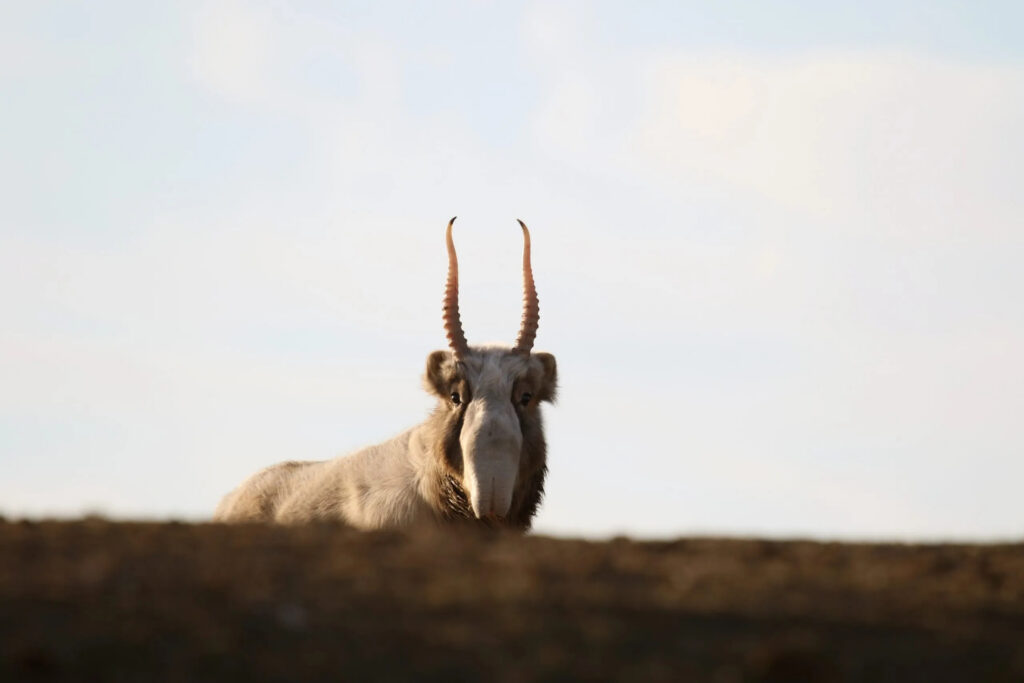
Through binoculars, observers witness an ancient tableau virtually untouched since the era of early human ancestors. Hundreds of saiga antelope pierce the frigid air with ringed horns, inhaling through distinctive, trunk-like snouts as they sprint across the desolate steppe. Charging through the treeless plain at full speed, these animals embody a resilient spirit that has persisted through radical climatic and geological shifts.
Prehistoric Origins and Evolutionary Resilience
Since time immemorial, saiga antelope have blazed trails across Central Asia while surrounding civilizations rose and fell. Paleontological records indicate that saigas once inhabited a Pleistocene world dominated by woolly mammoths, saber-toothed cats, and giant deer. While their contemporaries succumbed to extinction, the saiga survived, outlasting the megafauna of the last ice age. When pioneering human caravans first attempted to navigate the unforgiving Eurasian terrain, historical accounts suggest that travelers frequently relied on saigas as natural guides across waterless stretches.
The saiga’s unique physical adaptation—its floppy, elongated nose—is central to its survival. This specialized organ filters out dust during the dry summer months and warms frigid winter air before it reaches the animal’s lungs. During the annual rutting season, which typically occurs in late autumn or early winter, this physical feature takes on social significance. Males engage in competitive displays and headbutting to demonstrate physical prowess, while females assess potential mates based on physical condition and the size of their snouts. The energy expenditure of the rut is immense; many males become so focused on competition that they cease feeding entirely, occasionally perishing from exhaustion.
Chronology of Conservation Challenges and Infrastructure Expansion
The historical trajectory of the saiga population has experienced dramatic fluctuations, particularly over the past century.
- Pre-20th Century: Saiga herds numbering in the millions roamed freely across an expansive migratory range stretching from the Caucasus Mountains to Mongolia. Traditional human nomadic practices coexisted with these movements, establishing seasonal transit corridors that later informed portions of the historic Silk Road.
- Soviet Era (Mid-20th Century): Mandatory sedentarization policies implemented by the Soviet Union sought to lock nomadic human populations into permanent agricultural plots. While framed as modernization, these policies disrupted traditional land use and initiated widespread ecological shifts.
- Late 20th Century: Following the collapse of the Soviet Union, the relaxation of centralized wildlife enforcement led to a catastrophic surge in poaching, primarily driven by the demand for saiga horns in traditional Asian medicine. Populations plummeted from over one million individuals to fewer than 50,000 by the turn of the century.
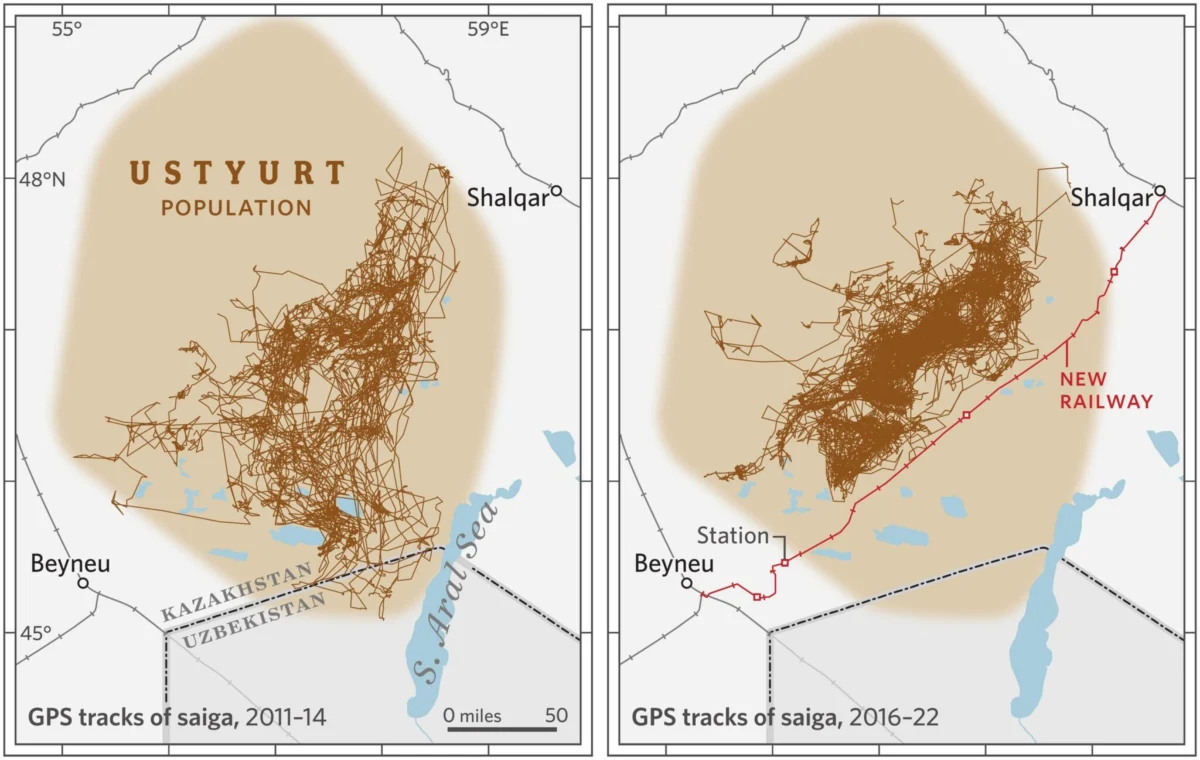
- 2014: A critical turning point occurred with the construction of a new railway line in the region. Tracking data from the Association for the Conservation of Biodiversity of Kazakhstan (ACBK) subsequently revealed that physical barriers severed traditional migration routes, trapping populations on the northern side of the tracks while vital grazing lands and water sources remained inaccessible to the south.
- Present Day: Concerted regional conservation efforts, coordinated by governmental bodies and NGOs like ACBK, have successfully stabilized populations in certain areas, though linear infrastructure continues to pose persistent fragmentation threats.
Field Audits and Tracking Methodology
To monitor recovery efforts, conservation teams conduct rigorous field audits timed to coincide with seasonal behavioral shifts. Researchers from ACBK, possessing decades of combined experience following saiga herds across the western steppe, utilize advanced technological tools to study animal behavior.
Because saigas prefer large-scale migrations across open landscapes devoid of trees, they are prime candidates for satellite tracking. Global Positioning System (GPS) collars deliver reliable daily pings without the risk of visual obstruction. This telemetry data has fundamentally transformed conservation strategies. Prior to the deployment of GPS technology, field biologists frequently spent weeks roaming the boundless steppe in unsuccessful attempts to locate nomadic herds.
Data gathered by ACBK directly informed the establishment of new wildlife sanctuaries designed to protect critical calving and rutting grounds. However, changing weather conditions—such as seasonal rains turning grasslands into impassable sludge, or sudden whiteout blizzards that freeze mud into concrete-like consistency—frequently complicate fieldwork, requiring researchers to adapt quickly to extreme meteorological events.
Institutional Responses and Cross-Border Mitigation
Addressing the fragmentation caused by linear infrastructure requires active international cooperation between Kazakhstan and neighboring nations like Uzbekistan. Conservation groups have partnered with state agencies to implement targeted engineering solutions aimed at reconnecting fragmented habitats.
Among the primary initiatives are the construction of saiga-friendly crossing points. These structures feature slightly sloping dirt ramps that rise to match the height of railway tracks, creating the optical illusion of a natural gap in the line. Additionally, cattle-guard fences positioned at a distance from these intersections prevent direct collisions between trains and herds while preserving the crossing pathways.
In border regions, traditional barbed-wire walls—which historically proved lethal or impassable to migrating ungulates—have been systematically redesigned. Collaborating with the Uzbek government, conservationists have replaced solid barriers with X-shaped barricades. These structures successfully block vehicular traffic while leaving precise ground clearance for saigas to pass underneath, gradually restoring traditional trans-boundary migratory routes.
Broader Socio-Ecological Implications
The plight of the saiga antelope mirrors the broader historical transformation of the Eurasian steppe. As agrarian development, paved roads, and industrial rail networks expand, ecosystems face increasing parcelization. Scientists and conservationists warn that physical barriers do more than restrict physical movement; they induce a collapse in spatial knowledge.
Much like human nomads who lost their connection to ancestral navigation routes following forced sedentarization, young saigas learn migration paths through active participation and social transmission from older generations. When linear infrastructure cleaves these routes, the collective memory of the herd is disrupted, leading to localized population declines even where habitat remains superficially intact.
Despite these anthropogenic pressures, the recent stabilization of saiga numbers—partially documented by international monitoring agencies noting rebounds from historic lows—demonstrates that targeted intervention can yield positive outcomes. Protecting the corridors between East and West, where European and Asian ecosystems converge along natural boundaries like the Ural River, remains essential for preserving one of the world’s last remaining large-scale terrestrial migrations.