












Modern artificial intelligence systems rely heavily on transformer architectures to drive natural language processing, computer vision, and generative tasks. However, the foundational design of a transformer layer introduces significant computational bottlenecks when executed through traditional, unoptimized frameworks. A standard transformer block is built from a predictable sequence of familiar mathematical operations: linear projections, multi-head attention mechanisms, layer normalizations, activation functions, and residual additions. In a naive, direct implementation of these components, deep learning frameworks typically launch a separate accelerator kernel for every individual operation. Consequently, every intermediate tensor is aggressively written out to device memory and subsequently read back in for the next step.
While the underlying mathematics remains entirely correct under this traditional execution paradigm, hardware resource utilization suffers immensely. Graphics processing units and specialized tensor accelerators frequently spend more operational cycles moving values across physical memory buses and launching distinct software kernels than they do performing actual, useful arithmetic calculations. This memory-bound bottleneck has catalyzed a sweeping engineering shift across the machine learning community. Researchers and hardware architects have increasingly focused on low-level optimizations—specifically fast attention kernels, dynamic memory paging, and sophisticated operator fusion—to fundamentally transform how large language models execute inference workloads at scale.
The Bottleneck of Eager Execution and the Mechanics of Operator Fusion
To understand why optimization is paramount, one must examine the inefficiencies of standard eager execution models. Consider the SwiGLU activation block, a sophisticated gating mechanism widely adopted by state-of-the-art decoder-only language models. Mathematically, the SwiGLU block computes the operation where an input tensor is projected via gate and up-projections, transformed by a Sigmoid-Weighted Linear Unit (SiLU), combined via element-wise multiplication, and finally passed through a down-projection layer.
In a standard, unoptimized PyTorch implementation, this sequence triggers multiple distinct events. The system launches individual matrix multiplication kernels for the projections, invokes a separate kernel for the SiLU activation, spawns another for element-wise scaling, and finishes with a final matrix multiplication kernel. Each computational boundary mandates that intermediate tensors traverse the high-bandwidth memory (HBM) bus of the accelerator. Because memory bandwidth on modern accelerators often fails to scale at the same aggressive rate as raw compute floating-point operations per second (FLOPS), these constant memory round-trips create a severe system bottleneck.
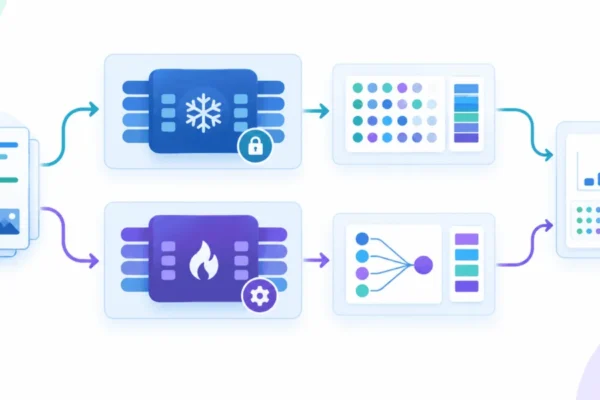
Operator fusion directly targets this architectural flaw by reorganizing execution pipelines. Fused implementations keep intermediate tensor values cached securely within the fast on-chip memory—such as registers or shared memory—located directly adjacent to the arithmetic logic units. By combining multiple operations into a single compiled execution plan, systems eliminate the need to write and read intermediate states from global device memory.
import torch
import torch.nn as nn
import torch.nn.functional as F

class GatedMLP(nn.Module):
    def __init__(self, hidden_size, intermediate_size):
        super().__init__()
        self.gate_proj = nn.Linear(hidden_size, intermediate_size, bias=False)
        self.up_proj = nn.Linear(hidden_size, intermediate_size, bias=False)
        self.down_proj = nn.Linear(intermediate_size, hidden_size, bias=False)

    def forward(self, x):
        gate = F.silu(self.gate_proj(x))
        up = self.up_proj(x)
        return self.down_proj(gate * up)

model = GatedMLP(hidden_size=16, intermediate_size=32).eval()
print("Initialized GatedMLP reference model with output shape:", model(torch.randn(2, 4, 16)).shape)
Despite the efficiency gains, fusion is not a universal panacea. Optimization boundaries exist due to hardware constraints and algorithmic limitations. When a large matrix multiplication already dominates the execution time of a specific layer, the relative benefit of fusing minor adjacent pointwise operations diminishes. Furthermore, attempting to fuse overly complex blocks can inflate register pressure on the processor cores, reducing overall execution occupancy and ultimately degrading performance. Determining the optimal kernel configuration requires rigorous empirical profiling across target hardware environments.
Revolutionizing Context Processing with FlashAttention-Style Kernels
Beyond multilayer perceptron blocks, the self-attention mechanism represents one of the most computationally expensive components of transformer models. Standard scaled dot-product attention computes an attention score matrix by multiplying queries and keys, scaling the result, applying an optional mask via a softmax function, and finally multiplying the output by the values.
For a sequence of length $T$, the intermediate attention-score matrix scales quadratically, containing $T^2$ elements per attention head. On a hardware accelerator, materializing this massive matrix, writing it to global HBM, and reading it back to compute the softmax reduction consumes immense memory bandwidth. During long context prefill phases—where large prompts are processed simultaneously—this memory traffic becomes the primary performance wall.
FlashAttention fundamentally alters this dynamic through algorithmic tiling. Instead of materializing the complete $T^2$ score matrix in global memory, FlashAttention loads blocks of queries, keys, and values into high-speed on-chip SRAM. It computes the attention scores incrementally, updates the online softmax normalization statistics on the fly, and accumulates the final output vectors without ever committing the full score matrix to global device memory.
Modern deep learning frameworks expose these optimizations natively. For instance, developers can explicitly leverage optimized backend kernels through PyTorch’s scaled dot-product attention utility:
import torch
import torch.nn.functional as F
from torch.nn.attention import SDPBackend, sdpa_kernel

if not torch.cuda.is_available():
    raise RuntimeError("This optimization example requires a CUDA-enabled GPU.")

device = "cuda"
dtype = torch.float16

q = torch.randn(2, 16, 512, 64, device=device, dtype=dtype)
k = torch.randn(2, 16, 512, 64, device=device, dtype=dtype)
v = torch.randn(2, 16, 512, 64, device=device, dtype=dtype)

with torch.no_grad(), sdpa_kernel([SDPBackend.FLASH_ATTENTION, SDPBackend.CUDNN_ATTENTION], set_priority=True):
    output = F.scaled_dot_product_attention(q, k, v, is_causal=True)

print("FlashAttention execution completed successfully. Output tensor shape:", output.shape)
By prioritizing backends like FlashAttention or cuDNN attention, inference engines drastically reduce memory footprint requirements and accelerate prefill throughput, enabling large language models to ingest thousands of tokens of context in a fraction of the time previously required.
Solving Memory Fragmentation with Paged Attention
While prefill phases benefit immensely from tiled attention, the generative decode phase introduces an entirely different scaling challenge: managing the Key-Value (KV) cache. As a generative model produces text token by token, its KV cache grows dynamically to store historical context. In traditional serving setups, allocating a single contiguous block of memory per request leads to massive inefficiencies. Because the final length of a generated response is inherently unpredictable, systems must reserve maximum possible memory allocations upfront, resulting in severe internal and external memory fragmentation.
Paged attention addresses this systemic issue by decoupling the logical representation of a sequence’s KV cache from its physical memory allocation. Drawing direct inspiration from virtual memory paging systems utilized in traditional operating systems, paged attention divides KV storage into fixed-size physical blocks. A logical sequence is mapped dynamically via a block table:
| Memory Layering | Block 0 | Block 1 | Block 2 | Block 3 |
|---|---|---|---|---|
| Logical Blocks | 0 | 1 | 2 | 3 |
| Physical Blocks | 17 | 4 | 29 | 8 |
When the attention kernel executes, it references the block table to traverse keys and values across non-contiguous physical memory spaces. This architecture completely eliminates internal fragmentation, allows memory blocks to be allocated strictly on demand, enables instant recycling of memory pools once a request concludes, and facilitates advanced memory sharing when multiple concurrent sequences share common prompt prefixes.
In production serving engines such as vLLM, paged attention is deeply integrated into the runtime architecture. The following configuration demonstrates how production environments instantiate models with explicit block-managed memory architectures:
from vllm import LLM, SamplingParams

attention_backend = "TRITON_ATTN"

llm = LLM(
    model="Qwen/Qwen2.5-1.5B-Instruct",
    dtype="float16",
    block_size=16,
    attention_backend=attention_backend,
)

print("Active vLLM attention backend initialized:", attention_backend)

sampling_params = SamplingParams(
    temperature=0.7,
    top_p=0.95,
    max_tokens=64,
)

prompts = [
    "Q: What is the capital of France?nA:",
    "Q: Who wrote 'Pride and Prejudice'?nA:",
]

outputs = llm.generate(prompts, sampling_params)

for output in outputs:
    print(f"Prompt: output.prompt!r")
    print(f"Generated Output: output.outputs[0].textn")
Automating Optimizations with PyTorch Compilation and CUDA Graphs
While hand-tuned low-level kernels written in CUDA or Triton offer absolute performance control, developing and maintaining them requires specialized systems engineering expertise. To democratize these performance gains, modern deep learning frameworks incorporate advanced graph compilation engines. In PyTorch, torch.compile() utilizes TorchDynamo to capture execution graphs and TorchInductor as its default optimizing backend.
TorchInductor performs automated graph rewriting, buffer reuse, and intelligent operator fusion. For tensor operations executed on modern GPUs, it compiles compatible pointwise and reduction sequences into unified Triton kernels, bypassing the overhead of traditional eager execution. Furthermore, when paired with execution modes like reduce-overhead, the compiler can capture entire sequence execution flows into CUDA Graphs.
import torch
import torch.nn as nn
import torch.nn.functional as F

class GatedMLP(nn.Module):
    def __init__(self, hidden_size, intermediate_size):
        super().__init__()
        self.gate_proj = nn.Linear(hidden_size, intermediate_size, bias=False)
        self.up_proj = nn.Linear(hidden_size, intermediate_size, bias=False)
        self.down_proj = nn.Linear(intermediate_size, hidden_size, bias=False)

    def forward(self, x):
        gate = F.silu(self.gate_proj(x))
        up = self.up_proj(x)
        return self.down_proj(gate * up)

if not torch.cuda.is_available():
    raise RuntimeError("Compilation examples require a CUDA-enabled accelerator.")

device = "cuda"
model = GatedMLP(hidden_size=1024, intermediate_size=4096).eval().to(device=device, dtype=torch.float16)
x = torch.randn(1, 128, 1024, device=device, dtype=torch.float16)

compiled_model = torch.compile(
    model,
    backend="inductor",
    mode="reduce-overhead",
)

with torch.inference_mode():
    expected = model(x)
    for _ in range(3):
        actual = compiled_model(x)

torch.cuda.synchronize()
torch.testing.assert_close(actual, expected, rtol=1e-2, atol=1e-2)
print("Compiled model validation successful. Output tensor shape:", tuple(actual.shape))
CUDA Graphs complement operator fusion by addressing CPU-side launch latency. In standard iterative execution, submitting operations to the GPU involves substantial overhead across the Python runtime, C++ framework layers, and device drivers. A CUDA Graph records the precise sequence of GPU work and replays the entire graph via a single CPU submission call. This technique is exceptionally valuable for repeated, small-batch decode workloads where launch latency dominates execution time.
Industry Implications and Future Outlook
The continuous evolution of specialized inference kernels, memory management strategies, and graph compilation tools marks a fundamental maturation phase in the deployment of artificial intelligence infrastructure. As foundation models grow increasingly massive—ranging from multi-billion parameter dense models to intricate mixture-of-experts architectures—hardware efficiency directly dictates economic viability and environmental sustainability.
Reducing memory bandwidth saturation through FlashAttention, eliminating memory fragmentation via paged attention, and automating low-level instruction fusion with framework compilers collectively allow data centers to serve significantly higher user concurrency with fewer physical accelerators. Moving forward, the boundary between hardware design and software compilation will continue to blur, making kernel optimization an indispensable pillar of modern machine learning engineering.