











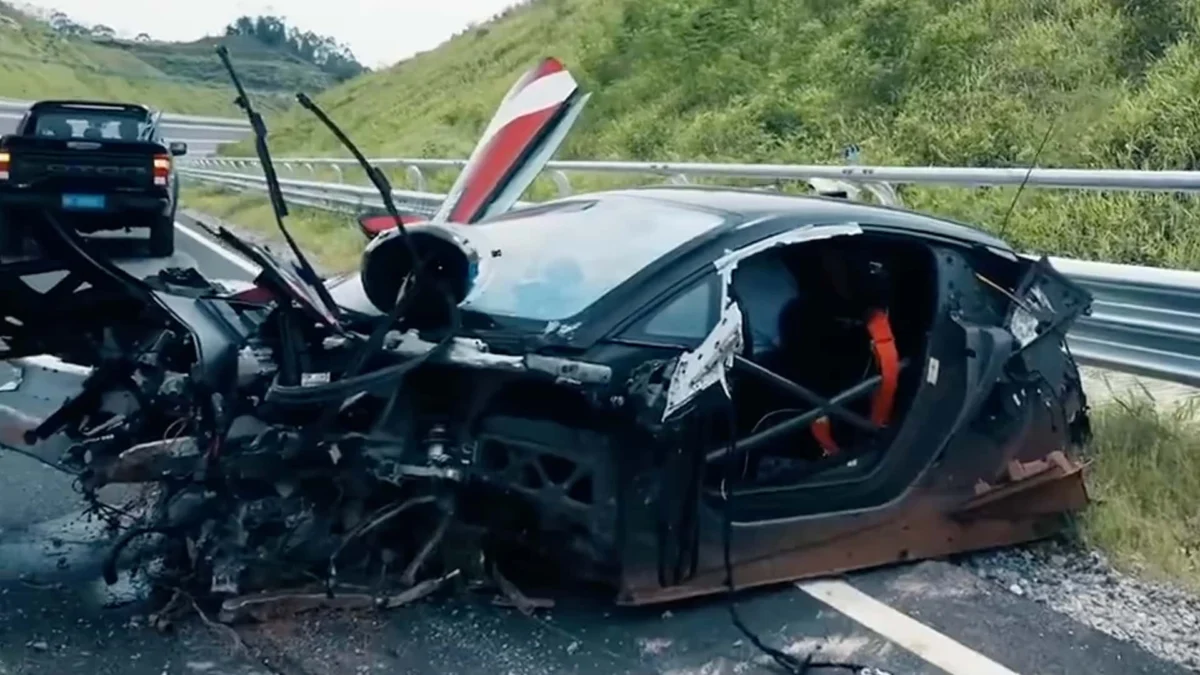
The high-stakes pursuit of automotive speed records has hit a significant setback as the BYD Yangwang U9 Xtreme, a formidable electric hypercar boasting 2,977 horsepower, was severely damaged in a high-speed crash during testing in China. The incident, which occurred just days before the manufacturer’s scheduled attempt to surpass the 311 mph (500 km/h) milestone, has sent shockwaves through the electric vehicle industry. While the vehicle sustained catastrophic structural damage, reports from the testing facility confirm that the test driver escaped the wreckage without suffering serious physical injury.
The footage and imagery of the incident, first brought to light by CarNewsChina on November 2, reveal the grim reality of pushing cutting-edge automotive technology to its absolute physical limits. The vehicle appeared to lose control on a closed-circuit track, subsequently impacting a safety barrier with enough force to cause the rear axle assembly to detach entirely from the chassis. This level of kinetic energy dissipation underscores the volatile nature of hypercar testing, particularly for electric vehicles that possess immense, instantaneous torque.
Chronology of the Development and Testing
The Yangwang U9 has been the crown jewel of BYD’s luxury sub-brand, Yangwang, since its inception. Positioned as a technological flagship, the U9 was engineered to challenge the established dominance of European and American hypercar manufacturers. The path to the U9 Xtreme’s development has been a rapid, intensive process characterized by aggressive performance metrics.
In September 2025, the U9 Xtreme set a landmark record, reaching 308.3 mph (496.22 km/h) in a controlled trial, officially cementing its status as one of the fastest production electric vehicles in history. This milestone was not merely a performance statistic but a strategic demonstration of BYD’s 1,200-volt electrical architecture and its proprietary four-motor e4 platform. Following this success, the engineering team turned its attention toward the psychological and engineering "holy grail" of the 500 km/h (311 mph) barrier. The recent testing session was intended to be the final refinement phase before a planned official attempt in the United Arab Emirates.
Engineering Analysis of the U9 Xtreme
The technical specifications of the Yangwang U9 Xtreme remain among the most advanced in the automotive sector. The vehicle is powered by a quad-motor configuration that generates a staggering 2,977 horsepower, a figure that dwarfs most internal combustion hypercars. This power is managed by an 80.0-kilowatt-hour battery pack, which is specifically tuned for high-discharge rates required for extreme velocity.
Beyond the powertrain, the vehicle utilizes the DiSus-X intelligent body control system. This system is capable of managing individual wheel torque and suspension damping in real-time, allowing the vehicle to perform feats such as "jumping" or "dancing" at low speeds. However, at the extreme velocities required for 300+ mph runs, the system’s primary objective shifts to maintaining aerodynamic stability and mechanical grip. The reliance on track-focused semi-slick tires is essential, as these tires are the only point of contact capable of translating such massive power into forward motion while resisting the intense heat generated by high-speed rotation.
Safety Protocols and Structural Integrity
The fact that the driver emerged from the wreckage unharmed is a testament to the safety engineering integrated into the U9’s platform. BYD’s "Super Carbon-Fiber Cabin" serves as the primary occupant cell, designed to maintain structural rigidity under extreme torsional stress. In high-speed impacts, the ability of this cell to maintain its shape while the peripheral components—such as the rear axle and bodywork—are sacrificed to absorb energy is a critical safety feature.
Furthermore, there have been no reports of a thermal runaway event or battery fire following the collision. For electric vehicles, the risk of fire post-impact is a significant concern for engineers. The successful containment of the 1,200-volt battery pack during such a violent impact suggests that BYD’s battery housing and isolation protocols are operating as designed, even under extreme duress.

The Broader Implications for BYD
This crash presents a complex scenario for BYD. While the loss of a prototype is a financial and temporal setback, it also provides invaluable data. Automotive manufacturers often view crashes during testing as an unintended, yet critical, "stress test" of their safety systems. The data collected from the onboard telemetry systems will likely be used to refine the vehicle’s stability control algorithms and aerodynamic profile.
However, the incident raises questions regarding the feasibility of the 311 mph goal in the near term. The global automotive community will be watching closely to see if BYD pauses its development cycle to conduct a thorough forensic analysis of the failed run. If the loss of control was caused by a mechanical failure—such as a suspension component or a tire delamination—the company may need to delay its next attempt significantly to ensure the safety of its test pilots.
Industry Context and Competitive Pressure
BYD’s aggressive push into the hypercar segment is part of a broader strategy to reposition itself from a mass-market EV producer to a global leader in high-performance engineering. As the company continues to challenge legacy manufacturers in Europe and the United States, proving its technical dominance on the track is essential for brand prestige.
The U9 Xtreme is not merely a car; it is a marketing vehicle that showcases the potential of the e4 platform. By demonstrating that they can navigate the extreme physics of 300+ mph travel, BYD is signaling to the world that their electrification technology is not limited to efficiency and city driving, but is capable of outperforming the most elite machines ever built.
Future Outlook and Next Steps
As of this report, BYD has maintained a professional silence regarding the specific cause of the incident. In the world of high-performance automotive testing, such silence is common while internal teams analyze the "black box" data logs from the vehicle.
The ambition to hit 311 mph remains, but the path to achieving it has grown more difficult. The U9 Xtreme project stands at a crossroads. The company must now balance the drive for record-breaking speed against the necessity of ensuring that their high-performance technology remains stable and safe. Whether the U9 Xtreme will return to the track in the coming months remains to be seen, but the event has undeniably added a chapter of caution to the narrative of the electric hypercar revolution.
The incident serves as a stark reminder that while electric power provides unprecedented performance, the laws of physics remain unchanged. The intensity of 300 mph driving requires not only immense power but also absolute mastery over aerodynamics and mechanical stability. For BYD, the road to 311 mph is no longer just a technical challenge; it is a test of resilience in the face of the inherent risks of automotive innovation. The global engineering community awaits further details, as the outcome of this investigation will likely influence the safety standards and design methodologies for the next generation of ultra-high-performance electric vehicles.
In the wake of this, the industry at large may see a shift toward more rigorous simulation-based testing before returning to live, high-speed runs. The safety of the driver, which was successfully maintained in this instance, will undoubtedly remain the top priority as the company decides its next move. For now, the Yangwang U9 Xtreme remains a symbol of what is possible in the age of electrification, even as it serves as a sobering example of the dangers involved in reaching for the absolute ceiling of speed.